



Signs of Authentic Antique Buddha Statues for Collectors
Distinguishing genuine antique Buddha statues from skillfully produced replicas is one of the most persistent challenges in Asian art collecting. The signs of authentic antique Buddha pieces are not always obvious from a photograph or a quick visual scan. They require understanding material composition, regional iconographic traditions, and the specific ways that centuries of age manifest on bronze, stone, and wood. This guide covers the key diagnostic criteria that experienced collectors use, organized to help you build a reliable, repeatable evaluation process.
Table of Contents
- Key takeaways
- 1. Signs of authentic antique Buddha: materials and patina
- 2. Iconographic details that confirm cultural and historical origin
- 3. Craftsmanship and physical wear
- 4. Authentic versus replica: a comparison
- 5. Practical verification strategies for collectors
- My perspective on authenticating antique Buddha statues
- Explore authenticated antique Buddha statues at Hdasianart
- FAQ
Key takeaways
| Point | Details |
|---|---|
| Patina reveals age | Natural patina develops in layers over decades and cannot be fully replicated by artificial aging techniques. |
| Iconography confirms origin | Mudras, drapery, and facial proportions reflect specific regional and historical traditions that forgers consistently misrepresent. |
| Craftsmanship shows in the details | Tool marks, casting irregularities, and wear patterns on hands and feet are the hardest elements for replica makers to reproduce accurately. |
| Provenance adds confidence | Documentation tracing ownership and origin provides critical supporting evidence beyond physical inspection alone. |
| Expert appraisal is often necessary | Scientific testing and professional consultation remain the most reliable final steps in authenticating high-value pieces. |
1. Signs of authentic antique Buddha: materials and patina
The physical material of a Buddha statue is the first and most informative place to start. Authentic antique pieces were cast in solid bronze, carved from stone, or shaped from aged hardwood. Each material ages in ways that are difficult to fake convincingly.
Bronze is the most common material for antique Buddha statues from Thailand, Cambodia, and Vietnam. Natural oxidation produces layered patina that carries genuine historical and aesthetic value. This is not simply corrosion. It is a record of the object’s environment over time. Bronze patina evolves through browns, reds, and blacks before reaching the greens and blue-greens that collectors associate with age. The progression is uneven, concentrated in recessed areas, and varies with exposure.
Replica makers apply chemical patinas to simulate this effect. The result tends to be uniform in color distribution, with an absence of the layered complexity found on genuine pieces. Cold-cast bronze sculptures are a particular concern. They can display convincing surface patina while weighing significantly less than solid bronze and producing a different sound when tapped. Weight and resonance are quick, practical tests.
Key patina indicators to examine:
- Uneven color transitions concentrated in recessed areas around folds and facial features
- Verdigris (blue-green deposits) appearing in protected cavities, not uniformly across surfaces
- Hairline cracks in wood consistent with natural drying and contraction over decades
- Stone surfaces with differential weathering, darker in sheltered areas and lighter on exposed edges
Pro Tip: Run a fingertip across the patina surface. Genuine natural patina has a slightly rough, stratified texture. Artificially applied patinas often feel smoother and more uniform, even when the color looks convincing.
2. Iconographic details that confirm cultural and historical origin
Authentic Buddha statues are not generic religious objects. They are products of specific artistic traditions tied to region, dynasty, and period. Understanding these traditions is one of the most reliable methods for how to identify antique Buddha pieces with confidence.
Mudras, the hand gestures depicted in Buddhist iconography, are strictly codified. The Bhumisparsha mudra (earth-touching gesture) associated with the moment of enlightenment appears frequently in Cambodian and Thai statues from the 9th through 14th centuries, but the exact finger position, wrist angle, and hand proportion vary by school and period. A replica maker copying a photograph will often miss these proportional subtleties.
Drapery folds and facial expressions are among the most telling authenticity indicators. Genuine antique statues feature naturalistic drapery with subtle variation in fold depth and spacing. Replicas frequently show repeating, mechanical patterns or overly simplified rendering. Facial features on authentic pieces reflect the specific aesthetic canon of their period. Sukhothai-era Thai statues, for example, display a distinctive flame-shaped ushnisha (cranial protuberance) and elongated facial features that differ markedly from Ayutthaya or Rattanakosin period work.
Symbolic motifs and inscriptions also carry diagnostic weight:
- Lotus base designs vary by region and period, with specific petal counts and profiles
- Inscriptions in Pali, Sanskrit, or regional scripts should be legible and consistent with known historical examples
- The urna (forehead mark) and ushnisha shape differ across Sri Lankan, Burmese, and mainland Southeast Asian traditions
- Aureoles and throne backs follow compositional rules specific to each school
Hands and feet contain the most complex detail work and are among the hardest elements for replica makers to reproduce accurately. When examining a piece, spend disproportionate time on these areas.
3. Craftsmanship and physical wear
The quality of workmanship on an authentic antique Buddha statue reflects both the technical skill of its period and the accumulated effects of genuine age. These two factors together produce a surface character that replicas rarely achieve.
Casting techniques for bronze statues evolved over centuries. Authentic pieces from the Khmer period, for example, were produced using lost-wax casting, which leaves specific surface characteristics including minor porosity, subtle casting seams, and tool mark patterns from finishing work. Close examination under magnification reveals these casting imperfections and tooling clues that are authentic to the age and method.
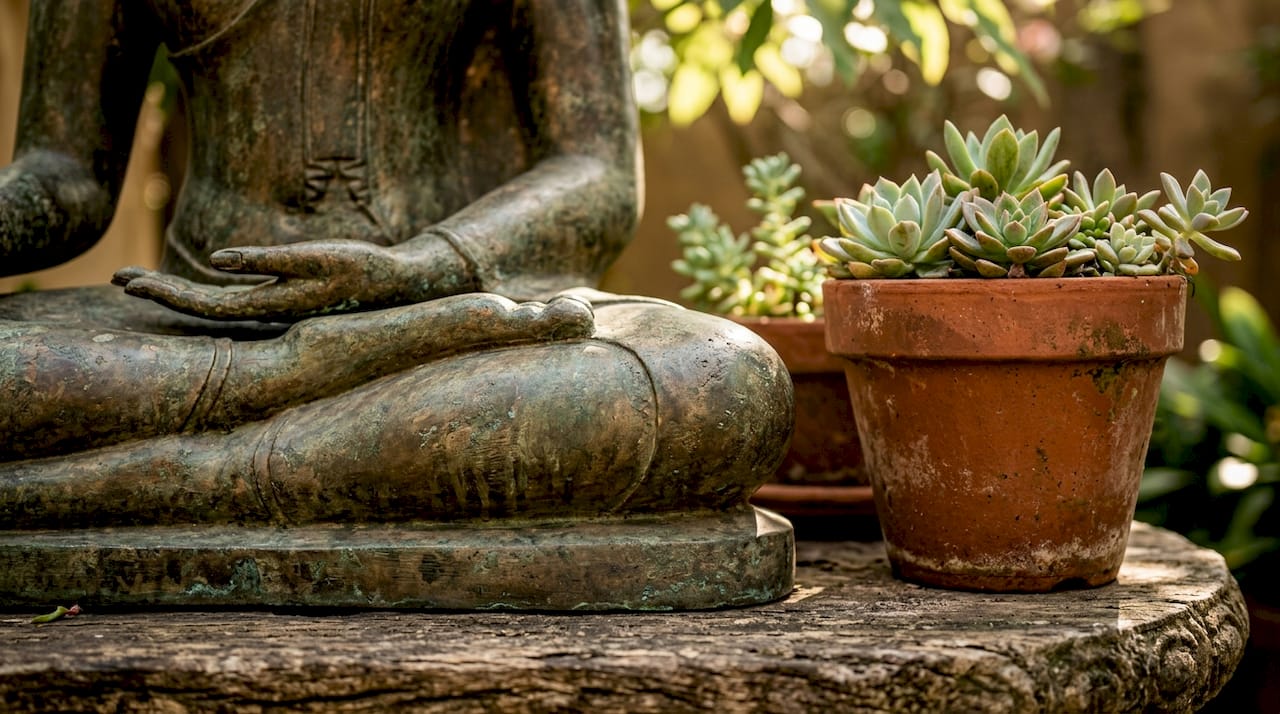
Wear patterns on authentic pieces follow the logic of use and handling. A temple statue that was regularly venerated will show wear on the hands, the feet, and the base from offerings and physical contact. A storage piece may show different patterns. Replicas typically display uniform artificial finishes that lack this contextual logic.
Additional craftsmanship indicators:
- Asymmetric tool marks on carved stone or wood surfaces consistent with hand production
- Minor casting irregularities on bronze pieces that reflect lost-wax technique
- Wear concentrated at contact points: base edges, hand surfaces, and facial high points
- Evidence of old repairs using period-appropriate materials and methods
Pro Tip: Overly neat, clean surfaces on a supposedly ancient piece are a red flag, not a sign of quality. Authentic antiques carry minor imperfections that reflect hand production. If a statue looks factory-perfect, treat that as a warning.
4. Authentic versus replica: a comparison
This table summarizes the primary diagnostic differences between genuine antique Buddha statues and modern replicas across the key evaluation categories.
| Feature | Authentic antique Buddha | Common replica |
|---|---|---|
| Patina | Layered, uneven, concentrated in recesses | Uniform color, smooth texture, applied chemically |
| Weight (bronze) | Heavy, consistent with solid casting | Lighter, hollow or cold-cast construction |
| Iconographic detail | Period-specific mudras, proportions, and motifs | Generic or slightly incorrect gesture and proportion |
| Drapery and faces | Naturalistic variation, nuanced expression | Mechanical repetition, simplified or crude rendering |
| Tool marks | Visible, asymmetric, consistent with hand production | Absent or machine-regular |
| Wear patterns | Contextually logical, concentrated at contact points | Uniform, artificial, or absent |
| Inscriptions | Legible, historically consistent | Absent, decorative, or inaccurate |
| Provenance | Documented ownership and origin history | No documentation or vague attribution |
The features of real antique Buddha statues cluster together. A piece that scores well on patina but poorly on iconographic accuracy warrants further scrutiny. Authentic pieces tend to be consistent across all categories.
5. Practical verification strategies for collectors
Physical examination is the starting point, not the conclusion. Serious collectors combine hands-on assessment with additional verification steps before committing to a significant acquisition.
-
Request full provenance documentation. Records tracing ownership and origin significantly increase confidence in authenticity. Ask for export licenses, auction records, collection histories, and any prior appraisal reports. Absence of documentation does not confirm a fake, but its presence adds meaningful weight.
-
Commission a professional appraisal. Expert appraisals focus on multi-angle imagery, particularly of hands and feet, to distinguish authentic craftsmanship from replica work. Select an appraiser with specific expertise in the relevant regional tradition, not generalist Asian art experience.
-
Consider scientific testing for high-value pieces. Thermoluminescence testing for ceramic and stone pieces, and X-ray fluorescence for bronze alloy composition analysis, can provide objective material dating and composition data. These tests are expensive but appropriate for significant acquisitions.
-
Consult regional style references. Familiarity with the specific artistic traditions of Thailand, Cambodia, Burma, Sri Lanka, and Indonesia is necessary for accurate assessment. Collector guides focused on regional Buddha styles provide the iconographic benchmarks needed for comparison.
-
Store and handle authenticated pieces correctly. Safe storage practices preserve the patina and surface integrity that constitute the authenticity evidence. Improper storage or aggressive cleaning can damage the very features that confirm a piece’s age. Over-cleaning bronze in particular can strip historical patina layers, reducing both authenticity evidence and long-term value.
My perspective on authenticating antique Buddha statues
I’ve spent years examining antique Buddhist sculpture, and the single most common mistake I see among newer collectors is over-relying on patina color as the primary authenticity signal. Color is the easiest thing to fake. What forgers consistently fail to replicate is the logic of aging. Authentic pieces age in ways that reflect their actual history. The wear is where the handling was. The patina is deepest where moisture and air accumulated.
What I’ve found actually separates experienced collectors from beginners is the ability to read a piece’s biography from its surface. A Khmer bronze that spent centuries in a temple environment tells a different story than one that was buried or stored. Neither is more authentic, but both have internal consistency. When a piece’s wear patterns, patina distribution, and iconographic details don’t tell a coherent story, that’s when I get skeptical.
The other thing I’ve learned is that restoration is not automatically disqualifying. Many authentic antique pieces have been repaired, re-gilded, or partially restored over their lifetimes. The question is whether the restoration materials and methods are consistent with the period and region. A Burmese lacquer repair on a Thai bronze is a red flag. A period-appropriate repair in the same tradition is simply evidence of a long life.
Authenticity in cultural heritage extends beyond material to historical, social, and artistic values. The most rewarding acquisitions are pieces where all of those dimensions align and tell a coherent, verifiable story.
— James
Explore authenticated antique Buddha statues at Hdasianart
For collectors who want to work with verified pieces from the start, Hdasianart offers a curated collection of authentic Buddhist statues from Cambodia, Thailand, Indonesia, Sri Lanka, and beyond. Each piece is individually researched, documented, and described by specialists, with full provenance support and worldwide insured shipping.
The Hdasianart blog also covers collector-focused topics including regional style guides, storage practices, and reliquary art, providing the reference material that serious collectors need alongside the pieces themselves.
FAQ
What are the first signs of authentic antique Buddha to check?
Start with patina and weight. Natural patina on bronze is layered and uneven, concentrated in recessed areas, while replicas show uniform color distribution. Weight is also diagnostic: solid bronze antiques are substantially heavier than cold-cast or hollow modern reproductions.
How can you tell if a Buddha statue’s iconography is genuine?
Examine the mudra (hand gesture), ushnisha shape, and drapery style against known examples from the specific region and period. Authentic pieces follow strict iconographic conventions that vary by tradition. Replicas frequently show generic or slightly incorrect proportions in the hands and facial features.
Is patina alone enough to authenticate a Buddha statue?
No. Patina is one indicator among several. Artificial patinas can mimic the color of aged bronze convincingly. Authentication requires cross-referencing patina with iconographic accuracy, craftsmanship quality, wear pattern logic, and provenance documentation for a reliable conclusion.
When should a collector seek professional appraisal?
For any piece representing a significant financial or collection investment, professional appraisal is advisable before purchase. Appraisers specializing in Southeast Asian Buddhist art use detailed multi-angle photography, particularly of hands and feet, to assess craftsmanship and detect replica characteristics.
Does restoration affect a Buddha statue’s authenticity?
Not necessarily. Many genuine antique pieces have been repaired or restored during their lifetimes. The key question is whether the restoration materials and methods are consistent with the statue’s period and regional tradition. Period-appropriate repairs are part of a piece’s history, not evidence against it.
