


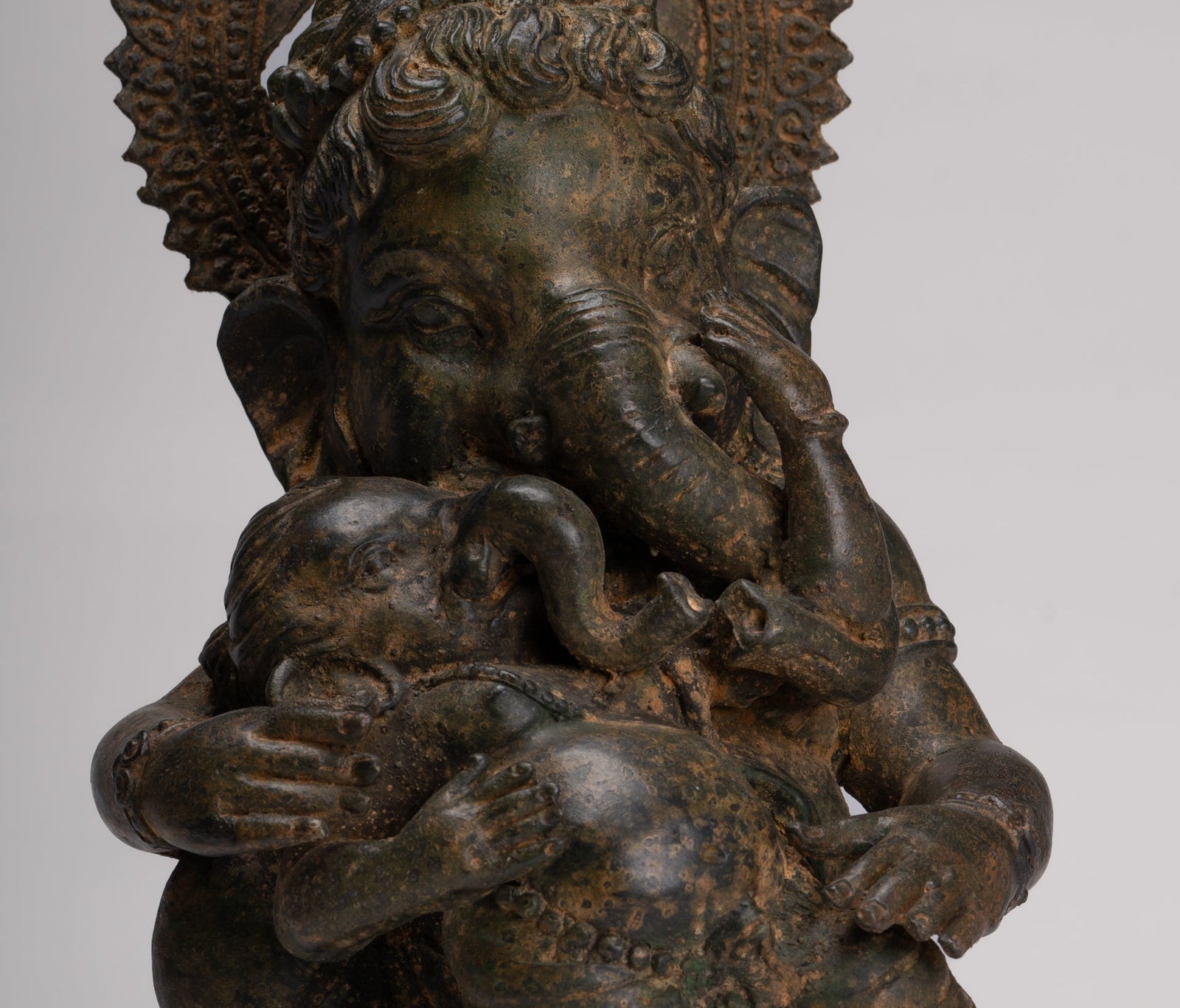
Ganesha Holding a Baby Elephant: Symbolism of Compassion, Continuity, and the Inner Child
Ganesha Holding a Baby Elephant: Symbolism of Compassion, Continuity, and the Inner Child
Among the many divine forms in Hindu iconography, Ganesha—the elephant-headed remover of obstacles—is perhaps the most beloved and instantly recognizable. He appears in countless variations: dancing, seated, with multiple arms, surrounded by consorts, or riding his mouse companion.
Yet one of the more tender and lesser-seen portrayals is that of Ganesha holding a baby elephant in his arms or lap.
This unusual yet deeply symbolic image weaves together profound spiritual meanings that touch on themes of nurturing love, divine responsibility, childlike purity, and the eternal cycle of renewal. Let’s explore the many layers of this gentle and emotionally resonant depiction.
1. Divine Compassion and Nurturing Energy
The image of Ganesha holding a baby elephant conveys a powerful sense of tenderness—rare in depictions of deities. As a god who is both a warrior against obstacles and a patron of wisdom, this gesture reminds us that true strength includes compassion.
In this image:
-
Ganesha becomes not just a remover of external obstacles, but a guardian of innocence.
-
His nurturing gesture reinforces his role as protector of children, families, and the vulnerable.
-
It speaks to unconditional love, especially a parent's love for a child, and reflects the divine archetype of caregiving.
This aspect of Ganesha is particularly resonant in homes and spaces seeking comfort, peace, and emotional harmony.
2. The Baby Elephant as a Symbol of the Inner Child
In Hindu thought and broader Eastern philosophy, the childlike mind is often associated with purity, curiosity, and innate wisdom. A baby elephant in the arms of Ganesha can be seen as a symbol of the inner child that lives within each of us.
By holding this symbolic child close:
-
Ganesha invites us to embrace our inner innocence, even as we pursue intellectual or spiritual growth.
-
He reminds us not to lose touch with our playfulness, vulnerability, and joy.
-
This motif can serve as a gentle call to heal emotional wounds and reconnect with our essential self—before ego, fear, or suffering took root.
3. Continuity, Legacy, and the Cycles of Rebirth
Elephants have long represented wisdom, longevity, and continuity in Hindu culture. A baby elephant in this context may symbolize the next generation, both physically and spiritually.
-
Ganesha holding a baby elephant signifies lineage and legacy, perhaps pointing to the cycle of dharma being passed from generation to generation.
-
In metaphysical terms, it also evokes the cycle of rebirth (samsara), where each new life contains the seeds of the previous one.
-
Some interpretations even consider the baby elephant as a representation of Ganesha himself in another life, symbolizing the continuity of the soul across lifetimes.
In this way, the statue becomes a visual expression of Hindu cosmology’s core belief in eternal renewal.
4. The Elephant as a Symbol of Wisdom and Royalty
Both Ganesha and the baby elephant represent the elephant as a sacred animal in Hindu culture. Elephants symbolize:
-
Strength balanced with patience
-
Wisdom born of memory and experience
-
Gentle majesty and leadership
A baby elephant reminds us that wisdom begins early, and must be cultivated with care. By cradling the young elephant, Ganesha embodies the divine responsibility to protect and nurture wisdom, whether in children, students, or the seeker on their spiritual path.
This has special significance for those who place such statues in homes of learning, study, or education.
5. Artistic and Regional Interpretations
While not as common as traditional four-armed or seated Ganesha depictions, Ganesha with a baby elephant appears in certain folk traditions, modern spiritual art, and increasingly in decorative sculpture inspired by emotional or symbolic resonance.
-
In some artistic interpretations, the baby elephant may be Ganesha’s own child or a reflection of his own youth.
-
In others, it may represent all sentient beings, especially those in need of protection.
-
It is also sometimes associated with Vinayaka Chaturthi celebrations, during which childlike depictions of Ganesha are created to emphasize his approachability and humanity.
Modern sculpture often captures this form with gentle expressions, playful postures, and warm, inviting compositions, making it popular for both sacred and decorative use.
6. Why Keep This Form in Your Home or Office?
A statue of Ganesha holding a baby elephant is not just a decorative object—it carries powerful, healing energy:
-
🕊️ Calming Atmosphere: Ideal for meditation spaces, therapy rooms, or homes seeking emotional peace.
-
🛡️ Protection & Safety: Offers a sense of divine watchfulness over children and vulnerable loved ones.
-
🌱 New Beginnings: Supports transitions such as births, adoptions, or starting anew after difficulty.
-
📚 Inspiration for Growth: Reminds us to nurture our inner child and pursue learning with humility.
This depiction brings an unmistakable warmth—a balance of divine power and human empathy.
Conclusion: A Divine Embrace of Innocence and Wisdom
In a world that often prizes achievement and control, the image of Ganesha cradling a baby elephant offers a rare moment of pause—a visual whisper that tells us: True power lies in love, and wisdom begins in the arms of compassion.
For devotees, seekers, and art lovers alike, this form serves as both a spiritual reminder and a symbolic talisman—inviting us to protect what is gentle, honor what is wise, and embrace what is deeply human within ourselves.
🛕 Discover Divine Forms of Ganesha
At HDasianArt.com, we curate rare and meaningful depictions of Ganesha, including unique forms such as Ganesha with baby elephant sculptures. Whether for your altar, workspace, or living area, these sacred forms bring a sense of calm, protection, and joyful grace.
