



Bodhisattva Concept Explained: Meaning and Practice
Bodhisattva Concept Explained: Meaning and Practice
A bodhisattva is defined as a being who generates the aspiration for full enlightenment with the explicit intention of liberating all sentient beings, choosing to remain in the cycle of existence rather than seeking personal release. This concept sits at the heart of Mahayana Buddhism and shapes its entire ethical and philosophical framework.
Understanding bodhisattva meaning requires grasping two inseparable forces: boundless compassion and perfect wisdom. The Sanskrit term bodhicitta, meaning “mind of awakening,” names the motivational core that distinguishes a bodhisattva from any other spiritual practitioner. What makes the bodhisattva ideal so compelling is not its mysticism but its radical ethical demand: to treat every being’s suffering as your own concern.
What is the bodhisattva concept explained through philosophy?
The word bodhisattva combines two Sanskrit roots: bodhi, meaning awakening, and sattva, meaning being. Together they name a being oriented entirely toward awakening, not for personal gain but for the liberation of all. This etymology is not just linguistic trivia. It encodes the entire philosophical stance of the Mahayana tradition.
Early Mahayana thinkers believed personal liberation was incomplete without compassion for all beings. The arahant ideal, which centers on individual liberation from suffering, was seen as a partial achievement. The bodhisattva ideal arose as a corrective, insisting that awakening requires both wisdom and compassion working together.
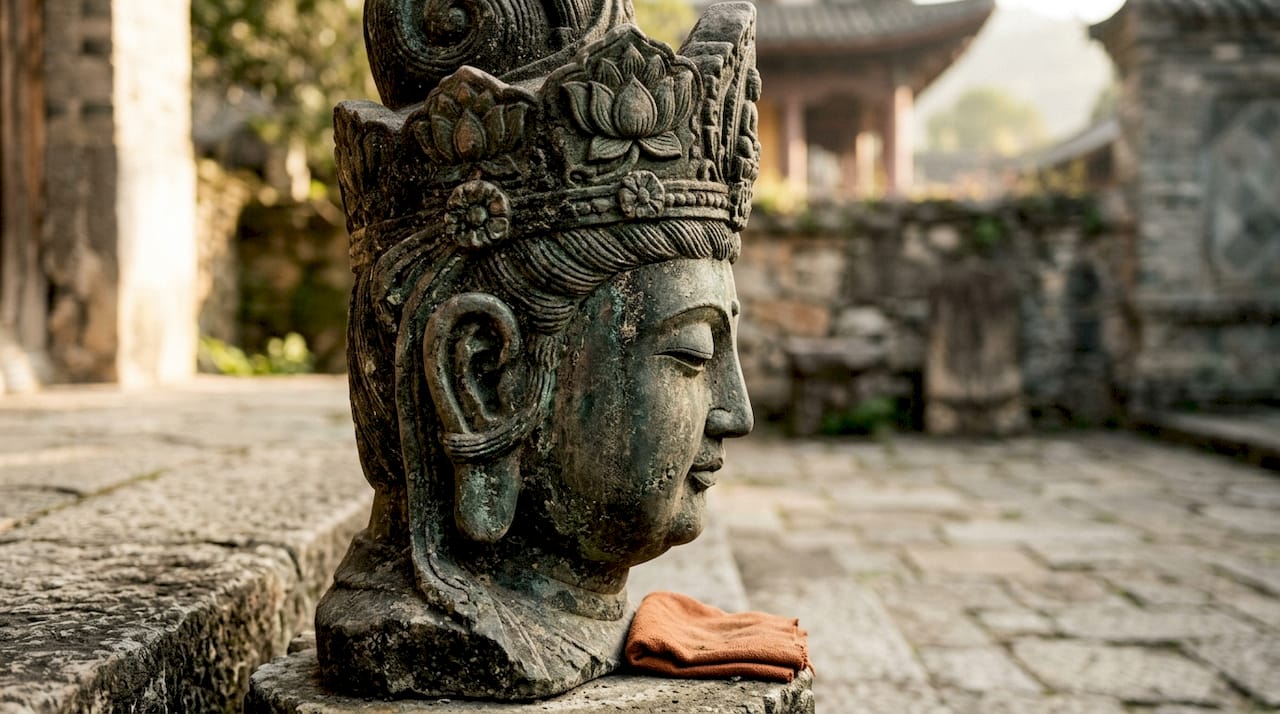
The philosophical underpinning rests on interconnectedness. No being exists in isolation. Suffering in one part of the web of existence affects the whole. A bodhisattva recognizes this and acts accordingly, not from obligation but from clear seeing.
The bodhisattva is often described as a spiritual warrior. This framing is precise, not poetic. Bodhisattvas reflect a courageous psychological and ethical stance to stay engaged with suffering rather than escape it. Their heroism is dedication to working through complexity, not fleeing it.
Key philosophical contrasts that define the bodhisattva path:
- Bodhisattva vs. arahant: The arahant seeks personal liberation; the bodhisattva delays nirvana until all beings are free.
- Compassion vs. wisdom: Neither alone is sufficient. The bodhisattva path requires both, integrated and inseparable.
- Engagement vs. withdrawal: The bodhisattva remains in samsara by choice, not by failure to escape it.
- Universal vs. individual: The bodhisattva’s aspiration is universal. No being is excluded from the scope of care.
What are the six paramitas in bodhisattva practice?
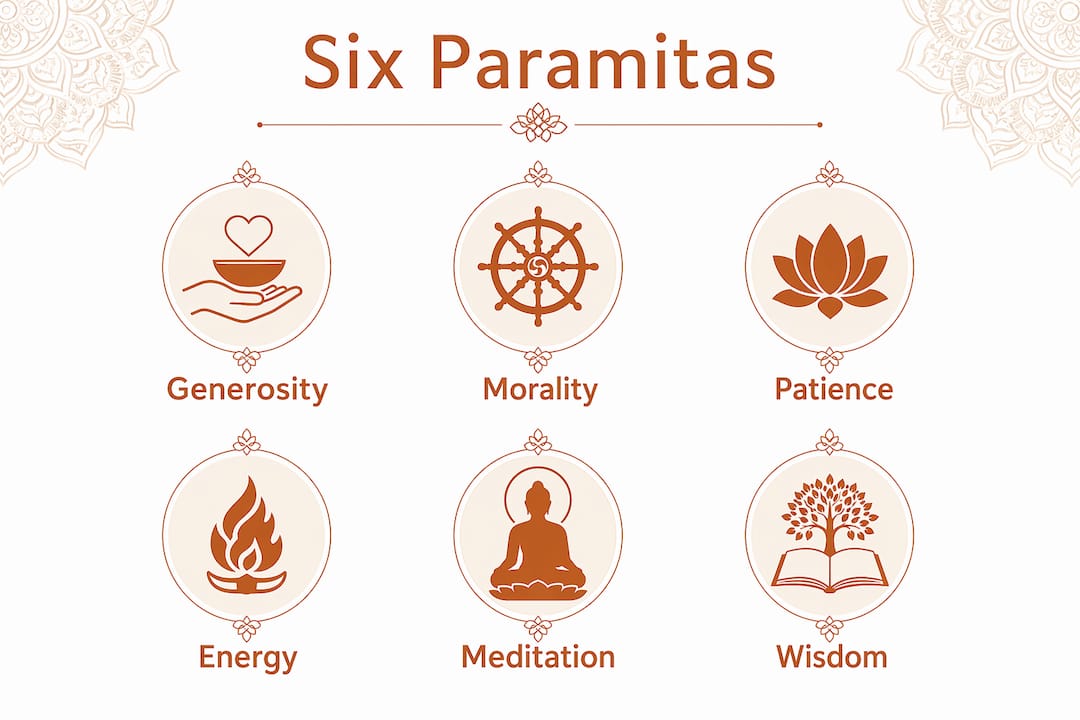
The six paramitas, often translated as “far-reaching attitudes,” form the practical behavioral framework for anyone walking the bodhisattva path. The six paramitas integrate generosity, ethical discipline, patience, enthusiastic perseverance, meditative concentration, and wisdom. Each one addresses a specific dimension of how a bodhisattva engages with the world.
- Generosity (dana): Giving material support, protection from fear, and the gift of the teachings. Generosity trains the practitioner to loosen the grip of self-centeredness.
- Ethical discipline (shila): Refraining from harm and actively benefiting others. This is not rule-following for its own sake but a commitment rooted in care.
- Patience (kshanti): Bearing difficulty without resentment. Patience is the antidote to anger, which destroys accumulated merit faster than almost any other force.
- Enthusiastic perseverance (virya): Sustained effort without discouragement. The bodhisattva path spans lifetimes, and perseverance is what keeps it alive.
- Meditative concentration (dhyana): Stabilizing the mind so that wisdom can function clearly. Without concentration, insight remains fragmented.
- Wisdom (prajna): Direct understanding of the nature of reality, specifically the emptiness of inherent existence. This is the sixth paramita and the most critical.
The first five paramitas constitute method, while the sixth, wisdom of voidness, is essential for full buddhahood. Method without wisdom produces good karma but not liberation. Wisdom without method produces insight without the capacity to help others.
Pro Tip: Practicing compassion without wisdom can lead to burnout or misguided help. Practicing wisdom without compassion produces cold detachment. The six paramitas only work when all six are cultivated together as an integrated whole.
What is the bodhisattva vow and why does it matter?
The bodhisattva vow is a formal commitment to attain full enlightenment for the benefit of all sentient beings. The vow is an ongoing commitment that recalibrates motivation across lifetimes, not a one-time promise. This distinction matters enormously. The vow is not a contract signed once and filed away. It is a living orientation that shapes every action, every decision, and every relationship.
Taking the vow involves two dimensions of bodhicitta. Bodhicitta has two aspects: the aspiration to attain awakening for all beings and the engagement in practices leading there. The first is the seed. The second is the ongoing path. Both are required.
Key features of the bodhisattva vow in practice:
- Motivation reorientation: Every spiritual practice is redirected from self-improvement toward universal benefit.
- Lifelong and trans-lifetime scope: The vow is understood to carry across rebirths in traditions that accept rebirth.
- Renewal and repair: Practitioners renew the vow regularly and repair it when broken, treating it as a living commitment rather than a permanent achievement.
- Community context: In Mahayana communities, the vow is often taken formally before a teacher. In Vajrayana communities, additional tantric vows layer on top of the bodhisattva vow.
The vow distinguishes the Mahayana path from individual liberation paths at the level of motivation, not just doctrine. A practitioner who holds the vow approaches every situation asking: how does this serve all beings?
How do Theravada and Mahayana traditions differ on the bodhisattva?
The bodhisattva concept does not function the same way across all Buddhist traditions. The Theravada tradition limits the term bodhisatta to beings predicted by a living Buddha to achieve enlightenment, making it rare. In Theravada, the historical Buddha Shakyamuni was a bodhisatta in his previous lives, and Maitreya is the future bodhisatta. The category is not open to ordinary practitioners.
Mahayana takes the opposite position. The bodhisattva path is presented as universally accessible. Any practitioner who generates bodhicitta and takes the vow enters the bodhisattva path. This democratization of the ideal is one of Mahayana’s defining features.
| Feature | Theravada | Mahayana |
|---|---|---|
| Who can be a bodhisattva | Only beings predicted by a living Buddha | Any practitioner who takes the vow |
| Rarity | Extremely rare | Universally encouraged |
| Primary ideal | Arahant (personal liberation) | Bodhisattva (universal liberation) |
| Role in practice | Historical and future figures | Active spiritual path for all |
These differences are doctrinal, not merely cultural. They reflect fundamentally different understandings of what the goal of Buddhist practice is. Theravada centers on the individual’s liberation through the Noble Eightfold Path. Mahayana reframes the goal as universal liberation, with the bodhisattva as the vehicle. Readers interested in how these distinctions appear in sculpture and iconography can explore Theravada Buddhist sculpture and Mahayana Buddhist art traditions for visual context.
How does the bodhisattva ideal shape daily ethical conduct?
The bodhisattva ideal is not confined to monasteries or meditation halls. A bodhisattva is not a static title but a dynamic path beginning with bodhicitta, requiring sustained practice balancing compassion and wisdom. This means the ideal has direct implications for how practitioners behave in ordinary life.
The ethical impact shows up in small, concrete choices. A practitioner holding the bodhisattva motivation pauses before reacting in anger, not because anger is forbidden but because the vow orients attention toward the other person’s welfare. Generosity becomes a reflex rather than an occasional act. Patience with difficult people is reframed as practice, not endurance.
The vow’s significance lies in realizing interconnectedness such that compassion becomes a natural expression rather than a burdensome duty. This shift in perception is the practical payoff of the bodhisattva philosophy. When you genuinely see that your wellbeing and others’ wellbeing are inseparable, ethical conduct stops feeling like sacrifice.
The bodhisattva ideal also extends beyond individual relationships. Practitioners apply it to social contexts, professional settings, and even political engagement. The question “how does this serve all beings?” is portable across every domain of life.
Pro Tip: You do not need to be an advanced practitioner to begin applying bodhisattva ethics. Start by asking, before any significant decision, whether your motivation includes the welfare of others. That single question shifts the orientation of practice.
Key Takeaways
A bodhisattva is defined by the commitment to attain full enlightenment for all beings, integrating compassion and wisdom through the six paramitas, the bodhisattva vow, and sustained ethical practice across every dimension of life.
| Point | Details |
|---|---|
| Core definition | A bodhisattva delays personal nirvana to liberate all sentient beings through compassion and wisdom. |
| Six paramitas | Generosity, discipline, patience, perseverance, concentration, and wisdom form the practical framework. |
| The bodhisattva vow | An ongoing commitment that reorients motivation toward universal benefit, renewed throughout practice. |
| Tradition differences | Theravada restricts the term to rare predicted beings; Mahayana opens it to all practitioners. |
| Daily application | Bodhisattva ethics shape every decision by asking how each action serves the welfare of all beings. |
The bodhisattva path in 2026: what modern seekers often miss
The most common misunderstanding I encounter is treating the bodhisattva ideal as an aspiration for saints, not ordinary people. Practitioners read about traversing the ten bodhisattva levels and conclude the path is too vast to begin. That conclusion is exactly backwards.
The vow is not a claim to have arrived. It is a direction of travel. Taking the bodhisattva vow as a beginner is not presumptuous. It is the most honest thing a practitioner can do, because it names the actual goal rather than a comfortable intermediate stop.
What I find genuinely surprising, after years of working with Buddhist art and iconography at HDAsianArt, is how clearly the bodhisattva ideal is encoded in the physical forms of the statues themselves. Avalokiteshvara’s thousand arms are not decorative. They represent the capacity to respond to every form of suffering simultaneously. Tara’s forward-stepping foot signals readiness to act, not contemplative withdrawal. The art is the philosophy made visible.
The second misunderstanding is treating compassion and wisdom as sequential. Practitioners often think: first I will develop wisdom, then I will help others. The six paramitas reject this sequencing entirely. Method and wisdom develop together or they do not develop at all. The bodhisattva path is not a ladder. It is a web.
— James, HDAsianArt.com
Bodhisattva statues and Buddhist art at HDAsianArt
Bodhisattva figures appear across the full range of Asian Buddhist art traditions, from Javanese bronze Avalokiteshvara to Cambodian stone Tara. HDAsianArt carries an individually researched collection of authentic bodhisattva statues and related Buddhist sculpture, each piece documented for its iconography, origin, and spiritual symbolism.
Every piece in the HDAsianArt collection is photographed and described by specialists with direct knowledge of Buddhist iconographic traditions. Bodhisattva statues serve as focal points for meditation, study, and reflection on the compassion and wisdom the figures embody. The collection spans Cambodia, Thailand, Indonesia, Sri Lanka, and Vietnam, with worldwide insured DHL shipping on every order.
FAQ
What does bodhisattva mean in Buddhism?
A bodhisattva is a being who aspires to full enlightenment for the benefit of all sentient beings and commits to remaining in the cycle of existence until all are free. The term combines the Sanskrit words bodhi (awakening) and sattva (being).
What is bodhicitta and how does it relate to the bodhisattva?
Bodhicitta is the “mind of awakening,” the motivational core of the bodhisattva path. It has two aspects: the aspiration to attain enlightenment for all beings and the active engagement in practices that lead there.
How is the bodhisattva different from a Buddha?
A bodhisattva is still on the path to full buddhahood, progressing through ten stages called the dashabhumi. A Buddha has completed that path and achieved full awakening.
Do Theravada Buddhists recognize the bodhisattva ideal?
Theravada Buddhism uses the term bodhisatta but limits it to beings specifically predicted by a living Buddha to achieve enlightenment, making it extremely rare. Mahayana Buddhism opens the bodhisattva path to all practitioners.
What are the six paramitas in bodhisattva practice?
The six paramitas are generosity, ethical discipline, patience, enthusiastic perseverance, meditative concentration, and wisdom. The first five constitute method; the sixth, wisdom, is essential for full buddhahood and cannot be separated from the others.
