



Hindu Religious Sculpture: Styles, Meaning and Care
Hindu Religious Sculpture: Styles, Meaning and Care
You're standing in front of a bronze figure in a gallery window, or scrolling a listing late at night. It has several arms, a tall crown and something that might be a weapon, a flower or a musical instrument. You like it, but you can't name the deity, judge the age or know whether it belongs on a bookshelf at all. That uncertainty is normal, and it's exactly where learning to read Hindu religious sculpture begins.
Table of Contents
- What Hindu Religious Sculpture Means Today
- Reading the Iconography of Major Hindu Deities
- Regional and Historical Styles of Hindu Sculpture
- Materials and Techniques Used in Hindu Sculpture
- How to Identify Authentic and Antique Hindu Sculptures
- Provenance and Responsible Collecting in the UK
- Living with Hindu Sculpture Respectfully
- Choosing the Right Hindu Sculpture for Your Collection
What Hindu Religious Sculpture Means Today
A first-time buyer often starts with the face. A curator starts somewhere else, with purpose. In Hindu traditions, a sculpted image, or murti, can serve devotional, ceremonial, educational and domestic purposes. For many worshippers it isn't just a picture of a deity. It's treated as a living presence, a form through which the divine can be approached, honoured and cared for.
That distinction changes how you look at everything else. A small Ganesha on a household shrine, a processional bronze carried in festival, and a stone Vishnu in a museum case may share iconography, but they don't share the same relationship with the people around them. One is greeted daily. One might be bathed, dressed and offered flowers. One is studied behind glass.
Why this matters in Britain now
These aren't distant objects in the UK. The 2021 Census for England and Wales recorded approximately 1.0 million people identifying as Hindu, representing 1.7% of the population, up from about 818,000 people, or 1.5%, in 2011, according to the ONS bulletin on religion in England and Wales from Census 2021. That growth of roughly 182,000 people doesn't measure sculpture ownership, and it shouldn't be read as a market statistic. It does explain why Hindu images are present and meaningful in British homes, temples, classrooms and museums.
Historic England's survey identified 187 Hindu temples in England, a figure summarised in the overview of Hinduism in the United Kingdom and Historic England's temple survey. Temples aren't galleries for statues. They're active religious buildings where images can form part of worship, ritual presentation and community life, which is why temple sculpture needs a different vocabulary from decorative collecting.
A murti can be art history and sacred presence at the same time. Holding both ideas together is the starting point for responsible collecting.
The age profile reinforces that living context. Among people identifying as Hindu, 68.4% were aged 16 to 64 and 20.3% were under 16, compared with 62.9% and 18.5% overall, as shown in the ONS analysis of religion by age and sex in Census 2021. Sculpture is therefore transmitted in family households, festivals and religious education, not preserved only as a historical subject.
If you're exploring the ideas that shape devotion, you might also reflect on dharma with Anvaya as a way into thinking about duty, purpose and practice alongside the objects themselves. From here, the practical path is clear. Learn the iconography, recognise regional styles, understand materials, then ask harder questions about authenticity, provenance and respectful display.
Reading the Iconography of Major Hindu Deities
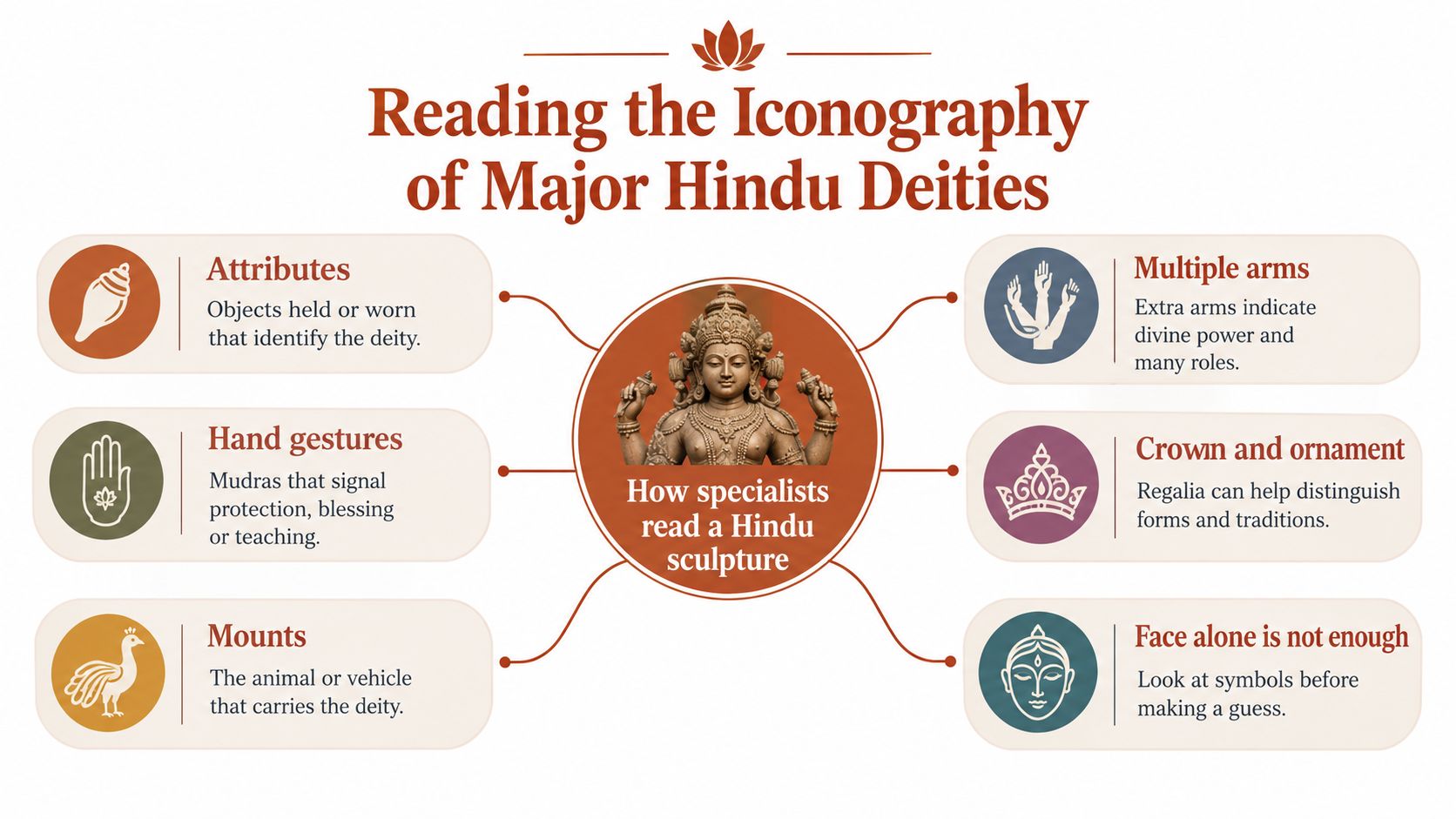
Don't guess from the face. Specialists identify a figure by working through three checks in order, attributes, gestures and mount. Attributes are the objects held or worn. Gestures, or mudras, communicate protection, blessing or meditation. The mount, or vahana, is the animal that carries or accompanies the deity.
This method works because sculptors followed shared conventions. A worshipper needed to recognise the deity at once, often in dim temple light or during procession. Extra arms aren't artistic licence. They let one figure hold several attributes and signal divine power across many roles at once.
Shiva and Vishnu
Shiva often carries a trident and a small damaru drum, wears a crescent moon, and may show a third eye on the forehead. His mount is Nandi the bull, frequently placed facing him. As Nataraja, Lord of the Dance, Shiva dances within a ring of flames, one foot raised and one pressing down a dwarf figure, a form you'll recognise once you've seen the circular aureole.
Vishnu is the preserver, and his classic attributes are the discus, or chakra, and the conch, or shankha, often with a mace and lotus in four hands. His mount is Garuda, the eagle-like being who may appear kneeling before him or carrying him. A tall cylindrical crown and a calm, frontal stance also help, but the discus and conch pairing is your strongest clue.
Ganesha, the Goddess and other familiar forms
Ganesha is the easiest identification you'll make. Look for the elephant head, broken tusk, rounded belly and a bowl of modaka sweets, with a mouse at his feet. His trunk may curl towards the sweets, a detail carvers repeat because devotees love it. If the head is human, it isn't Ganesha, however rotund the body.
Devi is the Goddess in her many forms. As Durga, she carries weapons in multiple arms and rides a lion or tiger, often shown defeating the buffalo demon. Lakshmi, goddess of prosperity, sits or stands on a lotus, sometimes with elephants pouring water over her. Hanuman, the devoted monkey god, carries a mace and may kneel with hands joined, while Brahma is identified by his four faces looking in four directions.
- Abhaya mudra: palm raised outwards, signalling protection and reassurance.
- Varada mudra: palm lowered with fingers down, signalling giving and granting boons.
- Dhyana mudra: hands resting in the lap, signalling meditation and inner stillness.
For a fuller reference you can keep open while browsing, use our detailed list of Hindu deity attributes and symbols and test each sculpture against it. The reusable logic is simple. Name the objects first, read the hands second, check the animal at the base third, and only then confirm with crown and ornament.
Identification rule: if you can't name at least two attributes, you haven't identified the deity yet. You've only described a style.
Regional and Historical Styles of Hindu Sculpture
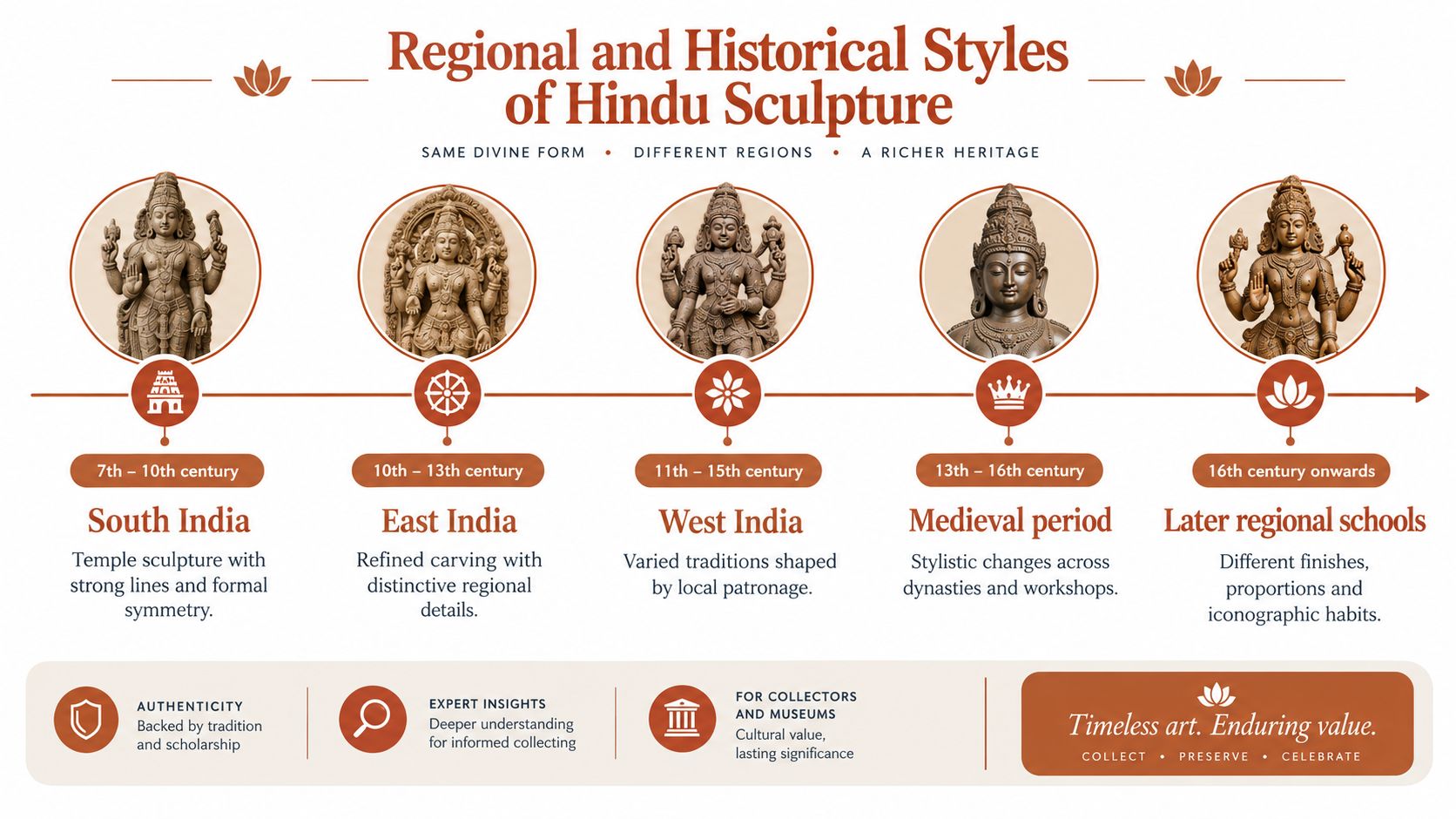
The same Vishnu can look slender and dancing in one bronze, block-like and architectural in another. That's not inconsistency. Region, period, material and temple practice shaped how sculptors solved the same iconographic problem. Learning those signatures lets you say what a piece claims to be before you judge whether the claim is convincing.
Start in South India. Chola-period bronzes are celebrated for slender proportions, fluid posture and finely modelled ornament, and many were made for processional worship, meaning they were designed to be carried, dressed and seen in movement. Look for a distinctive aureole, a lotus base with lugs for carrying poles, and a balance that feels intentional from every angle. A processional bronze should work in the round, not only from the front.
Stone traditions across India
In the northeast, Pala-period stone carving tends towards refined detail, elaborate back slabs and a dense, polished surface. Figures often stand against an ornate stele that frames attendant deities and decorative motifs. The overall effect is jewel-like, even at large scale.
Kashmiri sculpture offers a different clue. Carvers used green chlorite, a stone that takes crisp detail and a smooth finish. Multi-headed forms of Vishnu, known as Vaikuntha, appear in this tradition, combining human and animal faces in one image. If you're handling a greenish stone figure with exceptionally fine carving, Kashmir should be on your shortlist of possibilities, though surface coatings can change the colour you see.
Southeast Asian expressions
Hindu sculpture travelled with trade, court culture and religion into Southeast Asia, where local workshops made it their own. Khmer sculpture from Cambodia is known for serene faces, powerful torsos and the pleated sampot garment, often with a distinctive fishtail fold. Early Khmer Vishnu figures can feel stark and monumental, while later pieces soften. Crown shape, drapery and base mouldings are often more telling than the deity's identity.
In Indonesia, Javanese and Majapahit traditions produced Hindu and Buddhist images with their own proportions, ornament and casting habits. If that region draws you, our guide to Indonesian Hindu and Buddhist sculpture in Majapahit, Singhasari and East Java styles maps the differences in more depth. The habit to build is comparison. Place two images of the same deity side by side and ask what changed in crown, posture, base and finish, and why a workshop in that place would make those choices.
Materials and Techniques Used in Hindu Sculpture
Material isn't a neutral choice. It decides how fine the detail can be, how the surface ages, and what care the object will need in a British home. A bronze made for procession, a granite temple figure made to stay in place, and a wooden shrine image made for domestic devotion were engineered for different lives.
South Indian bronzes were typically cast by lost-wax casting, or cire perdue. The sculptor modelled the figure in wax, encased it in clay, melted the wax out, and poured molten metal into the void. Because the wax model is lost, each cast is unique. That process explains the crisp jewellery, flowing scarves and sense of movement you see in Chola bronzes, and it also means casting flaws and repairs need expert reading.
When surface colour is intentional
Don't assume colour variation is dirt or damage. The V&A records a South Indian Vishnu made with the Ganga-Jamuna two-metal technique, where dark-coloured flesh contrasts with bright brass elsewhere and the lotus base is carefully modelled, as detailed in the V&A collection record for the two-metal Vishnu figure. That contrast is an intentional material system creating visual hierarchy. Aggressive polishing could erase exactly what the maker intended.
Stone can mislead you in the same way. A Kashmir Vishnu Vaikuntha in green chlorite carries a black surface coating, so the colour you see reflects applied treatment rather than untreated geology. For your own records, separate substrate, coating, wear, losses and retouching into different fields. That discipline improves photography, valuation and any later decision about cleaning.
Materials at a Glance
| Material | Typical technique | Visual character | Care considerations |
|---|---|---|---|
| Bronze | Lost-wax casting | Crisp detail, warm metallic presence | Stable humidity, avoid abrasive polishing |
| Stone | Hand carving in granite, sandstone or chlorite | Architectural, grounded, durable | Check coatings and fragile edges before cleaning |
| Wood | Carving, sometimes painted | Warm, intimate, lighter in weight | Keep away from damp and sharp humidity swings |
| Brass | Casting, often for domestic images | Bright, golden tone | Gentle dusting, avoid harsh chemicals |
| Lacquer and papier-mâché | Built up and finished by hand | Lightweight, richly surfaced | Handle carefully, surfaces can be fragile |
The practical consequence is restraint. Abrasive polishing or indiscriminate chemical cleaning can remove intended contrast and evidential value. If a surface looks uneven, your first job is to understand whether that unevenness is age, worship, coating or damage. Cleaning before diagnosis destroys information you'll never recover.
How to Identify Authentic and Antique Hindu Sculptures
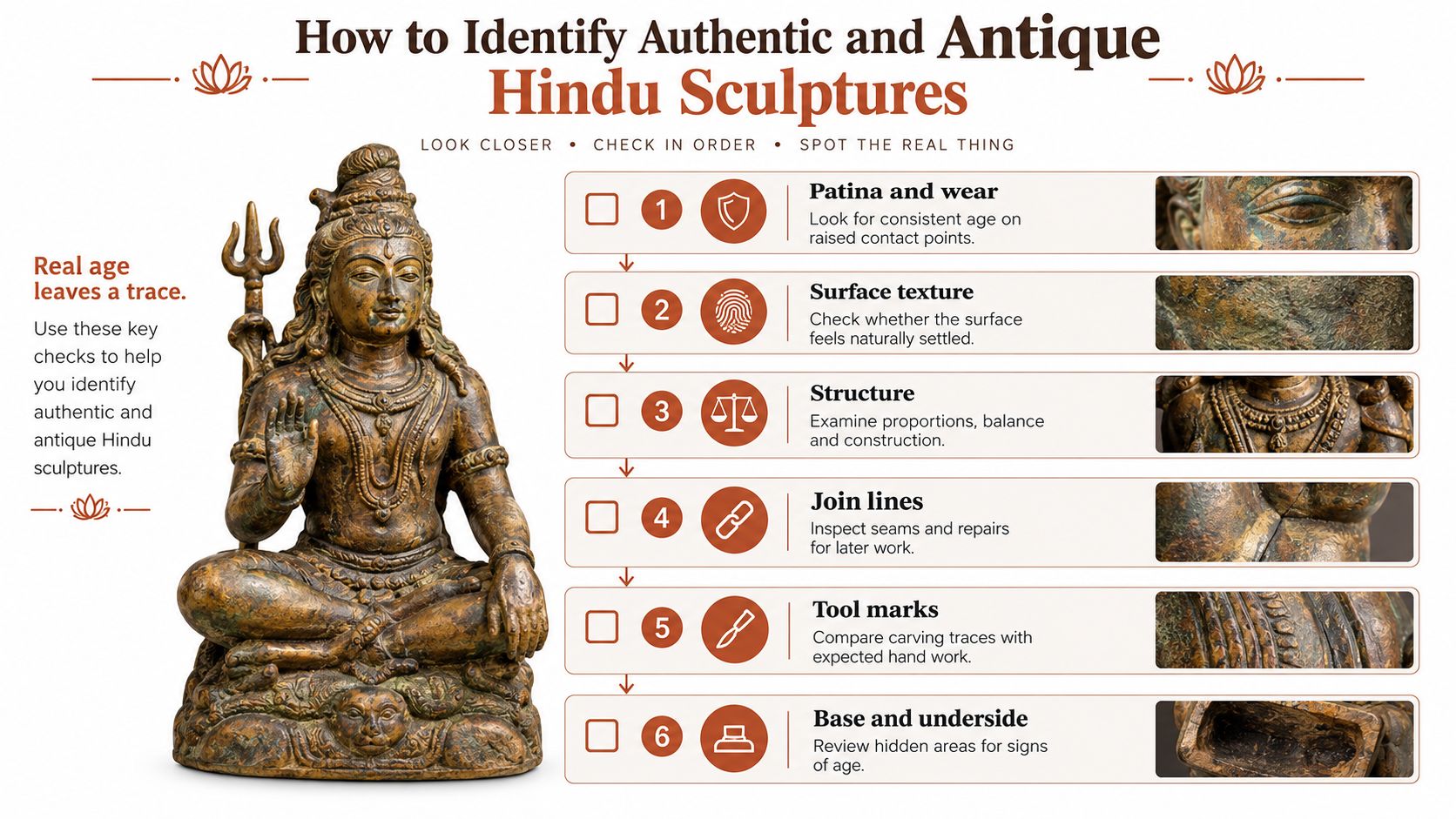
Work from surface to structure, in that order, and write down what you see. Genuine wear concentrates on raised contact points, the nose, hands, attributes and base edges that people touched, carried or anointed. Applied ageing often sits too evenly, settling in recesses where real handling wouldn't reach. If every crevice looks equally ancient and every high point looks untouched, slow down.
Next, look for casting seams, tool marks and weight. Hand finishing leaves irregularities that follow the form. Mould-made reproductions can feel uniform in a way period work rarely does, and their weight may not match the construction you'd expect. Turn the piece over when you're permitted to do so. Bases and undersides often reveal more about age and manufacture than a polished front.
The hidden structure problem
The most instructive UK museum case concerns a 12th-century South Indian Shiva Nataraja in the V&A. Spectrographic analysis identified copper with more than 2% lead and tin, plus smaller quantities of other elements, and its decorative aureole contains a complete internal iron hoop, as documented in the V&A collection record for Shiva Nataraja, Lord of the Dance. Oxidation made that hoop swell and split the surrounding bronze, requiring conservation treatment. Surface appearance alone would never have told that story.
Apply that lesson directly. Inspect joins, aureole edges, repaired breaks and concealed ferrous supports, not just patina. Ask for documentation of alloy testing, structural repairs and conservation history, because those records separate original casting features from later intervention. For any bronze with internal iron, stable humidity and dry storage aren't optional extras. Active corrosion can exert mechanical pressure from inside.
The same habit of checking construction rather than trusting a worn finish applies across antiques, which is why a furniture specialist such as Vinson Fine Furniture's cheval mirror guide can be a useful parallel read on reading age through structure and materials. Finally, use honest categories. Antique, vintage and faithful temple-style reproduction are different things, and a good reproduction doesn't become antique because the patina is dark.
Provenance and Responsible Collecting in the UK
Buyers often blur four separate questions into one feeling of confidence. Separating them protects you. A sculpture can depict Vishnu correctly, be technically old, still lack a documented ownership trail, and still raise unresolved questions about how it left its place of origin.
- Depiction: what deity, form and regional style does it show?
- Technical authenticity: do material, technique and wear support the claimed date?
- Ownership trail: can previous possession be documented?
- Removal history: does export or excavation raise cultural-property concerns?
British collections make this concrete. The British Museum notes that some Hindu sculptures in its Tantric collection were assembled by East India Company personnel, with histories spanning devotional use and problematic collecting contexts, as explained in the British Museum account of Tantra collecting histories. V&A research similarly records Hindu bronzes entering British collections through nineteenth and early twentieth-century colonial networks, including temple contexts and excavation in Tamil Nadu. Age and beauty don't settle ethical legitimacy.
Evidence you can actually request
Ask for prior invoices, collection labels, publication records, export documentation, old photographs and condition reports. Old photographs are especially valuable because they can place an object in a collection at a date and show earlier damage or restoration. Labels and inventory numbers matter too. Don't dismiss them as dirt to be cleaned off.
An undocumented object isn't automatically illicit, and an old-looking object isn't automatically valuable. Provenance is evidence, not atmosphere.
If you want a method for building that paper trail, our guide to provenance research for Asian antique sculpture sets out how specialists assemble and test it. Museum standards are stricter than private-market conventions, and gaps that a seller calls normal may still matter to you. When a high-value purchase has incomplete export history or signs of recent excavation, pause and seek specialist legal or conservation advice before money changes hands. Responsible collecting is not suspicion of everything. It's refusing to let a good story replace documentation.
Living with Hindu Sculpture Respectfully
Many guides reduce placement to a universal checklist. That approach fails because it treats every image as décor and every Hindu household as identical. Practice varies by sampradaya, region and family, and the status of the object itself varies too. Your first task is to know which kind of object you're living with.
A consecrated temple image has been ritually installed for worship and carries responsibilities set by temple tradition. A household altar sculpture is used in domestic devotion, often with daily offerings and family customs. A devotional image may focus prayer without formal consecration. A decorative collectible is owned primarily as art. Those categories can overlap, but they shouldn't be confused.
Museums are rethinking this in public. For its 2025 exhibition Ancient India, living traditions, the British Museum consulted ten London-based Hindu, Buddhist and Jain practitioners and addressed the understanding that murtis can be living manifestations of the divine requiring dignity in collections, as described in the British Museum account of community collaboration for Ancient India, living traditions. That consultation model is a useful standard for private owners too. Ask, listen, and don't assume a design rule outranks lived practice.
Questions collectors actually face
Can a previously owned sculpture go on an altar? Many families would say it depends on its history, condition and their own tradition, and some would seek guidance from a priest or elder. How should you handle a damaged or decommissioned image? Don't treat it as rubbish while you decide. Store it cleanly, wrapped and raised off the floor, and ask a temple or practitioner what respectful disposal or immersion practice applies in that tradition.
Touching, photographing and floor placement follow the same principle. Clean hands, careful handling and avoiding the floor are widely respectful defaults, but they aren't substitutes for asking in a specific context. Even digital presentation carries choices, and institutions learning to build engaging museum virtual tours face the same question of how to show sacred objects with context rather than as isolated ornaments. Informed sensitivity, sustained over years of ownership, is the standard.
Choosing the Right Hindu Sculpture for Your Collection
Choose purpose before deity, and deity before decoration. If the piece is for a home shrine or puja space, your tradition and daily practice should lead. If it's for study or display, let iconography and regional style lead. Common associations can help you shortlist, Ganesha for new beginnings and wisdom, Shiva for transformation, Vishnu for protection and Lakshmi for abundance, but treat them as starting points rather than substitutes for the identification work above.
Material follows space and climate. Bronze Shiva sculptures have fine, crisp details and a warm metallic presence, while stone Shiva statues feel more architectural and grounded, and that contrast holds across deities. Wood suits intimate interiors but dislikes damp. Stone anchors a room but needs a surface that can bear its weight. Measure the intended space, including viewing distance, before you fall for a photograph. A sculpture that overwhelms its shelf or vanishes on a mantel will disappoint you daily.
Antique, vintage or contemporary
Be clear about which category you're buying and why. Our collection includes antique, antique-inspired, faithful temple-style reproductions and contemporary interpretations, with each listing stating whether the statue is antique, vintage or modern. For unique sculptures, we ship the exact statue shown in the photographs and don't use generic images for one-off works, so the patina and wear you inspect online are the ones that arrive.
That transparency lets you apply this guide properly. Check the attributes against the deity name. Compare crown, base and drapery with the claimed regional style. Ask about repairs, coatings and provenance before you ask about discount.
Take one concrete next step. Shortlist one deity and one material, measure your space, and note whether the piece is for worship, study or display. If you'd like help narrowing it down, we can help you choose the right statue if you share photos, measurements of your space, and preferences such as deity, material or style. Bring your inspection and provenance questions with you. A specialist should welcome them.
Explore our curated Hindu deity sculptures in bronze, stone and wood, each listing stating whether the piece is antique, vintage or a contemporary interpretation inspired by historic temple art. Tell us the deity, material and measurements you have in mind, and we will help you find a sculpture that fits your space, your practice and your collection. Visit HD Asian Art to browse the collection and start that conversation.
