



Photographier des sculptures : liste de contrôle de qualité musée pour les collectionneurs
Photographier des sculptures : liste de contrôle de qualité musée pour les collectionneurs
Pour toute sculpture bouddhiste ou hindoue asiatique antique, le livrable minimum est un ensemble complet de vues : recto complet, dos, deux côtés, dessus/plan, base/dessous, deux angles de trois quarts, ainsi que des gros plans de toutes les marques distinctives, cachets de fonderie et anomalies d'état. Chaque session doit produire au moins un fichier RAW mis à l'échelle et calibré en couleurs et des exportations JPEG de haute qualité, avec des métadonnées IPTC/XMP intégrées reliant chaque image à l'enregistrement de l'objet.
Le ID d'objet La norme internationale définit les caractéristiques distinctives qui doivent être capturées : défauts de fabrication, réparations historiques et incohérences matérielles qui permettent d'identifier et de séparer un objet des autres du même type. HDAsianArt applique ces normes à chaque pièce de son catalogue.
Points clés à retenir
Une documentation précise des sculptures asiatiques antiques nécessite dix vues standard, des originaux RAW avec une carte de couleurs, des métadonnées IPTC/XMP intégrées et des photos d'état liées aux champs d'identification d'objet avant qu'un objet ne change de mains.
| Point | Détails |
|---|---|
| Ensemble de prises de vue à dix vues | Capturez au minimum l'avant, l'arrière, les côtés, le dessus, la base, les deux trois quarts et toutes les anomalies d'état. |
| Carte de couleurs RAW plus | Photographiez en RAW, archivez à deux endroits et incluez une carte d'étalonnage des couleurs dans la première image de chaque configuration. |
| Métadonnées intégrées | Remplissez les champs IPTC/XMP avec le numéro d'accession, le photographe, la date, la configuration de l'éclairage et l'échelle pour chaque fichier. |
| Embaucher un spécialiste | Externalisez lorsque la valeur de l'objet, l'utilisation légale ou les exigences en matière de photogrammétrie dépassent les capacités internes. |
| Norme HDAsianArt | HDAsianArt fournit l'ensemble complet de dix vues, le rapport d'état PDF et les fichiers RAW sur demande pour chaque objet répertorié. |
Table des matières
Ce que couvre la liste de plans standard et pourquoi chaque vue est importante
L'authentification, le rapport d'état et les décisions d'affichage nécessitent chacun des images différentes. Les hiérarchiser correctement permet de gagner du temps sans sacrifier la qualité de la documentation.
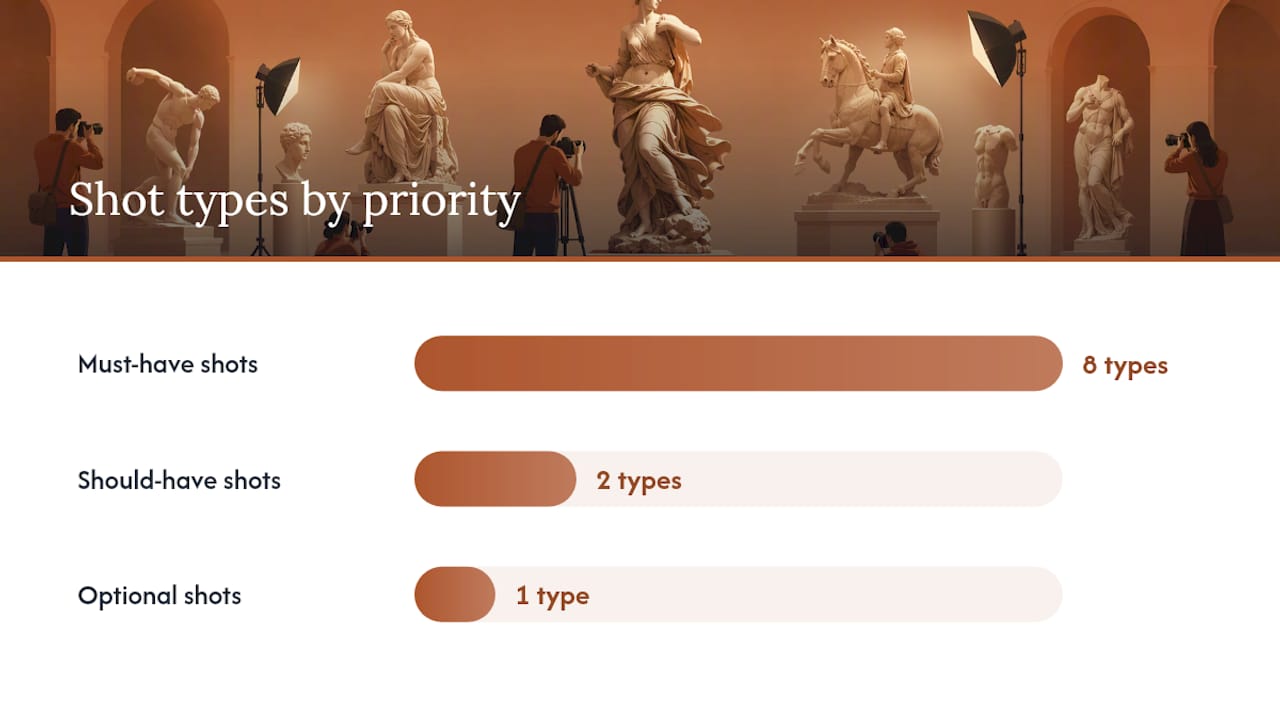
Prises de vue indispensables (obligatoires pour chaque objet) :
- Vue complète de face. Établit la proportion globale, l’iconographie et l’état primaire. Les évaluateurs l’utilisent comme image de référence.
- Vue arrière complète. Révèle les coutures de coulée, les inscriptions secondaires et les réparations invisibles de face.
- Les deux profils latéraux. Afficher la profondeur de la silhouette, l'alignement de la base et les dommages latéraux.
- Vue de dessus/plan. Documente les détails de la couronne, l’état de la coiffure et toute perte de surface sur les plans horizontaux.
- Base/dessous. La vue la plus importante pour l’attribution. Des marques de fonderie, des bouchons de coulée, des cavités de consécration et des timbres de collection apparaissent ici. Pour le contexte du moulage en bronze, consultez le guide de HDAsianArt pour marques de moulage à la cire perdue.
- Deux vues de trois quarts (avant gauche et avant droit). Communiquez une forme tridimensionnelle pour les décisions d'affichage et montrez la profondeur qui manque aux profils plats.
- Gros plans de toutes les marques distinctives. Variations de patine, marques d'outils, jointures, corrosion et réparations historiques. ID d'objet les traite comme des caractéristiques qui rendent un objet individuellement identifiable.
- Plans d’anomalies de condition. Chaque anomalie photographiée avec une référence à l'échelle millimétrique et une note d'angle de lumière.
Plans indispensables (à ajouter lorsque le temps le permet) :
- Détail très clair de la texture de la surface et des marques d'outils.
- Lumière transmise ou axiale pour pierre translucide ou laque.
Facultatif :
- Séquence de photogrammétrie 360° pour objets de grande valeur ou de prêt.
Conseil de pro : Photographiez la base avant de placer l'objet sur la table de tir. Retourner un lourd bronze en cours de séance risque de l’endommager et de perturber votre configuration d’éclairage.
Paramètres et équipements de la caméra qui produisent des résultats de qualité évaluation
Un boîtier sans miroir ou reflex numérique plein format avec une résolution suffisante pour une imagerie détaillée gère la plupart des objets mesurant jusqu'à un mètre de haut avec une résolution suffisante pour un recadrage et une photogrammétrie futurs. Pour les petites sculptures de table, un objectif macro de 60 mm ou 100 mm offre une netteté en champ plat sans la distorsion de perspective introduite par un grand angle. Les statues grandeur nature nécessitent une distance focale de 70 à 105 mm pour conserver des proportions naturelles.
Montez l'appareil photo sur un trépied robuste et utilisez un déclencheur à distance ou une minuterie de deux secondes. Photographiez avec une ouverture optimisée pour la profondeur de champ et un réglage ISO faible pour des fichiers nets, et laissez l'éclairage prendre en charge l'exposition plutôt que de pousser l'ISO. La capture connectée sur un moniteur calibré (via le partage de connexion Capture One ou Lightroom) vous permet de confirmer la mise au point et la couleur avant de passer à la vue suivante.
Filmez en RAW et archivez les originaux RAW à deux endroits avant toute modification. Exportez des fichiers JPEG de haute qualité (qualité 90+, sRGB pour le partage, Adobe RGB pour l'impression) sous forme de copies de travail. Inclure un carte d'étalonnage des couleurs dans la première image de chaque configuration d’éclairage. L'étalonnage du moniteur avec un colorimètre matériel (X-Rite i1Display ou Datacolor Spyder) est requis pour un rendu des couleurs défendable.
Pour les sculptures petites mais profondes, le focus stacking (trois à cinq images à différentes distances de mise au point, fusionnées dans Helicon Focus ou Photoshop) capture toute la surface sans sacrifier la netteté.
Conseil de pro : La capture connectée est l’étape d’assurance qualité la plus rapide disponible. Un problème détecté sur un moniteur calibré pendant le tournage prend quelques secondes à résoudre ; le même problème détecté après le reconditionnement de l'objet coûte une nouvelle prise de vue complète.
Configurations d'éclairage qui fonctionnent sur le bronze, la pierre, le bois et la laque
La base de référence pour toute photographie de documentation est deux sources lumineuses à environ 45° à l'axe de l'objet, éclairage croisé des côtés opposés. Cela élimine la plupart des reflets de surface et produit une couleur uniforme sur l'objet. Utilisez un éclairage diffus sur une grande surface, tel que des panneaux LED ou des sources diffusées par parapluie. Pour la photographie orientée affichage, les principes de conseils d'éclairage d'exposition compléter cette base de documentation.
Ajustements spécifiques au matériau :
- Bronze réfléchissant. Le Directives Getty pour le bronze sont directs : évitez le flash intégré à l'appareil photo et les petites sources proches de l'appareil photo. Utilisez de grands panneaux diffusants placés sur les côtés. La polarisation croisée (un filtre polarisant sur la lentille associé aux feuilles polarisantes sur les lumières) élimine les reflets spéculaires résiduels sur les patines très brillantes.
- Pierre mate. Deux feux à 45° fonctionnent sans modification. Une légère augmentation de la distance entre la lumière et le sujet adoucit toute microtexture qui pourrait être interprétée comme un dommage.
- Laque et bois doré. Réduisez l’intensité lumineuse et augmentez la diffusion. Les surfaces laquées se reflètent comme des miroirs sous certains angles ; faire pivoter légèrement l'objet plutôt que de repositionner les lumières résout souvent un point chaud plus rapidement.
- Lumière rasante. Une seule source directionnelle à faible angle (15° à 20° de la surface) révèle les marques d'outils, les joints de coulée et l'usure de la surface que dissimule un éclairage croisé plat. Par Conseils pour la documentation Getty Bronze, la lumière rasante est la technique standard pour enregistrer la topographie de surface.
Contexte et échelle : Utilisez un fond neutre et non texturé (gris moyen ou blanc, selon la gamme tonale de l'objet). Placez une échelle millimétrique standardisée et un X-Rite ColorChecker ou une carte de couleur équivalente dans au moins un cadre par configuration d'éclairage. Recherchez les points chauds en examinant l'histogramme avant l'archivage.
Comment photographier les caractéristiques distinctives et les détails de l'état
L'identification d'objet nécessite de capturer les caractéristiques précises qui permettent une identification individuelle : défauts de fabrication, variations de patine, réparations historiques et marques d'outils. Pour Identification de la dynastie des sculptures asiatiques, ces micro-détails constituent souvent la principale preuve d’attribution.
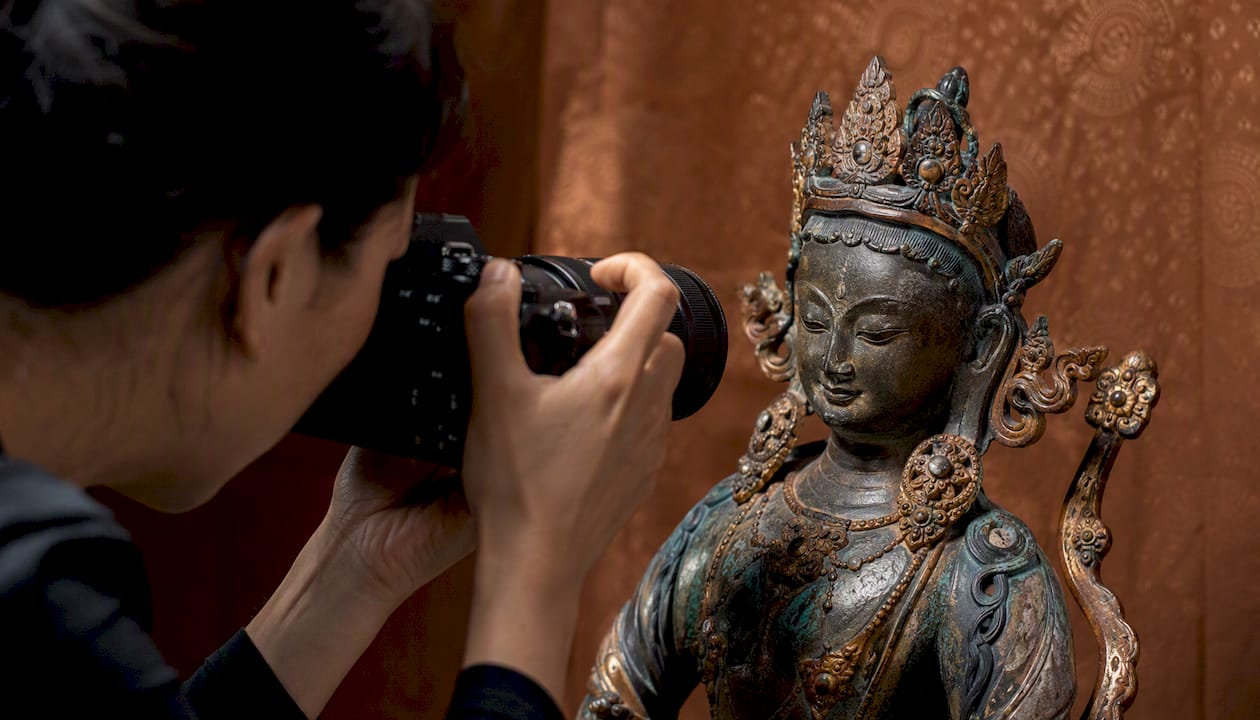
Pour les détails macro, les photos doivent être prises avec un objectif macro approprié à une ouverture appropriée, un petit panneau LED à un angle de coupe et une échelle millimétrique dans le cadre. Normes de documentation sur la conservation nécessitent d'enregistrer l'angle et la direction de la lumière à côté de chaque image afin que la photo puisse être reproduite.
Liste de contrôle des photos d’état :
- Emplacement sur l'objet (par exemple, « avant-bras droit approprié, surface antérieure »)
- Référence d'échelle dans le cadre (règle millimétrique ou barre d'échelle calibrée)
- Angle et direction de la lumière notés dans le nom du fichier ou la légende IPTC
- Paramètres de l'appareil photo enregistrés (ouverture, ISO, focale)
- Superposition d'annotations ou diagramme marquant l'emplacement des dommages sur une image de référence
Modèle de métadonnées pour les photos de condition :
Pour les objets culturellement sensibles ou sacrés, appliquez un minimum de retouches et documentez toutes les modifications dans un journal ; le dossier photographique doit refléter l’état réel de l’objet sans altération esthétique.
Règles de post-traitement, dénomination des fichiers et normes de livraison
Les modifications acceptables sont limitées à : la correction des couleurs à l’aide de la carte de couleurs capturée, les réglages de l’exposition et de la balance des blancs et le recadrage. Aucun clonage, cicatrisation ou toute modification altérant l'état visible ou la patine. Conservez un journal de modifications (exportation de l'historique Lightroom ou un simple fichier texte) à chaque session.
Convention de dénomination des fichiers : [InventoryPrefix]_[ViewCode]_[Date]_[Version] Exemple : CAM2024047_FRONT_20250312_v1.tif
Champs de métadonnées obligatoires (IPTC/XMP) :
Archivez les fichiers RAW à deux emplacements : NAS local et stockage cloud hors site crypté (Backblaze B2 ou équivalent). Générez des sommes de contrôle SHA-256 à la livraison pour vérifier l'intégrité des fichiers. Livrez des fichiers JPEG fonctionnels dans un dossier structuré (/RAW, /JPEG, /ConditionReport) avec un seul ensemble JPEG XMP intégré et un rapport de condition PDF qui l'accompagne.
Assurance qualité rapide à la livraison : confirmez que la carte de couleur apparaît dans au moins une image, qu'un fichier RAW existe pour chaque vue et que tous les champs IPTC obligatoires sont remplis avant d'accepter la livraison.
Comment lier des photos aux enregistrements d'objets et aux rapports de condition
Un flux de travail de catalogage reproductible empêche les images de devenir orphelines de leurs données de provenance.
Liste de contrôle du flux de travail :
- Pré-shooting : étiquetez l'objet avec son numéro d'accession ; confirmer que le dossier existe dans le système de gestion des collections (TMS, Argus ou équivalent).
- Pendant le tournage : utilisez le numéro d'accession comme préfixe du nom de fichier à partir de la première image.
- Immédiatement après : téléchargez les fichiers RAW dans le dossier désigné, exécutez les sommes de contrôle et liez les noms de fichiers à l'enregistrement de l'objet.
- Entrée du rapport de condition : joignez les noms de fichiers d'images aux champs de condition pertinents ; notez la configuration de l'éclairage et l'échelle pour chaque image conformément aux normes de documentation PMG.
- Référence croisée de provenance : reliez les images aux champs de provenance (date d'acquisition, source, collection antérieure). Pour la méthodologie de recherche de provenance, voir HDAsianArt's guide de recherche de provenance.
Pour les prêts et transferts, les rapports de condition doivent être mis à jour à plusieurs étapes (clou à clou) : avant l'emballage, après le déballage sur le lieu de réception et au retour. Chaque étape nécessite son propre décor photographique.
Tenez un journal d'accès enregistrant les images qui ont été utilisées dans les évaluations, les documents de prêt ou les réclamations d'assurance. Lorsqu'un rapport d'état complet n'est pas possible, un rapport d'état avec les huit vues indispensables et les métadonnées intégrées est acceptable dans des délais serrés.
Quand faire appel à un photographe spécialisé
Embauchez un spécialiste lorsque l'un des cas suivants s'applique : la valeur de l'objet dépasse les seuils d'assurance nécessitant une documentation indépendante, la sensibilité culturelle ou le statut sacré exige une surveillance éthique de la conservation, la photogrammétrie ou l'imagerie par transformation par réflectance (RTI) est requise, une intervention de conservation est prévue ou les images seront utilisées dans des procédures judiciaires.
Liste de contrôle pour l'externalisation :
- Livrables : originaux RAW, exportations JPEG vérifiées, métadonnées XMP intégrées, rapport de condition au format PDF, déclaration de chaîne de traçabilité signée et preuve d'assurance responsabilité professionnelle.
- Qualifications : expérience en photographie de musée ou de conservation, familiarité avec les normes Object ID et PMG et références vérifiables d'institutions.
- Photogrammétrie/RTI : confirmez que le photographe a produit des livrables acceptés par un musée ou un laboratoire de conservation, et pas seulement des scans 3D grand public. Les directives de Getty notent que la photogrammétrie nécessite une photographie soigneusement contrôlée pour des couleurs et une géométrie précises.
- Minimums SLA : délai d'exécution de cinq à dix jours ouvrables pour un ensemble standard de dix vues ; plus long pour la photogrammétrie. Les fourchettes de coûts varient considérablement selon le marché, la taille de l'objet et les services requis ; demander des devis détaillés à au moins deux fournisseurs.
À la réception, vérifiez : la carte de couleur présente, la somme de contrôle des fichiers RAW, tous les champs IPTC renseignés, les noms de fichiers d'images de référence du rapport de condition et le document de chaîne de traçabilité signé.
Pourquoi les normes de documentation sont importantes : un point de vue de HDAsianArt
L’échec le plus courant dans la photographie de collection privée n’est pas technique. C'est l'absence du coup de base. Un collectionneur photographie un Vishnu cambodgien en bronze sous tous les angles sauf le dessous, puis découvre des années plus tard que le bouchon de coulée et la cavité de consécration sont la principale preuve de son attribution. Les images existent ; ce n’est pas le cas des preuves.
Chaque objet du catalogue HDAsianArt est photographié selon les normes de ce guide avant d'être répertorié. Cela signifie des prises de vue de base, des détails en lumière rasante, une carte de couleurs dans le cadre et des métadonnées intégrées reliant l'image au rapport de condition. Lorsqu'un acheteur à New York demande l'ensemble d'images complet pour une évaluation à distance, les fichiers sont prêts. Lorsqu'un assureur demande un enregistrement de l'état avant expédition, la documentation photographique clou à clou est conservée.
Le Conseils pour signaler l'état de Te Papa nécessite des superpositions photographiques et des dimensions précises à côté des images. L’application de cette norme à chaque annonce ne représente pas une surcharge ; c'est la différence entre un litige de provenance et un transfert net de titre.
Les objets HDAsianArt sont pré-documentés selon ces normes
Chaque pièce répertoriée sur HDAsiatiqueArt arrive avec des photographies de qualité muséale : l'ensemble complet de dix vues, des prises de vue détaillées en lumière rasante, un cadre calibré en couleurs et des métadonnées intégrées. Les acheteurs peuvent demander l’ensemble complet d’images RAW, le rapport de condition PDF et le dossier de chaîne de traçabilité avant l’achat.
Lorsque vous contactez un revendeur, demandez ces quatre éléments : des fichiers RAW avec des métadonnées XMP intégrées, un rapport de condition PDF référençant chaque image par nom de fichier, une déclaration de chaîne de traçabilité et une confirmation de l'expédition assurée. HDAsianArt fournit les quatre en standard. Parcourez le catalogue ou envoyez une demande pour demander une documentation complète pour tout objet répertorié.
Sources
- ID d'objet (Getty Publications)
- Meilleure configuration de photographie d'art pour la documentation de collection - ArtVault Pro
- Lignes directrices pour l'examen technique de la sculpture en bronze | Photographie et autres techniques d'imagerie pour la visualisation d'une sculpture (Getty)
- Examen et documentation PMG - Conservation Wiki
- Rapport de condition Cristina Resti ARTE Generali 2024
- Rapport de condition - Te Papa (guide du musée)
Recommandé
- Guide d’identification de la dynastie des sculptures asiatiques pour les collectionneurs – HD Asian Art
- L’art symbolique pour une vie en pleine conscience : un guide pour les collectionneurs – HD Asian Art
- Le rôle de la sculpture faite à la main dans la création d’un intérieur plein d’âme – HD Asian Art
- Comment conserver une sculpture bouddhiste en pierre antique en toute sécurité – HD Asian Art
