



Mudras dans l’art bouddhiste : significations et gestes sacrés de la main
Mudras dans l’art bouddhiste : significations et gestes sacrés de la main
Les gestes de la main connus sous le nom de mudras représentent l’un des éléments les plus visuellement reconnaissables de l’art bouddhiste et des traditions de méditation. Chaque geste incarne de profonds enseignements spirituels et des états d’illumination raffinés au fil des siècles.
Table des matières
-
Types de gestes de la main de Bouddha : les sept mudras primaires
- Dharmachakra Mudra : Tourner la roue du Dharma
- Abhaya Mudra : Le geste de l'intrépidité
- Bhumisparsha Mudra : toucher à la Terre et illumination
- Dhyana Mudra : méditation profonde et pratique spirituelle
- Varada Mudra : Compassion et dons de bienfaisance
- Vitarka Mudra : Enseignement et discussion sacrée
Que sont les mudras ? Définition et symbolisme sacré
Un mudra est un geste symbolique de la main utilisé dans la pratique spirituelle et l'iconographie bouddhistes et hindoues. Le mot sanscrit suggère un geste qui éveille la conscience spirituelle. Les mudras fonctionnent comme des incarnations du dharma, des enseignements bouddhistes sur la réalité et sur le chemin de l'illumination. Chaque placement de doigt a une signification distincte, le positionnement des mains, des doigts et des pouces indique si une figure représente l'enseignement, la méditation, l'intrépidité ou la compassion.
Origines du sanskrit et signification iconographique
Le terme sanskrit « mudra » apparaît dans les anciens textes bouddhistes, en particulier dans les traditions Mahayana et Vajrayana où la pratique rituelle est mise en avant. L'iconographie s'appuie fortement sur les mudras comme langage visuel. Un artiste bouddhiste pourrait transmettre des concepts théologiques complexes uniquement par le positionnement des mains, permettant ainsi aux enseignements de se propager à travers différentes cultures et langues sans de longues explications textuelles.
Le symbolisme Mudra s'est développé parallèlement à la philosophie bouddhiste elle-même. Les premiers bouddhismes Theravada mettaient l'accent sur les enseignements du Bouddha historique, tandis que les traditions Mahayana ultérieures introduisirent plusieurs bouddhas et bodhisattvas, chacun développant des mudras associés reflétant leur rôle spirituel particulier.
Mudras comme incarnation du Dharma et de l'Illumination
Le Dharma, les enseignements bouddhistes sur la souffrance et le chemin vers la libération, s'incarne dans la pratique à travers les mudras. Lorsqu'un pratiquant exécute un mudra pendant la méditation, il active l'état spirituel que représente le mudra. Une statue affichant un mudra particulier devient un outil pédagogique, un rappel visuel de l'accomplissement spirituel qu'elle représente.
Le rôle des mudras dans l’iconographie bouddhiste et l’histoire de l’art
Les mudras servent d'identifiants visuels dans l'art bouddhiste, tout comme les attributs de l'iconographie chrétienne identifient des saints spécifiques. Un spectateur formé peut reconnaître un Bodhisattva ou un Bouddha spécifique grâce au mudra affiché, même sans inscriptions. Les significations des Mudra ont évolué à mesure que le bouddhisme se propageait Indie à travers l'Asie centrale, le Tibet, Chine, Asie du Sud-Est et Japon, chaque région adaptant ses traditions tout en conservant les significations symboliques essentielles.
Positions des mains dans les statues de Bouddha à travers les traditions
Les statues de Bouddha affichent une cohérence remarquable dans la représentation des mudra à travers les traditions, tout en présentant des variations régionales distinctives dans le style artistique. Dans le bouddhisme Theravada, qui prédomine en Asie du Sud-Est, les statues de Bouddha présentent généralement des mudras associés à la vie historique du Bouddha. Le Bhumisparsha mudra, le geste touchant la terre, apparaît fréquemment car il fait référence au moment d'illumination du Bouddha.
Le bouddhisme Mahayana a développé des systèmes iconographiques plus élaborés dans lesquels chaque bodhisattva possède des mudras distinctifs. Une statue peut montrer une main dans le mudra Varada tandis que l'autre affiche un geste différent, créant des déclarations symboliques complexes illustrant des enseignements spirituels nuancés.
Mudras dans le bouddhisme Mahayana, Theravada et Vajrayana
Les trois principales branches bouddhistes ont chacune développé des approches distinctes des mudras tout en conservant des significations symboliques fondamentales. Le bouddhisme Theravada se concentre sur le Bouddha historique et l'illumination individuelle, avec des mudras directement liés aux événements de la vie du Bouddha. Le bouddhisme Mahayana met l'accent sur les bouddhas multiples et l'illumination pour tous les êtres, les mudras représentant des principes spirituels abstraits plutôt que de simples événements historiques.
Le bouddhisme Vajrayana, développé au Tibet, intègre des pratiques tantriques dans lesquelles les mudras prennent des significations supplémentaires. Le positionnement précis des doigts dirige des flux d’énergie subtils à travers le corps, faisant de la pratique du mudra une forme d’alchimie interne.
Types de gestes de la main de Bouddha : les sept mudras primaires
Sept mudras apparaissent le plus fréquemment dans les traditions bouddhistes et représentent le cœur du langage iconographique bouddhiste.
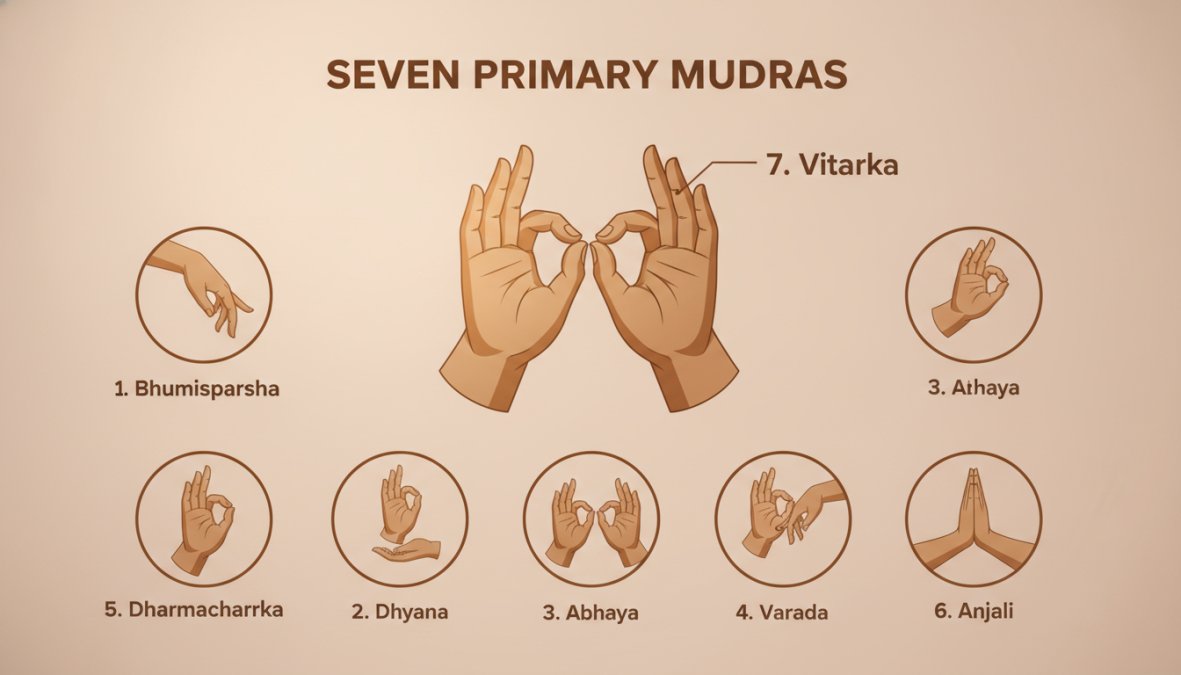
| Nom Mudra | Position des mains | Signification primaire | Bouddha/Bodhisattva associé |
|---|---|---|---|
| Dharmachakra | Les deux mains sur la poitrine, les doigts formant des cercles | Enseignement, transmission du Dharma | Bouddha Shakyamuni |
| Abhaya | Une ou les deux mains levées, paume vers l'avant | Protection, intrépidité, réconfort | Divers bouddhas et bodhisattvas |
| Bhumisparsha | Main droite touchant le sol, gauche sur les genoux | Lumières, témoignage de la terre | Bouddha Shakyamuni à l'illumination |
| Dhyana | Les deux mains sur les genoux, droite devant gauche | Méditation, contemplation, paix intérieure | Bouddha Amitabha |
| Varada | Main tendue vers le bas, paume ouverte | Compassion, don, réalisation de souhaits | Avalokiteshvara, d'autres figures compatissantes |
| Vitarka | Main levée avec le pouce et l'index touchant | Enseignement, discussion, transmission intellectuelle | Bouddha dans les moments d'enseignement |
| Anjali | Les deux paumes pressées l'une contre l'autre | Révérence, salutation, respect | Pratiquants, fidèles |
Dharmachakra Mudra : Tourner la roue du Dharma
Le Dharmachakra mudra représente le premier enseignement du Bouddha après l’illumination. Les deux mains sont tenues au niveau de la poitrine, le pouce et l'index de chaque main formant des cercles tandis que les doigts restants s'étendent vers le haut. Les cercles représentent la roue du dharma symbolisant les enseignements du Bouddha qui avancent au bénéfice de tous les êtres. Chaque statue de Bouddha affichant ce mudra fait référence à ce moment charnière et invoque le pouvoir des enseignements bouddhistes pour transformer la conscience.
Abhaya Mudra : Le geste de l'intrépidité
L'Abhaya mudra montre une main levée à hauteur d'épaule avec la paume tournée vers l'avant et les doigts étendus vers le haut. Ce geste communique la protection, le réconfort et l’absence de peur. Dans l'enseignement bouddhiste, l'Abhaya mudra représente l'intrépidité intérieure qui découle de la compréhension de la vraie nature de la réalité. De nombreux Bodhisattvas affichent ce mudra car leur fonction est de rassurer les êtres souffrants sur le fait que la libération est possible.
Bhumisparsha Mudra : toucher à la Terre et illumination
Le mudra Bhumisparsha montre la main droite étendue vers le bas avec les doigts pointés vers la terre, tandis que la main gauche repose sur les genoux. Selon les textes bouddhistes, lorsque le Bouddha était assis en méditation sous l'arbre Bodhi, il fut défié par Mara, représentant l'ignorance et l'illusion. Le Bouddha a touché la terre et l'a prise à témoin de son illumination, symbolisant que l'illumination n'est pas subjective mais une transformation objective vérifiée par la réalité elle-même.
Dhyana Mudra : méditation profonde et pratique spirituelle
Le Dhyana mudra montre les deux mains posées sur les genoux, la main droite placée sur la gauche, les paumes tournées vers le haut. Ce geste représente les états les plus profonds d’absorption méditative et de paix intérieure. Ce mudra est le plus étroitement associé au Bouddha Amitabha, le Bouddha de la Lumière et de la Compassion infinies, au cœur du bouddhisme de la Terre Pure.
Varada Mudra : Compassion et dons de bienfaisance
Le mudra Varada affiche une main tendue vers le bas, la paume ouverte et les doigts pointés vers le sol. Le geste signifie « donner une bénédiction » ou « exaucer un souhait », représentant l'engagement du Bouddha ou du Bodhisattva à satisfaire les besoins de tous les êtres. Avalokiteshvara, le Bodhisattva de la compassion, affiche fréquemment le mudra Varada parce que la compassion s'exprime naturellement par le don.
Vitarka Mudra : Enseignement et discussion sacrée
Le Vitarka mudra montre une ou les deux mains levées avec le pouce et l'index se touchant pour former un cercle tandis que les trois doigts restants s'étendent vers le haut. Ce geste représente la transmission intellectuelle, le débat et la discussion des enseignements bouddhistes. Le cercle formé par le pouce et l’index fait écho à la roue du dharma, suggérant que l’enseignement se fait par la circulation des idées.
Importance des mudras dans les statues : énergie spirituelle et rituel
De nombreux pratiquants bouddhistes croient que les mudras des statues rayonnent d'énergie spirituelle et influencent la conscience de ceux qui les regardent. Cela reflète un principe bouddhiste fondamental : les formes externes et la conscience interne ne sont pas séparées mais intimement liées. On pense qu’une statue affichant un mudra particulier transmet l’état spirituel que représente le mudra.
Flux d'énergie et processus internes
Dans la philosophie bouddhiste, en particulier dans les traditions Vajrayana, le corps est compris comme un réseau de canaux énergétiques à travers lesquels circulent des forces vitales subtiles. On pense que les mudras dirigent et régulent ce flux d’énergie. Le positionnement spécifique des doigts et des mains crée des configurations énergétiques affectant le corps subtil, la dimension non physique de la conscience et de la vitalité humaines.
Mudras comme sceaux sacrés et objets rituels
Dans les rituels et la pratique bouddhistes, les mudras fonctionnent comme des sceaux sacrés authentifiant la pratique spirituelle. Lorsqu'un pratiquant exécute un mudra pendant la méditation ou la prière, il scelle son intention et son engagement. Dans le bouddhisme Vajrayana, les mudras sont incorporés dans des séquences rituelles complexes où le positionnement précis des mains est censé invoquer des divinités ou des forces spirituelles spécifiques.
Variations stylistiques régionales dans la représentation Mudra
Bien que les significations fondamentales du mudra restent cohérentes dans les traditions bouddhistes, la représentation artistique varie considérablement selon les régions. Ces variations reflètent des adaptations aux styles artistiques, aux matériaux et aux préférences esthétiques locales plutôt que des changements dans la signification spirituelle.
Bouddhisme tibétain et placement des doigts Vajrayana
L'art bouddhiste tibétain présente des mudras avec une précision et une complexité particulières. Dans les statues et peintures tibétaines, les deux mains s'engagent fréquemment simultanément dans les mudras, créant des configurations de mains complexes représentant l'union de différents principes spirituels. La fonte du bronze, principal médium du Tibétain Statues bouddhistes, permet des détails fins dans le positionnement des doigts.
Interprétations artistiques d’Asie du Sud-Est et khmères
L'art bouddhiste d'Asie du Sud-Est, en particulier en Thaïlande, Cambodge, et Laos, développé des approches distinctives reflétant les traditions Theravada et l’esthétique locale. Les statues de Bouddha d'Asie du Sud-Est affichent généralement des mudras plus simples et plus naturalistes par rapport aux configurations tibétaines élaborées. Les sculpteurs khmers ont atteint un équilibre remarquable entre précision spirituelle et grâce artistique.
Conventions Mudra Zen et Bouddhiste Japonais
L'art bouddhiste japonais, en particulier dans les traditions zen, a développé des approches distinctives mettant l'accent sur la simplicité et la franchise. Les statues japonaises affichent souvent des mudras avec calme et retenue, reflétant l'accent mis par le Zen sur l'expérience directe plutôt que sur la compréhension conceptuelle. Les artistes japonais représentent souvent le Dhyana mudra avec une sensibilité particulière, montrant le calme paisible résultant d'une pratique méditative profonde.
Interprétation psychologique moderne de la pratique du Mudra
La psychologie et les neurosciences contemporaines ont commencé à étudier les effets de la pratique du mudra sur la conscience et le bien-être. Des études sur la cognition incarnée suggèrent que des positions spécifiques des mains peuvent activer des schémas neuronaux et des réponses émotionnelles particuliers. Lorsqu'une personne assume un mudra associé à la confiance ou à la compassion, son cerveau peut évoluer vers l'état mental que représente le mudra.
De nombreux praticiens de la méditation contemporains intègrent la pratique des mudra dans leurs routines, utilisant les mudras comme outils pour orienter la conscience vers des états mentaux spécifiques.
Conclusion : honorer les gestes sacrés dans votre espace spirituel
Comprendre les significations des mudra dans l’art bouddhiste transforme votre relation avec les statues et les œuvres d’art bouddhistes. Chaque mudra communique des principes spirituels spécifiques et invite les pratiquants à reconnaître et à cultiver ces qualités en eux-mêmes. Lorsque vous sélectionnez une statue de Bouddha ou de Bodhisattva pour votre espace de méditation, le mudra affiché doit résonner avec votre pratique et vos aspirations spirituelles actuelles.
Foire aux questions
Quels sont les différents types de mudras dans l’art bouddhiste ?
Les sept mudras principaux de l'art bouddhiste comprennent Dharmachakra (enseignement du dharma), Abhaya (intrépidité), Bhumisparsha (toucher la terre), Dhyana (méditation), Varada (compassion), Vitarka (discussion) et Anjali (révérence). Chaque position de la main a une signification spirituelle distincte et apparaît dans les statues de Bouddha des traditions Mahayana, Theravada et Vajrayana. Des variations régionales existent, notamment dans le bouddhisme tibétain et l'iconographie de l'Asie du Sud-Est.
Pourquoi les gestes de la main sont-ils importants dans l’iconographie et le symbolisme bouddhiste ?
Les gestes de la main, ou mudras, servent de sceaux visuels qui communiquent des états spirituels et des enseignements sans paroles. Dans l’art bouddhiste, ils incarnent des processus internes d’illumination et de pratique du dharma. Les mudras fonctionnent comme des objets rituels qui guident la méditation et le flux d’énergie, rendant tangibles les concepts spirituels abstraits. Ils sont essentiels à l'iconographie bouddhiste car ils permettent aux spectateurs de reconnaître instantanément le rôle d'enseignant, l'état de méditation ou la nature compatissante d'un Bouddha grâce au seul placement des doigts.
Que symbolise l'Abhaya mudra dans les statues bouddhistes ?
L'Abhaya mudra, ou « geste d'intrépidité », représente une ou les deux mains levées, les paumes tournées vers l'extérieur et les doigts tendus vers le haut. Cette position des mains symbolise la protection, le réconfort et la suppression de la peur. Dans l'art bouddhiste, il représente la compassion du Bouddha envers les êtres souffrants et la promesse de sécurité sur le chemin spirituel. Ce mudra est largement utilisé dans toutes les traditions bouddhistes et apparaît fréquemment dans les sculptures de Bouddha khmères et d’Asie du Sud-Est, ce qui en fait l’un des gestes sacrés les plus reconnaissables.
Comment les mudras peuvent-ils aider à approfondir la pratique de la méditation et la compréhension spirituelle ?
Les mudras servent d'incarnations du dharma qui soutiennent les états de méditation en dirigeant le flux d'énergie à travers des placements spécifiques des doigts. Lors de la pratique des mudras, les positions des mains créent des processus internes qui correspondent à différents niveaux d’illumination et de conscience. Le Dhyana mudra, par exemple, approfondit la concentration méditative, tandis que le Vitarka mudra facilite l'enseignement et la discussion. L'utilisation des mudras pendant la pratique spirituelle aide les praticiens à aligner leur geste physique avec leur intention mentale, créant ainsi un pont entre la forme extérieure et la transformation intérieure.
