



Khmer Sculpture: Why Collectors Prize Cambodian Art
Khmer Sculpture: Why Collectors Prize Cambodian Art
Few traditions in world art history command the reverence that Khmer sculpture does among serious collectors. These works, produced across more than six centuries of Cambodian civilisation, represent a fusion of Buddhist and Hindu iconography so refined that major museum curators and private collectors have competed fiercely to acquire them.
Yet that very demand has also fuelled an illicit trade that continues to taint the market today, making provenance knowledge not just an ethical concern but a practical necessity for any collector. Whether you are drawn to the serene faces of Cambodian Buddhist art or the dynamically carved figures of Cambodian Hindu sculpture, understanding what defines quality, authenticity, and legitimacy in this field is the difference between building a meaningful collection and making an expensive mistake.
Table of Contents
- Quick Takeaways
- What Is Khmer Sculpture and Where Does It Come From?
- Why Collectors Prize Khmer Works Above Most Asian Art
- Buddhist and Hindu Iconography in Cambodian Sculpture
- Angkor Art and Its Regional Styles
- How to Assess Quality and Authenticity
- Provenance: The Non-Negotiable Issue for Modern Collectors
- Comparing Collecting Approaches: Ancient Originals, Attributed Reproductions, and Museum-Quality New Casts
- Building a Collection with Integrity
- Frequently Asked Questions
- References
Quick Takeaways
|
Key Insight |
Explanation |
|---|---|
|
Khmer sculpture spans over six centuries |
Cambodian stone carving developed distinct regional and dynastic styles from roughly the 6th to the 15th centuries, meaning period and style identification matters as much as subject matter. |
|
Both Buddhism and Hinduism are represented |
Khmer rulers alternated royal patronage between Shaivite Hinduism, Vaishnavism, and Mahayana Buddhism, producing a uniquely layered iconographic tradition not found elsewhere in Southeast Asia. |
|
Stone type and carving technique are primary quality indicators |
Authentic Khmer work was predominantly carved from sandstone or, in rarer pieces, schist. The finish of the face, the depth of the relief, and the treatment of jewellery details are direct indicators of workshop quality. |
|
Provenance documentation is now a legal and ethical requirement |
Investigations into the trade in looted Cambodian antiquities, including those connected to dealers who supplied major Western institutions, have made clear that an undocumented piece is a liability, not an asset. |
|
Museum-quality reproductions serve a legitimate collecting purpose |
Ethically produced, high-quality reproductions allow collectors and spiritual practitioners to engage with Khmer iconography without participating in the problematic trade in looted originals. |
|
The serene Khmer face is iconographically intentional |
The characteristic half-smile, downcast eyes, and broad flat nose of Khmer figures are not generic stylistic choices. They reflect a specific theology of meditative equanimity and divine impassivity. |
|
Regional style variation affects value and identification |
Works attributed to the Bayon, Baphuon, or Banteay Srei periods each carry distinct stylistic fingerprints. Collectors who can read these differences are better positioned to assess both authenticity and significance. |
What Is Khmer Sculpture and Where Does It Come From?
Khmer sculpture refers to the stone and, to a lesser extent, bronze figurative work produced by the Khmer Empire, which at its height controlled much of mainland Southeast Asia from its capital in what is now Siem Reap province, Cambodia. The empire's monumental religious architecture, most famously Angkor Wat, was inseparable from its sculptural tradition: temples were conceived as three-dimensional cosmological maps, and the sculptures that filled them were active participants in ritual, not mere decoration.
The production of this art was not confined to a single period or a single faith. Khmer sculpture evolved across several distinct stylistic eras, from the pre-Angkorean Phnom Da and Sambor Prei Kuk styles through the classical Angkor Wat and Bayon periods and into the post-Angkorean Buddhist tradition. Each era carried its own technical priorities and iconographic emphases, which is why a trained eye can distinguish a 10th-century Baphuon-style torso from a 12th-century Bayon-period head without needing an inscription to confirm the date.
The temples at Koh Ker, a 10th-century complex in northwest Cambodia, produced some of the most powerful Khmer figures known to scholarship, including large-scale warrior and deity figures that commanded seven-figure prices when they appeared on the Western market. Their removal from those temple sites, which occurred through organised looting operations, became the subject of significant legal and journalistic investigation. That history is now embedded in how collectors must think about any work attributed to this tradition.
Why Collectors Prize Khmer Works Above Most Asian Art
The appeal of Cambodian Buddhist art and Cambodian Hindu sculpture to serious collectors is not simply a matter of aesthetic taste. It is rooted in a combination of art-historical rarity, technical mastery, and iconographic sophistication that has no direct parallel in other Asian traditions.
Formal Beauty Achieved Through Severe Stylisation
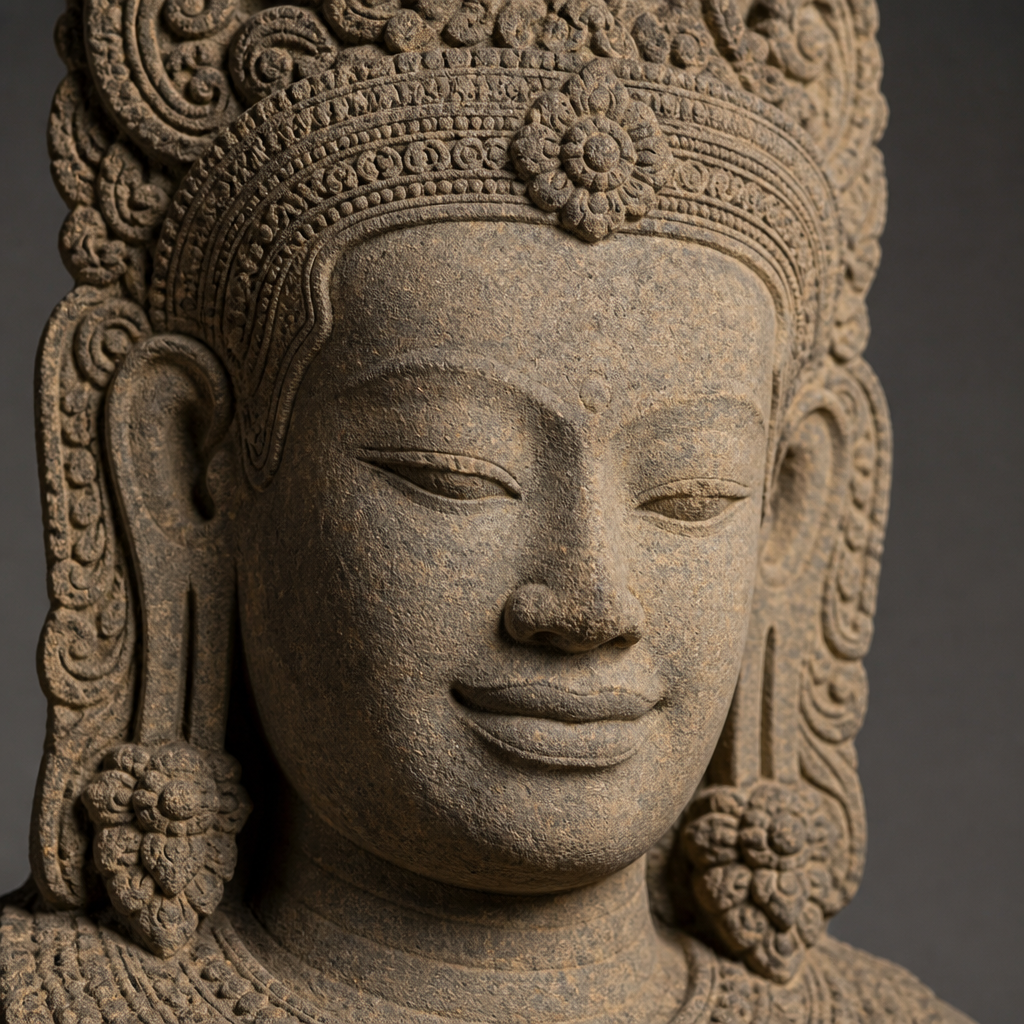
Khmer sculptors developed a formal language of extreme refinement. The human body is rendered with anatomical accuracy but pushed toward an ideal: broad shoulders tapering to a narrow waist, limbs of perfect proportion, surfaces polished to a smoothness that catches light differently from any other stone-carving tradition. The faces, with their characteristic broad foreheads, arched brows, and the famous Khmer smile, carry an expression that reads simultaneously as serene and deeply alert. This is not a generic aesthetic. It took centuries of workshop tradition to produce, and it is immediately recognisable to anyone who has studied it.
The Rarity Factor in the Open Market
Authentic period Khmer sculpture of any significant quality is genuinely rare. The Cambodian government, working with international partners, has successfully repatriated a number of major works from Western institutions, and international law has made the open sale of unprovenanced Cambodian antiquities increasingly difficult. This combination of legal pressure and ethical scrutiny means that the supply of legitimately available period pieces is contracting, which intensifies collector interest in what does appear on the documented market.
The illicit trade in Cambodian sculptures endures for one reason: demand from buyers willing to pay seven-figure prices for works taken from temple sites. Understanding that dynamic is the first responsibility of any serious collector entering this field.
Buddhist and Hindu Iconography in Cambodian Sculpture
One of the features that makes the Khmer tradition genuinely unusual is that its sculptural output encompasses both major South and Southeast Asian religious traditions with equal fluency. Unlike Japan, where Buddhist iconography dominates the classical sculptural canon, or medieval India, where regional traditions tend to emphasise one faith, Cambodian Hindu sculpture and Buddhist sculpture were produced simultaneously, often within the same temple complexes, by workshops that clearly understood both traditions from the inside.
The Hindu Deities of the Khmer Empire
Shiva was the dominant deity of the early Khmer royal cult, and figures associated with him, including Nandin (his sacred bull), Mahishasuramardini (Durga slaying the buffalo demon), and the linga, appear extensively in Khmer temple sculpture. Vishnu was also prominently represented, often in his cosmic form reclining on the serpent Ananta, and in the avatars Rama and Krishna. The Koh Ker site mentioned in published accounts of the antiquities trade produced warrior figures identified with characters from Hindu epic literature, including what appears to be a representation of Bhima from the Mahabharata.
Buddhist Iconography and the Transition to Theravada
From the Bayon period onward, Mahayana Buddhist iconography became increasingly central to Khmer royal patronage. The face of the Bodhisattva Avalokiteshvara, often identified with the king himself in Bayon-period sculpture, appears on the towers of the Bayon temple in a form that blends royal portraiture with divine iconography in a way that has no parallel elsewhere in Buddhist art. Following the eventual decline of the Khmer Empire and the adoption of Theravada Buddhism, the sculptural tradition shifted toward the production of Buddha images in a more standardised Southeast Asian idiom, which is the tradition most directly continuous with contemporary Cambodian Buddhist practice.
Pro tip: When examining a Khmer-style Buddhist figure, look at the ushnisha (the cranial protuberance above the head). In genuinely Khmer work, it tends to be rendered as a tight flame or conical form, distinct from the more rounded ushnisha seen in Thai or Sri Lankan traditions. This single detail can help you place a figure within its correct regional context before you examine anything else.
Angkor Art and Its Regional Styles
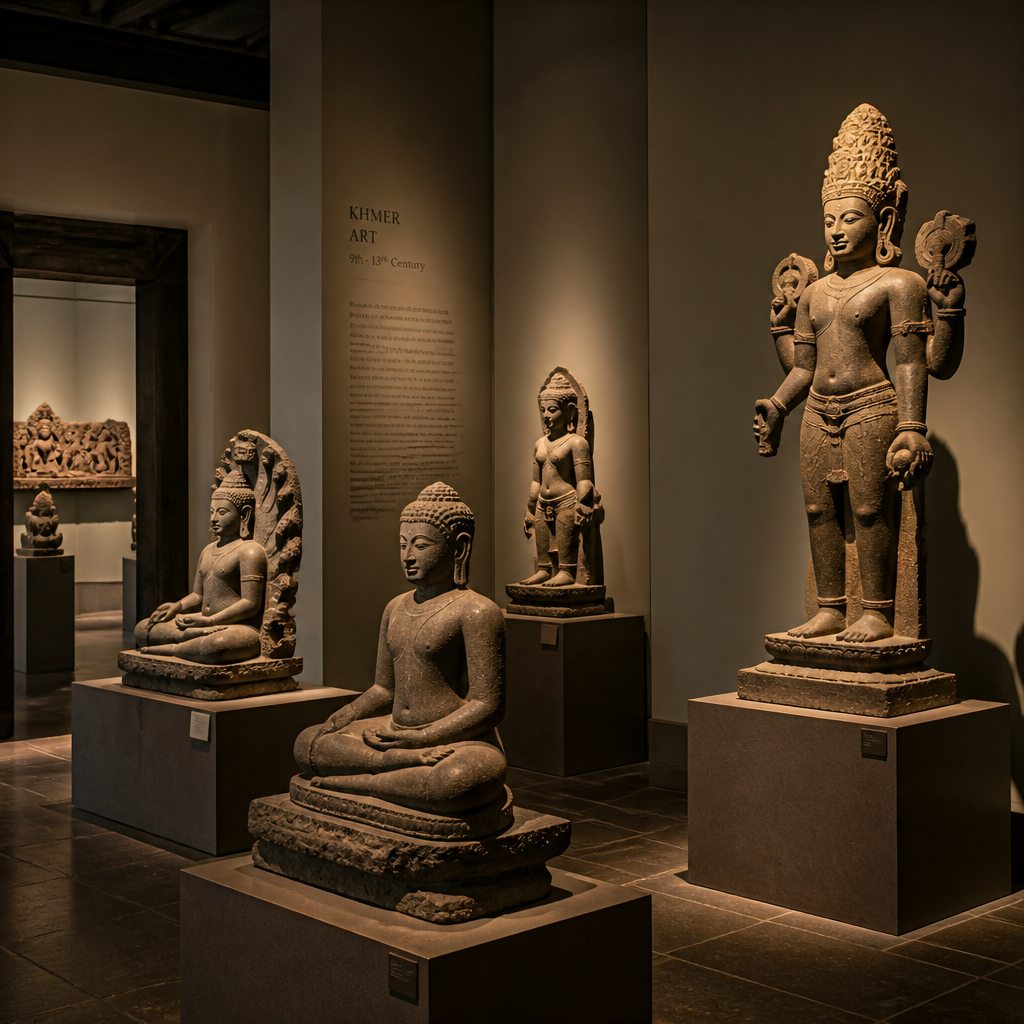
Angkor art is not a monolithic category. Scholars and curators divide Khmer sculpture into named periods, each associated with specific architectural complexes and carrying distinct stylistic characteristics. For collectors, learning to read these differences is fundamental.
Baphuon Style (mid-11th century)
Baphuon-period figures are notable for their rounded, almost fleshy modelling. The bodies have a warmth and sensuality that differs from the more austere classicism of later periods. Faces tend to show a more naturalistic treatment of features, with lips that carry a subtle fullness. These are among the most approachable of classical Khmer works and have been particularly sought by collectors who respond to their human quality.
Angkor Wat Style (first half of the 12th century)
The Angkor Wat period produces the most recognisably classical Khmer forms. Figures are taller and more elongated, with elaborate costumes and jewellery rendered in precise detail. The treatment of samput (the skirt worn by both male and female figures) is one of the key diagnostic features of this period: the fabric folds, the arrangement of the central panel, and the way the hem falls all vary systematically between stylistic periods and provide reliable dating evidence.
Bayon Style (late 12th to early 13th century)
Bayon-period sculpture is the most immediately distinctive. Faces show the characteristic broad smile associated with the Khmer tradition in popular perception, and the overall treatment of figures tends toward a gentle softening of contour. This is also the period most associated with Mahayana Buddhist iconography and with the synthesis of royal and divine imagery that makes Khmer art so historically complex.
How to Assess Quality and Authenticity
The question of quality in Khmer sculpture is not subjective once you know what to look for. There are specific technical and iconographic benchmarks that distinguish serious work from inferior copies or later provincial imitations.
Stone and Surface
Authentic Khmer sculpture was almost exclusively carved from sandstone sourced from the Kulen Hills north of Angkor. The stone has a particular warm grey-brown colour and a grain structure that is visible under close examination. The surface of high-quality Khmer work is polished to a consistency that takes considerable skill to achieve, and the transition between polished areas and relief-carved ornamental detail is executed without the tool marks or hesitation lines that characterise inferior workshop production.
Facial Treatment as the Primary Quality Indicator
In practice, the face of a Khmer figure is where quality differences become most apparent. The brow arc, the handling of the eyelids, the depth and curvature of the lips, and the modelling of the philtrum all require a level of carver skill that takes years to develop. A common mistake among new collectors is to focus on the overall silhouette and miss the face's technical execution. An impressive bodily form with a poorly executed face almost certainly indicates a later copy or provincial work.
Pro tip: Examine how the jewellery and ornamental detail connects to the body surface beneath it. In genuinely skilled Khmer work, the jewellery sits convincingly on the skin, with visible spatial differentiation between the ornament and the body. In lower-quality reproductions, ornamental detail tends to merge with the body surface in a way that looks flat and unconvincing from any angle other than straight on.
Provenance: The Non-Negotiable Issue for Modern Collectors
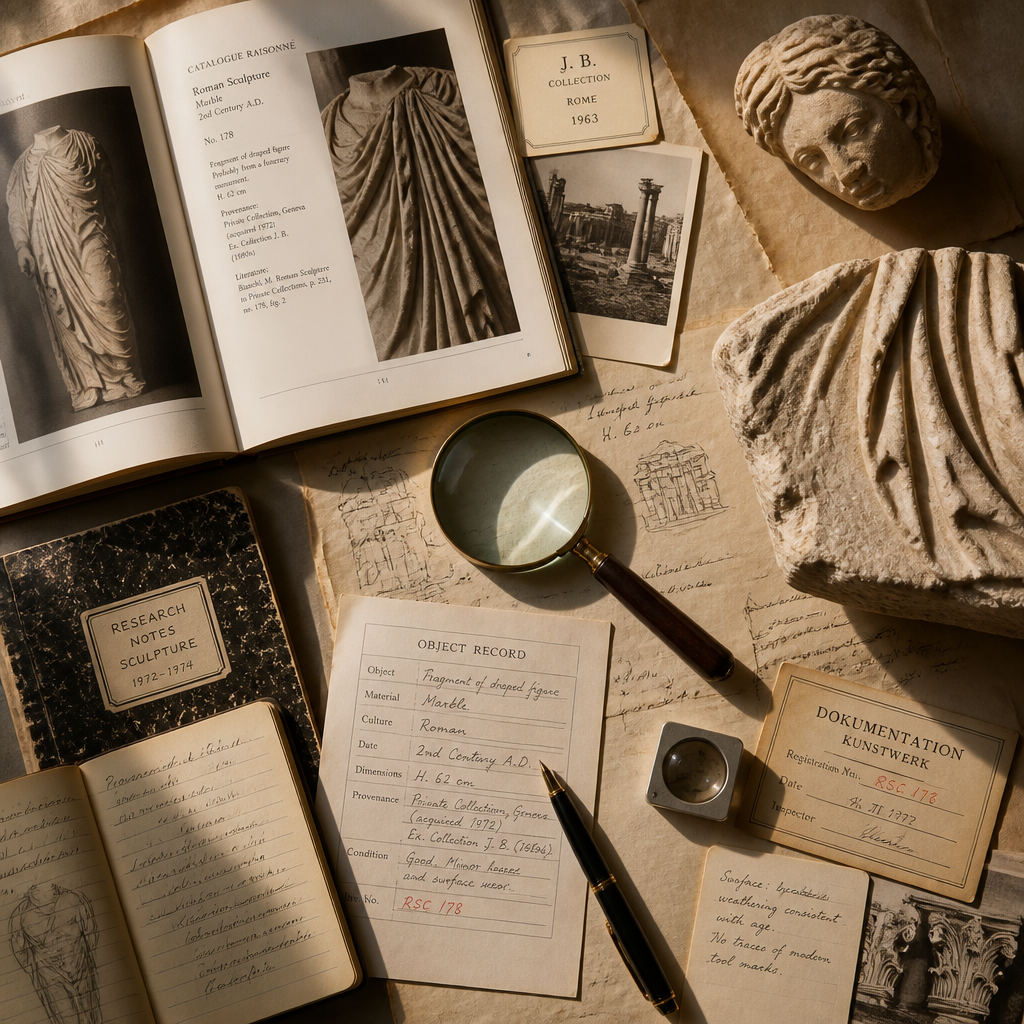
The history of Khmer sculpture in the Western market cannot be separated from the history of organised looting. Published investigations have documented how temple sites across Cambodia were systematically stripped of their sculptural programmes, particularly during and after the decades of conflict that devastated the country. Works removed from sites like Koh Ker entered the market through networks of dealers and brokers, and some of these works reached the collections of major Western institutions before those institutions fully understood the provenance problems involved.
Two significant Koh Ker figures were subsequently returned to Cambodia following investigations connected to the late British dealer Douglas Latchford, who was alleged to have trafficked stolen Cambodian sculptures to Western buyers over many decades. The repatriation of these works from institutions including the Metropolitan Museum of Art demonstrates that provenance risk is not abstract: it can result in loss of the work itself, regardless of how much was paid for it.
For collectors today, this history has a direct practical implication. Any period Khmer sculpture offered without documentation of its whereabouts before 1970 (the date used internationally as the baseline for legitimate pre-conflict ownership) must be treated with significant caution. The demand that drives the illicit trade is real and documented, and participating in that demand, even unknowingly, carries both legal and reputational consequences.
Comparing Collecting Approaches: Ancient Originals, Attributed Reproductions, and Museum-Quality New Casts
Collectors approaching the Khmer field today effectively have three distinct options, each with different implications for cost, risk, and purpose.
|
Approach |
Key Characteristics |
Best Suited For |
|---|---|---|
|
Period Originals with Full Provenance |
Genuine antiquities with documented ownership history pre-dating 1970. Extremely rare on the legitimate market. Prices typically reach auction house levels. Requires specialist legal and provenance due diligence. |
Institutional collectors and specialist private collectors with the resources and expertise to conduct thorough due diligence. Not suitable for general collectors without specialist support. |
|
Attributed Reproductions from Regional Workshops |
Pieces produced in Cambodia or Thailand that replicate specific Khmer period styles using traditional stone-carving methods. Quality varies enormously. Some are exceptional; many are tourist-grade. Provenance is not an issue, but accurate representation of what the piece is matters greatly. |
Collectors who want engagement with Khmer stylistic tradition at accessible price points. Requires careful sourcing from sellers who are transparent about what they are selling. |
|
Museum-Quality Specialist Reproductions |
Pieces produced to a documented museum-quality standard by specialist retailers who source directly from skilled artisans and are transparent about the nature of the work. Materials and iconographic accuracy are primary concerns for reputable sellers in this category. |
Spiritual practitioners, home altar decorators, serious collectors who want iconographically accurate pieces without provenance risk. The approach taken by specialist retailers like HD Asian Art, which sources museum-quality Buddhist and Hindu sculptures across Asia. |
Building a Collection with Integrity
The most durable collections in the Khmer field are built around a consistent framework of iconographic knowledge, quality assessment, and provenance discipline. Collectors who approach the field purely as financial investors tend to make the worst decisions, because financial pressure creates incentives to overlook provenance problems that a more dispassionate collector would catch.
The most practical starting point for any collector entering this area is to develop genuine familiarity with the iconographic tradition before acquiring anything significant. Understanding why a particular figure holds a specific mudra (hand gesture), why the headdress takes the form it does, and what the iconographic relationship is between different deities in the Khmer pantheon is not just academic background. It is the foundation of quality assessment, because you cannot evaluate whether a figure is correctly and skillfully rendered if you do not know what it is supposed to represent.
Specialist retailers who focus specifically on museum-quality Asian religious sculpture, such as HD Asian Art, serve an important function here. Their collections of Cambodian-style Buddhist and Hindu figures allow collectors and spiritual practitioners to engage directly with the Khmer iconographic tradition through pieces that are produced with full transparency about their nature and origins. Exploring a curated collection of this kind is a more reliable education than searching undifferentiated auction catalogues, and it avoids entirely the provenance risks that make period-piece collecting in this field so fraught.
Building familiarity with the full range of Southeast Asian Buddhist sculpture is also valuable context. The Cambodian tradition exists in productive dialogue with the traditions of Thailand, Laos, Burma, and Indonesia, and understanding how Khmer iconography both influenced and diverged from those neighbouring traditions sharpens your eye considerably. HD Asian Art's collections from across the full region provide that broader context in one place, which is one practical advantage of working with a specialist retailer rather than assembling context piecemeal from auction catalogues.
Frequently Asked Questions
What makes Khmer sculpture different from other Southeast Asian Buddhist art?
The most distinctive feature of Khmer sculpture is its dual command of both Hindu and Buddhist iconographic traditions, produced simultaneously across centuries of Cambodian royal patronage. The technical execution, particularly the treatment of the face and the rendering of costume detail, reached a level of refinement that influenced sculptural traditions across mainland Southeast Asia. The characteristic Khmer smile, the formal handling of the body, and the specific iconographic conventions around headdresses and hand gestures are all recognisably distinct from Thai, Burmese, or Javanese sculptural traditions, even when the subject matter overlaps.
What Hindu deities appear most frequently in Khmer sculpture?
Shiva is the most prominently represented deity in early Khmer royal sculpture, reflecting the Shaivite orientation of many Khmer kings. Vishnu appears frequently, both in his cosmic form and in avatar manifestations. Female deities, including Lakshmi, Saraswati, and forms of Durga, are also well represented. The apsaras (celestial dancers) that adorn Angkor Wat's walls represent a category of semi-divine figure unique to the Khmer tradition. Later periods increasingly feature Bodhisattvas from the Mahayana Buddhist tradition, particularly Avalokiteshvara.
How can I tell whether a Khmer-style piece is high quality?
Start with the face. The quality of facial carving, particularly the handling of the eyelids, lips, and the arc of the brow, reveals the carver's skill more reliably than any other feature. Then examine how ornamental detail, jewellery, and textile patterns relate to the body surface beneath them. High-quality work shows clear spatial separation between ornament and skin; inferior work flattens these elements together. Finally, assess the consistency of surface finish across the whole figure, including the back, which less skilled workshops often treat as an afterthought.
Why do major museums hold Khmer sculptures if their acquisition was problematic?
Many major Western institutions acquired Khmer sculpture during a period when provenance standards in the international art market were considerably less rigorous than they are today. Some acquisitions were made in good faith based on documentation that later proved to be falsified or incomplete. The subsequent repatriation of works from institutions to Cambodia reflects a broader shift in how the international museum community understands its obligations regarding cultural property, rather than necessarily implying deliberate wrongdoing at the point of acquisition. That said, the pattern of acquisitions documented in published investigations does show that warning signs were sometimes present and not always acted upon.
What is the best approach for spiritual practitioners who want a Cambodian Buddhist figure for a home altar?
Specialist retailers who focus on museum-quality Asian religious sculpture are the most reliable source. Look for sellers who are explicit about the iconographic tradition their pieces represent, who can explain the mudras and attributes of the figures they sell, and who are transparent about how and where pieces are produced. A well-made Cambodian-style Buddha or Bodhisattva from a specialist retailer like HD Asian Art will carry genuine iconographic integrity and be produced without the ethical complications that attend the period antiquities market. For altar use, iconographic accuracy and quality of execution matter far more than age.
Have you encountered a particularly memorable Khmer sculpture, whether in a museum, a specialist collection, or a retailer's gallery, and if so, what drew you to it? Share your experience in the comments below.
References
