



Bouddha en bronze ou en pierre pour l'intérieur : un guide complet
Bouddha en bronze ou en pierre pour l'intérieur : un guide complet
Quand choisir une statue de Bouddha pour votre maison, le choix entre le bronze et la pierre ne se limite pas à l'esthétique. Les statues en bronze conservent leur intégrité structurelle pendant des siècles, tandis que la pierre nécessite des soins différents selon la composition du matériau. À HD Asian Art, nous avons guidé des milliers de clients dans ce choix. La réponse dépend de votre espace, de votre engagement en matière de maintenance et de vos objectifs de conception.
Table des matières
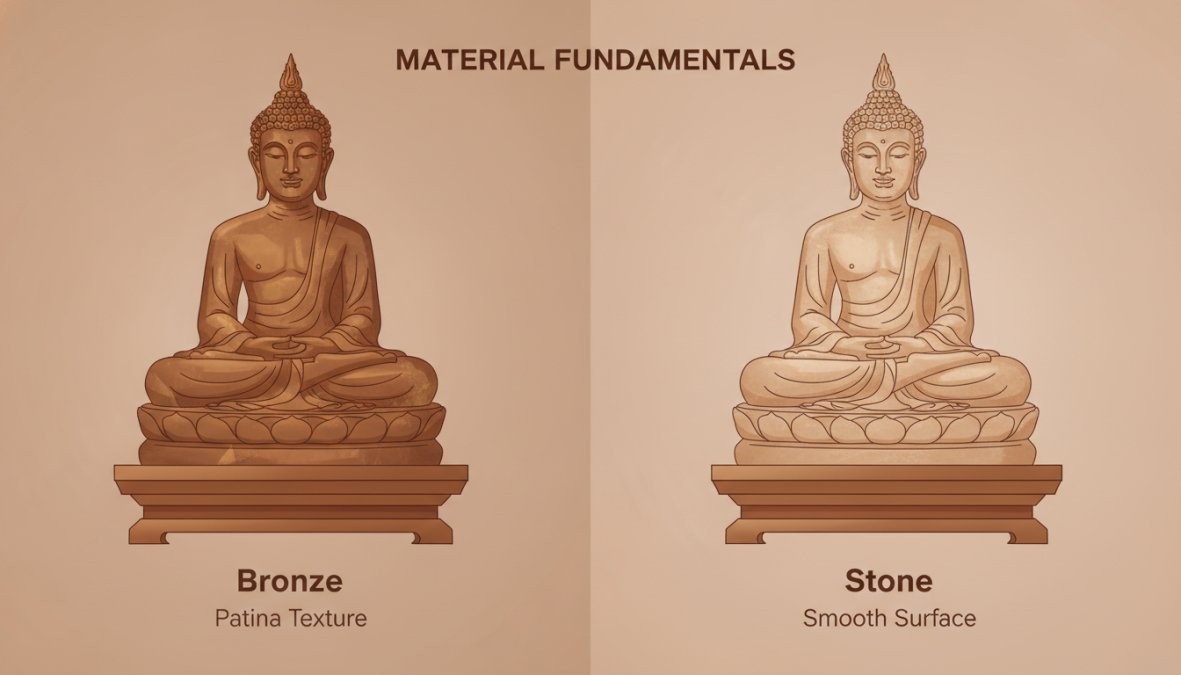
Bouddha en bronze ou en pierre pour l'intérieur : principes fondamentaux des matériaux
La coulée du bronze consiste à verser du métal en fusion dans des moules, tandis que les statues de Bouddha en pierre sont sculptées à partir de matériaux naturels ou reconstitués. Ces méthodes de production façonnent tout, de l’apparence à la longévité.
Le moulage du bronze commence par un savoir-faire artisanal. Les sculpteurs créent une iconographie détaillée capturant des expressions subtiles et des gestes de la main mudra essentiels à la représentation bouddhiste. Les techniques de bronze doré ajoutent un placage doré sur la base en bronze, créant une surface plus chaude et plus réfléchissante. La pièce résultante développe une patine au fil du temps, une couche d’oxydation naturelle que beaucoup considèrent comme belle.
Techniques de fonte du bronze et de bronze doré
Le moulage à la cire perdue, une méthode traditionnelle, produit des pièces plus détaillées que le moulage au sable. Les artisans utilisant cette technique capturent les moindres détails du visage, des robes et des éléments symboliques du Bouddha. Cette qualité finie à la main distingue pièces authentiques à partir de reproductions produites en série.
Les statues en bronze doré nécessitent des soins spécifiques pour préserver la couche d'or. La patine en dessous se développe différemment du bronze non plaqué, et l'interaction entre l'or et le bronze sous-jacent crée une profondeur qui change selon l'éclairage. Cette composition rend le bronze doré particulièrement adapté aux espaces intérieurs où vous contrôlez les conditions environnementales.
Options de pierre : marbre, granit et pierre reconstituée
Les statues de Bouddha en pierre offrent différentes qualités esthétiques et pratiques selon le matériau. Le marbre offre une apparence élégante avec des veines naturelles. Le granit offre une durabilité et une résistance aux intempéries supérieures. La pierre reconstituée, un mélange de poussière de pierre et de résine, est abordable tout en conservant son aspect naturel.
Le marbre est raffiné et sophistiqué mais nécessite un entretien plus fréquent dans les environnements humides. Le granit, étant plus dense, résiste mieux à la pénétration de l’humidité. La pierre reconstituée allie l’esthétique de la pierre à une durabilité accrue à moindre coût que la pierre naturelle.
Chaque matériau affecte la façon dont la lumière interagit avec la statue. La translucidité du marbre crée une lueur subtile à la lumière naturelle. La densité du granit produit une apparence uniforme et ancrée. Ces textures de surface influencent la présence esthétique dans votre décoration intérieure.
Comparaison de la durabilité et de la longévité des matériaux
Les statues de Bouddha en bronze et en pierre peuvent durer des siècles, mais grâce à des mécanismes différents. Le bronze développe une couche de patine protectrice qui ralentit la poursuite de l'oxydation. La pierre reste chimiquement stable mais peut subir des dommages physiques par fissuration si elle est exposée aux cycles de gel-dégel ou à l’infiltration d’humidité.
Développement de la patine du bronze et résistance aux intempéries
La durabilité du bronze vient de sa patine, la couche verdâtre ou brunâtre formée lorsque le cuivre s'oxyde. Cette couche protège le métal sous-jacent d’une corrosion supplémentaire. Pour les statues d’intérieur, la patine se développe lentement et crée un effet vieilli apprécié par de nombreux collectionneurs. Le processus prend des années mais est entièrement naturel et réversible grâce au nettoyage si vous préférez la couleur bronze d'origine.
Les statues d'intérieur subissent un stress environnemental minimal et restent indéfiniment en excellent état avec des soins de base. Une température et une humidité stables empêchent une corrosion accélérée. La durabilité du bronze dans les décors intérieurs est essentiellement illimitée ; de nombreuses pièces de musée restent intactes après plus de 500 ans.
Porosité de la pierre et stabilité à long terme
La durabilité de la pierre dépend fortement de sa porosité. La porosité plus élevée du marbre le rend vulnérable aux taches et aux dommages causés par l'humidité. La faible porosité du granit offre une résistance supérieure à l'humidité et aux taches. Le liant en résine de la pierre reconstituée crée un matériau plus dense avec une porosité inférieure à celle du marbre, ce qui le rend plus résistant à l'humidité et aux taches.
L'avantage de la pierre en matière de stabilité réside dans son inertie chimique. Contrairement au bronze, la pierre ne s’oxyde pas et ne développe pas de patine. Il reste visuellement cohérent au fil des décennies. Cependant, la fragilité de la pierre signifie qu'une statue tombée peut se fissurer de façon permanente, alors que le bronze ne fait généralement que se bosser.
Prendre soin des statues de Bouddha en bronze : les éléments essentiels de l'entretien
L'entretien du bronze se concentre sur la gestion du développement de la patine et la prévention de la corrosion indésirable. Les statues intérieures en bronze nécessitent une intervention minimale. La plupart des collectionneurs époussetent simplement régulièrement et laissent la patine se développer naturellement.
Nettoyer le bronze sans endommager la patine
Un dépoussiérage doux avec un chiffon doux élimine la poussière sans affecter la patine. Pour un nettoyage en profondeur, utilisez de l'eau distillée et une brosse douce ; l'eau du robinet contient des minéraux qui accélèrent l'oxydation indésirable. Évitez les produits à polir pour métaux du commerce, sauf si vous souhaitez éliminer complètement la patine, ce qui nécessite un nouveau cirage.
Si la patine s'accumule de manière inégale ou si vous remarquez une corrosion verte, utilisez une brosse en laiton douce avec de l'eau distillée en effectuant de légers mouvements circulaires. Après le nettoyage, séchez soigneusement avec un chiffon non pelucheux. De nombreux collectionneurs appliquent ensuite une fine couche de cire de qualité musée pour ralentir le développement futur de la patine.
Guide d'entretien et de nettoyage de la pierre
Époussetez régulièrement les statues de pierre avec des chiffons doux. Pour le marbre, utilisez des nettoyants pour pierre au pH neutre formulés pour le matériau. Les nettoyants acides endommagent la surface du marbre et créent des taches ternes.
Pour les statues de Bouddha en granit, une solution savonneuse douce et une brosse douce fonctionnent bien. Le granit résiste mieux aux taches que le marbre, l’entretien semble donc moins urgent. Scellez les statues en granit tous les 2-3 ans avec un scellant pour pierre pour maintenir la résistance à l'eau.
La pierre reconstituée nécessite le même soin que le marbre. Utilisez des nettoyants au pH neutre et évitez les substances acides. Le liant en résine peut se dégrader s’il est exposé à des produits chimiques agressifs.
Règles Feng Shui pour les statues de Bouddha dans votre maison
Les statues de Bouddha ont une signification spirituelle au-delà de la composition matérielle. Dans la pratique du Feng Shui, le placement et l’orientation comptent autant que la statue elle-même.
Signification spirituelle et iconographie du bodhisattva
L'iconographie bouddhiste porte une signification spécifique. Différentes représentations de Bouddha, Bouddha Shakyamuni, Bouddha qui rit, Guanyin Bodhisattva, incarnent différentes qualités spirituelles. Gestes de la main (mudras) communiquent des significations spécifiques : protection, méditation, compassion ou enseignement.
Les qualités réfléchissantes du bronze améliorent la présence spirituelle dans les espaces de méditation. La pierre, en particulier le marbre, offre une énergie stable et ancrée qui soutient une méditation profonde. Les deux matériaux servent différemment des objectifs spirituels, reflétant la philosophie bouddhiste sur l’impermanence et l’endurance.
Meilleur emplacement pour la statue de Bouddha dans le salon
Placez les statues de Bouddha face à la pièce plutôt qu'aux murs. Cela crée une présence spirituelle active. Placez les statues sur des surfaces surélevées, des étagères, des tables d'autel ou des socles pour montrer du respect et créer une hiérarchie visuelle. La statue doit être au niveau des yeux ou légèrement au-dessus lorsqu’elle est assise.
Évitez de placer des statues de Bouddha dans les salles de bains, les chambres ou les cuisines. Les salons, les espaces de méditation et les entrées sont idéaux. La lumière naturelle met en valeur les statues en bronze et en pierre, même si la lumière directe du soleil peut décolorer certaines finitions en pierre.
Considérations relatives à la mise en charge et à la sécurité des surfaces
Le poids des statues en bronze varie considérablement en fonction de leur taille et de la méthode de moulage. Un petit Bouddha en bronze peut peser de 5 à 10 livres ; les morceaux plus gros dépassent 50 livres. Vérifiez les spécifications de poids avant de placer sur les étagères, en vous assurant que les surfaces supportent la charge.
Les statues en pierre sont systématiquement plus lourdes que les pièces en bronze de taille équivalente. Les statues de Bouddha en marbre et en granit peuvent peser plus de 100 livres. Cela nécessite des meubles robustes ou un placement au sol. Utilisez de la cire de musée ou des tampons antidérapants sous les statues sur les étagères pour éviter les accidents.
Authenticité vs reproduction : identifier les pièces de qualité
Les pièces authentiques démontrent un savoir-faire supérieur par rapport aux reproductions produites en série. Les statues en bronze authentiques présentent des détails finis à la main. Examinez le visage de près. les pièces authentiques affichent un caractère individuel dans l'expression du Bouddha. Les yeux, le nez et la bouche doivent être intentionnels plutôt que génériques.
Le développement de la patine sur le bronze authentique suit des motifs naturels. Une oxydation inégale concentrée dans les plis indique un âge réel ou un vieillissement correct. La patine verte uniforme appliquée artificiellement semble plate. Les pièces authentiques présentent des motifs d'usure correspondant à la manipulation et à l'âge.
L'authenticité de la pierre implique une vérification matérielle. Le marbre véritable contient des veines naturelles uniques à chaque pièce. Interrogez les fournisseurs sur l'approvisionnement en matériaux ; les pièces authentiques sont accompagnées d'une documentation sur l'origine de la pierre.
Artisanat fini à la main et valeur d'investissement
Le savoir-faire fini à la main détermine la valeur de l'investissement. Les artisans qui sculptent des moules individuels créent des pièces uniques de caractère. Les statues moulées à la machine manquent de variations subtiles qui rendent les pièces finies à la main attrayantes.
La valeur de l'investissement augmente avec la documentation d'authenticité. Les pièces de provenance commandent des prix plus élevés. Les statues contemporaines finies à la main par des artisans connus s'apprécient au fil du temps. Les pièces produites en série sont rarement appréciées.
Examinez attentivement les mudras (gestes de la main) ; les pièces authentiques montrent des doigts sculptés individuellement avec des variations naturelles. Les robes doivent présenter une texture suggérant des plis de tissu. Le halo derrière la tête doit montrer des motifs rayonnants détaillés dans des pièces de qualité.
Bronze vs Pierre : considérations de prix et de budget
Les statues en bronze coûtent généralement plus cher que les pièces de pierre équivalentes pour la même taille et la même qualité. Les pièces en bronze doré coûtent cher en raison du revêtement en or. Le bronze coulé creux coûte moins cher que le bronze massif tout en conservant une esthétique similaire.
Les statues en pierre offrent des points d'entrée plus économiques, notamment en pierre reconstituée. Le marbre et le granit naturels coûtent plus cher que les alternatives reconstituées mais moins que les pièces de bronze comparables. La durabilité de la pierre justifie l’investissement dans des pièces que vous envisagez de conserver des décennies.
Le prix reflète l’approvisionnement en matériaux et les méthodes de production. Les pièces artisanales créées selon des techniques traditionnelles coûtent plus cher que les articles fabriqués en usine. Pour connaître les prix et les options actuels, visitez HD Asian Artpour parcourir leur collection organisée avec des prix transparents.
Comment choisir : Bouddha en bronze ou en pierre pour votre intérieur
Équilibrez les préférences esthétiques, l’engagement d’entretien, les intentions spirituelles et le budget.
Choisissez le bronze si : Vous préférez les surfaces chaudes et réfléchissantes ; vous appréciez le développement de la patine ; vous voulez un entretien minimal ; vous recherchez des pièces d'investissement ; votre décoration intérieure est traditionnelle ou éclectique.
Choisissez la pierre si : Vous préférez une esthétique stable et ancrée ; vous voulez une apparence cohérente ; vous avez des contraintes budgétaires ; vous préférez un changement visuel minimal ; votre intérieur met l'accent sur les matériaux naturels et les tons terre.
Présence esthétique et intégration du design d’intérieur
Le poids visuel du bronze crée des points focaux grâce à ses qualités réfléchissantes. Dans les intérieurs minimalistes, un seul Bouddha en bronze devient l’ancre de la méditation. La présence ancrée de Stone s'intègre subtilement. Le marbre sublime les intérieurs classiques et raffinés. Le granit fonctionne bien dans les espaces architecturaux modernes.
Tenez compte des matériaux de la pièce existants. Le bronze complète le bois, le cuivre et les métaux chauds. La pierre se coordonne avec les matériaux naturels, les palettes neutres et les éléments architecturaux.
Cadre de décision par cas d'utilisation
Pour les espaces de méditation : Les qualités réfléchissantes du bronze soutiennent une pratique ciblée. La pierre offre une stabilité ancrée pour une contemplation profonde.
Pour l'affichage du salon : Le bronze apporte une touche de design plus forte. La pierre offre une élégance discrète.
Pour les espaces d’autel : Les deux servent également bien spirituellement. Choisissez en fonction de vos préférences esthétiques et de votre engagement d’entretien.
Pour les acheteurs soucieux de leur budget : La pierre reconstituée offre une excellente valeur avec un minimum d'entretien.
À des fins d’investissement : Le bronze fini à la main par des artisans établis s’apprécie avec le temps. La pierre s'apprécie rarement, sauf si elle est antique et revêt une signification historique.
| Facteur de décision | Bronze | Pierre |
|---|---|---|
| Impact visuel | Point focal fort | Subtil, intégré |
| Entretien | Patine minimale et naturelle | Nettoyage régulier nécessaire |
| Durabilité | Des siècles à l'intérieur | 50+ ans typique |
| Coût | Un investissement plus élevé | Plus économique |
| Flexibilité de conception | Chaleureux, traditionnel | Polyvalent et moderne |
| Présence spirituelle | Énergie réfléchissante et chaleureuse | Énergie stable et ancrée à la terre |
| Valeur d'investissement | Apprécie avec authenticité | Apprécie rarement |
Choisir entre des statues de Bouddha en bronze et en pierre reflète vos valeurs personnelles et votre situation de vie. Le bronze récompense ceux qui recherchent un savoir-faire authentique et une présence spirituelle qui s’approfondit avec le temps. La pierre est au service de ceux qui apprécient la stabilité, la simplicité et l’élégance discrète.
HD Asian Art se spécialise dans les statues bouddhistes finies à la main honorant l’artisanat traditionnel tout en servant des intérieurs contemporains. Notre collection comprend des pièces de bronze authentiques dont la provenance est documentée et des statues en pierre de haute qualité sélectionnées pour leurs qualités esthétiques et spirituelles. Chaque pièce est soumise à une évaluation minutieuse de son authenticité, de son savoir-faire et de son intégrité spirituelle. Parcourez notre collection pour trouver la statue de Bouddha qui résonne avec votre espace et votre pratique.
Foire aux questions
Quelle est la principale différence entre les statues de Bouddha en bronze et en pierre pour un usage intérieur ?
Les statues en bronze sont créées grâce à des techniques de moulage en bronze ou de bronze doré, développant une patine protectrice au fil du temps et offrant une excellente durabilité en intérieur. Les statues de Bouddha en pierre, généralement fabriquées à partir de marbre, de granit ou de pierre reconstituée, offrent une esthétique différente avec différents niveaux de porosité. Le bronze développe son caractère en vieillissant, tandis que la pierre reste stable. Les deux conviennent aux espaces intérieurs, mais le bronze offre plus de résistance aux intempéries s’il est placé près des fenêtres, tandis que la pierre offre une présence plus statique et intemporelle, idéale pour les autels domestiques et les espaces de méditation.
Comment nettoyer une statue de Bouddha en pierre sans l’abîmer ?
Utilisez un chiffon doux et humide avec de l'eau tiède pour un nettoyage en douceur. Évitez les produits chimiques agressifs ou les frottements abrasifs, car la porosité de la pierre peut absorber des substances nocives. Pour le marbre ou la pierre reconstituée délicate, testez d’abord toute solution de nettoyage sur une zone peu visible. Séchez immédiatement avec un chiffon doux pour éviter les taches d'eau. Pour les salissures tenaces, utilisez un nettoyant pour pierre au pH neutre. N’utilisez jamais de nettoyants acides sur le marbre et évitez le lavage sous pression, qui peut éroder les détails de la surface et l’iconographie spirituelle.
Quelles sont les règles feng shui pour placer une statue de Bouddha dans votre salon ?
Placez votre statue de Bouddha sur une surface surélevée comme une étagère ou un autel, face à la pièce pour inviter une énergie positive. Évitez de le placer directement face à une porte ou à une salle de bain. La statue doit être au niveau des yeux ou légèrement au-dessus lorsqu’elle est assise. Dans la pratique du feng shui, le coin est ou sud-est de votre salon est considéré comme propice à la décoration spirituelle. Gardez la zone propre et sans encombrement pour honorer la signification spirituelle du Bodhisattva. Ne placez jamais de statues de Bouddha sur le sol ou dans des positions basses et irrespectueuses.
Les statues de Bouddha en bronze sont-elles plus chères que celles en pierre ?
Le prix dépend de la quantité, de la qualité de l'artisanat, de la taille et du caractère ancien ou contemporain des pièces. Généralement, les pièces moulées en bronze finies à la main avec une iconographie détaillée coûtent plus cher en raison des techniques à forte intensité de main-d'œuvre et des coûts des matériaux. Cependant, les sculptures en marbre ou en granit de qualité supérieure peuvent rivaliser avec le prix du bronze. Les options de pierre reconstituée offrent généralement des points d’entrée plus abordables. La valeur d’investissement favorise souvent les pièces en bronze authentiques, en particulier celles présentant un développement de patine supérieur et une provenance reconnue. Pour connaître les prix actuels des pièces sélectionnées, visitez HD Asian Artpour des citations spécifiques.
