



Thai Buddha Statue: Region-by-Region Style Guide
Thai Buddha Statue: Region-by-Region Style Guide
Most buyers of a Thai Buddha statue make the same mistake: they choose entirely by aesthetic and then discover later that the piece they loved is a Rattanakosin reproduction of a Sukhothai original, or a Lanna-style casting sold with no regional context at all. That is not necessarily a problem, but it is a missed opportunity.
Understanding the four main regional and period traditions of Thai Buddhist sculpture transforms the buying experience from a hunch into an informed judgment. This guide walks through each tradition in turn, identifies what distinguishes one from another, and tells you what to look for before you commit to a piece.
Table of Contents
- Quick Takeaways
- Why Regional Style Matters to Serious Collectors
- Sukhothai: The Defining Vocabulary of Thai Buddhist Sculpture
- Ayutthaya: Royal Authority in Bronze and Gilt
- Chiang Saen and Lanna: The North's Quieter Tradition
- Rattanakosin: The Bangkok Period and Its Refinements
- Comparing the Four Traditions: A Quick Reference
- Mudras, Postures, and What They Tell You
- Materials and Finish Across Periods
- Frequently Asked Questions
- References
Quick Takeaways
|
Key Insight |
Explanation |
|---|---|
|
The flame ushnisha is Sukhothai's signature |
The sharply rising flame-shaped finial above the cranial protuberance is the single most reliable visual marker of the Sukhothai tradition, distinguishing it immediately from Ayutthaya's tiered or umbrella-form ushnisha. |
|
Crowned Buddhas are almost always Ayutthaya or Rattanakosin |
The jeweled crown and royal regalia merging kingship with Buddhahood is a distinctively Ayutthaya development. If you see a crown, you are in the central plains court tradition, not the northern Lanna or earlier Sukhothai idiom. |
|
Chiang Saen faces are rounder and fuller than Sukhothai faces |
Northern Thai Lanna sculpture favors a broad, rounded face with a more compact body and a conical rather than flame-shaped ushnisha, making it easy to separate from the elongated oval face of a Sukhothai piece. |
|
Rattanakosin work is the most technically finished but not the oldest |
The Bangkok period introduced electroplating, dense glass mosaic inlay, and what is often called the "Bangkok smile." The refinement is real, but these pieces post-date 1782 and should be priced and collected accordingly. |
|
The Walking Buddha is an almost exclusively Sukhothai invention |
No other Thai regional tradition produced a Walking Buddha with comparable frequency or artistic confidence. Its presence is one of the strongest indicators of Sukhothai aesthetic influence, regardless of when the casting was made. |
|
Right-hand position identifies the spiritual message before anything else |
The mudra, or hand gesture, communicates the primary iconographic meaning of the piece. Earth-touching means enlightenment; open palm raised means protection; hands in the lap signal meditation. Read the hand first. |
|
Robe treatment separates periods as reliably as facial features |
Sukhothai robes are nearly invisible on the surface, while Ayutthaya and Rattanakosin work shows increasingly carved and patterned textile detail. A richly decorated robe almost always points to a later or more courtly tradition. |
Why Regional Style Matters to Serious Collectors
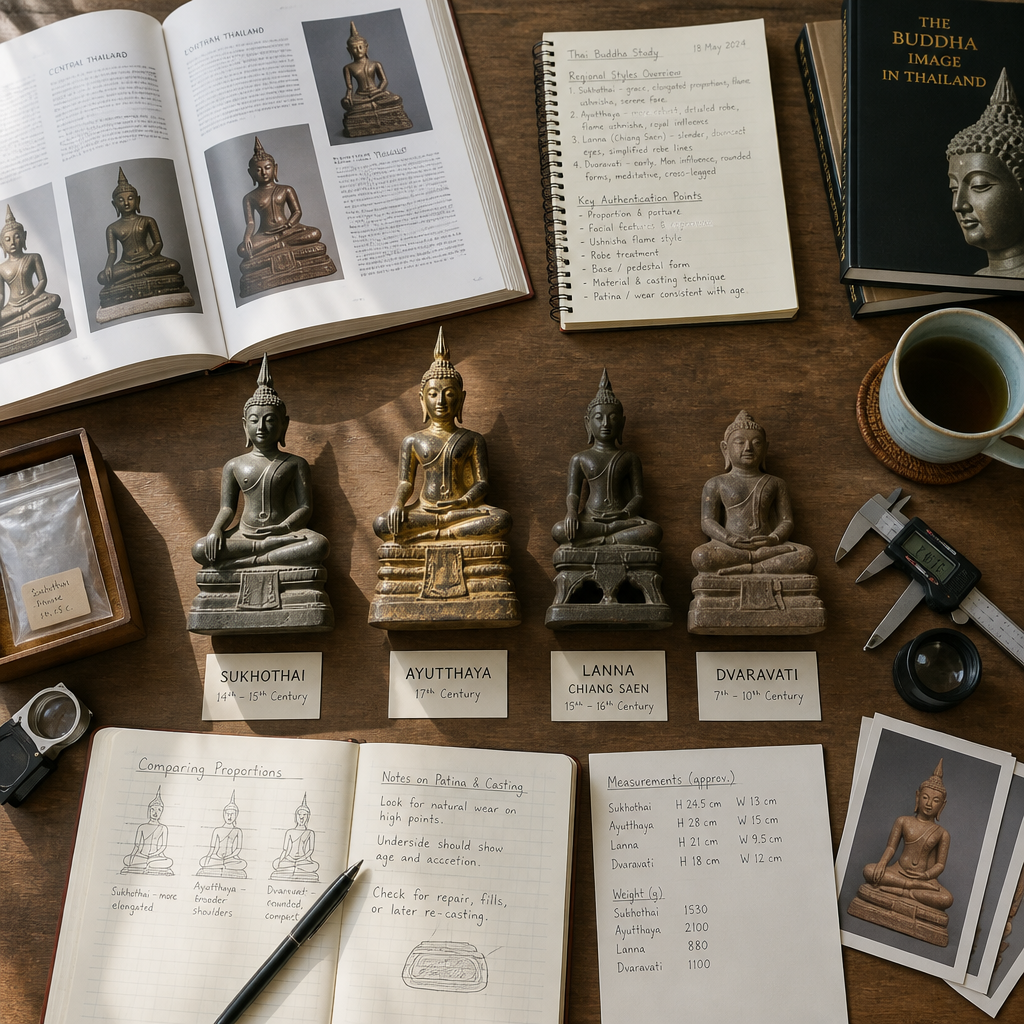
Thai Buddhist sculpture spans roughly a thousand years and a dozen distinct regional centres. Within that span, four traditions dominate the collector market: Sukhothai, Ayutthaya, Chiang Saen and Lanna, and Rattanakosin. Each carries its own formal logic, its own relationship to Theravada Buddhist theology, and its own production materials and techniques.
Knowing the difference is not academic posturing. It determines what a piece is actually worth, whether a reproduction is faithful or misleading, and whether the statue you are considering fits the collection context you are building. A collector who can identify a Sukhothai flame ushnisha at a glance, or who recognizes the crowned Buddha as a specifically Ayutthaya political statement, is far less likely to overpay for a recent Bangkok casting presented vaguely as "antique Thai."
The broad historical names matter because they anchor the object in time and place. Sukhothai belongs to the 13th to 15th centuries and gives us the most famous Thai sculptural vocabulary. Ayutthaya expresses the royal court style that matured in the central plains. Lanna or northern Thai work often points toward Chiang Mai and nearby centres. Rattanakosin belongs to the Bangkok period and later restorations of older tastes. Each of those anchors carries different implications for a buyer.
Pro tip: When a dealer describes a piece simply as "Thai Buddha" with no period attribution, treat that as a gap, not a neutral description. Ask specifically which regional tradition the statue represents and how that reading is supported by the iconographic features you can see.
Sukhothai: The Defining Vocabulary of Thai Buddhist Sculpture
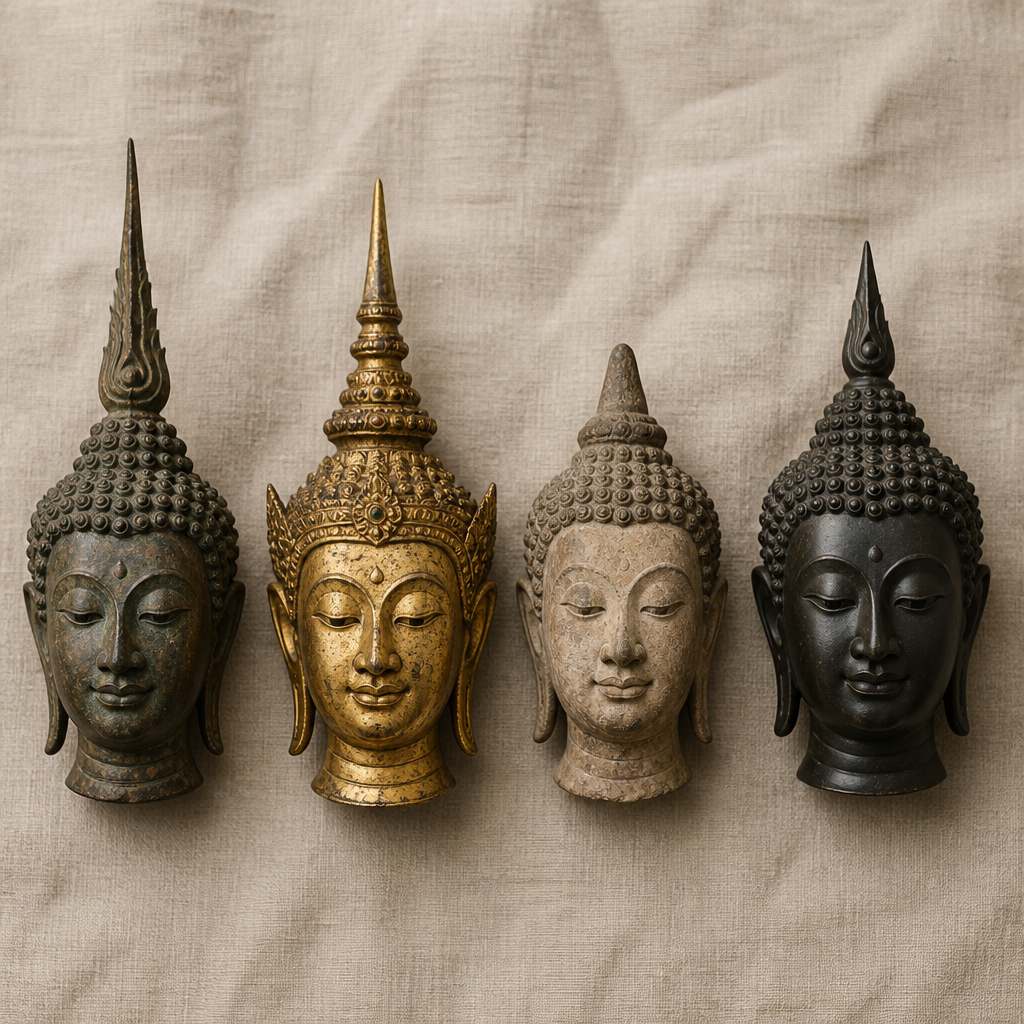
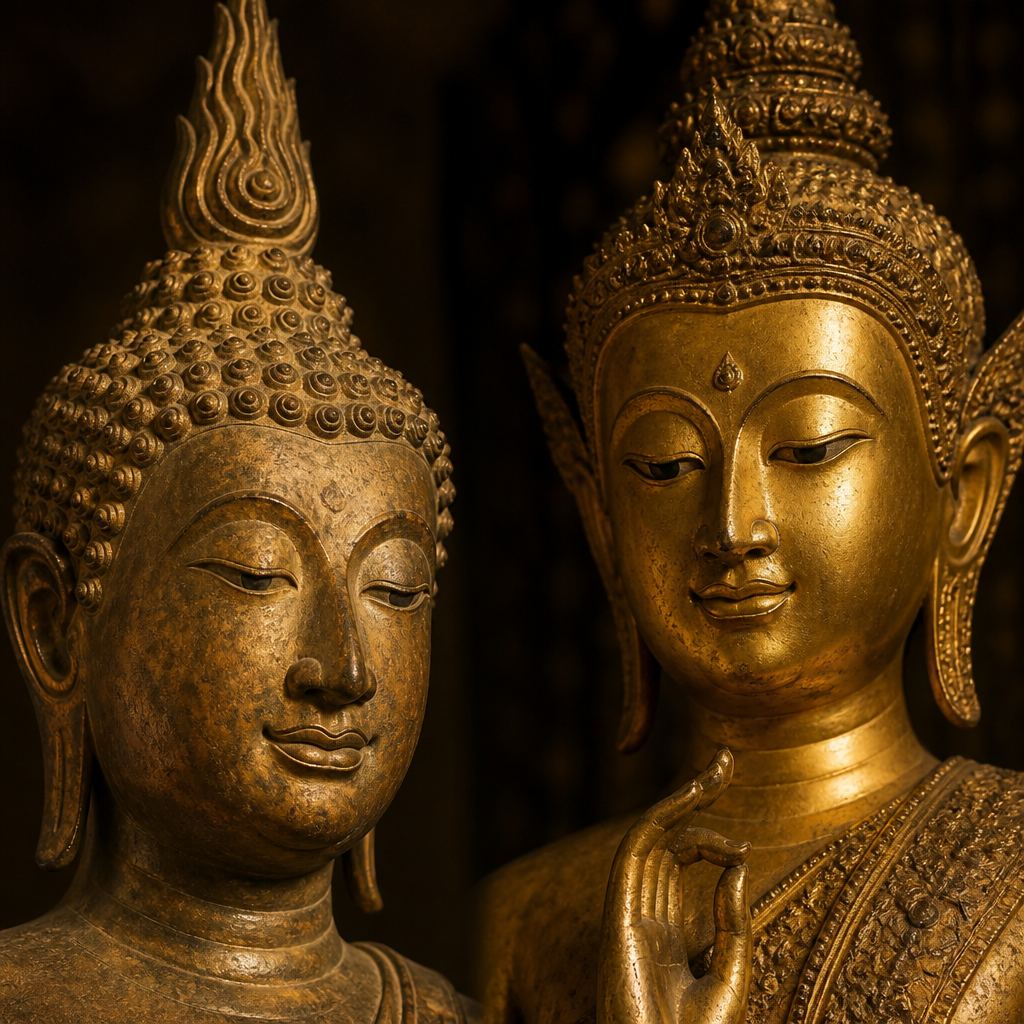
The Sukhothai kingdom flourished from the 13th to the 15th centuries and produced what most scholars and collectors regard as the most distinctively Thai sculptural tradition. Its influence on Sri Lankan Theravada Buddhism is visible in the flame-shaped ushnisha, the cranial protuberance that marks a Buddha's enlightened wisdom, rising sharply from the crown of the head in a single, elegant point. No other tradition uses this form with quite the same confidence.
The Sukhothai Face and Body
Sukhothai sculptors favored an oval, egg-shaped face with gently arched brows that meet in a single curved line, a broad nose, and a very slight, almost imperceptible smile. The eyes are typically downcast, suggesting meditative inwardness rather than outward engagement. The neck carries three rings, a traditional sign of beauty in Thai aesthetic convention. The shoulders are broad but the overall body is elongated and fluid, with limbs that taper smoothly in a way that no other period matches.
The robe is treated as nearly invisible, with only a thin, schematic line indicating its edge. This restraint is deliberate. Sukhothai sculptors were communicating spiritual essence, not physical detail. Ornament, for them, was a distraction from enlightenment rather than a symbol of it.
The Walking Buddha
The Walking Buddha is Sukhothai's most original contribution to world Buddhist sculpture. No other regional tradition in Thailand produced it with such frequency or inventiveness. The figure steps forward with one foot slightly raised, one arm swinging naturally, the other raised in the Abhaya gesture of reassurance. The effect is simultaneously dynamic and serene: a Buddha moving through the world, not retreating from it.
If you are building a focused Thai collection, a Sukhothai-style Walking Buddha represents one of the most iconographically significant acquisitions you can make. It is not merely decorative. It is a statement about the artist's theological vision.
The shift from Khmer angularity to Sukhothai fluidity reflected a deliberate promotion of Theravada Buddhist ideals by Thai rulers who used art to emphasize compassion and serenity over power and authority.
Ayutthaya: Royal Authority in Bronze and Gilt
The Ayutthaya kingdom succeeded Sukhothai in the 15th century and lasted until 1767, producing a tradition that is fundamentally different in spirit even when it superficially resembles its predecessor. Where Sukhothai sculpture communicates spiritual abstraction, Ayutthaya sculpture communicates royal power. The Buddha in the Ayutthaya tradition is simultaneously an enlightened being and a divine king, and the statuary makes that dual identity explicit.
The Crowned Buddha
The most distinctive Ayutthaya development is the crowned Buddha: an image wearing a tiered jeweled crown and elaborate royal regalia, merging the identity of the king and the Buddha in a single form. This is a political as much as a devotional image, and collectors should understand it as such. The Ayutthaya court was cosmopolitan, wealthy, and deeply invested in the symbolic power of Buddhism as a legitimizing force.
Facial features in Ayutthaya work became more refined and angular compared to Sukhothai softness. The ushnisha was often topped with a tiered umbrella or conical form rather than a single flame. Robes received more decorative attention, with carved textile patterns replacing the near-invisible treatment of Sukhothai work. Shoulders are broader, posture is more frontal and authoritative.
Ayutthaya Heads and Fragments
The sack of Ayutthaya by Burmese forces in 1767 left behind an enormous number of damaged and decapitated statues, which means the market contains many Ayutthaya-period Buddha heads offered separately from their bodies. These are legitimate collector objects with significant historical presence. When considering a head alone, examine the ushnisha form, the treatment of the hairline, and the facial geometry. Authentic Ayutthaya work shows a characteristic angularity at the jaw and cheekbones that distinguishes it clearly from Sukhothai softness and Rattanakosin delicacy.
Pro tip: An Ayutthaya crowned Buddha in good condition is among the most culturally resonant objects available in the Thai collector market. The crown is not decoration. It is a direct statement about the relationship between temporal and sacred authority in a civilization that took both with complete seriousness.
Chiang Saen and Lanna: The North's Quieter Tradition
The northern Thai Lanna tradition, often called Chiang Saen style after the ancient town where its earliest examples were produced, covers the period from the 14th to the 19th century. The Lanna kingdom had Chiang Mai as its cultural and political centre and maintained a distinct artistic identity that absorbed Burmese, Mon, and Sri Lankan influences without merging entirely with the central Thai mainstream.
Facial and Physical Characteristics
The Chiang Saen face is the most immediately recognizable feature of northern Thai sculpture. It is broad, round, and full, quite unlike the elongated oval of Sukhothai or the angular refinement of Ayutthaya. The forehead is high, the features are soft but compact, and the expression conveys stillness and interiority without the spiritual abstraction of Sukhothai's near-featurelessness. The body tends toward a more compact, grounded physique compared to the fluid elongation of the central Thai traditions.
The ushnisha in Chiang Saen work is typically conical rather than flame-shaped, often with a small knob or lotus bud at the apex. The hairline is usually shown as a series of tight curls rather than the smooth, stylized treatment of Sukhothai work. These are the details that separate a genuine Lanna piece from a northern reproduction of a Sukhothai model.
The Emerald Buddha Connection
The Emerald Buddha, now housed at Wat Phra Kaew in Bangkok and revered as the palladium of the Thai state, is described by art historians as belonging to the Chiang Saen style of the 15th century, confirming that this northern tradition produced objects of the highest sacred and political significance. That context matters for collectors: Lanna sculpture is not a provincial backwater but a fully developed artistic tradition with its own theological language.
Rattanakosin: The Bangkok Period and Its Refinements
The Rattanakosin period began in 1782 when King Rama I founded Bangkok as the new capital of Thailand after the fall of Ayutthaya. It continues to the present day under the Chakri dynasty, making it simultaneously the most recent and the most technically sophisticated of the four traditions. Rattanakosin sculpture consciously fused Sukhothai's graceful curves with Ayutthaya's monumentality, then added its own distinctive refinements.
Technical Innovations of the Bangkok Period
Rattanakosin craftsmen introduced electroplating for gilding, allowing a uniformity and fine detail of gold coverage that earlier methods could not achieve. Dense colored glass mosaic inlay appeared on halos, bases, and stucco ornament, creating a jewel-like richness that is immediately identifiable. The "Bangkok smile," as it is sometimes called, is a more delicate and nuanced expression than the expressions of either Sukhothai or Ayutthaya work, conveying refinement and interior calm simultaneously.
The period also saw the production of some of Thailand's most famous large-scale images, including the 46-metre gilded Reclining Buddha at Wat Pho in Bangkok. These temple commissions set the visual standard for Rattanakosin style: technically impeccable, richly ornamented, and explicitly tied to royal and national identity.
What Rattanakosin Means for Collectors
Rattanakosin pieces are not ancient, and collectors should not pay ancient prices for them. The tradition begins in the late 18th century, and most pieces available on the collector market date from the 19th or early 20th century. That does not diminish their quality or their significance, but it does mean they occupy a different category from Sukhothai or Ayutthaya originals. The technical excellence is real and the aesthetic is genuinely compelling. Price them accordingly.
For home altar use, Rattanakosin-style bronzes are an excellent choice. The gilding is durable, the proportions are elegant, and the iconography is precise. Many of the finest contemporary Thai Buddhist sculptures produced for devotional and collector markets follow the Rattanakosin model.
We would love your feedback and any insights you would share with others. What perspective would you add?
Comparing the Four Traditions: A Quick Reference
The table below isolates the most collector-relevant visual features across the four main regional traditions. Use it as a field guide when examining a piece for the first time.
|
Feature |
Sukhothai (13th-15th c.) |
Ayutthaya (14th-18th c.) |
Chiang Saen / Lanna (14th-19th c.) |
Rattanakosin (1782-present) |
|---|---|---|---|---|
|
Face shape |
Elongated oval, gently arched brows |
Angular, refined, more symmetrical |
Broad, round, full |
Delicate, refined, subtle "Bangkok smile" |
|
Ushnisha |
Sharply rising flame finial |
Tiered, umbrella-form, or conical crown |
Conical with lotus bud apex |
Slender flame finial (refined Sukhothai revival) |
|
Ornamentation |
Minimal, near-invisible robe |
Royal regalia, jeweled crown frequent |
Moderate, Burmese-influenced detail |
Heavy gilding, glass mosaic, intricate patterning |
|
Body type |
Fluid, elongated, tapering limbs |
Broader shoulders, grounded authority |
Compact, well-proportioned |
Elegant, elongated, architecturally precise |
|
Signature feature |
Walking Buddha posture |
Crowned Buddha (Chakravartin image) |
Round face, tight hair curls |
Electroplated gilding, glass inlay |
Mudras, Postures, and What They Tell You
Regional style tells you where and roughly when a piece was made. The mudra, or hand gesture, tells you what spiritual moment or teaching the sculptor was depicting. In Thai Buddhist sculpture, these two layers of meaning stack on top of each other, and a serious collector needs to read both.
The Four Core Mudras in Thai Sculpture
The Bhumisparsha mudra, where the right hand reaches down to touch the earth, depicts the moment of enlightenment when the Buddha called the earth to witness his awakening. It is the most common mudra in Thai Buddhist sculpture across all periods. The Dhyana mudra, both hands resting in the lap with palms upward, signals deep meditation and is frequently used in images intended for shrine or altar contexts.
The Abhaya mudra, right hand raised with palm facing outward, means protection and reassurance. In Sukhothai work it appears most often on Standing and Walking Buddhas. The Dharmachakra mudra, both hands raised with fingers forming a wheel gesture, represents the first teaching at Deer Park and is relatively less common in Thai sculpture than in other Southeast Asian traditions.
Posture and Period Together
A seated Dhyana Buddha can appear in any period. But a Walking Buddha in the Abhaya mudra is almost certainly drawing on Sukhothai formal vocabulary, regardless of when it was actually cast. A standing figure in Abhaya with a jeweled crown is Ayutthaya or Rattanakosin. A seated crowned Buddha in Bhumisparsha is Ayutthaya at its most politically explicit. These combinations are not arbitrary. They encode specific iconographic programs, and recognizing them separates an informed collector from a casual buyer.
Pro tip: When examining a Thai Buddha statue, look at the right hand first. Its position almost always identifies the primary spiritual message of the piece before you consider posture or period style. The hand is the quickest diagnostic tool available to you.
Materials and Finish Across Periods
Materials are the third layer of analysis, after regional style and iconographic program. Across all four traditions, bronze is the dominant medium for collector-grade Thai Buddhist sculpture. But the way bronze was used, finished, and decorated changed substantially across periods and regions.
Bronze, Patina, and Gilding
Original bronze pieces from the Sukhothai and Ayutthaya periods show a fine, even patina with green or brown oxidation consistent with centuries of exposure. This patina is not something that can be perfectly replicated in a short period, and it is one of the most reliable indicators of age. Gilding appears from the earliest periods onward, beginning with simple gold leaf application in Sukhothai and Ayutthaya work. Rattanakosin introduced electroplating for uniform, fine-detailed gilding covering entire surfaces.
Wood, Lacquer, and Stone
Carved and lacquered wood appears across all periods, particularly in northern Thailand where the Lanna tradition produced wooden images of considerable refinement. Stone and stucco were more common in the earliest Dvaravati and Lopburi work and in temple relief decoration throughout the Chiang Saen and Sukhothai periods. For the collector, wood pieces require more careful attention to condition and provenance, since carved wood is more vulnerable to damage and more easily modified than cast bronze.
Mother-of-pearl or glass inlay for the eyes appears on finer crowned Ayutthaya heads and becomes far more widespread and colorful by the Rattanakosin period, extending to glass mosaic covering entire statues and pedestals. If you see extensive glass mosaic work, you are almost certainly looking at a Rattanakosin or later piece. That is useful information for dating, pricing, and contextualizing the object correctly.
Explore the Thai Buddha statue collection at HD Asian Art to see how these regional distinctions manifest across a curated range of museum-quality pieces, from Sukhothai-style bronzes to Rattanakosin gilt images.
Frequently Asked Questions
What is the most collectible style of Thai Buddha statue?
Sukhothai-style pieces are generally the most sought-after by serious collectors because the tradition is historically significant, iconographically inventive, and aesthetically unmatched in Thai art. The Walking Buddha in particular is considered one of the finest achievements in world Buddhist sculpture. That said, Ayutthaya crowned Buddhas carry enormous cultural weight, and Lanna pieces appeal strongly to collectors who prefer regional distinctiveness over mainstream Thai aesthetics.
How do I tell a Sukhothai Buddha from an Ayutthaya Buddha?
Start with the ushnisha. A flame-shaped finial rising to a single sharp point indicates Sukhothai influence. A tiered, umbrella-form, or crowned ushnisha points to Ayutthaya. Then look at ornamentation: Sukhothai pieces are notably plain, while Ayutthaya work frequently shows royal regalia, jeweled crowns, and decorated robes. Finally, examine the face: Sukhothai faces are elongated and oval; Ayutthaya faces are more angular and symmetrical.
Are Rattanakosin Buddha statues worth collecting?
Absolutely, provided they are priced and understood correctly. Rattanakosin work represents the peak of Thai Buddhist sculptural technique, with electroplated gilding, glass mosaic inlay, and refined proportions that are genuinely impressive. The key is not to pay Sukhothai or Ayutthaya prices for a piece that post-dates 1782. Within its own period, a fine Rattanakosin bronze is an excellent acquisition for both devotional use and serious collecting.
What does the Buddha's hand gesture mean in Thai statues?
Hand gestures, called mudras, encode specific spiritual meanings. The right hand reaching down to touch the earth signals the moment of enlightenment. Both hands resting in the lap indicate meditation. The right hand raised with palm outward means protection and reassurance. Both hands raised in a wheel gesture represent the first teaching. In Thai Buddhist sculpture, the mudra and the regional style together define the complete iconographic meaning of a piece.
Is the Walking Buddha style exclusive to Thailand?
The Walking Buddha posture exists in other Buddhist traditions, but the specific formal vocabulary developed in Sukhothai, with its fluid elongated body, swinging arm, and raised Abhaya hand, is uniquely Thai and uniquely Sukhothai. No other regional tradition in Southeast Asia produced the Walking Buddha with the same frequency, artistic confidence, or formal consistency. It is the clearest single indicator of Sukhothai aesthetic influence in any piece.
What materials are used in authentic Thai Buddha statues?
Bronze is the dominant material for collector-grade Thai Buddhist sculpture across all periods, typically cast using the lost-wax method. Wood, often lacquered and gilded, is also common, particularly in northern Lanna work. Stone and stucco appear in temple contexts and in the earliest periods. Rattanakosin pieces frequently show electroplated gilding and glass mosaic inlay. A genuine antique bronze will carry an even patina of green or brown oxidation that is very difficult to replicate convincingly.
Can Thai Buddha statues be displayed in a home that is not Buddhist?
Yes. Thai Buddha statues have a long history of display in secular contexts, including in Western homes and private art collections, and no formal religious requirement prohibits non-Buddhist ownership. The main considerations are practical and respectful: place the statue at a comfortable height, keep the area clean, and choose a position where the figure is not on the floor or in a bathroom. These are common-sense guidelines rather than absolute rules, and they apply whether you are a practitioner or a collector.
If you have handled Thai Buddha statues from different regional traditions, share what helped you most in identifying the style, whether it was the ushnisha, the face, or the mudra.
References
-
Smarthistory: Analysis of the Sukhothai Walking Buddha, its Sri Lankan influences, and its distinctive sculptural features
