



Sculpture de la période de Sukhothai : guide d'histoire de l'art d'un érudit
Sculpture de la période de Sukhothai : guide d'histoire de l'art d'un érudit
La sculpture de la période de Sukhothai est définie comme la production artistique bouddhiste et royale du royaume de Sukhothai dans le nord actuel. Thaïlande, s'étendant du XIIIe au XVe siècle. Ces œuvres ont établi une tradition visuelle distinctement thaïlandaise qui rompait avec les précédents khmers et introduisait des formes reconnues mondialement comme le fondement de l'art bouddhiste thaïlandais.
Le style se concentre sur des images gracieuses et idéalisées de Bouddha rendues en bronze, en pierre et en stuc, façonnées par la doctrine bouddhiste Theravada et les ambitions politiques des premiers dirigeants thaïlandais. Pour les historiens de l’art et les étudiants, comprendre ce qui définit les sculptures de Sukhothai signifie comprendre comment un royaume régional a transformé l’iconographie religieuse en une esthétique nationale durable.
Qu'est-ce que la sculpture de la période de Sukhothai ?
La sculpture de la période de Sukhothai fait référence à l'ensemble des œuvres religieuses et royales produites sous le royaume de Sukhothai), un régime politique qui a prospéré d'environ 1238 à 1438 de notre ère dans les plaines centrales de l'Asie du Sud-Est continentale. Le royaume a adopté le bouddhisme Theravada comme religion d’État, et cet engagement doctrinal a façonné toutes les productions artistiques majeures de l’époque. Les sculptures de cette époque ne sont pas des objets décoratifs. Ce sont des déclarations théologiques rendues sous forme matérielle.
Le style se caractérise par une synthèse philosophique de sérénité spirituelle et de naturalisme, exprimant les idéaux bouddhistes à travers des formes humaines abstraites plutôt que par le réalisme ou une convention symbolique stricte. Les artistes de Sukhothai s'éloignent délibérément des postures rigides et frontales héritées de la sculpture khmère. Ils ont remplacé la solidité sculptée dans la pierre par des figures fluides en bronze qui semblent presque en apesanteur.
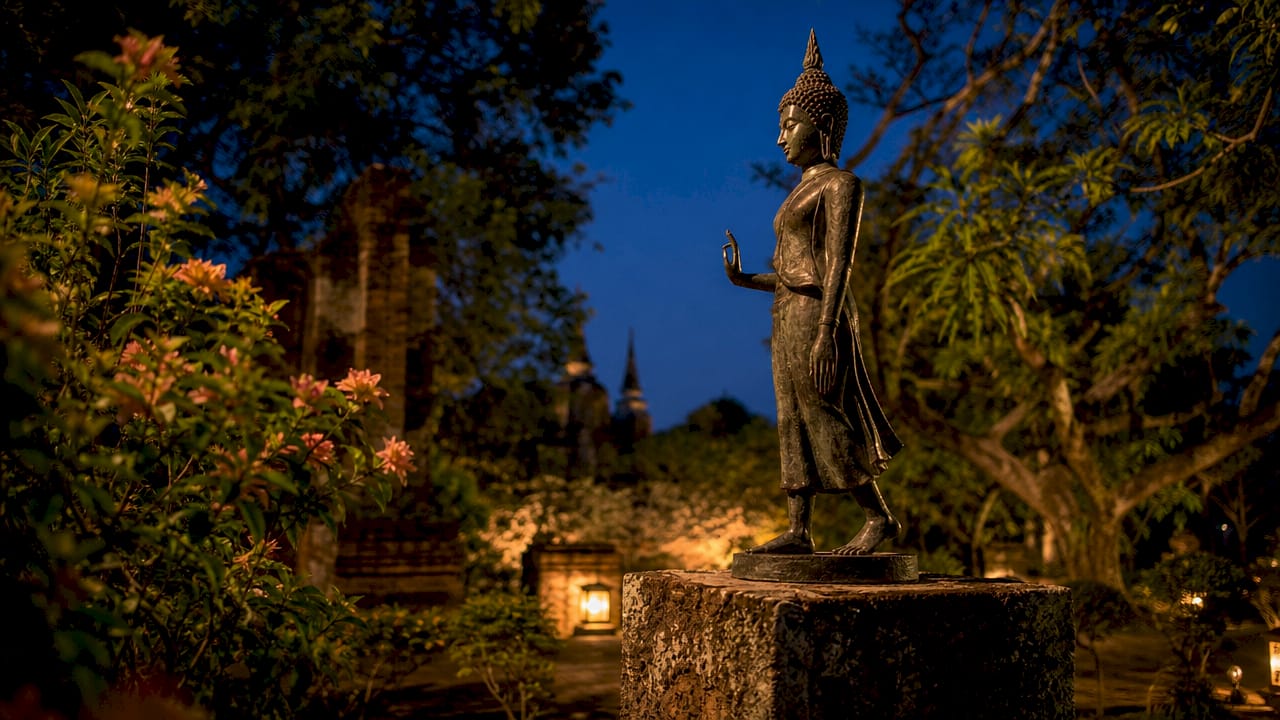
Le Ville historique de Sukhothaï et ses sites associés ont été inscrits sur la Liste du patrimoine mondial de l'UNESCO en 1991, reconnaissant la valeur culturelle exceptionnelle des monuments et des sculptures survivants. Cette désignation confirme que l’héritage artistique de Sukhothai n’est pas une note régionale. Il s’agit d’une contribution mondialement significative au patrimoine culturel humain.
Conseil de pro : Lorsque vous étudiez la sculpture de Sukhothai dans les collections de musées, recherchez l'étiquette de provenance du Wat Mahathat. Les sculptures attribuées à ce temple royal central ont le poids historique de l’art le plus élevé et sont datées de la manière la plus fiable de la période classique de Sukhothai.
Principales caractéristiques de la sculpture de Sukhothai
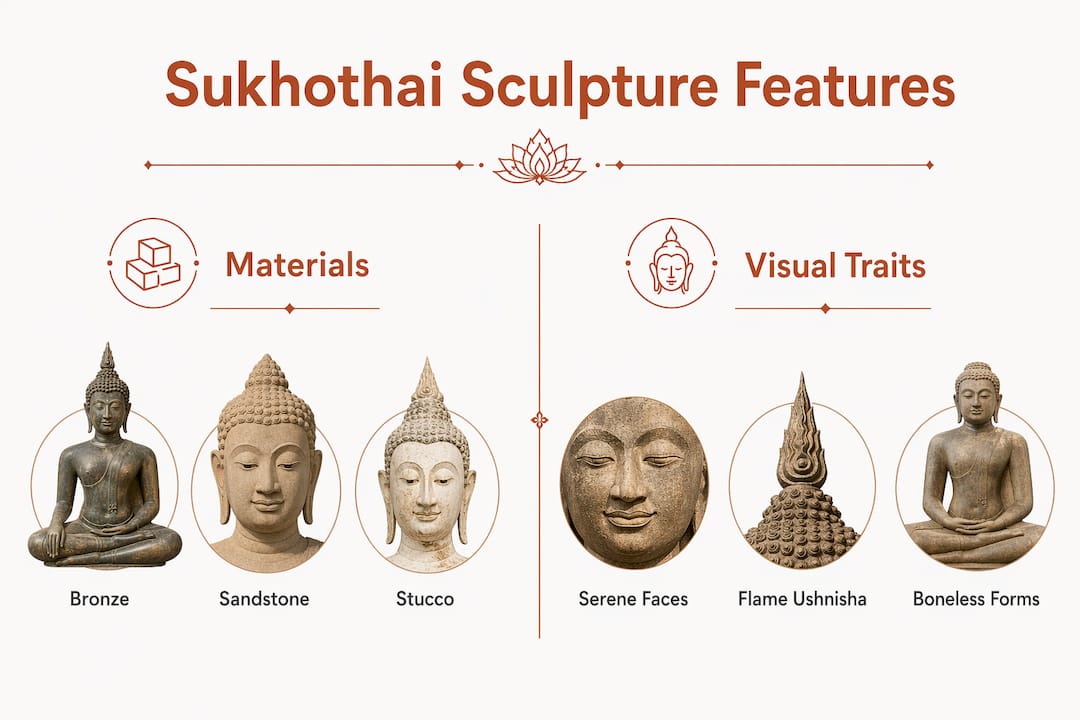
Le langage visuel de l’art de la période de Sukhothai est précis et cohérent sur tous les supports. Plusieurs éléments apparaissent de manière répétée dans les œuvres en bronze, en pierre et en stuc :
- Formes sinueuses et désossées. Le corps est rendu avec des courbes sinueuses et des corps désossés), donnant aux figures une qualité fluide, presque liquide. Les membres se rétrécissent gracieusement et le torse se courbe d'une manière qu'aucun corps anatomique ne pourrait reproduire. C'est intentionnel. La forme surhumaine signale la transcendance des limitations physiques du Bouddha.
- Ushnisha en forme de flamme. La protubérance crânienne (ushnisha) sur les têtes de Bouddha de Sukhothai prend la forme d'une flamme pointue plutôt que du bouton arrondi observé dans les œuvres khmères ou sri lankaises. Cette ushnisha à flamme est devenue un marqueur emblématique du style Sukhothai dans l'art thaïlandais.
- Expression faciale sereine. Le visage présente des yeux baissés, un léger sourire et une peau lisse et sans rides. Le expression du visage sereine communique simultanément la compassion et le calme intérieur, reflétant l’idéal d’équanimité Theravada.
- Motifs de lotus et gestes symboliques. Des éléments architecturaux en forme de lotus apparaissent dans les complexes des temples de Sukhothai, et les sculptures elles-mêmes incorporent des mudras (gestes de la main) liés à des enseignements bouddhistes spécifiques.
- Le Bouddha qui marche. L'apport le plus original de la sculpture de Sukhothai est le Bouddha qui marche, un Bronze thaïlandais du XIVe siècle innovation sans prototype indien connu. Le personnage avance à grands pas avec la main droite levée en abhayamudra (le geste d'intrépidité), représentant le Bouddha en mouvement actif plutôt qu'en méditation assise.
Les matériaux utilisés tout au long de cette période comprennent le bronze coulé, le grès sculpté et le stuc modelé. Bronze, pierre et stuc ont été sélectionnés en fonction de l’ampleur et de la permanence requises. Les grandes images de temples utilisaient généralement du stuc sur des noyaux de briques, tandis que les objets de dévotion portables et les commandes royales privilégiaient le bronze.
Comment le contexte historique et religieux a façonné l’art de Sukhothai
L’adoption par le royaume de Sukhothai du bouddhisme Theravada comme religion d’État était un acte politique délibéré, et pas seulement spirituel. Le roi Ramkhamhaeng, qui régna à la fin du XIIIe siècle, utilisa le patronage religieux pour consolider son autorité et distinguer Sukhothaï de ses voisins khmers de l'est. Le Inscription du roi Ram Khamhaeng de 1292 relate l'invention de l'écriture thaïlandaise et décrit un royaume organisé autour des principes bouddhistes, fournissant ainsi la base documentaire que les historiens de l'art utilisent pour dater et attribuer les sculptures à cette période.
Le bouddhisme Theravada, tel qu'il est pratiqué à Sukhothai, s'inspire largement des traditions monastiques sri lankaises. Cette connexion sri-lankaise explique plusieurs écarts stylistiques par rapport à la norme khmère. Là où la sculpture khmère mettait l'accent sur la fusion du roi divin (devaraja) avec les divinités hindoues, la sculpture de Sukhothai centrait le Bouddha historique en tant qu'enseignant compatissant accessible à tous les fidèles.
Le contexte religieux n'était pas exclusivement bouddhiste. Des images en bronze de dieux hindous couronnés et vêtus d'insignes royaux ont également été coulées pendant la période de Sukhothai et utilisées dans les rituels de la cour brahmane. Cette coexistence d’images bouddhistes et hindoues reflète l’environnement religieux syncrétique des cours continentales d’Asie du Sud-Est, où les prêtres brahmanes célébraient des cérémonies royales aux côtés des moines bouddhistes.
Trois facteurs distinguent le contexte religieux de Sukhothai des traditions voisines :
- La doctrine Theravada donnait la priorité au Bouddha historique par rapport aux bodhisattvas, concentrant la production artistique sur une gamme plus restreinte de types iconographiques.
- Le mécénat royal a financé des complexes de temples à grande échelle sur des sites comme Wat Mahathat et Wat Si Chum, créant ainsi des centres concentrés de production sculpturale.
- Le style Sukhothai est reconnu comme le fondement des traditions artistiques de la civilisation thaïlandaise ultérieure, avec des écarts stylistiques par rapport à ses prédécesseurs khmers et mon qui étaient conscients et programmatiques.
Comment la sculpture de Sukhothai se compare-t-elle aux autres styles d’Asie du Sud-Est ?
Positionner la sculpture de Sukhothai dans l’histoire de l’art plus large de l’Asie du Sud-Est nécessite une comparaison directe avec les traditions khmères, Ayutthaya et Mon qui l’ont précédée et suivie.
| Période / Style | Matériau dominant | Traitement du corps | Type de visage | Caractéristique distinctive |
|---|---|---|---|---|
| Khmer (IXe-XIIIe s.) | Grès | Rigide, frontal, musclé | Sourire large, serein et archaïque | Iconographie Devaraja, linteaux en pierre |
| Sukhothaï (XIIIe-XVe s.) | Bronze, stuc | Fluide, sinueux, désossé | Ovale, yeux baissés, flamme usnishha | Bouddha ambulant, pas de prototype indien |
| Ayutthaya (XIVe-XVIIIe s.) | Bronze, bois laqué | Plus élaboré, orné de bijoux | Coiffe couronnée et ornée | Insignes royaux sur les images de Bouddha |
| Rattanakosin (18e s.+) | Bronze doré | Formel, symétrique | Très stylisé, doré | Surfaces dorées, canon strict |
Le contraste avec la sculpture khmère est le plus instructif. Les œuvres khmères sont sculptées dans le grès en haut-relief, avec des corps qui semblent architecturalement solides. Les figures en bronze de Sukhothai, en revanche, sont coulées en ronde-bosse et conçues pour être vues sous plusieurs angles. Le passage de la pierre au bronze comme médium de prestige est en soi une déclaration de priorités artistiques : le bronze permet les contours fluides qu'exigeaient les sculpteurs de Sukhothai.
La transition vers le style Ayutthaya, qui a commencé au 14ème siècle alors que le royaume d'Ayutthaya accédait à la domination régionale, a introduit l'ornementation royale sur les images de Bouddha. Les bouddhas de Sukhothai portent de simples robes monastiques. Les bouddhas d'Ayutthaya portent des couronnes et des bijoux. Ce changement reflète une orientation théologique différente, qui fusionnait les identités royale et divine d’une manière que l’orthodoxie Theravada de Sukhothai avait délibérément évitée. Pour les collectionneurs et les chercheurs Guides de style Bouddha thaïlandais, cette distinction constitue le moyen le plus fiable de différencier les deux périodes d'un seul coup d'œil.
Que symbolisent spirituellement les sculptures de Sukhothai ?
Chaque élément formel de la sculpture de Sukhothai a un poids doctrinal. Le images au Wat Mahathat et d'autres sites de Sukhothai illustrent plusieurs poses de Bouddha, chacune avec un mudra spécifique et une signification spirituelle correspondante. Comprendre ces symboles transforme une sculpture d'objet décoratif en texte théologique.
Le Bouddha ambulant mérite une attention particulière. La statue du Bouddha qui marche symbolise l’activité du Bouddha au cours de la troisième semaine après son illumination, lorsqu’il descendit du ciel après avoir enseigné le Dharma à sa mère. La foulée vers l’avant et la main levée communiquent à la fois mouvement et réconfort. Il s’agit du Bouddha en tant que professeur actif et non en tant que méditant passif. Aucune autre culture bouddhiste n’a produit ce type iconographique avant Sukhothaï, ce qui en fait la preuve la plus claire de la contribution originale du royaume à l’art religieux asiatique.
Les principales lectures symboliques de la sculpture de Sukhothai comprennent :
- Abhayamudra (main droite levée). Intrépidité et protection. Trouvé sur les figures de Bouddha ambulant et les images debout.
- Bhumisparsha mudra (main droite touchant la terre). Le moment des Lumières, prenant la terre à témoin. La posture assise la plus courante dans la production de bronze de Sukhothai.
- Dhyana mudra (mains jointes sur les genoux). Méditation profonde. Associé à la pratique pré-Illuminée du Bouddha.
- Ushnisha de flamme. Rayonnement spirituel et sagesse surnaturelle de l’être pleinement illuminé.
Le Sculpture bouddhiste Theravada tradition dont Sukhothai a hérité Sri Lanka a souligné l’humanité du Bouddha aux côtés de sa transcendance. Le corps désossé et fluide n’est pas un échec de l’observation anatomique. Il s’agit d’une affirmation théologique délibérée : le corps du Bouddha fonctionne selon des règles différentes de celles de la chair humaine ordinaire.
Conseil de pro : Lorsque vous lisez les mudras sur les bronzes de Sukhothai, vérifiez la position des deux mains ensemble, pas seulement celle dominante. Les positions des mains secondaires précisent souvent si une figure est dans un état spirituel de transition ou complet, ce qui affecte la datation et la classification iconographique.
Points clés à retenir
La sculpture de la période de Sukhothai est le langage visuel fondateur de l'art bouddhiste thaïlandais, défini par des formes fluides en bronze, l'ushnisha de la flamme et l'iconographie originale du Bouddha ambulant qu'aucune autre tradition asiatique n'a produite.
| Point | Détails |
|---|---|
| Définir un délai | La sculpture de Sukhothai s'étend du XIIIe au XVe siècle sous le royaume de Sukhothai en Thaïlande. |
| Marqueur stylistique de base | Les formes sinueuses et désossées et l'ushnisha en forme de flamme distinguent les œuvres de Sukhothai de la sculpture khmère et d'Ayutthaya. |
| Invention iconographique originale | Le Bouddha qui marche n’a pas de prototype indien et représente la contribution unique de Sukhothai à l’art bouddhiste dans le monde. |
| Fondation religieuse | Le bouddhisme Theravada, s'inspirant des traditions monastiques sri lankaises, a façonné tous les choix iconographiques majeurs de l'époque. |
| Valeur comparative | La sculpture de Sukhothai se situe entre la rigidité khmère et l’ornementation d’Ayutthaya, formant l’identité esthétique thaïlandaise distincte. |
Pourquoi la sculpture de Sukhothai remet toujours en question ce que nous pensons savoir
La plupart des récits introductifs sur la sculpture de Sukhothai traitent le Bouddha qui marche comme une curiosité, une charmante variation locale sur un thème universel. Ce cadrage sous-estime ce qui s’est réellement passé. Les artistes de Sukhothai ont résolu un problème que des siècles de sculpteurs indiens, sri-lankais et khmers n'avaient pas résolu : comment montrer le Bouddha en mouvement sans sacrifier l'autorité spirituelle. Le résultat est sans précédent nulle part en Asie.
Ce qui me frappe après des années de manipulation et de recherche d'œuvres de cette période chez HDAsianArt, c'est la façon dont la convention du corps désossé est systématiquement interprétée à tort par les nouveaux spectateurs comme une limitation technique. C'est le contraire. Les fondeurs de bronze de Sukhothai étaient techniquement sophistiqués. Les formes fluides nécessitaient un moulage précis à la cire perdue à grande échelle. L'abstraction était un choix, pas une contrainte.
L’autre chose qui est négligée, ce sont les preuves documentaires. L’inscription du roi Ram Khamhaeng offre aux historiens de l’art un point d’ancrage rare. La plupart des sculptures d'Asie du Sud-Est sont attribuées uniquement pour des raisons stylistiques. Sukhothai possède à la fois des preuves matérielles et des confirmations textuelles, c'est pourquoi la désignation du site au patrimoine mondial de l'UNESCO en 1991 était si importante. Cela a validé une méthodologie, pas seulement un monument.
Pour les étudiants qui entrent dans ce domaine, la leçon pratique est la suivante : ne jamais séparer l'objet de son contexte de site. La définition par l’UNESCO de la valeur de Sukhothai se concentre sur les sculptures monumentales survivantes dans le cadre d’origine du temple, et non sur les artefacts portables isolés. Un Bouddha ambulant en bronze dans une vitrine de musée raconte une partie de l'histoire. Le même personnage du Wat Si Chum raconte toute l’histoire.
— Jacques, HDAsianArt.com
Explorez l'authentique sculpture bouddhiste de Sukhothai et thaïlandaise à HDAsianArt
HDAsianArt se spécialise dans la sculpture bouddhiste et hindoue asiatique antique et traditionnelle, avec une sélection organisée qui comprend des œuvres de la période thaïlandaise recherchées et documentées par des spécialistes. Chaque pièce de la collection est photographiée individuellement, décrite avec le contexte de provenance et évaluée pour son authenticité avant d'être répertoriée.
Pour les collectionneurs et les érudits à la recherche de sculptures bouddhistes thaïlandaises de qualité muséale, le Collection HDAsianArt propose des pièces en bronze, en pierre et en bois de Thaïlande et dans toute l’Asie du Sud-Est, avec une expédition DHL assurée dans le monde entier. Que vous constituiez une collection de recherche ou que vous acquériez une seule œuvre importante, l'équipe vous fournit des conseils d'experts sur l'attribution de la période, la classification iconographique et le stockage sécurisé. Pour des conseils pratiques d'entretien, le guide sur ranger une sculpture en pierre ancienne est un point de départ utile pour les nouveaux collectionneurs.
FAQ
Quelle est la période de Sukhothai dans l’histoire de l’art thaïlandais ?
La période Sukhothai dans l’histoire de l’art thaïlandais s’étend du XIIIe au XVe siècle, correspondant au règne du royaume de Sukhothai. Elle est reconnue comme l’ère formatrice de la sculpture bouddhiste distinctement thaïlandaise, établissant des conventions stylistiques qui ont influencé toutes les traditions artistiques thaïlandaises ultérieures.
Qu'est-ce qui définit visuellement les sculptures de Sukhothai ?
Les sculptures de Sukhothai sont définies par des formes de corps sinueuses et désossées, une ushnisha en forme de flamme, des visages ovales sereins aux yeux baissés et l'utilisation du bronze comme principal support de prestige. Le Bouddha qui marche, figure s'avançant à grands pas, la main droite levée, est l'invention iconographique la plus originale de l'époque.
En quoi la sculpture de Sukhothai diffère-t-elle de la sculpture khmère ?
La sculpture khmère est sculptée dans le grès avec des postures frontales rigides et des corps musclés reflétant l'iconographie hindoue devaraja. La sculpture de Sukhothai utilise du bronze coulé avec des formes fluides et abstraites centrées sur le Bouddha historique en tant que professeur Theravada, représentant un départ théologique et esthétique délibéré.
Pourquoi le Bouddha ambulant est-il unique à Sukhothai ?
Le Bouddha qui marche n’a aucun prototype connu dans l’art bouddhiste indien, sri-lankais ou khmer. Il a été inventé à Sukhothai au XIVe siècle pour représenter le Bouddha en mouvement actif, symbolisant sa descente des cieux après avoir enseigné le Dharma. Cette originalité iconographique est la preuve la plus claire de la contribution indépendante de Sukhothai à l’art religieux asiatique.
Quels matériaux ont été utilisés dans la sculpture de la période de Sukhothai ?
Les sculpteurs de Sukhothai travaillaient principalement le bronze, le grès et le stuc. Les grandes images de temples utilisaient du stuc sur des noyaux de briques pour des raisons d'échelle et de permanence, tandis que le bronze était privilégié pour les commandes royales et les objets de dévotion portables. Les sculptures royales hindoues en bronze coexistaient également aux côtés des œuvres bouddhistes dans le même contexte judiciaire.
Recommandé
- La sculpture bouddhiste Theravada expliquée aux chercheurs en art – HD Asian Art
- Les styles de bouddha thaïlandais expliqués : un guide du collectionneur – HD Asian Art
- Pourquoi la sculpture asiatique ajoute de l'énergie spirituelle à votre espace – HD Asian Art
- Comment conserver une sculpture bouddhiste en pierre antique en toute sécurité – HD Asian Art
