



Thai Buddha Figurines: A Practical Buyer's Guide
Thai Buddha Figurines: A Practical Buyer's Guide
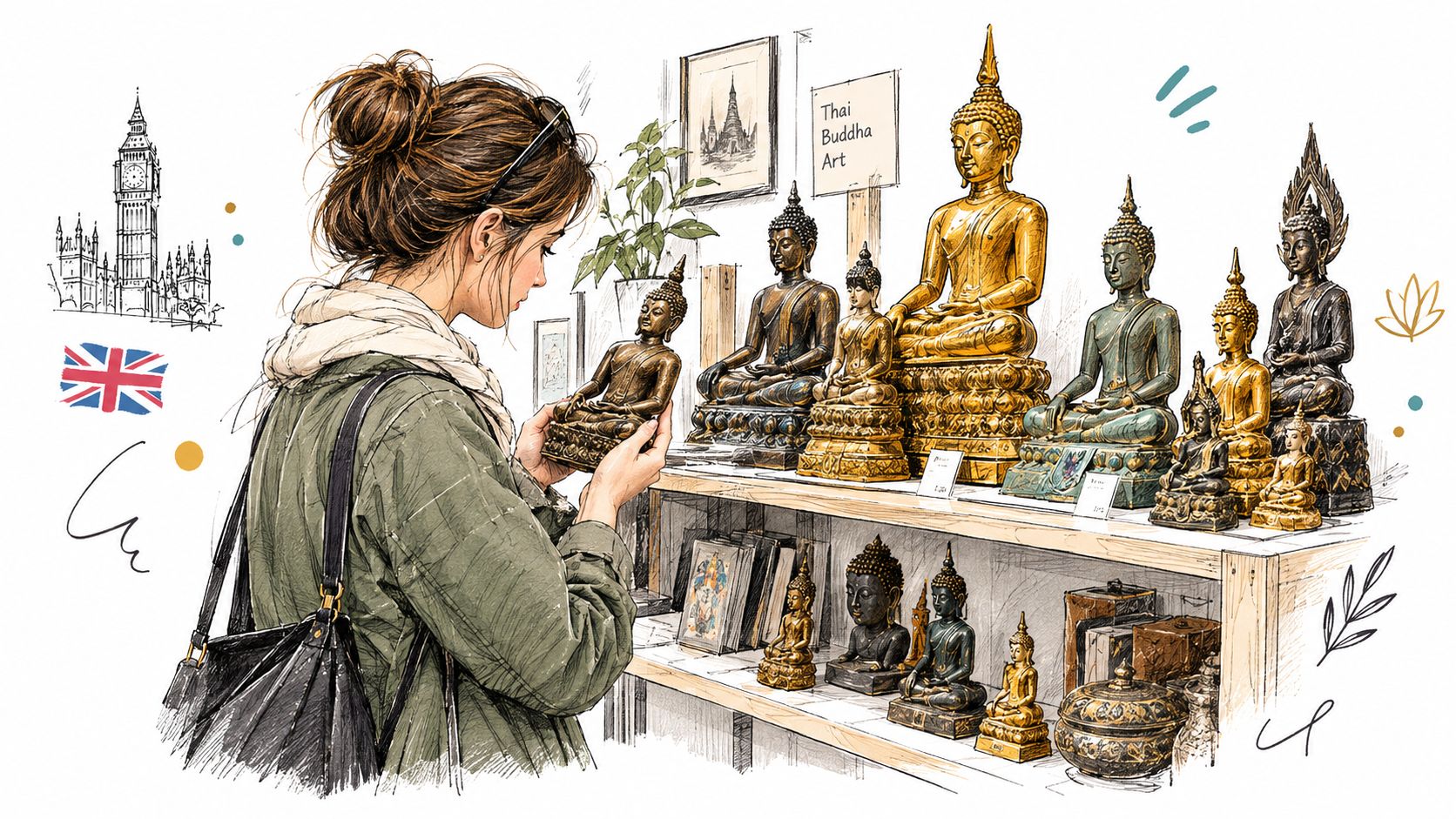
You're standing in a London gallery, turning two Thai Buddha figurines towards the light. One has a soft green-brown surface and a quiet seated expression. The other is brighter, taller and more immediately decorative. The dealer describes both as “Thai Buddhas”, but that label leaves almost every important question unanswered. Which period does each one resemble? Is either suitable for devotional use? What materials are present, and can the seller document how the object reached the UK?
Thai Buddha figurines reward close looking. A useful purchase begins with three jobs: identify the image, evaluate the object, and decide how you'll live with it. Posture and style help you understand what you're seeing, while material checks and provenance records help you judge whether the object is responsibly marketable in the UK. Placement then requires a separate kind of care, because a sacred image isn't automatically equivalent to interior décor.
Table of Contents
- What a Thai Buddha Figurine Actually Is
- Reading the Posture and Hand Gestures
- Periods and Styles Worth Knowing
- Materials, Craftsmanship and Quality Signals
- Provenance, Paperwork and UK Import Rules
- Collecting Versus Decorating With Thai Figurines
- Placement, Etiquette and Respectful Use
- Care, Cleaning and Shipping in the UK
What a Thai Buddha Figurine Actually Is
A Thai Buddha figurine is an image of the Buddha made in present-day Thailand or in one of the kingdoms that preceded the modern state. Most examples relate to the Theravada Buddhist tradition that shaped Thai religious art, but they don't form one uniform visual category. Kingdom, region, material, date, intended use and workshop practice all affect the result.
The first distinction is practical. A devotional image may be used on an altar, in a temple or as part of an active religious setting. A decorative sculpture may be chosen for its form, colour or relationship with a room. A collectible is evaluated more closely for period, attribution, condition, provenance and comparative quality. One object can occupy more than one category, but you shouldn't assume that a visually striking figurine has the same status as an image used in worship.
Start with three questions
Ask these questions before you negotiate a price:
- What am I looking at? Record the posture, hand gestures, clothing, crown, head shape and material.
- What can be demonstrated? Separate stylistic opinion from dated records, ownership history and export documents.
- How will it be used? A shelf ornament, a private altar and a museum display each carry different practical and cultural responsibilities.
The Victoria and Albert Museum's Thai records show why broad descriptions can mislead. Its collections include a silver repoussé relief of seated Buddha Sakyamuni associated with the Dvaravati period, a standing bronze from Ayutthaya, and a crowned copper-alloy Buddha head from seventeenth-century Ayutthaya. These objects belong to different historical and artistic contexts, not interchangeable versions of one style. The museum's records also include a nineteenth-century emaciated Buddha in bronze and a Lopburi sculpture acquired through Horace Geoffrey Quaritch Wales, demonstrating how region, material and acquisition history shape interpretation. The V&A collection record for the crowned Buddha head is a useful reminder to look beyond the generic label.
Reading the Posture and Hand Gestures
Begin with the hands. In Buddhist sculpture, a mudra is a meaningful hand gesture, but it should be read alongside the figure's posture, clothing and expression. A listing that says only “meditation Buddha” may leave out details that help identify a regional or historical form.
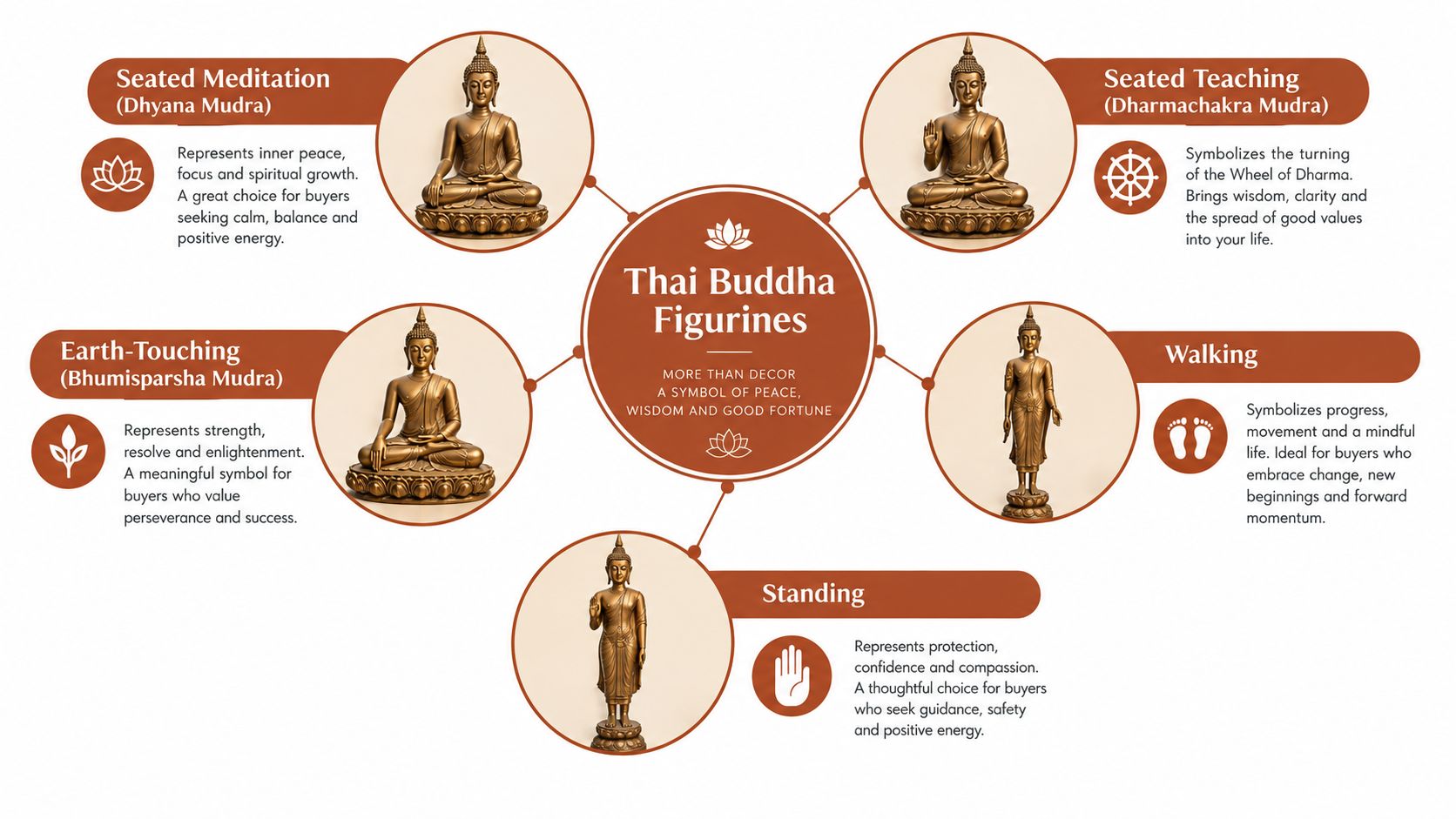
The most familiar gesture is Dhyana mudra, with both hands resting in the lap. It supports an association with meditation and inward concentration, making it common in seated images intended for contemplative settings. Dharmachakra mudra places the hands before the chest in a wheel-turning gesture associated with teaching. Abhaya mudra, often shown with one hand raised, conveys reassurance or fearlessness, while Varada mudra, with the hand lowered, is associated with giving and generosity.
Bhumisparsha mudra: the Buddha reaches down towards the earth, recalling the moment of enlightenment and the earth's witness to his attainment.
The earth-touching form is especially recognisable in Thai and related Southeast Asian traditions. A guide to Buddha mudras and their meanings can help you compare the gestures, but a photograph shouldn't replace inspection of the whole object.
Match the gesture to the posture
- Seated meditation: The figure sits calmly with the hands joined or resting in the lap. Look for a balanced torso and a stable base.
- Seated teaching: The hands are raised near the chest. Small differences in finger contact can matter, so ask for a clear frontal image.
- Earth-touching: One hand descends towards the knee while the other remains in the lap. This is often called the enlightenment posture.
- Reclining Parinirvana: The Buddha lies on one side, representing the passage into final nirvana. Check the length and support of the base carefully, because reclining figures can be structurally vulnerable.
- Standing Abhaya or Varada: The upright body may carry a protective or generous gesture. Standing figures also reveal proportion, robe rhythm and the treatment of the feet more clearly than compact seated examples.
Walking Buddhas deserve separate attention. Their movement is usually expressed through a lifted heel, a relaxed arm and a body that appears to advance rather than sit rigidly within a block. Don't identify a figurine from one hand alone. A crowned head, robe arrangement, facial modelling and body proportion may point towards a different period than the gesture initially suggests.
Periods and Styles Worth Knowing
A working timeline helps you ask better questions, but it shouldn't encourage overconfident dating from appearance alone. Thai Buddhist sculpture changed across successive kingdoms, and the same broad subject could acquire different proportions, clothing and royal associations.
Dvaravati and early forms
The Victoria and Albert Museum holds a Thai silver repoussé relief of seated Buddha Sakyamuni dated to the late seventh to eighth century, associated with the Dvaravati period in central Thailand. This provides an early anchor for the history of Thai Buddhist imagery in UK collections. In a figurine or relief, look first at the overall restraint of the form, the treatment of the body and the relationship between surface technique and iconography. A thin repoussé relief shouldn't be judged by the same standards as a cast bronze.
Lopburi and regional influence
Lopburi represents a distinct historical context, with forms shaped by regional connections and Khmer-influenced visual language. The V&A records a sculpture made in Lopburi that entered the museum in 1929, acquired as part of a group purchased from Horace Geoffrey Quaritch Wales. The record notes that Wales collected Buddhist statuary during travel in Thailand, including objects obtained through visits to historical sites and gifts received at modern temples. That collecting history is not proof that every similarly styled object has the same origin, but it shows why acquisition circumstances deserve attention.
Sukhothai and flowing elegance
Sukhothai examples are often associated with an elegant, elongated body, an oval face, arched brows and a flame-like finial above the head. These features can be useful starting points, particularly when comparing a walking or seated figure with a more compact Ayutthaya example. They remain indicators, not certificates. Later works can borrow earlier forms, and modern makers may reproduce famous Sukhothai characteristics.
Ayutthaya and royal imagery
The V&A records a standing bronze Buddha made in Ayutthaya during the fifteenth to sixteenth century. It also holds a crowned copper-alloy Buddha head dated to seventeenth-century Ayutthaya. The crowned form reflects a revival of crowned and royally dressed Buddha images during the sixteenth century, drawing on earlier Lopburi and Sukhothai forms. Crown, jewellery and regalia therefore carry historical information, but they need to be considered with the face, body proportions and construction.
Thai Buddhist imagery continued beyond the antiquarian periods. The British Museum records a golden Buddha made in Ayutthaya province in 1980 for the royal opening of a temple. After being blessed by Buddhist monks, it was installed at London's Buddhapadipa Temple in Wimbledon in 1982, where it has been venerated by members of the local Thai Buddhist community and other visitors. The Thai Buddha styles collector's guide offers a further comparison point, but museum records and specialist examination remain essential for attribution.
Materials, Craftsmanship and Quality Signals
A first-time buyer may see bronze, wood or lacquer and assume the material settles the question of quality. It does not. Each material ages differently, records damage in different places and reveals workshop decisions through different clues.
Bronze and gilded copper alloy
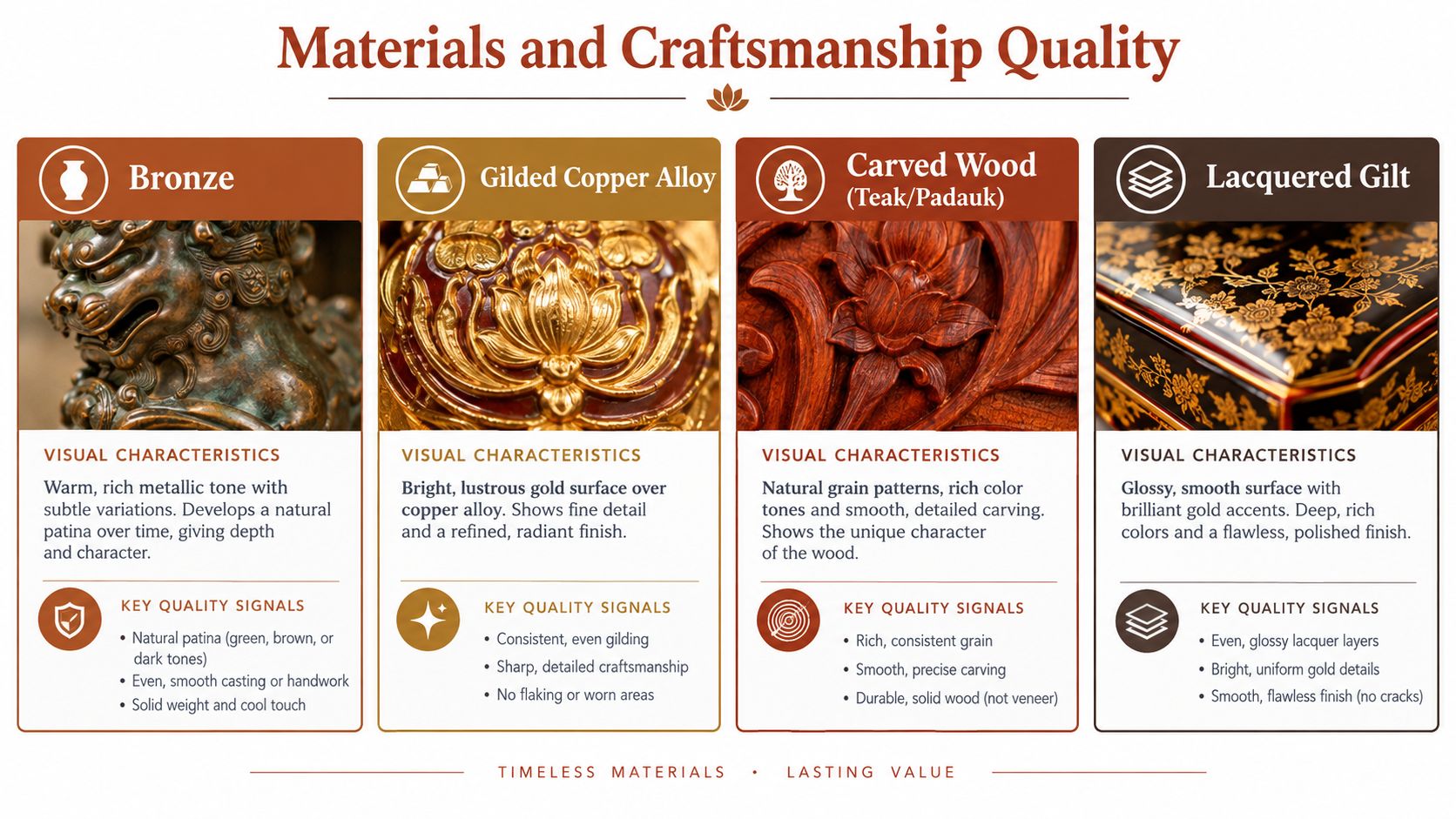
Bronze may develop layered patina, softened edges and small surface variations from handling or exposure. Inspect the casting joins, underside, robe hem and flame finial. A carefully finished figure usually has crisp, natural transitions. Hurried modern work may show cold joins, repeated texture or parts assembled awkwardly.
Gilded copper alloy needs a separate reading. Look for gold surviving in protected recesses, abrasion on raised areas and a consistent relationship between exposed metal and gilding. Uniform brilliance can indicate recent surface treatment rather than untouched age. Blistering, lifting or an unusually thick coating calls for questions about restoration.
Wood, lacquer and stone
Carved teak or padauk can reveal grain, tool marks and shrinkage. Check the base, joins and concealed areas for spongy wood, fresh breaks or filler. A dry surface does not prove age, and a dark finish does not prove historic patina.
Lacquered gilt may cover a wood or stucco core. Fine cracks, losses and gentle variation can occur with age, while broad blistering or detached layers need professional advice. Household polish, wax and solvent can obscure or damage the finish, so do not use them as tests.
Stone gives a figurine weight and visual stability. Chips, repairs and mineral deposits still require separate assessment. A repaired break may suit a decorative purchase, yet matter greatly to a collector seeking an untouched example.
Practical rule: Hand-finished detail at a robe edge or flame finial usually reveals more than a uniformly glossy surface.
Request close photographs of the face, hands, back, base, underside and every reported repair before committing. Compare the seller's description with the visible evidence. Clean casting can still be recent, while a worn surface can conceal structural weakness. For display and handling decisions, refer to a dedicated care guide, but material identification may require a conservator.
Provenance, Paperwork and UK Import Rules
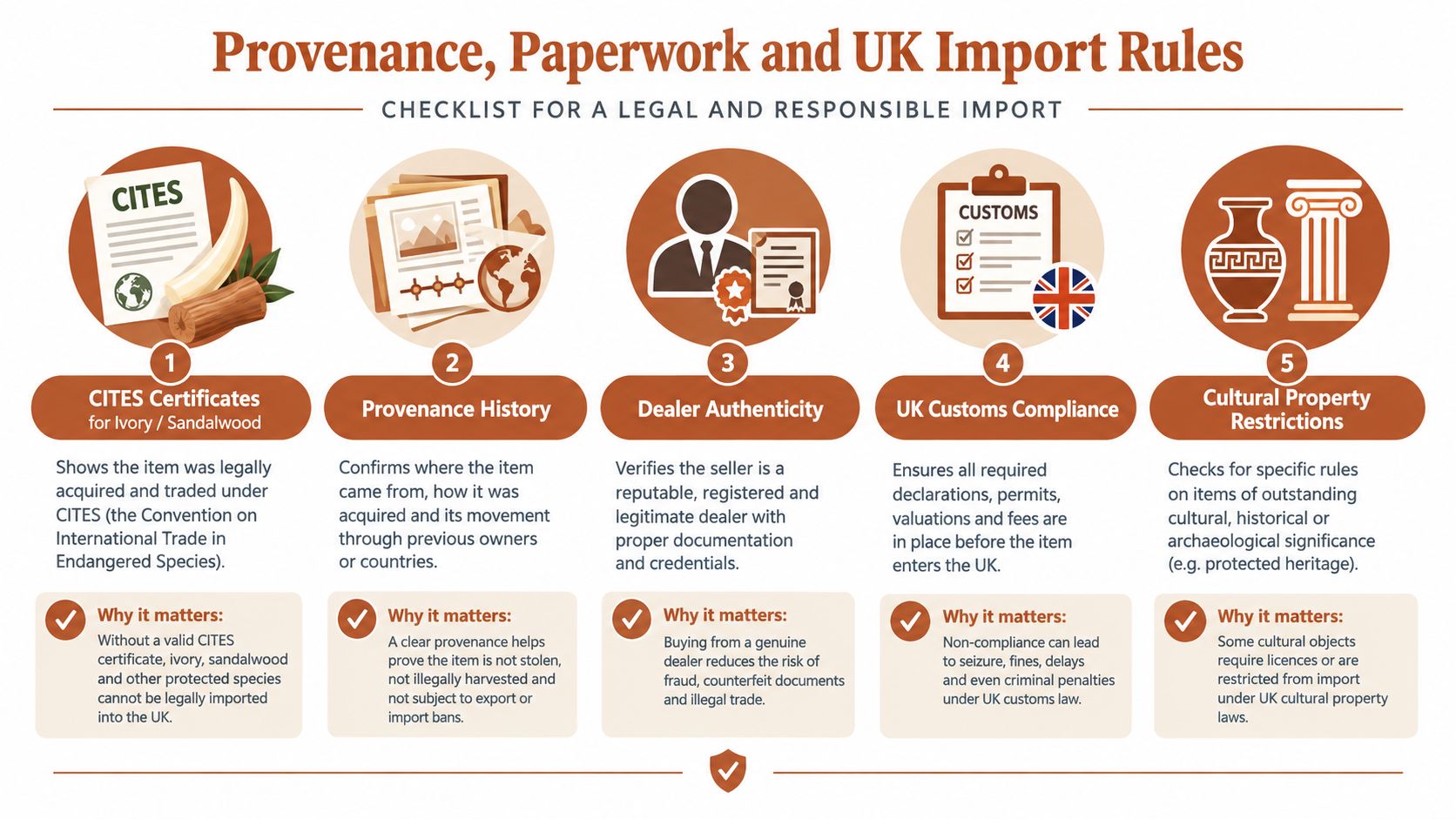
For a UK buyer, provenance is not a decorative paragraph attached to an object. It can affect whether the figurine may be bought, imported, resold or displayed by an institution. Under the Dealing in Cultural Objects (Offences) Act 2003, dealing in cultural property that was unlawfully exported can be a criminal offence when the dealer knows or has reason to suspect that the export was unlawful. The official guidance explains that dealing can include acquiring, disposing of, importing or exporting an object, or arranging for another person to do so. It applies to cultural property imported into the UK on or after 12 December 2017, including religious works of artistic or historical importance. The government guidance on dealing in cultural objects sets out the legal context.
Build an item-level file
Ask the seller for records that relate to the actual figurine, not just a general statement that the gallery deals in authentic art.
- Invoice and seller identity: Keep the purchase invoice, description, price and seller details together.
- Ownership history: Request previous collection details, old photographs, inventory references or estate documentation where available.
- Date and place of manufacture: Treat an approximate date as an attribution, not proof of age.
- Material statement: Ask specifically about ivory, tortoiseshell, horn and other animal-derived components, including concealed inlays.
- Export and customs records: Retain any export licence, customs paperwork, shipping invoice and import documentation.
- CITES evidence: If regulated wildlife material is present, ask for the relevant CITES paperwork before payment or shipment.
The Ivory Act 2018 bans dealing in ivory, including importing ivory into the UK for sale or hire, subject to defined exemptions. Certain pre-1918 objects of outstanding artistic, cultural or historical importance may qualify through certification or registration, but you shouldn't assume a small ivory detail falls outside the rules. The official Ivory Act enforcement guidance makes material inspection actionable. Look at teeth, tusks, inlays, cabochons and concealed components before arranging import.
Understand the route
Government guidance states that importing cultural objects into Great Britain may require compliance with the exporting country's licensing regime. Requirements can differ for Northern Ireland and for movements involving the European Union. From 28 June 2025, certain movements involving Northern Ireland and the EU can require an import licence or importer statement supported by evidence of lawful provenance. The UK guidance on exporting or importing objects of cultural interest explains why destination and route matter.
Museum standards make the logic clearer. Guidance discussed in relation to a thirteenth-century Thai Buddha at SOAS identifies three evidential routes: proof that the object was already in the UK before 1970, proof that it was outside its country of origin before 1970 together with evidence of import into the UK, or proof that it remained in its country of origin after 1970 together with documentation of legal export. The SOAS discussion of provenance standards also cites ethical guidance advising museums to reject an item lacking a secure ownership history unless reliable documentation shows export before 1970.
A plain figurine with a traceable history may therefore be a safer long-term purchase than a more attractive object supported only by patina and confident sales language.
Collecting Versus Decorating With Thai Figurines
The right purchase depends on what you expect the object to do. A collector wants evidence that survives scrutiny. A decorator wants a form that works in a room. A practitioner may need an image that can occupy a devotional setting with appropriate respect.
| Your priority | What to examine first | Dealer conversation |
|---|---|---|
| Collecting | Provenance, period, attribution and condition | Ask for records, comparable examples and details of repairs |
| Interior use | Scale, silhouette, finish and placement | Ask about material care, weight and safe display |
| Devotional use | Iconography, condition and cultural context | Ask whether the image's history and intended use are known |
Collectors should resist buying solely because a figure resembles Sukhothai or Ayutthaya work. They'll want a coherent description, a documented ownership trail and a condition report that distinguishes old wear from recent intervention. Comparative quality matters too. A finely finished modern image can be preferable to a damaged antique if the buyer's purpose is visual or devotional rather than historical.
Decorators face a different tension. A highly reflective gilded figure may dominate a quiet room, while a dark bronze may disappear against dark shelving. A standing image needs enough surrounding space to remain legible, whereas a small seated figure can sit comfortably within a carefully arranged display. Material also affects daily life. Wood and lacquer usually need more protection from heat, sunlight and unstable conditions than a durable bronze surface.
The British Museum's record of the golden Buddha installed at Buddhapadipa Temple in Wimbledon in 1982 demonstrates a third category. It is an object with aesthetic and historical interest, but it also remains connected to active veneration by a Thai Buddhist community. That status can't be inferred from appearance alone. Ask how the object was made, where it has been used and whether the seller describes it as devotional, decorative or collectible.
Placement, Etiquette and Respectful Use
A Thai Buddha figurine shouldn't be placed according to a universal “lucky direction” rule. Start by deciding whether the image is devotional or decorative, then give it a clean, raised position where it isn't crowded by footwear, household clutter, waste or casual utility objects. Floor-level placement can be considered disrespectful by some practitioners, particularly when the image is intended for worship.
Thai Theravada expectations aren't interchangeable with Burmese, Tibetan, Chinese, Japanese or Zen conventions. A home altar may include a simple arrangement for meditation and offerings, while a decorative shelf may need only a dignified setting and sufficient visual space. In either case, avoid positioning the face where people routinely step over or handle the object carelessly.
The context matters in Britain. An Oxford-hosted study reports 174,000 Buddhists in England and Wales in the 2018 census, representing 0.47% of the population. Those figures come from the Oxford-hosted study, and they underline that respectful presentation affects real communities, not an abstract etiquette debate.
For a meditation room, hotel, restaurant, museum or public installation, ask a local Thai Buddhist temple or practitioner before fixing the display. Their guidance may differ according to lineage, household practice and intended use. Consultation is more reliable than assuming that one placement diagram represents every Buddhist tradition.
Care, Cleaning and Shipping in the UK
A figurine can leave a gallery in excellent condition and arrive with a broken finial or loosened base. Good care therefore begins before unpacking and continues through display.
Dust bronze and gilded surfaces with a soft, dry brush or cloth. Keep carved wood and lacquer away from radiators and strong direct sunlight, and avoid sudden changes in temperature or humidity. Household polish can stain, abrade or soften lacquered gilt, so use it nowhere near a figurine unless a conservator has approved the treatment.
Bronze and gilded pieces generally withstand more routine handling than carved wood, but every material has vulnerable points. Lift the object with both hands, support projecting elements, and never carry it by the finial, arm, crown or another attached detail. If a bronze surface needs treatment, consult Evo Dyne Products bronze restoration first. Valuable, unstable or structurally damaged pieces should go to a conservator.
Record the journey home
Treat delivery like a condition check in a museum store:
- Photograph the outer packaging before opening it.
- Keep all outer and inner packing materials until the object has been inspected.
- Photograph the figurine from every side immediately after unpacking.
- Record chips, detached parts, crushed corners or movement inside the box.
- Contact the seller promptly and retain the packaging for a possible claim.
UK buyers should read the seller's shipping and returns terms before ordering. Check the stated free-shipping threshold, delivery arrangements and process for reporting transit damage. For practical advice on display, care and transit, consult this Buddha statue shipping and care guide.
HD Asian Art offers Thai Buddha statues and related Southeast Asian sculptures organised by region, material and form. Its descriptions support collectors, institutions, private interiors and devotional settings. Visit HD Asian Art to compare seated, standing, walking, reclining and teaching images, then request the material, condition and provenance details needed before choosing.
