



History of Buddhism in Southeast Asia
History of Buddhism in Southeast Asia
A bronze Buddha can travel farther than the temple that first housed it. A collector in Britain may hold the object in a quiet room, yet its form still carries the imprint of royal patronage, monastic learning, and the maritime routes that once tied Southeast Asia to Sri Lanka, India, and China.
Table of Contents
- The Journey of Sacred Art Across Centuries
- Maritime Trade and Early State Formation
- The Classical Period and Theravada Reforms
- Mainland Orthodoxy Versus Maritime Syncretism
- Reading the Material Culture of Devotion
- The Modern Footprint in UK Collections and Society
- Stewardship and Responsible Acquisition
The Journey of Sacred Art Across Centuries
A stone or bronze Buddha rarely stays just one object for long. It may begin in a workshop shaped by court taste, monastic teaching, and local devotion, then pass through centuries of use, damage, burial, removal, and survival before it reaches a modern collection. That is why History of Buddhism in Southeast Asia is easier to understand through objects than through dates alone.
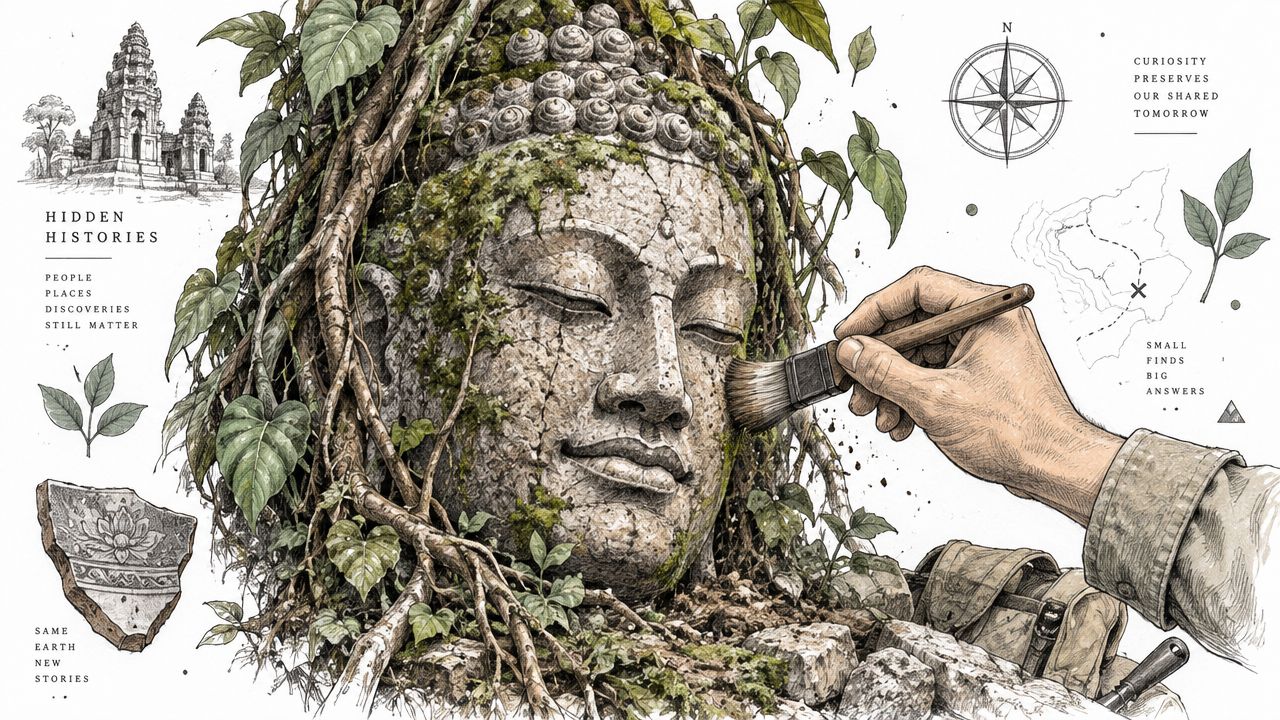
From temple altar to study shelf
A sculpture made for a monastery in mainland Southeast Asia could begin as an act of merit, then move into a courtly setting where rulers used Buddhist imagery to support political authority. The same piece might later survive burial, relocation, or sale, and finally appear in a UK collection where its surface, posture, and iconography can still be studied. One object can hold several lives at once.
That continuity matters because a Buddhist image is evidence of a religious world shaped by monastic networks and royal support across Sri Lanka, Burma, and Thailand (British Library manuscript collection).
For private collectors, the appeal is not only visual. A well-made bronze or stone image often reveals its history in the folds of the robe, the calm of the face, or the shape of the hands. Those details are not random decoration. They help place the object within the wider Buddhist world, much as a trained curator reads a label alongside the object itself.
A serene surface can hide a dense cultural vocabulary. In Southeast Asian Buddhist art, restraint often signals a developed theological and courtly language.
The British Library's Southeast Asian Buddhist manuscripts, including material dating to around 1700 or earlier, preserve the textual side of that same world (British Library manuscript collection). The object and the manuscript belong to the same story, even when they now sit in different institutions.
Maritime Trade and Early State Formation
Buddhism entered Southeast Asia through movement, not as a sealed system. Merchants, monks, gifts, and ideas travelled along sea routes linking the region with India, China, and Sri Lanka. Early rulers were active participants in that process. They selected, adapted, and sponsored Buddhist forms that suited court life, trade, and political order, a pattern that helps explain why objects in museum cases often look both local and widely connected (Britannica on Southeast Asia).
Ports were cultural workshops
Ports brought together people who spoke different languages and followed different rituals. Sacred texts, workshop skills, and visual motifs could circulate in the same harbour. A kingdom such as Srivijaya functioned as a maritime hub and a place where monks and artisans moved between languages, devotional practice, and local belief. Its wider network is well described in an overview of Srivijaya's maritime power and its links to Thailand (HD Asian Art on Srivijaya's maritime power).
That setting produced layered art. Buddhist images often sit beside older Hindu forms and indigenous spirit traditions, like a manuscript written in more than one hand. The port did not erase local culture. It gave local culture new patrons, new materials, and new symbols.
A monastery needed support. A ruler needed legitimacy. A merchant network needed trust. Buddhism could serve all three, which is one reason it became part of court culture rather than remaining only a private faith.
The British Museum's Asia Department describes its Southeast Asian holdings as “extraordinarily rich” and notes sculpture, coins, lacquer, Thai banner paintings, and Javanese theatrical objects among them (British Museum Asia Department). That breadth matters. It shows that Buddhism belonged to a wider material world of trade, diplomacy, and ceremony, not just to scripture.
Why courts mattered
Local courts used Buddhist cosmology to support political authority. In practical terms, that meant commissioning images, sustaining monastic communities, and tying the ruler's status to religious merit. The result was a distinct Southeast Asian Buddhism that could absorb older beliefs without losing its own ritual centre.
Collectors often notice the visual result before the history behind it. A carved head from the mainland may seem restrained beside a more narrative maritime relief, yet both were shaped by exchange networks and royal patronage. The difference lies not only in style. It lies in the kind of religious world each court chose to build.
The Classical Period and Theravada Reforms
A useful way to read mainland Buddhist art is to follow the court centers that gave it form, from Śrīvijaya and Angkor to Pagan, Sukhothai, and Luang Prabang. During the classical period, these courts helped shape how Buddhism was taught, sponsored, and pictured in stone and bronze. The shift towards Theravāda on the mainland also brought Pali learning into closer contact with ritual life and image-making (Encyclopedia.com overview).
Reform changed the look of the Buddha
The 11th-century Theravāda reform in mainland Southeast Asia linked local practice more closely to the Sinhala Mahāvihāra monastic line. A clear overview of Theravāda Buddhism helps explain why this mattered for both doctrine and objects. When patrons and monks accepted Pali authority more fully, they also changed the visual language they preferred, from the Buddha's posture to the degree of ornament around an image (HD Asian Art's overview of Theravāda Buddhism).
A collector looking at a Burmese or Thai bronze should read that reform in the object itself. The calm face of a Pagan Buddha, or the poised elegance of a Thai standing figure, reflects a religious world that valued court sponsorship, monastic discipline, and a more disciplined public image of devotion. The style feels restrained because the theology behind it asked for clarity.
A few landmarks help anchor the period
- Pagan became a major centre of mainland Buddhism, and its sculpture and temples show Theravāda ideals settling into court culture.
- Sukhothai is closely linked with the graceful walking Buddha, a posture that gives visible motion to a teaching usually expressed through stillness.
- Angkor shows older Khmer religious layers persisting even as Buddhist forms gained strength.
- Luang Prabang belongs to the same broad classical world, where royal sponsorship helped stabilise Theravāda practice.
Pilgrimage also tied this region to a wider sacred world. Accounts noted in the medieval period place Bodh Gaya as a major pilgrimage centre for the Buddhist world, and that connection matters for Southeast Asia because it shows how regional courts looked beyond their own borders for religious authority. Objects made under these conditions often carry that same outward reach, even when they were made for local use.
Curatorial note: when a bronze image feels unusually balanced and restrained, ask whether it belongs to a reform moment. Formal calm often signals theological consolidation as much as aesthetic taste.
For the visual side, mainland reform did not erase artistry. It gave patrons a narrower set of forms to work with, and that is why so many surviving images feel carefully edited, almost like a manuscript copied by a strict hand.
Mainland Orthodoxy Versus Maritime Syncretism
Mainland Southeast Asia moved toward Sinhala Theravāda orthodoxy, while the maritime world retained stronger Mahayana, tantric, and syncretic layers for longer. That contrast helps explain why a statue from Burma or Thailand often reads differently from a monument in Java or Sumatra, even when both belong to the wider Buddhist world.
Two religious climates, two visual languages
On the mainland, image-making usually stresses clarity, poise, and doctrinal discipline. Smooth bronze surfaces, refined facial features, and restrained hand gestures create figures that communicate meditation, teaching, or reassurance with little ornament. The effect is controlled and legible, which suits a court culture that wanted the Buddha to appear calm and authoritative.
In the maritime archipelagos, Buddhist art remained closely tied to broader tantric and Mahayana traditions. Multi-armed deities, layered cosmological programmes, and narrative reliefs continued much longer there. Borobudur stands as the clearest reminder of that world, and Britannica on Southeast Asia notes how this regional diversity shaped the Buddhist record. For collectors, the point is simple, provenance and regional setting shape how an object should be read.
Why the distinction matters for art
A bronze from Thailand and a carved figure from Java may both show the Buddha, yet they solve different artistic problems. One belongs to a tradition of courtly orthodoxy. The other comes from a ritual setting where local cosmology remained visible. Recognising that difference keeps the region from collapsing into a single style.
The British Museum Asia Department preserves this diversity in sculpture, lacquer, and banner paintings, and that material record is part of the story collectors study today. Objects in such collections work like gallery labels in three dimensions. They show how trade routes, royal patronage, and local belief left distinct traces in bronze, stone, and carved relief.
Reading the Material Culture of Devotion
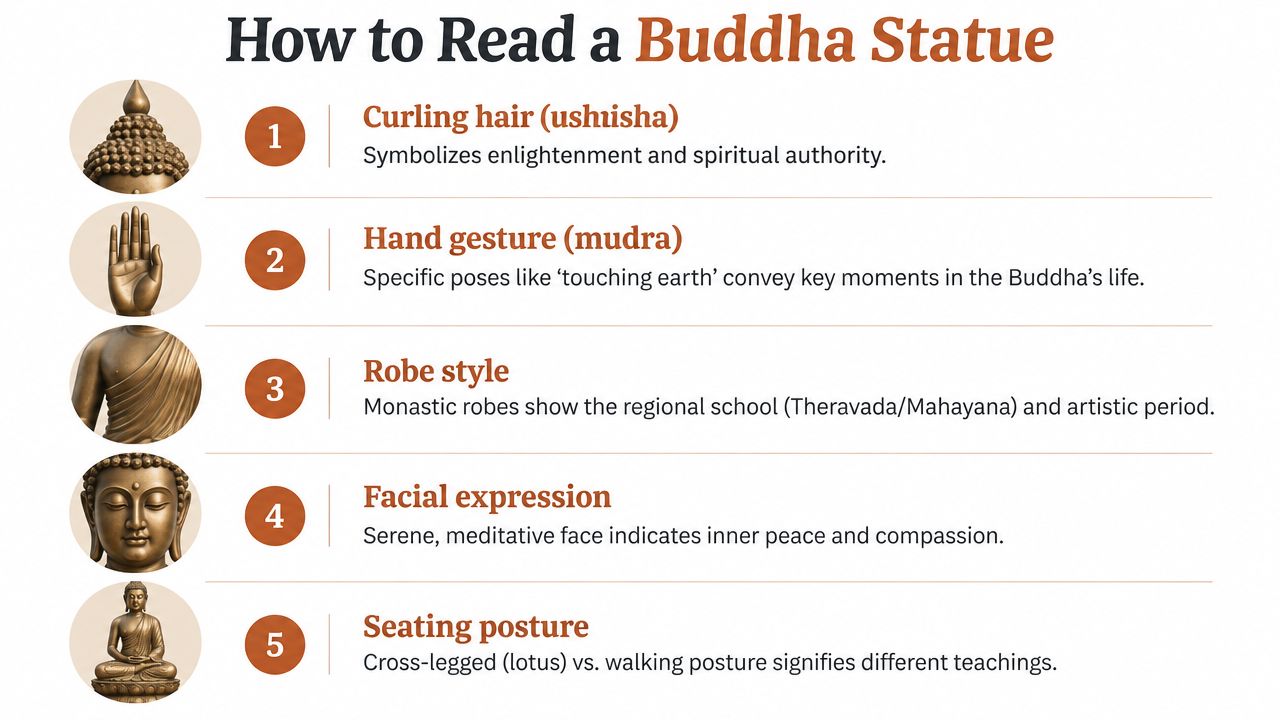
A Southeast Asian Buddhist statue can be read like a document if you know where to look. Start by separating what carries meaning from what merely decorates. Material, posture, and hand gesture usually reveal more than surface polish or a later mount.
Start with the body
A seated figure usually points to contemplation, teaching, or enlightenment. A walking Buddha, especially in the Thai tradition, suggests active grace and a different devotional emphasis. In the classical mainland context, posture can be as revealing as an inscription.
Then read the mudra, the hand gesture. Earth-touching gestures point to a decisive moment in the Buddha's life, while teaching gestures suggest a more public doctrinal setting. These poses are not interchangeable, because each one shows how a community understood the Buddha's presence.
Then read the surface
The robe matters too. A tight, simplified robe can reflect Theravāda restraint, while more elaborate drapery may point to a different school or artistic setting. Facial expression is equally important. A softened, inward-looking face often signals meditative calm, which helps explain why so many mainland bronzes feel composed and self-contained.
For collectors, the practical question is not only “Is it beautiful?” but “What religious world is this object carrying?” The answer usually comes from several small details working together:
- Hair and cranial form can indicate spiritual elevation.
- Mudra can identify a life episode or teaching mode.
- Robe treatment can hint at school and period.
- Facial expression can suggest regional preferences for serenity or intensity.
- Seating or standing posture can place the figure within a broader iconographic tradition.
Practical rule: do not judge a Buddhist sculpture by age alone. A later piece can preserve an older iconographic language, and a damaged object can still hold the most important historical clues.
The British Library's manuscripts, including the Pātimokkha in the Sloane collection, show that the textual side of Southeast Asian Buddhism can be preserved as carefully as sculpture (British Library manuscript collection). A useful comparison comes from a study of Buddha imagery and iconographic signs in sculpture, which helps connect mudra, robe treatment, and bodily form to the devotional world an object came from. The careful collector reads both the object and its literary world.
The Modern Footprint in UK Collections and Society
A collector standing before a Southeast Asian Buddha in a UK gallery is looking at more than a finished object. The sculpture has travelled through worship, trade, scholarship, and museum care, and its present setting still reflects those earlier routes.
The modern UK holds that history in two visible ways: in the Buddhist communities who live here, and in the collections that keep older material forms within reach. The 2021 England and Wales census recorded 272,508 Buddhists, or 0.5% of the population, while the UK total was 289,551, about 0.4% (UK Buddhist population census summary). Within England and Wales, 67,152 Buddhists were born in Southeast Asia, or 24.6% of the Buddhist population, which makes that region the single largest overseas birthplace category after the UK itself.
What the institutions hold
| Institution | Collection Focus | Historical Significance |
|---|---|---|
| British Library | Southeast Asian Buddhist manuscripts, including material dating to around 1700 or earlier | Preserves textual evidence of the region's Buddhist traditions in Britain |
| British Museum | Asia collections spanning East Asia, South and Central Asia, and Southeast Asia | Provides a wide material archive for studying Buddhist art across regions |
The British Library's holdings show how long Southeast Asian Buddhist textual culture has been preserved in Britain. A manuscript can do for doctrine and ritual what a bronze statue does for devotion, it keeps a way of seeing alive in material form. The British Museum's Asia collections provide a broad field of comparison for Buddhist art across regions. British Museum Asia Department
Migration and museum audiences meet in the same space
The census figures explain audience as much as population. People with Buddhist backgrounds from Southeast Asia now live alongside the collections that preserve older forms of their visual heritage. That creates a living bridge between temple history and museum interpretation.
Collectors should take that seriously. A sculpture from Myanmar or Thailand is not only an art object, it belongs to a wider British cultural conversation that includes diaspora communities, scholars, and museum visitors. Those communities give the history present-day relevance, and they give curators a reason to handle these works with care and context.
Stewardship and Responsible Acquisition
A collector holding a Southeast Asian Buddhist image is holding more than an object. The piece has likely passed through devotion, political upheaval, and periods of fragile survival, so stewardship begins before purchase and continues long after it enters a collection. Provenance, condition, and cultural sensitivity all matter.
What responsible ownership looks like
Start with origin. Where did the object come from, and how did it leave its original setting? If the history is unclear, caution is the right response. A sound collection rests on evidence, not assumption.
Then look at conservation. Bronze, stone, lacquer, and polychrome surfaces age in different ways, so display conditions should match the material. Direct sunlight, unstable humidity, and rough cleaning can cause lasting harm, especially to pieces with fragile surfaces or old repairs.
Context matters too. A statue shown only as decoration loses the historical and devotional meaning that shaped it. Better records note region, likely date, school, and iconographic features, so the work remains readable as a Buddhist image rather than a generic ornament.
For a more detailed framework, HD Asian Art's legal and ethical guide to collecting Southeast Asian art is a useful place to begin. It aligns with the standards museums use when acquiring or displaying similar material.
Collector's discipline: buy slowly, document everything, and treat every piece as part of a living historical record.
Responsible collecting protects more than market value. It keeps the story of History of Buddhism in Southeast Asia intact for the next researcher, the next curator, and the next household that chooses to live with these works.
