



What Does “Style of” Mean in Asian Art? a Guide to Attribution Language
What Does “Style of” Mean in Asian Art? a Guide to Attribution Language
Have you ever seen “style of” on an Asian art catalogue entry and assumed it meant either “poor quality” or “modern fake”? That reaction misses the more useful question: what evidence does the wording support?
For collectors, attribution language is a working vocabulary. It separates a firm artist identification from a resemblance, a workshop connection, a school tradition, a later copy, or a revival. In Asian art, where unsigned objects, collaborative production, repeated devotional forms, and regional transmission are historically common, that distinction matters.
A bronze Hindu deity, Buddhist figure, stone relief, or carved wooden statue may be visually compelling without being directly attributable to the named artist. A cautious description can therefore be more informative than a confident but unsupported name. The task isn't to treat uncertainty as a defect. It's to understand what the object, its materials, its history, and its comparison with documented examples can legitimately establish.
Table of Contents
- Why Attribution Language Matters in Asian Art Collecting
- The Evidential Hierarchy Behind Style Of Attributions
- Comparing Key Attribution Terms For Collectors
- Assessing Indian Bronze Stone And Wood Statues
- Workshop Production And Collaborative Attribution
- Conservation And Shipping Fragile Asian Sculptures
- Making Confident Attribution-Based Buying Decisions
Why Attribution Language Matters in Asian Art Collecting
A collector browsing an online catalogue may find an Indian bronze described as “style of” a regional school or deity tradition. The label can seem unsatisfying at first. If the sculpture resembles a recognised Chola, Pala, or Himalayan form, why not just name the artist or period?
Because resemblance and authorship aren't the same claim.
Specialist cataloguers work with objects that may be unsigned, moved between regions, copied across generations, or produced within workshops. A facial type, hand gesture, crown, robe, or lotus base can persist through a tradition without identifying one maker. The phrase “style of” communicates that the object follows a known visual language, while the evidence doesn't justify saying that the named artist made it.

A label is not a verdict on quality
“Style of” doesn't automatically mean an object is worthless, inauthentic, or newly manufactured. It may describe a historically meaningful work made by an artist outside the named master's immediate workshop, a later follower, a regional interpreter, or a maker participating in a revival tradition.
UK museum practice uses attribution terms to express degrees of confidence. The British Museum, for example, catalogues a Japanese screen as “Attributed to the Manner of” Watanabe Shiko. The record identifies the Rinpa School, places production in the 18th century, and explains that an earlier attribution to Watanabe Shiko, who lived from 1683 to 1755, was reconsidered because the screen was probably made at least a century later. See the British Museum catalogue record for the Japanese screen for the relationship between artist, style, school, geography, and date.
That example shows why a collector shouldn't isolate one phrase from the rest of the description. Date, place, school, materials, provenance, and attribution work together.
Collector's rule: Read “style of” as a statement about visual relationship, not as a hidden declaration that the object is defective.
Before buying, ask what the phrase refers to. Does it describe iconography, brushwork, casting, carving, composition, or an overall appearance? Then ask what evidence could support stronger wording, such as “attributed to,” “workshop of,” or “after.” A useful provenance research guide for Asian antique sculpture can help organise the object's ownership history and documentary trail.
The Evidential Hierarchy Behind Style Of Attributions
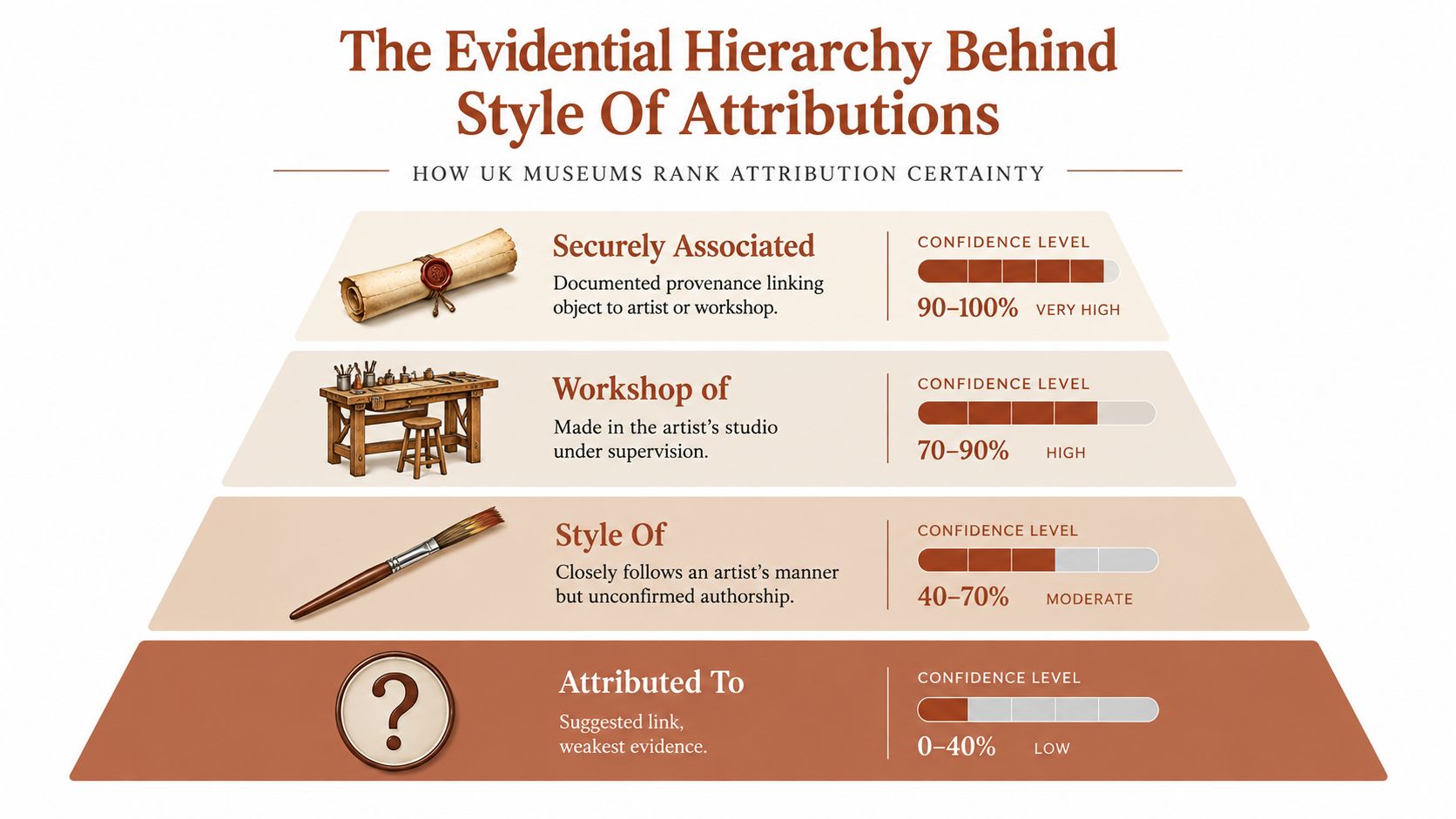
UK museum catalogues often arrange attribution as an evidential hierarchy rather than a list of interchangeable labels. At one end are signed or securely associated works. Further down come objects linked to a workshop, studio, circle, follower, or visual tradition. Copies and later imitations occupy different positions because they make different claims about authorship and date.
How museum frameworks separate claims
The National Gallery's cataloguing framework places securely associated or signed works first. Works connected with an artist's workshop follow. Paintings made outside the workshop but practising in the artist's manner come later, and copies appear at the end. The catalogue also warns that dating can remain speculative when it rests only on stylistic criteria. Its discussion of the National Gallery's attribution framework demonstrates why a stylistic match can't establish exact date or maker by itself.
This hierarchy matters because each term carries a different evidential burden.
| Position in the hierarchy | What the wording supports | What it doesn't prove |
|---|---|---|
| Securely associated or signed | A strong connection to the named artist or workshop | That every aspect of production involved the artist personally |
| Workshop of or studio of | Production within an artist's working environment, possibly collaboratively | That the master executed the whole object |
| Style of or manner of | Resemblance to an artist's visual language | Direct authorship, workshop manufacture, or precise dating |
| Copy or after | A work based on a known prototype or composition | That it was made during the prototype's period |
The British Museum's terminology also distinguishes “claimed to be by”, which records an earlier assertion, from “attributed to”, which reflects a later scholarly judgement. “In the style of” can indicate that likeness exists while the original attribution is doubtful. This is especially relevant for Asian objects carrying later inscriptions or no maker's inscription at all.
Why cautious language protects the collector
A catalogue that says “style of” prevents several errors at once. It stops a visual resemblance becoming a false artist attribution, prevents a stylistic label from supplying an unsupported date, and gives the buyer a reason to investigate construction, materials, restoration, and provenance.
That caution isn't evasive. It's a form of accuracy. A collector can still value the object for its design, devotional meaning, workmanship, rarity, or cultural context without treating uncertain authorship as established fact.
Comparing Key Attribution Terms For Collectors
Auction catalogues and museum records use related terms with distinct implications. The wording can affect how a collector understands authorship, date, workshop connection, and the evidence still required.
The table below offers a practical reading guide.
Asian Art Attribution Terms Explained
| Attribution Term | Implied Relationship | Typical Date Context |
|---|---|---|
| By | The cataloguer considers the object to be by the named artist | Consistent with the artist's lifetime or documented production |
| Attributed to | Probably by the named artist, at least in part, but open to revision | Usually compatible with the artist's period, though uncertainty remains |
| Workshop of | Made in the artist's studio or workshop, possibly under supervision | Generally contemporary with the artist's working period |
| Studio of | Associated with production in the artist's studio | Usually contemporary or close to the artist's period |
| Circle of | A period work showing the artist's influence, without secure workshop evidence | Usually contemporary or nearly contemporary |
| Follower of | Made in the named artist's manner by a contemporary or nearly contemporary artist | Often close to the artist's period |
| Style of | Imitates or follows the artist's manner without claiming direct authorship | May be contemporary, later, or from a revival context |
| Manner of | Executed in the artist's style at a later date | Later than the named artist |
| After | A copy based on a work by the named artist | Any period after the prototype, depending on the catalogue |
UK auction guidance treats these expressions as opinions that communicate degrees of attribution certainty. “Attributed to” is stronger than “style of” because it presents a probable authorship claim. “Workshop of” suggests a more specific production relationship. “Circle of” indicates influence, not necessarily physical studio participation.
The difference between style of and after
Collectors often confuse “style of” with “after.” The first describes a relationship of manner or visual language. The second identifies a copy of a particular work, regardless of when that copy was made. A statue may be in the style of a regional tradition without reproducing one known prototype, while an object described as after a named work should be traceable to that composition or model.
“Manner of” usually places the work later than the named artist. By contrast, UK auction guidance allows “style of” or “follower of” to describe work that may be contemporary or nearly contemporary, depending on the catalogue's opinion. Christie's Asian-art terminology makes a related distinction between “manner of,” “after,” “follower of,” and “style.” The Asian art attribution terminology reference is useful when a sale description uses several of these terms together.
For a broader discussion of regional wording, see this guide to Khmer style and honest catalogue language.
Assessing Indian Bronze Stone And Wood Statues
A stylistic label should start an examination, not finish it. Indian bronze, stone, and wooden statues require separate attention to iconography, material, construction, surface, inscription, restoration, and ownership history.
Begin with the image and the object
First, identify what the statue represents. Confirm the deity, Buddhist figure, mudra, vehicle, attributes, crown, jewellery, posture, and base. Iconography can support a regional or religious association, but it rarely identifies a single maker because devotional forms are intentionally repeated.
Next, inspect the material and construction.
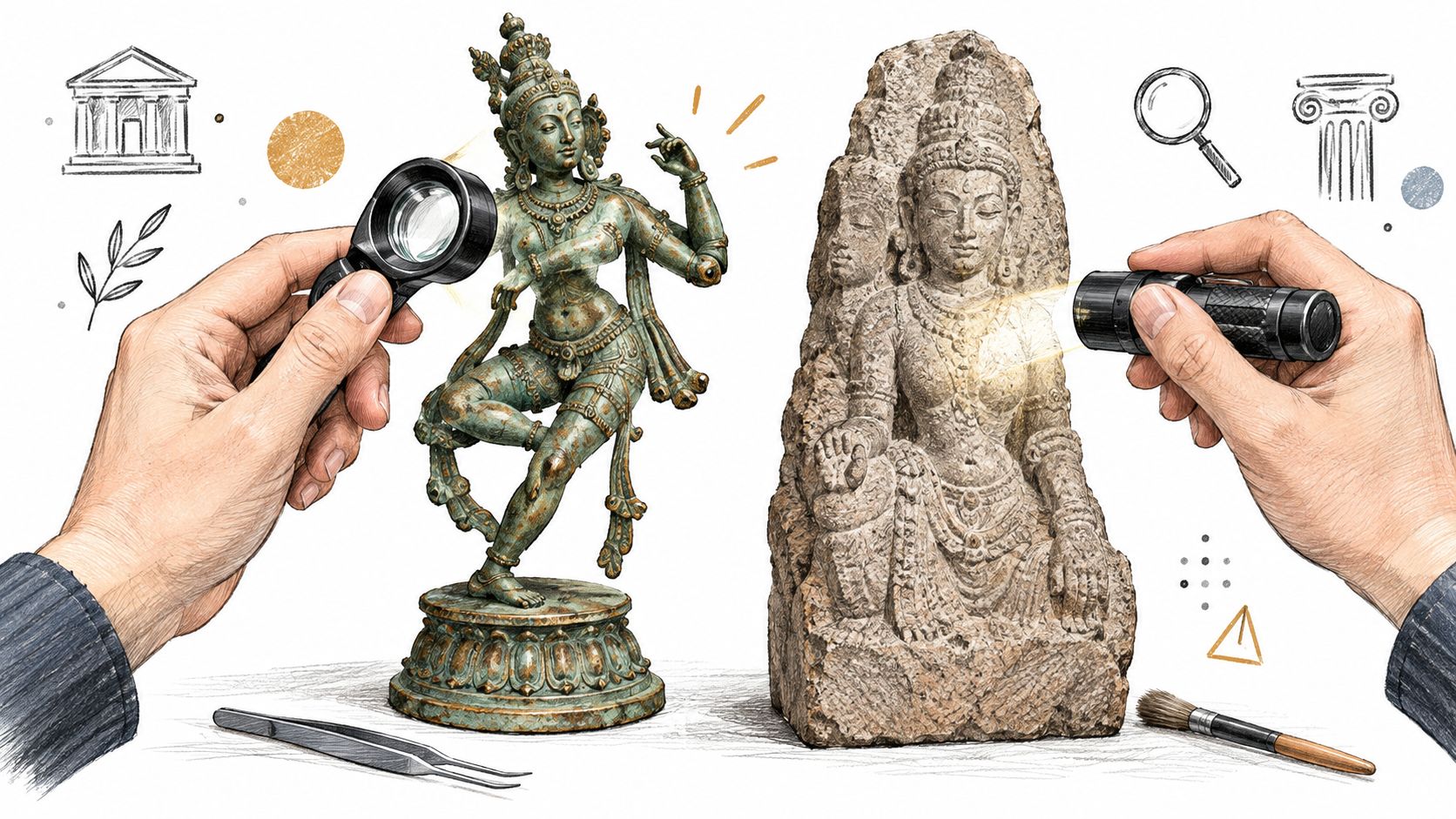
- Bronze: Look at casting quality, joins, hollow or solid construction, chasing, attachments, surface deposits, and areas of handling wear. A convincing appearance doesn't establish an early date.
- Stone: Examine the stone type, tool marks, carving depth, edges, abrasions, breaks, and whether the surface treatment is consistent across protected and exposed areas.
- Wood: Check grain, shrinkage, joints, cracks, insect damage, gesso, lacquer, pigment layers, and areas where later paint or repair may conceal the original surface.
The National Gallery's attribution practice is a useful reminder that dating based only on style can remain speculative. A later artist may reproduce canonical facial types, gestures, robes, and compositional formulas with considerable skill.
Treat surfaces and inscriptions carefully
Patina isn't a date stamp. Bronze surfaces can be cleaned, chemically treated, repaired, or artificially altered. Stone can acquire surface staining, and wood can receive later coatings. Compare areas that would have been handled with recesses, undersides, cavities, and protected folds. Consistent wear tells a more useful story than a darkened surface alone.
Inscriptions need equal caution. They may preserve a maker's name, a dedication, a donor's identity, a later ownership note, or a collector's interpretation. The Natural History Museum's UK collection documentation notes that much Indian and Chinese material was made by commissioned artists, remains unsigned, and may carry notes from collectors or recipients rather than authenticated maker text. The Natural History Museum-related discussion of unsigned Asian material reinforces why an inscription must be assessed in context.
Practical test: Ask whether the iconography, material, construction, surface, inscription, repairs, and provenance tell the same story. If they don't, preserve the uncertainty rather than forcing a conclusion.
Workshop Production And Collaborative Attribution
The expectation that one named artist must have made every part of an important Asian artwork can be historically misleading. Court and religious art often depended on teams, specialist roles, assistants, designers, painters, carvers, metalworkers, and supervisors.
The Victoria and Albert Museum's documentation of the Mughal Akbarnama offers a particularly clear example. The manuscript was commissioned by Emperor Akbar and illustrated approximately between 1592 and 1594 by at least 49 artists working in the imperial studio. The manuscript was completed in writing between 1590 and 1596, remained in the libraries of Jahangir and Shah Jahan after Akbar's death in 1605, and was purchased by the V&A in 1896. These details appear in the V&A record for the Akbarnama painting.
One painting, several contributors
The V&A describes one painting as having its composition and general painting executed by Bhura, while the portraits were painted by the better-known artist Basawan. A contemporary Persian inscription records this division of labour.
That evidence changes how a collector should read attribution. A work can be historically important and artistically accomplished without being the isolated creation of one celebrated name. “Workshop of” may acknowledge production within an artist's studio. “Circle of” may recognise a related work influenced by the artist without claiming documented studio participation. “Style of” remains appropriate where resemblance is visible but the connection is less secure.
This vocabulary protects the integrity of collaborative traditions. It doesn't diminish them.
Applying the lesson to sculpture
The same principle can guide the assessment of an Indian bronze or Southeast Asian stone figure. A workshop may have repeated a respected model, assigned different tasks to different makers, or adapted a regional form for a patron. A sculpture's value can therefore rest on its devotional role, technical accomplishment, historical setting, or visual power rather than on a single autograph attribution.
Ask the seller which part of the claim is documented. Is the evidence a provenance record, a comparable object, a workshop feature, an inscription, a technical examination, or only visual similarity? The answer helps distinguish documented association from informed comparison.
A responsible catalogue makes that distinction visible. It gives the collector a description that can survive further research, condition review, and comparison with museum examples.
Conservation And Shipping Fragile Asian Sculptures
Attribution and condition belong in the same buying conversation. A sculpture's surface, repairs, and structural stability affect how its visual evidence should be read, while poor handling can create new damage after purchase.
Match care to the material
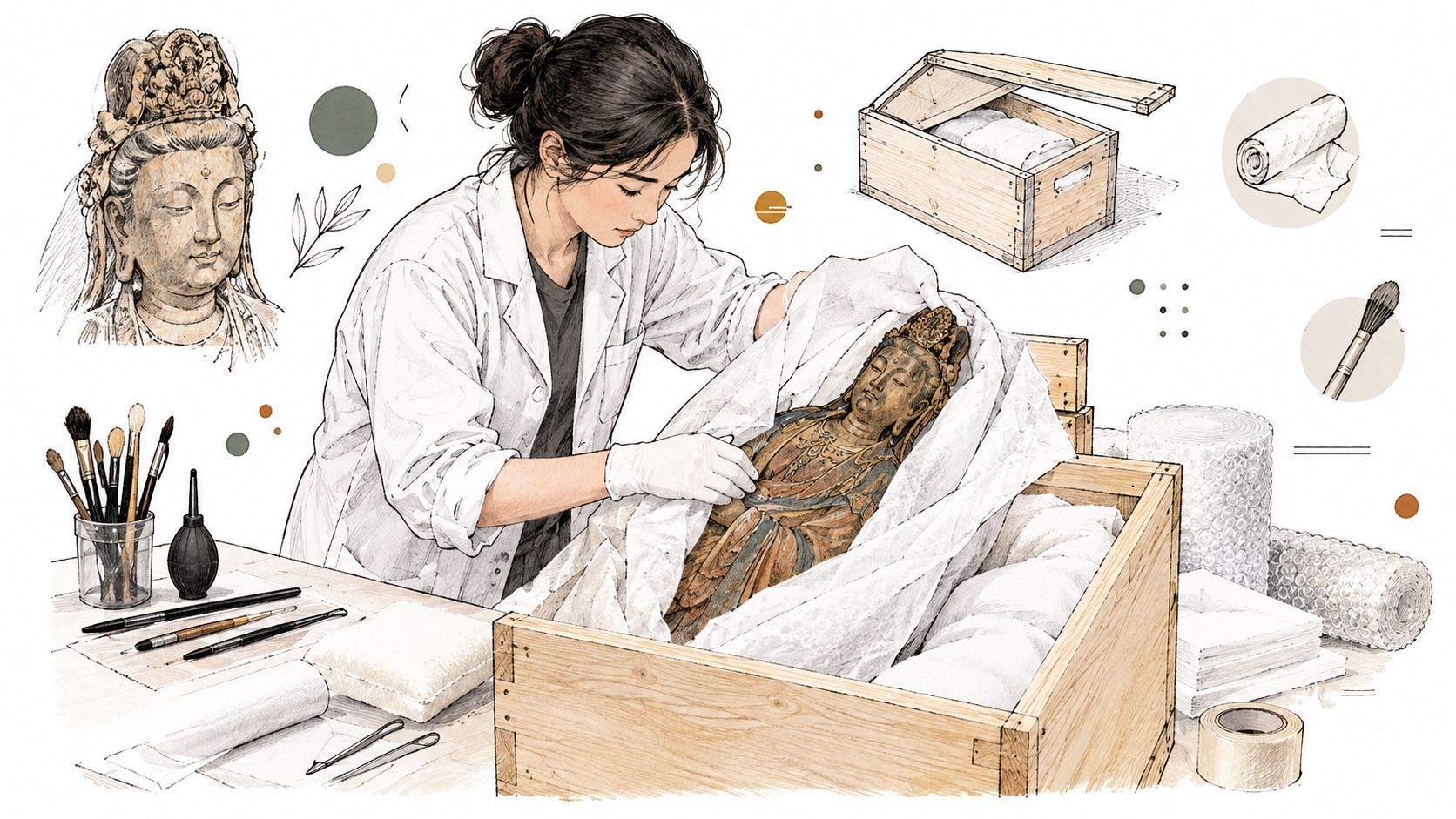
Bronze generally needs gentle handling and restrained cleaning. Aggressive polishing can remove meaningful surface evidence and change the appearance that supports comparison. Stone should be protected from knocks, unstable shelving, and unsuitable cleaning products. Wood and lacquer are especially vulnerable to environmental fluctuation, abrasion, and pressure on projecting details.
Before purchase, request a condition report with clear photographs of the front, back, underside, joins, cracks, losses, old repairs, repainting, and replaced elements. Ask how the statue has been displayed and whether restoration was carried out. A seller who can't explain those points leaves the buyer unable to separate original surface from later intervention.
Plan the journey before payment
Packing must restrain movement without pressing fragile areas. Corners, fingers, crowns, weapons, halos, lotus petals, and projecting attributes need particular protection. The package should absorb vibration, prevent direct contact between surface and wrapping, and remain secure if the outer carton is handled roughly.
For a useful explanation of protecting artwork during transit, consult this guide to packing rolled canvas. Although the material differs, its emphasis on layered protection and controlled handling is relevant to planning an art shipment.
Keep the statue upright where appropriate, label the package clearly, and confirm who is responsible if damage occurs in transit. A seller's guide to displaying, caring for, and shipping Buddha statues offers further practical considerations for respectful display and movement.
Making Confident Attribution-Based Buying Decisions
A collector doesn't need to eliminate every uncertainty before making a sound purchase. The better aim is to identify exactly what is known, what is proposed, and what remains unresolved.
Use the catalogue wording as a starting point, then request the evidence behind it.
- Provenance: Ask for the object's ownership and movement history, including earlier catalogues, invoices, collection labels, or export documentation where available.
- Comparison: Request photographs of securely documented examples used to support the proposed school, period, or manner.
- Materials and construction: Find out whether the seller has examined casting, carving, joining, pigment, lacquer, wood grain, or other technical features.
- Inscriptions: Ask whether marks are original, later, translated, altered, or associated with ownership rather than manufacture.
- Restoration: Obtain a written account of repairs, replacements, surface treatment, repainting, and structural work.
- Condition: Request an independent condition report when the purchase is significant or the object is fragile.
A careful buyer asks, “What would justify stronger wording?”
That question is more productive than asking whether “style of” means “real” or “fake”. Stronger wording might require a coherent combination of provenance, material evidence, construction details, inscriptions, and comparison with documented works. No single visual resemblance can supply all of that.
For collectors considering Buddhist, Hindu, and Southeast Asian sculpture, HD Asian Art presents descriptions that distinguish regional styles and differentiate antique, vintage, and contemporary works inspired by historic traditions. Its catalogue can be one reference point among museum records, auction documentation, conservation advice, and independent specialist opinion.
Cautious attribution is therefore not a reason to dismiss an object. It can signal that the seller or institution is separating market appeal from scholarly certainty, which is exactly the distinction a serious collector needs.
HD Asian Art offers Buddhist and Hindu statues, Southeast Asian sculptures, and Burmese lacquerware with descriptions focused on region, style, material, and period context. Visit HD Asian Art to explore pieces and request the documentation that will help you assess attribution, provenance, condition, and display suitability.
