



Understanding the Symbolism of Lord Shiva
Understanding the Symbolism of Lord Shiva
Have you ever looked at a Shiva statue and assumed it means destruction, when the image is making a more complex statement about creation, knowledge, protection, and release from ignorance? In UK collections, that gap between popular simplification and theological detail matters. A collector, practitioner, or curator needs to read the figure properly, because Shiva's symbolism changes with posture, companions, attributes, and ritual context.
The symbolism of Lord Shiva is best understood as layered rather than fixed. Some forms present him as the compassionate protector, others as the cosmic dancer, and others as the silent teacher. UK museum records, especially from the V&A and the British Museum, make that range visible in a way that's useful for anyone interpreting sculpture in a home, gallery, or shrine. A clear overview of Shiva symbolism helps, but the sculpture itself always rewards closer looking.
Table of Contents
- The Dual Nature of Shiva Symbolism
- Decoding Key Iconographic Attributes
- The Cosmic Dance of Nataraja
- Interpreting Relational Context in Sculpture
- Affiliation Versus Lived Practice in the UK
- Display and Interpretation for Collectors
The Dual Nature of Shiva Symbolism
Is Shiva the god of destruction, or is that only the easiest part to explain? The answer is both simpler and more subtle than the internet usually suggests. Shiva can appear fierce, but in devotional and museum readings he is also the one who protects, teaches, and clears the way for renewal.
Personal presence and cosmic principle
In lived Hindu practice, Shiva is not just an abstract idea. He can be approached as a deity who reassures, disciplines, and transforms. At the same time, museum-held images show something larger, a cosmic principle expressed through form, gesture, and symbol.
That duality matters because a statue can carry both meanings at once. A serene face, a raised hand, or a balanced posture can signal calm presence, while a weapon or dance pose can point to a wider metaphysical role. The symbolism of Lord Shiva is therefore not a single message but a set of related meanings held together in one figure.
Practical rule: if a reader sees only “destruction,” they're missing the devotional language of restoration and release.
A good starting point is to ask what the image is doing, not only what it is holding. Is Shiva being shown as a householder, a yogi, a cosmic dancer, or a teacher? The answer shapes interpretation far more than a single label does.
Decoding Key Iconographic Attributes
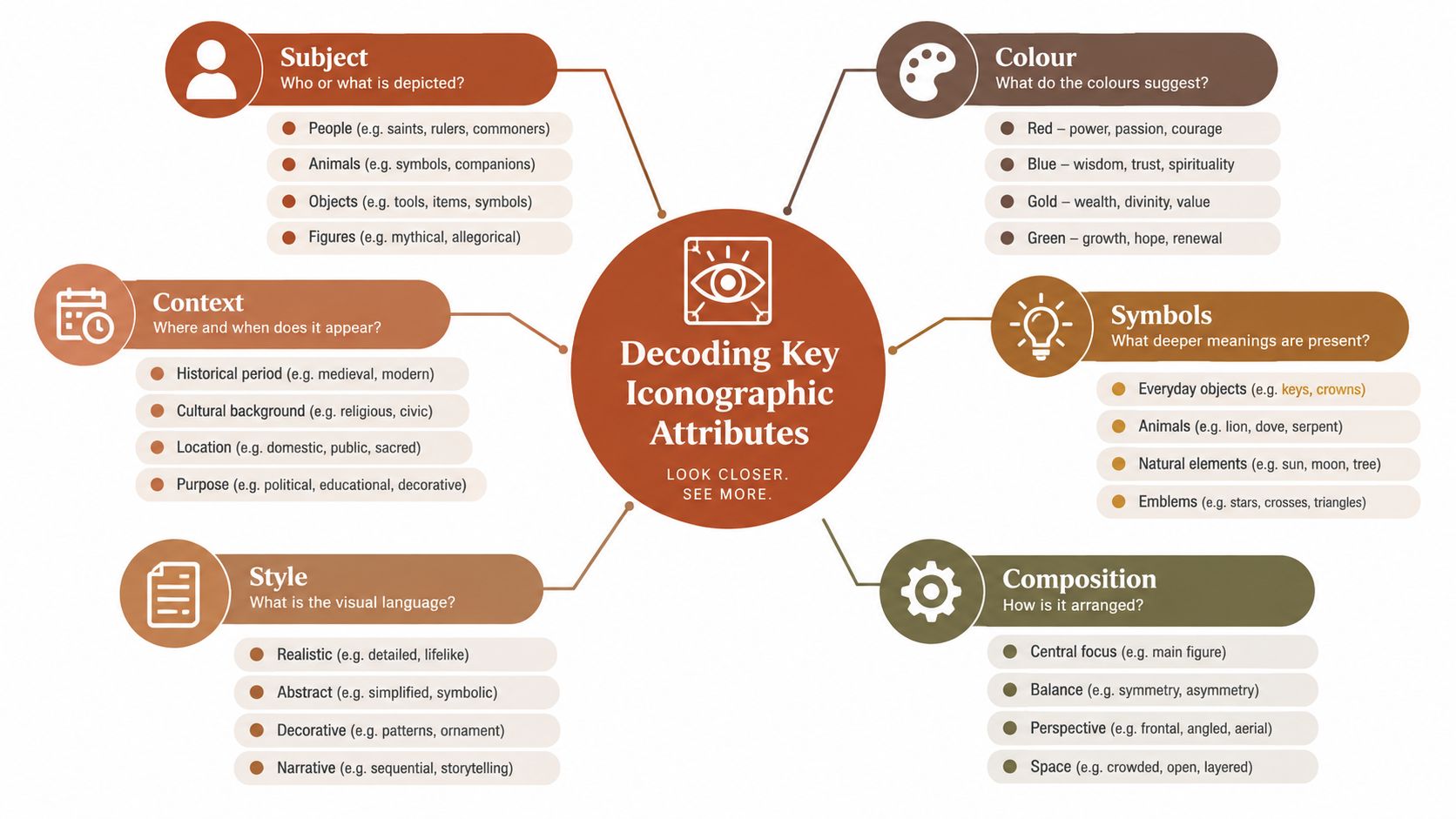
Why does one Shiva statue feel severe, while another feels calm or contemplative? The answer usually lies in the details. Collectors and practitioners often notice the trident, the snake, or the third eye first, but accurate reading begins by separating each attribute and asking what it does in the image.
The trident, third eye, crescent moon, and serpent
The British Museum records the trisul or trident as a defining symbol, and the museum's ancient India guide notes that it appears on Yaudheya coins from roughly AD 100 to 200 as some of the earliest surviving images of Shiva with the weapon. Its meaning is specific. The object record explains that the trident signifies the destruction of evil and the bestowal of grace, because it severs the soul from the endless cycle of rebirth. For a fuller reading of this attribute across traditions, see the trident (trishula) meaning in Hinduism and Buddhism and its role in sacred art.
The linga works differently. The British Museum guide states that the Sanskrit word means “symbol” or “sign”, and that Shiva has long been worshipped in linga form in clay, metal, and stone. It is a devotional sign-form rather than a literal body image. That distinction matters to anyone trying to identify whether a sculpture is primarily an aniconic shrine object or a figural representation.
The third eye is usually read as spiritual insight and the power to see through illusion. The crescent moon in Shiva's hair is linked with time, calm awareness, and restraint. The serpent around the neck is commonly understood as mastered fear or conquered death, while the matted hair suggests ascetic discipline rather than royal status. Together, these details show whether a sculpture stresses force, inner control, or transcendence.
How to read the statue as a whole
A useful habit is to read from head to body to base. Start with the face, then the attributes, then the feet and companions. That sequence often reveals whether the image is offering meditation, authority, or cosmic action.
A single symbol rarely carries the whole meaning. The relationship between symbols does the real work.
The same figure can shift tone with its setting. A seated Shiva with a calm gaze reads differently from a dancing Shiva surrounded by fire. Once you separate attribute from attribute, the statue stops feeling obscure and starts becoming legible.
The Cosmic Dance of Nataraja
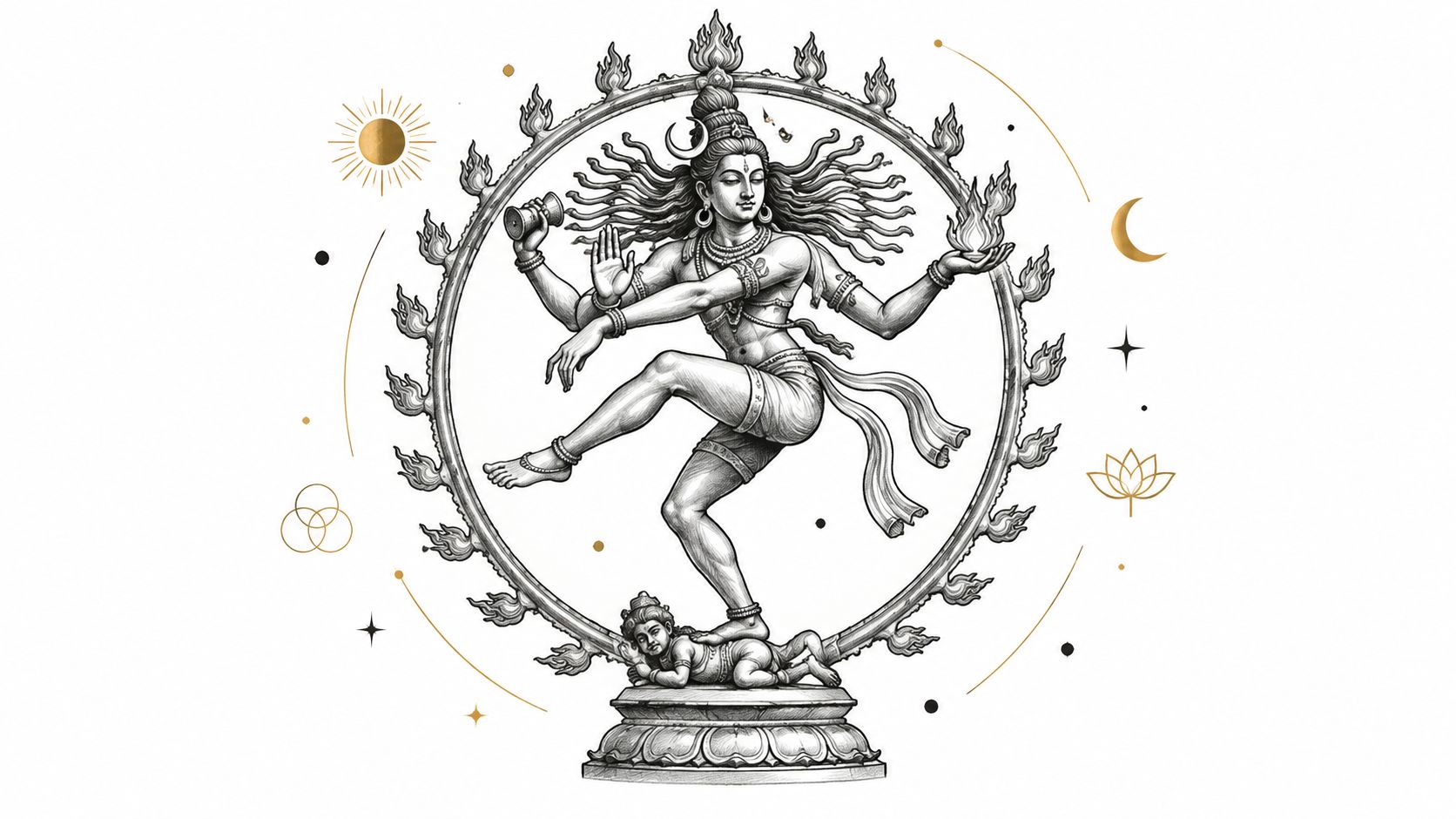
The V&A's Nataraja gives one of the clearest museum readings of Shiva's cosmic role. It shows him not as a static deity but as movement itself, dancing inside a ring of fire. That ring, the museum notes, is the jvala mala, a circular aureole that represents the life of the universe.
Reading the hands, fire, and foot placement
The V&A records a precise visual sequence. The upper hand holds the damaru drum, which symbolises creation, while the other upper hand carries the flame, the force through which the universe is ultimately destroyed. The lower hand gives abhaya mudra, reassurance and protection, and the other points towards the raised foot. The sculpture's four arms spread those meanings across distinct positions, so the eye can follow the theology through the body.
The foot on the dwarf figure, Apasmara, matters just as much as the fire. The museum identifies Apasmara as ignorance. Shiva does not merely overpower a demon. He suppresses ignorance, which links the image to enlightenment and spiritual release. The V&A therefore treats destruction as part of a three-stage cosmic process, not simple annihilation.
Why the dance is not only about ending
That's why Nataraja is so often misunderstood. People call it a “god of destruction” image and move on, but the sculpture does more than that. The drum signals creation, the flame signals dissolution, and the foot on ignorance signals liberation.
The best way to read the image is as a cycle. Creation begins, form appears, ignorance is overcome, and renewal follows. The cosmic dance holds those movements together in one frame, which is why the figure remains so compelling for both worshippers and collectors.
For a more extended meditation on the form, see Shiva Nataraja and the cosmic dance of creation, preservation, and destruction.
Museum insight: the most important question is not whether Nataraja is “fierce”, but what kind of transformation the image is teaching.
In a gallery setting, that means you should look beyond the dramatic pose. The sculpture is not only about Shiva's energy, it is about the universe moving through change without losing order. That's a very different message from destruction alone.
Interpreting Relational Context in Sculpture
A Shiva image can't always be read in isolation. Companions, attendants, and surrounding figures often carry as much meaning as the central deity. The British Museum's chlorite relief makes that obvious.
Why companions change the meaning
The relief shows three-headed Shiva with Parvati, both haloed, and places Nandi behind them. Their sons, Ganesha and Karttikeya, appear at a smaller scale on either side, while a dwarf attendant stands near Parvati. That family grouping shifts the reading away from an isolated ascetic and towards a relational, domestic, and hierarchical composition.
The museum identifies the three heads in canonical terms, with Bhairava on Shiva's proper right and Parvati on the female, inauspicious left. Bhairava's skull crown and severed hands make the fierce aspect visually distinct, so the relief isn't just showing one personality of Shiva. It's presenting several aspects within one sacred family structure.
Collector's clue: when scale, position, and missing limbs all matter, the sculpture is asking to be read as an arrangement, not as a single icon.
Reading damage and missing attributes carefully
The same relief preserves evidence of loss. Shiva was originally four-armed, and the far proper-right arm held a trident, though the arm and prongs are gone while the shaft survives. His lower left hand may have held a pot. Those survivals are not minor details. They tell you what the image was meant to communicate before damage altered it.
Shiva is also shown discreetly ithyphallic, and both main figures wear extensive jewellery and vanamala garlands. That combination creates a layered reading, part household deity, part powerful sovereign, part ascetic presence. For a collector, the lesson is straightforward. Don't identify Shiva only by face or gender. Read the whole relational field around him.
Affiliation Versus Lived Practice in the UK
The UK context makes interpretation even more nuanced. The 2021 Census recorded about 1.0 million Hindus in England and Wales, up from 818,000 in 2011 (ONS census religion data). The Office for National Statistics also warns that census religion measures affiliation rather than belief or active religious practice. That distinction matters when discussing Shiva, because symbols don't always carry one fixed meaning for every reader.
Shared symbols and local meanings
A Shaiva devotee, a museum curator, and a family using a statue for a home altar may all read the same object differently. The linga can be treated as a sign of presence rather than a literal form. Nataraja may be approached as a devotional focus, a philosophical image, or a museum object with historical value.
Many popular explanations go wrong here. They flatten regional practice, sectarian theology, and household custom into one neat sentence. The result sounds clear, but it isn't accurate.
For readers setting up meditative spaces, even surrounding choices can affect how a Shiva image is received. A thoughtful guide such as aromatherapy candles for meditation can help with atmosphere, but it doesn't replace iconographic understanding.
Why nuance protects respect
Respectful interpretation starts with asking what context the image belongs to. Is it for worship, contemplation, teaching, or display? A sculpture intended for puja deserves a different approach from one chosen purely as an interior feature.
That's why it helps to distinguish shared symbolism from sectarian interpretation. Some meanings travel widely across Hindu art, while others depend on temple tradition or family practice. The more carefully you separate affiliation from lived ritual, the more accurately you'll read the object in front of you.
Display and Interpretation for Collectors
Collectors often want one simple rule for where to place a Shiva sculpture. There isn't one. The right answer depends on whether the image is meant for active worship, quiet meditation, or visual display, and that distinction should be made with care.
Choosing the right context
A statue designed for ritual use carries a different intention from one selected for a study, shelf, or console table. A seated yogic Shiva may support a contemplative space, while Nataraja brings motion, energy, and cosmological symbolism into the room. The point isn't to impose a rigid rule, it's to respect the image's function.
The same applies to material and finish. Bronze, stone, and chlorite each change how the form is received. A museum-like placement can suit one object, while a more intimate altar setting suits another. What matters is whether the display matches the sculpture's meaning.
Using interpretation before placement
Before placing a Shiva image, check three things. First, identify the form. Second, look at the symbols. Third, decide whether the setting supports worship or contemplation. That order prevents a lot of confusion.
For practical recording and presentation, a tool like Sculpty's 360 turntable export can help you document the statue from every angle before it's installed or sold. That's especially useful for collectors who want to track attributes such as hand positions, lost elements, and base figures.
Simple rule of care: if you can explain the image clearly, you're more likely to place it respectfully.
HD Asian Art works with Hindu and Buddhist sculpture for collectors and institutions, and that kind of catalogue context can help when comparing Shiva forms across periods and materials. The value comes from matching the object's symbolism to its intended use, not from treating every Shiva image as interchangeable.
If you're selecting a Shiva statue, or trying to interpret one already in your collection, HD Asian Art can help you compare forms, symbolism, and placement with museum-level care. Visit HD Asian Art to explore sculptures and guidance that support collectors, practitioners, and interior spaces with a more accurate reading of sacred art.
