



Laotian Buddha Statue: The Phra Bang Style Guide
Laotian Buddha Statue: The Phra Bang Style Guide
Most people drawn to Southeast Asian Buddhist sculpture can name a Gandharan Buddha or a Thai Sukhothai image on sight. Far fewer can identify a Laotian Buddha statue with the same confidence, and that gap is worth closing. Laotian sculpture, particularly the tradition shaped by the Phra Bang, is one of the most historically layered and iconographically distinctive bodies of work in all of Buddhist art.
It absorbed Khmer technique, Sinhalese legend, Theravada doctrine, and the political ambitions of the Lan Xang kingdom into a visual language that influenced neighbouring sculptural traditions for centuries, and yet it remains underrepresented in most collectors' understanding.
Table of Contents
Quick Takeaways
|
Key Insight |
Explanation |
|---|---|
|
The Phra Bang is the most sacred Buddha image in Laos |
Standing at 83 centimetres, cast in a bronze, gold, and silver alloy, it gave its name to the city of Luang Prabang and defines an entire sculptural tradition. |
|
Its stylistic roots are Khmer, not Sinhalese |
Despite local legends attributing its origin to Sri Lanka, art historical analysis points to Khmer craftsmanship and iconography consistent with Angkorian bronzework. |
|
The abhaya mudra with both palms forward is the defining gesture |
This "Calling for Rain" or "Dispelling Fear" posture, with both hands raised and palms facing outward, is the signature feature of the Phra Bang style. |
|
Political legitimacy was inseparable from the image |
In 1359, the Khmer king gave the Phra Bang to Lan Xang ruler Fa Ngum precisely to confer Buddhist legitimacy on his kingdom. Possession of the image was equated with the right to rule. |
|
The statue was captured and returned multiple times |
Siamese forces took the Phra Bang in 1778 and again in 1828. Each return reinforced its role as a symbol of Lao sovereignty, making it one of the most politically charged sacred objects in Southeast Asia. |
|
Luang Prabang's name derives directly from the statue |
The former Lao capital was named after the image, a degree of cultural imprint that has no parallel in most other Buddhist traditions. |
|
The style influenced Lao, northern Thai, and adjacent Burmese traditions |
The Phra Bang's posture and proportions were widely replicated across the Mekong region, creating a family of related images that collectors often mistake for purely Thai or Burmese work. |
The Phra Bang: Origin and Sacred Status
The Phra Bang is a standing Buddha image enshrined today in the Haw Pha Bang pavilion within the former Royal Palace grounds in Luang Prabang, Laos. It measures 83 centimetres in height and is cast from a bronze alloy covered in gold, with traditional accounts also crediting silver in the composition. It is, without qualification, the most venerated Buddha image in the country.
Local chronicles describe its creation in Sri Lanka sometime between the 1st and 9th centuries CE, linking it to the ancient prestige of Sinhalese Theravada Buddhism. In practice, art historical analysis tells a different story. The statue's proportions, iconographic details, and metallurgical character are consistent with Khmer craftsmanship, pointing to an Angkorian origin in the 14th century rather than ancient Ceylon. This gap between legend and stylistic evidence is not unusual in Southeast Asian sacred art. It reflects how origin myths were constructed to maximise a sacred object's authority, drawing on the most prestigious Buddhist lineage available, which in this context meant Sri Lanka.
The historical record becomes firmer at the mid-14th century. In 1359, the Khmer king gave the Phra Bang to his son-in-law Fa Ngum, the first monarch of Lan Xang, which translates roughly as "Land of a Million Elephants" and formed the precursor state to modern Laos. The gift was explicitly political. It conferred Theravada Buddhist legitimacy on Fa Ngum's rule and, by extension, on the new kingdom itself. The city where the image was kept was renamed in its honour, giving us Luang Prabang.
A sacred image in Southeast Asia was never merely a devotional object. It was a statement of dynastic right, territorial claim, and spiritual authority compressed into bronze and gold.
The Phra Bang's subsequent history confirms how deeply this political dimension ran. Siamese forces captured the image in 1778, taking it to Bangkok. Political instability followed, and it was returned to the Lao people in 1782. The Siamese took it again in 1828, and returned it once more in 1867 after a similar period of upheaval. Each episode of seizure and repatriation reinforced, rather than diminished, the image's power as a symbol of Lao sovereignty and resilience. In 2013, it was moved from a national museum in Vientiane to its current home in the Haw Pha Bang, where it remains a focal point for Buddhist ritual, including an annual New Year bathing ceremony during Pi Mai, the Lao New Year.
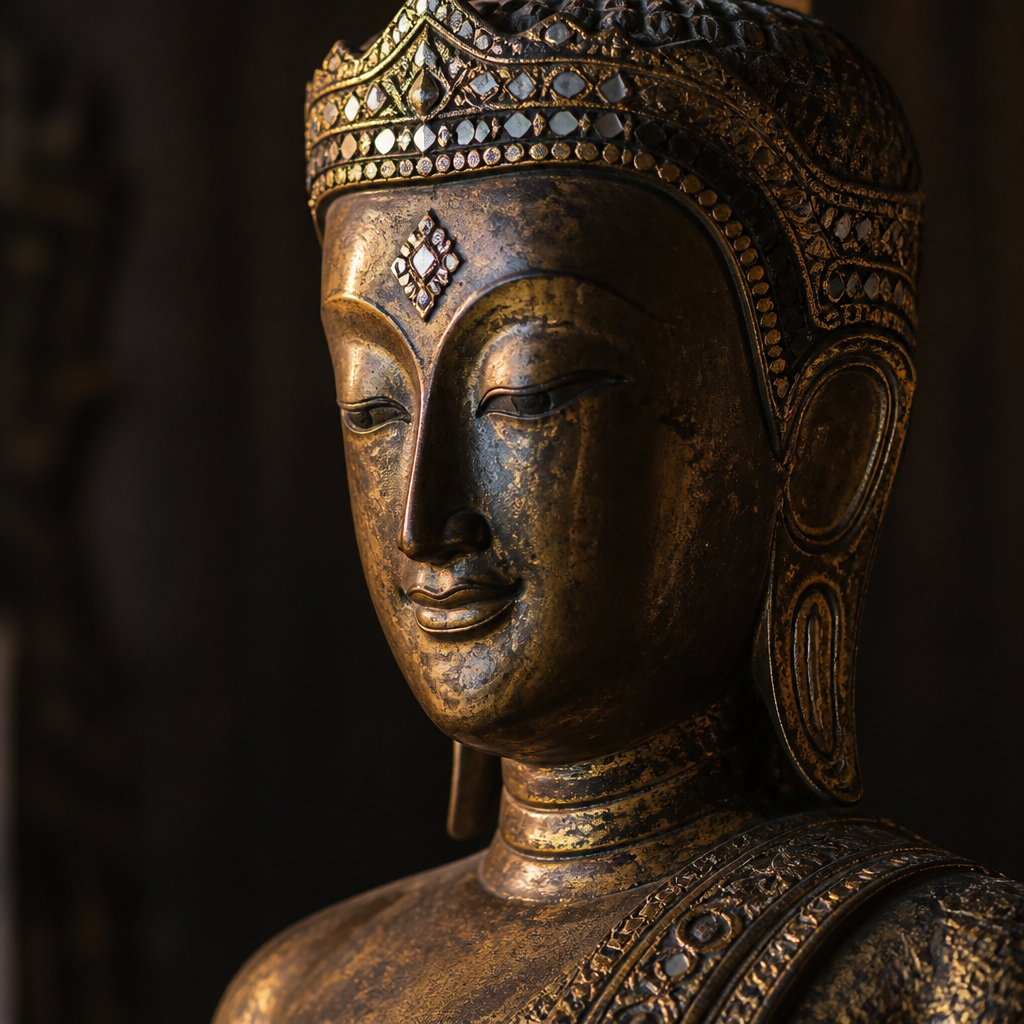
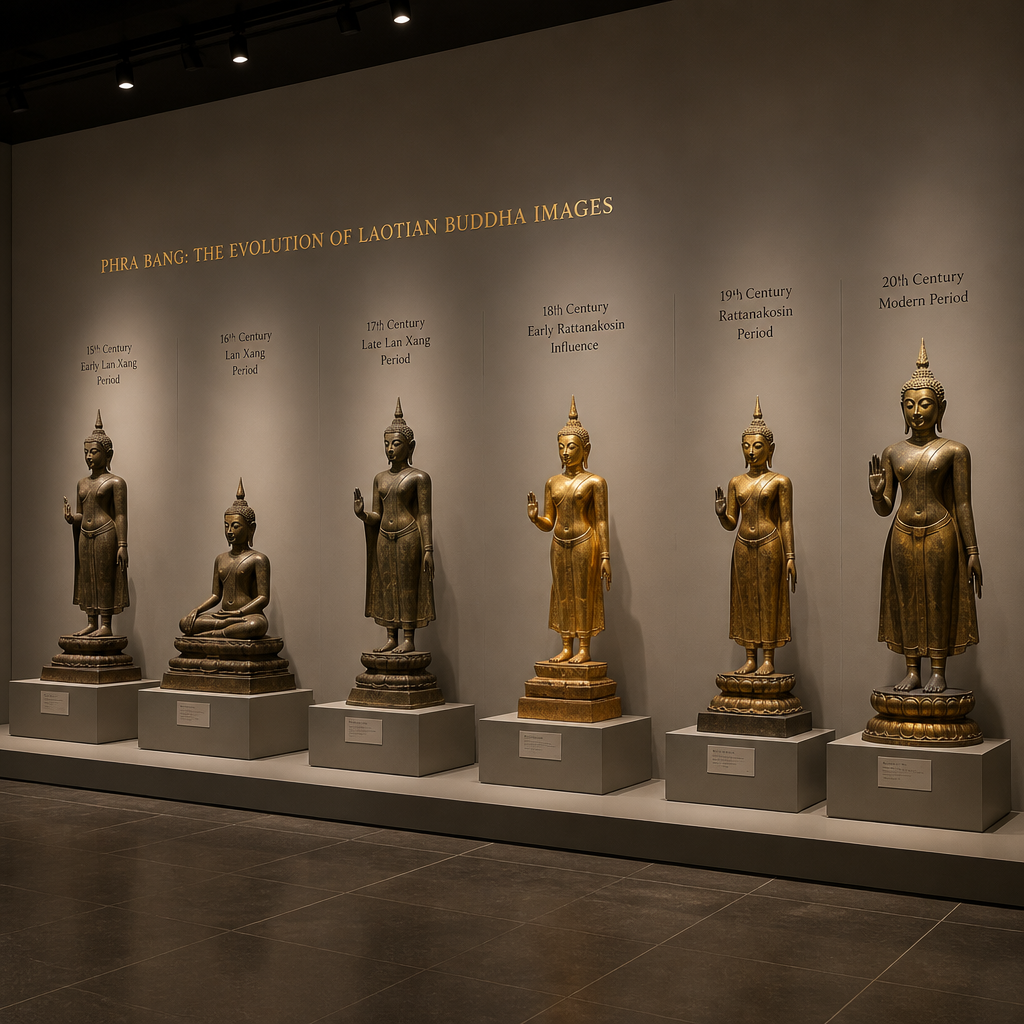
Defining Features of Phra Bang Style Sculpture
Understanding what makes a Laotian Buddha statue distinctly Phra Bang in style requires looking past the broad category of "Southeast Asian Buddhist sculpture" and into the specific formal choices that distinguish Lao work from its Thai, Khmer, or Burmese neighbours.
The Standing Posture and Double Abhaya Mudra
The most immediately recognisable feature is the standing posture combined with both arms raised, palms facing forward. This gesture is known in Laotian Buddhist art as the "Calling for Rain" posture, though it is formally related to the abhaya mudra of "Dispelling Fear." What makes the Phra Bang version distinct is the symmetry: both hands raised simultaneously, with the fingers pointing downward in some regional variants, creating a silhouette that is unlike anything in the Sukhothai or Ayutthaya traditions of Thailand, where a single raised hand is far more common.
Body Proportions and Surface Treatment
Phra Bang style figures tend toward elongated, slightly stiff proportions with a high, flame-like ushnisha (the cranial protrusion symbolising wisdom) and a serene, almost expressionless facial type. The torso is smooth and cylindrical rather than anatomically modelled. Robes are indicated minimally, often as a thin ridge at the hem rather than carved drapery. This restraint reflects Khmer aesthetic influence filtered through Lao sensibility, producing figures that feel monumental even at modest scale.
Materials and Finishing
The Phra Bang itself was cast in a bronze-gold-silver alloy, and this tradition of mixed-metal casting or heavy gilding carried through into the broader Lao sculptural tradition. Many Laotian Buddha statues were finished with gold leaf over a bronze or lacquered core, giving them a luminous, warm surface quality. The use of lacquer as both a ground and a decorative medium connects Lao Buddhist sculpture to the wider mainland Southeast Asian lacquerware tradition, a craft that HD Asian Art also carries in its Burmese lacquerware collection, reflecting just how interconnected these regional material cultures were.
Pro tip: When examining a Laotian Buddha statue, look at the hem line of the robe at the ankles. In authentic Phra Bang style work, this edge is typically a fine, raised line rather than carved drapery folds. Heavy drapery modelling usually signals Thai or Burmese influence rather than a core Lao piece.
Luang Prabang Buddhist Art and Its Regional Reach
Luang Prabang Buddhist art did not develop in isolation. The city sat at a convergence of trade, pilgrimage, and political influence routes along the upper Mekong, and its sculptural tradition absorbed and transmitted influences in multiple directions simultaneously.
The Khmer Foundation
The Khmer contribution to Lao sculpture is substantial and consistently underacknowledged. The Phra Bang itself, by the best available art historical assessment, is Khmer work. Khmer iconographic conventions, including the treatment of the ushnisha, facial proportions, and the smooth, highly polished bronze surface, fed directly into the Lao aesthetic. What Lao sculptors did over the following centuries was adapt that foundation into something distinctly their own, particularly in the development of the characteristic Lao mudra and the elongated figure type.
Theravada Doctrine as a Shaping Force
The arrival of the Phra Bang in Lan Xang coincided with the kingdom's formal adoption of Theravada Buddhism as its state religion. This was not incidental. Theravada's emphasis on the historical Buddha Shakyamuni, and on specific textual traditions regarding his gestures and attributes, constrained Lao sculptors in productive ways. Unlike the Mahayana and Vajrayana traditions of Tibet or Japan, which generated enormous pantheons of deities and bodhisattvas in highly complex iconographic programmes, Theravada Lao art concentrated its energy on a relatively narrow set of Buddha images. The result was depth rather than breadth: a tradition that refined a small number of image types to great sophistication.
Influence on Northern Thailand and Beyond
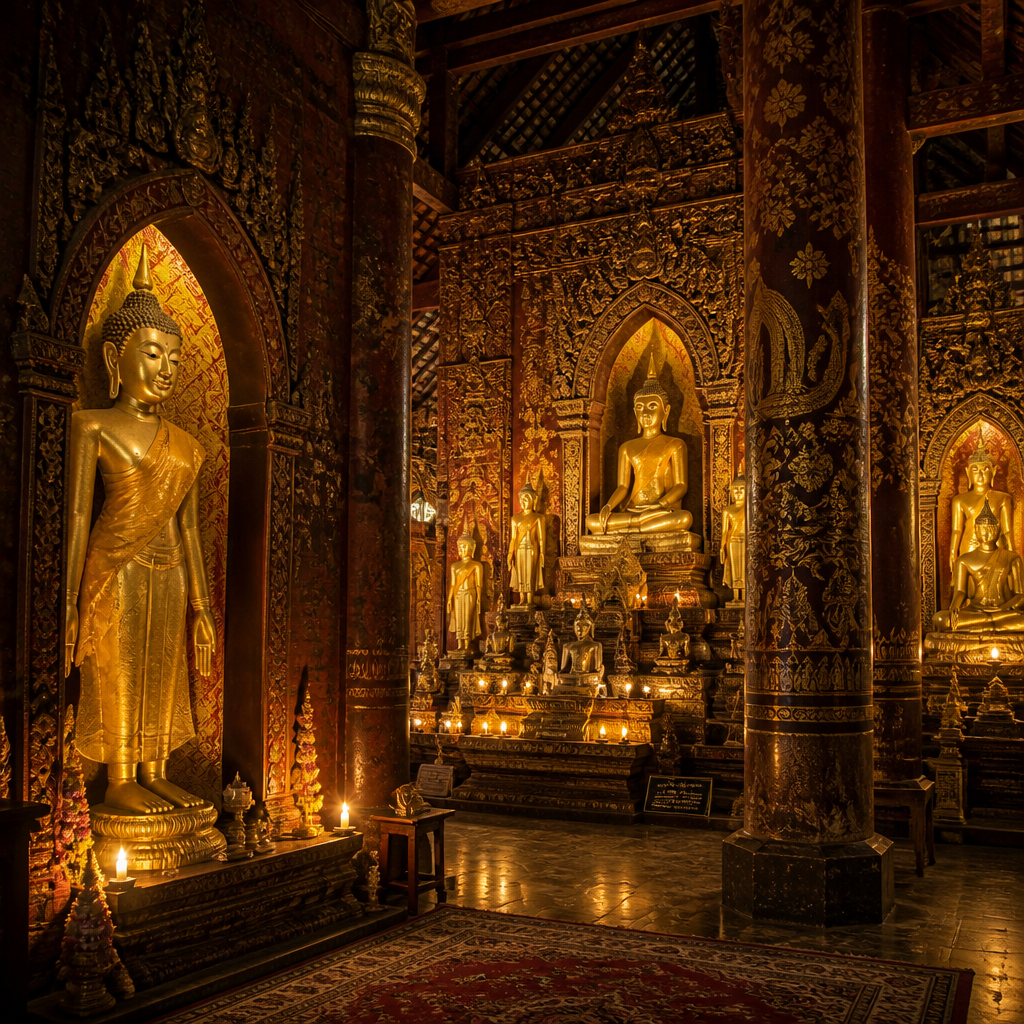
The Lan Xang kingdom at its height exercised cultural and political influence over areas that are now part of northern and northeastern Thailand, and the Phra Bang style travelled with that influence. The "Calling for Rain" posture appears in the sculptural traditions of the Isan region of northeastern Thailand and in parts of northern Thai Buddhist art, where it is sometimes described as a local innovation without acknowledgment of its Lao origins. For collectors, this creates both an opportunity and a hazard: images in Phra Bang style were produced across a wide geography, and distinguishing a piece made in Luang Prabang from one made under its influence in what is now Thai territory requires careful attention to material, finish, and specific iconographic details.
Pro tip: If you are comparing a Lao-attributed piece to northern Thai work in the same stylistic family, examine the base. Lao figures often have a simpler, more architecturally abstract lotus base, while northern Thai pieces in a related style tend toward more elaborate petal modelling with visible layering.
Phra Bang vs. Other Southeast Asian Styles: A Comparison
Placing the Phra Bang style in direct comparison with the two other dominant mainland Southeast Asian Buddhist sculptural traditions helps clarify exactly what is distinctive about Laotian work. The following table compares the Phra Bang (Lao), Sukhothai (Thai), and Khmer traditions across the features most relevant to collectors and practitioners choosing a piece for a collection or altar.
|
Feature |
Phra Bang Style (Lao) |
Sukhothai Style (Thai) |
Khmer Style (Cambodian) |
|---|---|---|---|
|
Characteristic posture |
Standing, both arms raised with palms forward ("Calling for Rain") |
Seated in meditation or walking with right hand in abhaya; flowing, flame ushnisha |
Seated or standing with one hand raised; solid, architectural presence |
|
Facial type |
Serene, slightly elongated, minimal expression, high arched brows |
Ovoid face, aquiline nose, gentle smile, flame finial ushnisha |
Broad, symmetrical, enigmatic "Khmer smile," strong jaw |
|
Robe treatment |
Minimal, indicated by a fine hem ridge at ankles |
Flowing robe flap over left shoulder, sometimes with elaborate border detail |
Short sampot (hip garment), torso largely bare, smooth surface |
|
Material tradition |
Bronze-gold-silver alloys, heavy gilding, lacquered cores |
Bronze, stucco-over-brick, stone; gilded finishes common in later periods |
Sandstone, bronze; polished surfaces, minimal surface decoration |
|
Religious context |
Theravada; image tied to state legitimacy and royal ritual |
Theravada; emphasis on the walking Buddha unique to Sukhothai |
Initially Hindu-Buddhist synthesis; later Theravada in post-Angkor period |
|
Regional influence radius |
Northeastern Thailand (Isan), northern Thailand, parts of southern Yunnan |
Central Thailand, spreading into Lao and Burmese border zones |
Southern Laos, northeastern Thailand, Vietnam's Mekong delta |
Collecting Laotian Buddha Statues: What to Look For
For collectors approaching Laotian Buddhist art, the Phra Bang style presents a specific challenge and a genuine reward. The challenge is that Phra Bang style images were produced over a long period and across a wide geographic area, so attribution requires real attention to detail. The reward is that this tradition produces some of the most compositionally powerful standing Buddha images in all of Southeast Asian art.
Authenticity Markers in Established Pieces
In established, museum-quality pieces, the key markers are consistent. The standing posture with both palms raised and facing forward should be combined with an elongated, cylindrical torso and a high ushnisha. The facial expression should be genuinely serene rather than merely bland: there is a subtlety to the best Lao Buddhas that distinguishes them from competent but generic regional production. The surface should show evidence of gilding or lacquer work, and the alloy, if exposed at any worn point, should have the reddish-gold warmth characteristic of high-tin bronze rather than the greener patina of later, lower-quality castings.
Contextualising Your Purchase
A common mistake among first-time buyers of Laotian Buddha statues is treating the piece as interchangeable with Thai or Cambodian work of similar appearance. It is not. The Phra Bang style carries a specific religious and historical identity rooted in the Lan Xang kingdom and the Theravada traditions of the upper Mekong. Buying with that context in mind changes how you live with the piece, whether it sits on a home altar or in a display collection. HD Asian Art's collection of Laotian Buddhist sculptures is specifically sourced to reflect this regional integrity, rather than aggregating Southeast Asian pieces under a single undifferentiated "Asian art" label.
Scale and Placement for Home Altars
The standing posture of Phra Bang style figures makes them particularly effective as focal points for home altars, where a seated meditating Buddha can sometimes feel static. The raised palms carry an active, protective energy that many practitioners find more engaging for daily devotional practice. At smaller scales, around 30 to 50 centimetres, a Phra Bang style Laotian Buddha statue works well as a standalone altar centrepiece. At larger scales, the figure's vertical emphasis and symmetry make it a strong anchor for a more elaborate display incorporating offering bowls, incense, and flanking figures.
The relationship between Laotian Buddhist art and the broader Southeast Asian sculptural tradition is also worth considering when building a collection. A Lao Phra Bang style figure placed alongside a Burmese Mandalay-period Buddha or a Thai Sukhothai-influence piece creates an immediate, visible conversation about how a single religious tradition expressed itself differently across neighbouring cultures. That conversation is, in many ways, the most compelling argument for collecting regionally rather than by a single national tradition.
Frequently Asked Questions
What is the Phra Bang, and why does it matter for understanding Laotian Buddha statues?
The Phra Bang is an 83-centimetre standing Buddha image currently housed in the Haw Pha Bang pavilion at the former Royal Palace in Luang Prabang, Laos. It is the most sacred Buddhist image in the country and the defining prototype for the entire Phra Bang sculptural style. Its distinctive double abhaya mudra, with both palms raised and facing outward, became the template for generations of Laotian Buddha statues across the Mekong region. Understanding it is the essential starting point for understanding Lao Buddhist art.
Is the Phra Bang really from Sri Lanka as tradition claims?
Local chronicles attribute its creation to Sri Lanka between the 1st and 9th centuries CE, but art historical analysis of the statue's stylistic features and material composition points to a Khmer origin in the 14th century. The Sri Lankan attribution was almost certainly constructed to enhance the image's prestige by connecting it to the most authoritative Theravada Buddhist lineage in the region. This kind of origin myth is common in Southeast Asian sacred art and does not diminish the statue's genuine historical and spiritual significance.
How does Phra Bang style differ from Thai Sukhothai Buddha statues?
The most immediate difference is the posture and gesture. Sukhothai Buddhas are most celebrated in the walking posture with a single hand raised, or the seated meditation posture with a flame-like ushnisha. Phra Bang style Lao Buddhas stand with both hands raised symmetrically, palms forward. The facial type also differs: Sukhothai faces tend toward an ovoid softness with a distinctive aquiline nose, while Phra Bang faces are slightly more elongated and austere. Robe treatment in Phra Bang style is notably minimal compared to the flowing garment details found in mature Sukhothai work.
Why was the Phra Bang seized multiple times by Siamese forces?
Because possessing the Phra Bang was understood to confer the right to rule over Laos. The image functioned as a palladium, a sacred object whose presence legitimised political authority. When Siamese forces took the image in 1778, they were not simply looting a valuable artwork; they were symbolically asserting sovereignty over the Lao territories. The political upheaval and misfortune attributed to the statue while it was in Bangkok on both occasions, leading to its return in 1782 and 1867 respectively, reflects how seriously this sacred status was taken by all parties.
What should I look for when buying a Laotian Buddha statue in the Phra Bang style?
Look for the standing posture with both arms raised and palms facing forward. The torso should be elongated and relatively smooth, with robe detail indicated minimally at the hem. The ushnisha should be prominent and flame-like or conical. Quality pieces will show evidence of gilding or lacquer finishing. Be cautious of pieces described as "Lao style" that show heavy robe drapery or a single raised hand, as these features suggest Thai or Burmese influence rather than a core Phra Bang tradition piece. Buying from a specialist retailer with documented provenance and regional sourcing, rather than a general Asian art aggregator, significantly reduces the risk of misattribution.
How did Luang Prabang Buddhist art influence neighbouring sculptural traditions?
At the height of the Lan Xang kingdom's political influence, which extended into areas of what is now northeastern and northern Thailand, the Phra Bang style spread alongside Lao political and religious authority. The "Calling for Rain" standing posture appears in the sculptural traditions of the Isan region of northeastern Thailand and in parts of northern Thai Buddhist art. This regional diffusion means that Phra Bang style images were produced well beyond the borders of modern Laos, and the tradition's influence can be traced in workshop production across a broad swathe of mainland Southeast Asia.
If you collect Southeast Asian Buddhist sculpture or maintain a home altar, we would love to hear which regional tradition speaks most clearly to you and why. Share your experience in the comments.
We would love your feedback and any insights you would share with others. What perspective would you add?
References
