



4 Garuda Symbolism Signs Every Collector and Seeker Should Know
4 Garuda Symbolism Signs Every Collector and Seeker Should Know
Garuda is a divine, eagle-like symbol of protection, swift liberation, and victory over poison and ignorance across Hinduism, Buddhism, and Jainism. In Hindu tradition he is Vishnu’s mount and emblem; in Buddhism he stands among the Four Dignities as a guardian of wisdom; in Jainism he serves as a protective yaksha attending Shantinatha.
The details shift by tradition, but the core meaning of garuda symbolism stays remarkably consistent: a fierce, fast, incorruptible force standing between the sacred and the dangerous.
Key Features:
- Garuda’s imagery and symbolism vary across traditions but consistently represent protection, sovereignty, and the overcoming of primal or dangerous forces.
- In Hinduism, Garuda’s role as Vishnu’s swift and fearless mount emphasizes its function as a divine protector capable of rapid intervention across the cosmos.
- Buddhist depictions focus on Garuda as a protector of wisdom and clarity, often used in meditation and prayer to internalize fearless awareness rather than for external protection.
- Jain representations portray Garuda as a specific guardian attached to a Tirthankara, emphasizing custodial protection rather than divine power or mythic heroism.
- Accurate identification of Garuda in art relies on key iconographic markers like arm number, held objects, posture, and regional style, with provenance and craftsmanship crucial for authentication.
Table of Contents
- Garuda Symbolism in Hinduism: Myths, Vishnu’s Vahana, and What It All Means
- Garuda in Buddhism: Protector, One of the Four Dignities
- Garuda in Jainism: A Guardian With a Distinct Face
- Common Threads: What Garuda Represents Across Every Tradition
- How to Read Garuda in Sculpture, Painting, and Temple Carving
- From Temple Icon to National Emblem: Garuda’s Civic Life
- What It Means to Encounter Garuda in Dreams or Meditation
- How Provenance and Iconography Together Determine a Garuda Piece’s Meaning
- Garuda as a Bridge Between Freedom and Responsibility
- Where to Find Authenticated Garuda Sculptures Worth Collecting
- Sources
- FAQ
Garuda Symbolism in Hinduism: Myths, Vishnu’s Vahana, and What It All Means
Garuda’s Hindu identity starts with a job description: he is Vishnu’s vahana, the mount that carries the preserver-god across the cosmos. That role is not decorative. A vahana in Hindu iconography embodies a quality its rider needs, and Garuda’s contribution is speed married to fearlessness. Riding on Garuda, Vishnu can intervene anywhere, instantly, which is part of why Garuda’s image shows up on temple flags and gateways meant to signal protection over a threshold.
The myths behind that role matter as much as the role itself. Garuda’s mother, Vinata, was enslaved by her rival Kadru, mother of the nāgas (serpent beings), after losing a wager. To win her freedom, Garuda had to steal amrita, the nectar of immortality, from the gods and trade it to the nāgas. He succeeded, tricked the serpents out of drinking it on the spot, and secured his mother’s release. Wikipedia’s overview of the myth frames this as the origin of his lasting enmity with snakes, and that enmity became shorthand for a much larger idea: overcoming what enslaves you, even when the obstacle looks like immortality itself.
That amrita episode does double duty as origin story and moral lesson. Garuda acts as a devoted son and, at the same time, a cosmic agent of renewal, since the nectar he carries is tied to life, death, and rebirth across Puranic literature. Temple sculptors leaned on this scene constantly because it gives an artist motion, tension, and stakes all in one pose: a bird straining upward with a vessel gripped in his talons.
Hindu sources describe a fairly consistent visual vocabulary for identifying Garuda, and each detail carries meaning:
- Golden or reddish body — associated with solar and fire imagery, tying Garuda to the sun’s life-giving but fierce nature.
- Red wings and a white face — a color scheme repeated across early textual descriptions, marking him as distinct from ordinary birds of prey.
- A hybrid human-bird body — human torso and arms, eagle head, beak, and talons, a form scholars at Britannica describe as a deliberate bridge between the celestial and the human realm.
- Multi-armed variants — later devotional and Pañcarātra-influenced sculpture sometimes gives Garuda four arms holding conch, discus, mace, or lotus, echoing Vishnu’s own attributes and marking a closer devotional identification between mount and rider.
Ritual use extends this symbolism into architecture. Garuda dhvaja, or Garuda banners, appear on Vishnu temples and in royal processions across South and Southeast Asia, functioning as a visual proclamation that the space or the ruler enjoys divine protection. Placed at a temple entrance, Garuda’s image works the same way a guardian lion or door god does in other traditions: he tells you what is being kept out.
Garuda in Buddhism: Protector, One of the Four Dignities
Buddhist traditions absorbed Garuda but shifted his emphasis from divine transport to spiritual guardianship. He appears as a dharmapala, a protector of the dharma, and is counted among the Four Dignities, a set of symbolic animals used in Tibetan Buddhist and Vajrayana visual language to represent qualities a practitioner cultivates on the path.
Each of the Four Dignities carries a distinct meaning, and Garuda’s assignment is specific. According to practitioner writing at BuddhistDoor, Garuda represents wisdom and what the tradition calls pristine awareness, the clear, unclouded perception that Buddhist practice aims to uncover. Where the Hindu Garuda protects through raw power, the Buddhist Garuda protects through clarity. He does not just fight threats; he sees through them.
That distinction shapes how Garuda gets used in practice:
- Visualization and yidam practice — practitioners in some Vajrayana lineages meditate on Garuda’s form to internalize fearless clarity, treating the image as a mirror for a quality they want to develop rather than an external deity to petition.
- Lungta and prayer flags — Garuda appears alongside the other Four Dignities on Tibetan prayer flags (lungta means “wind horse”), where his presence is meant to carry protective and auspicious energy on the wind.
- Talismans and amulets — across Southeast Asia, Garuda images serve as personal protective charms, a practice with particularly deep roots in Thailand and Cambodia, where Garuda motifs decorate everything from amulets to royal regalia.
- Regional variation — Tibetan Buddhist Garuda imagery tends toward the fierce and wrathful, consistent with the dharmapala role, while Southeast Asian Buddhist and Hindu-influenced art often renders him closer to a noble, upright guardian figure standing at rest.
The Garuda-naga relationship gets a second life in Buddhist and yogic-influenced readings. Rather than reading the myth as a hero-versus-monster story, practitioner interpretations treat the snake as primal, instinctual energy (the kind associated with kundalini in tantric frameworks) and the bird as elevated awareness. Garuda’s dominance over the naga becomes a metaphor for integrating rather than suppressing that energy, a theme that recurs in contemplative essays on Garuda symbolism. The bird does not destroy the snake so much as transform its power into something usable.
Garuda in Jainism: A Guardian With a Distinct Face
Jain tradition gives Garuda a narrower, more specific role: he serves as a protective yaksha, a class of guardian spirit, attached specifically to Shantinatha, the sixteenth Jain Tirthankara. That attachment matters. Jain cosmology assigns each Tirthankara a pair of guardian deities, a yaksha and a yakshi, and Garuda’s selection for Shantinatha ties his protective symbolism to a particular teacher and a particular set of virtues associated with peace, since Shantinatha’s name itself relates to tranquility.
Jain depictions diverge from Hindu and Buddhist convention in ways worth noticing if you are trying to identify a piece correctly. Sources describing Jain iconography note Garuda sometimes appears with four arms, holding objects like a lotus, a mongoose, or a rosary, a combination that does not map cleanly onto either the Vishnu-attribute set seen in Hindu sculpture or the wrathful dharmapala style common in Tibetan Buddhist art. The mongoose is a particularly telling detail, since it echoes wealth and protective symbolism found elsewhere in Jain and Hindu iconography rather than repeating the naga-slaying imagery so central to the Hindu myth cycle.
The practical difference across traditions comes down to emphasize. Hindu Garuda is fundamentally relational, defined by service to Vishnu. Buddhist Garuda is fundamentally internal, defined by the quality of awareness he represents. Jain Garuda is fundamentally custodial, defined by his specific assignment to guard one Tirthankara’s teaching. Same bird, three different jobs.
Common Threads: What Garuda Represents Across Every Tradition
Strip away the tradition-specific detail and a handful of themes repeat everywhere Garuda appears. Understanding these threads is what actually lets you interpret a piece of art, a temple carving, or a personal encounter with the symbol without needing to memorize every regional variant first.
- Protection through confrontation, not avoidance. Garuda does not guard by hiding what he protects. He guards by standing between danger and what matters, then acting decisively, whether that means stealing amrita or devouring a snake outright.
- Freedom and sovereignty, expressed through flight. Garuda’s association with sky, sun, and unimpeded movement makes him a natural symbol for liberation, both the literal freedom he won for his mother and the metaphorical freedom Buddhist and Jain readings extend to spiritual liberation.
- Rebirth and instant maturity. Several myth cycles describe Garuda as born fully grown, capable of extraordinary feats from the moment of hatching. That detail feeds directly into contemplative uses of his image, since it suggests wisdom or awakening can arrive suddenly rather than only through gradual accumulation.
- Integration of opposing forces. The Garuda-naga pairing recurs as a shorthand for sky versus earth, wisdom versus primal energy, refined awareness versus instinct. Where Hindu myth frames this as conflict, Buddhist and yogic readings increasingly frame it as complementary tension, two forces that need each other rather than a simple winner and loser.
Which theme dominates depends entirely on where you encounter the image. A Garuda dhvaja above a Vishnu temple entrance leans hard on protection and sovereignty. A Garuda woven into a Tibetan thangka alongside the other Four Dignities leans on internal clarity. A Garuda yaksha guarding a Jain shrine leans on custodial devotion to a specific teacher’s peace. The bird is constant; the emphasis moves.
How to Read Garuda in Sculpture, Painting, and Temple Carving
Identifying Garuda correctly, and reading what a particular piece is trying to communicate, comes down to a handful of physical markers you can check systematically.
- Head and beak. A sharp, raptor-like beak signals fierce protective intent; a softer, more human-adjacent face (common in Nepalese work) signals a gentler, more approachable guardian.
- Wings. Fully spread wings in flight suggest active protection or urgent mission (the amrita theft, for instance); wings folded or worn like a cloak, a convention seen in some Nepalese sculpture, suggest a more settled, dignified guardian role.
- Talons and posture. Talons gripping a serpent or clutching a vessel point to active myth-narrative scenes; talons at rest, with Garuda standing upright and unencumbered, point to an emblem or standalone protective icon rather than a narrative moment.
- Number of arms. Two arms generally signal an earlier or more strictly bird-form depiction; four arms holding Vishnu-associated objects signal later devotional syncretism; four arms with Jain-specific objects (lotus, mongoose, rosary) signal Jain iconography specifically.
- Serpent presence. A snake underfoot, in the beak, or wrapped around the figure ties the piece directly to the amrita and naga-enmity myths rather than the more abstract dharmapala or yaksha roles.
- Color remnants. Where pigment survives, red and gold tones reinforce the solar and fire associations described in Puranic and Vedic-derived sources, while darker, wrathful color schemes point toward Tibetan Buddhist ritual objects.
Regional style adds another layer. Cambodian Garuda figures, drawing on Angkorian conventions, tend to keep the beak sharp and the talons prominent even in static poses. Nepalese work often softens the face toward the youthful and human, sometimes letting the wings read almost like a cape. Indonesian and Thai traditions frequently show Garuda upright and human-postured, wings extended behind like a cloak of feathers rather than mid-flight, a style that carried directly into Indonesia’s modern national emblem. Recognizing which convention a piece follows tells you roughly where and roughly when it was likely made, before you even look at the base material.
Pro Tip: When examining a Garuda figure for a collection, photograph the talons, the number of arms, and any held objects separately in good light before you compare it against reference examples. These three details, more than the overall silhouette, are what actually distinguish a Hindu devotional piece from a Buddhist ritual object or a Jain guardian figure.
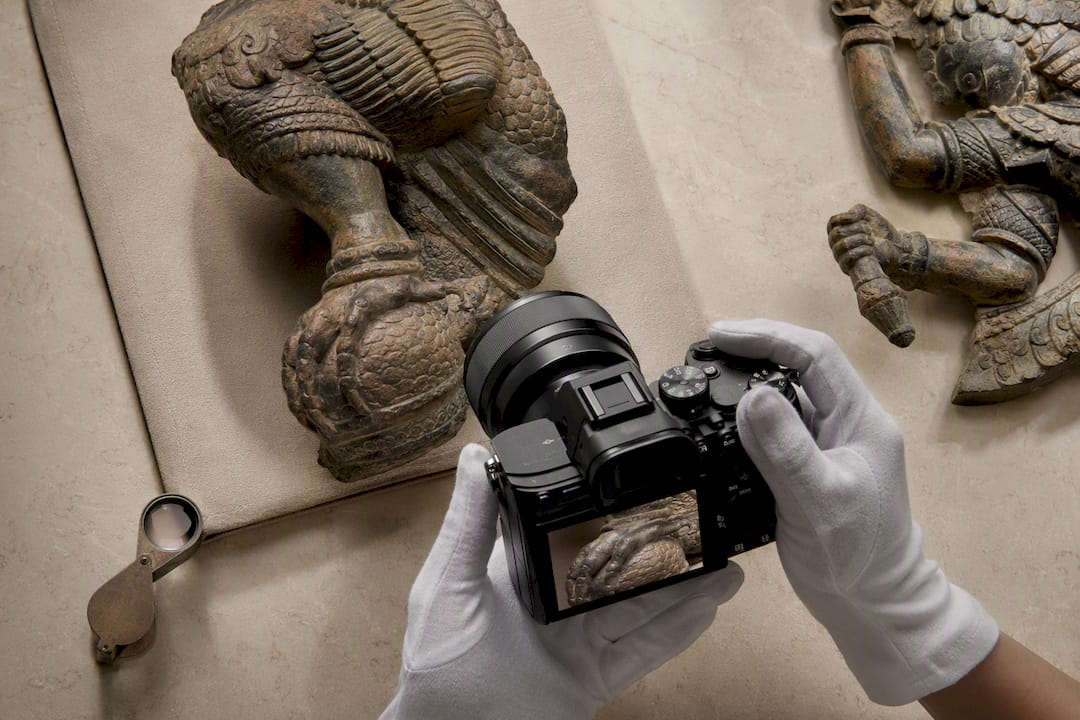
Collectors evaluating an antique piece should ask for the same fundamentals every time: documented provenance, material analysis consistent with the claimed region and period, and photographs showing wear patterns consistent with genuine ritual or architectural use rather than artificial aging. A detailed look at Garuda’s trident, sword, and serpent motif shows how much interpretive weight a single held object can carry, which is exactly why unclear or undocumented attributes should raise questions before a purchase, not after.
From Temple Icon to National Emblem: Garuda’s Civic Life
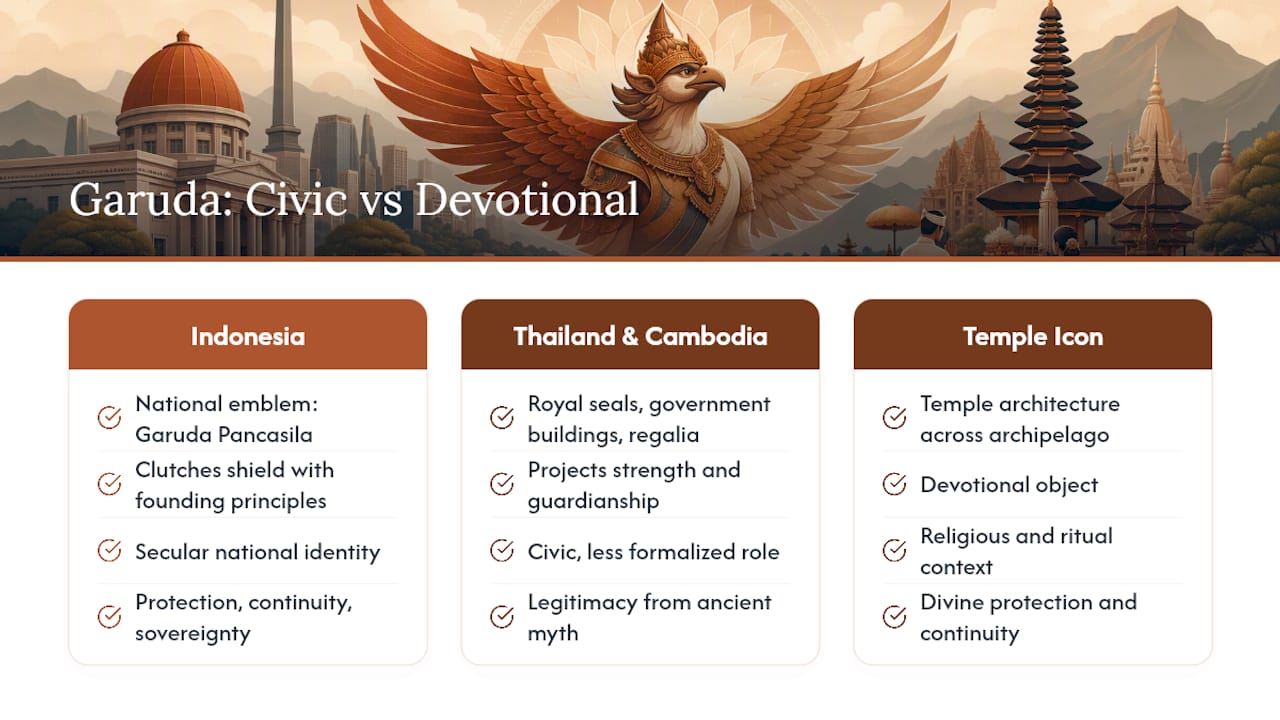
Garuda’s leap from devotional icon to secular state symbol is one of the more striking developments in his long history. Indonesia’s Garuda Pancasila, adopted as the national emblem, puts a stylized Garuda front and center, clutching a shield inscribed with the country’s founding principles. The Sonobudoyo Museum’s account of Garuda’s cultural role describes him as chosen specifically because his mythic associations with protection and continuity translate cleanly into a modern national identity.
That choice was not arbitrary. States reaching for a founding symbol tend to want something that already carries weight, and Garuda arrived pre-loaded with centuries of association with strength, sovereignty, and divine sanction. A deeper look at Garuda’s role in Indonesian symbolism shows how the modern emblem deliberately echoes the same protective and unifying qualities that made Garuda a fixture of temple architecture across the archipelago centuries earlier.
Thailand and Cambodia show a related, if less formalized, pattern. Garuda motifs appear on royal seals, government buildings, and ceremonial regalia throughout mainland Southeast Asia, drawing on the same core association: a figure powerful enough to guard a kingdom and ancient enough to lend that guardianship legitimacy. The distinction worth holding onto is that civic use strips away most of the devotional context. A Garuda on a government seal is not asking for worship; it is borrowing mythic authority to project strength and continuity, a use that runs parallel to, but separate from, temple devotion.
What It Means to Encounter Garuda in Dreams or Meditation
Spiritually curious readers who encounter Garuda in a dream or during meditation often want a quick verdict: good sign or bad sign? Practitioner interpretation generally resists that binary. Writing on Garuda’s symbolism at BuddhistDoor frames encounters with the image less as omens to be graded and more as invitations, prompts toward vigilance, transformation, or a needed confrontation with something you have been avoiding.
Context shapes the reading. Someone with a Hindu devotional background might experience Garuda appearing as reassurance of protection during a difficult period, echoing his role as Vishnu’s guardian mount. Someone drawing on Buddhist practice might read the same image as a nudge toward clearer awareness, a signal that clarity is available if you are willing to look directly at whatever feels threatening. Neither reading is more correct than the other; they simply draw on different traditions’ emphasis.
A useful, low-stakes practice is to journal the encounter honestly rather than reaching immediately for a fixed meaning. Note what Garuda was doing in the dream or vision (flying, fighting, resting, carrying something), what emotion accompanied it, and what in your waking life that emotion connects to. If you want a more structured visualization, approaches drawn from devotional readings of Garuda as guardian and symbol of freedom offer a respectful starting point, provided you treat the practice as personal reflection rather than an attempt to replicate a specific tradition’s formal ritual without guidance.
How Provenance and Iconography Together Determine a Garuda Piece’s Meaning
Getting Garuda symbolism right in a piece of art is not just an academic exercise. Misidentifying a Jain yaksha as a Hindu devotional Garuda, or a Tibetan wrathful protector as a Southeast Asian civic emblem, changes how the object should be understood, displayed, and valued. HD Asian Art’s own research into Garuda’s Hindu and Buddhist symbolism treats iconographic precision as inseparable from authentication, because the two questions are actually the same question asked from different angles.
Authenticating a Garuda sculpture or painting typically involves several concrete checks:
- Material analysis. Bronze alloy composition, stone type, or wood species should be consistent with the claimed region and era; inconsistencies are often the first red flag.
- Stylistic dating. Facial treatment, wing posture, and the number and position of arms should match known conventions for the claimed origin, whether Cambodian, Nepalese, Thai, or Indonesian.
- Provenance paperwork. A documented chain of ownership, export records, or prior collection history adds confidence that a piece is what it claims to be.
- Ritual wear signs. Genuine devotional pieces often show wear patterns from handling, offerings, or exposure consistent with temple or shrine use, patterns that are difficult to fake convincingly.
Getting the iconography right does more than settle a dating question. It determines whether a collector is looking at a devotional object meant to channel Vishnu’s protection, a contemplative aid tied to Buddhist practice, or a guardian figure attached to a specific Jain Tirthankara, and that distinction genuinely affects both spiritual context and long-term collectability. Anyone examining a piece seriously should feel free to request material analysis results, provenance documentation, and detailed photographs of iconographic attributes before relying on a seller’s description alone, and to seek an independent appraisal when a piece’s origin or period carries real weight for the purchase decision.
Garuda as a Bridge Between Freedom and Responsibility
Garuda’s story keeps circling back to a single tension: power that exists to serve, not to dominate. He steals immortality itself and hands it over rather than keeping it. He guards a threshold rather than claiming what’s inside. Across Hindu, Buddhist, and Jain readings, the most durable version of his symbolism treats freedom as something earned through responsibility, not something taken for its own sake.
That framing is worth sitting with before treating any Garuda image, devotional or decorative, as simple decoration. A little respectful curiosity about which tradition shaped a particular piece goes a long way toward honoring what it was actually made to mean.
— James, HDAsianArt.com
Where to Find Authenticated Garuda Sculptures Worth Collecting
Recognizing genuine garuda symbolism in a sculpture is one thing; finding a piece with the documentation to back it up is another. A specialist online gallery curates individually researched antique and traditional pieces from various Asian regions, with each Garuda figure photographed, described, and assessed for iconographic markers such as arm count, held attributes, regional carving style, and material consistency with claimed origin.
Every listing includes a detailed description built around provenance and craftsmanship, and orders ship worldwide with insured delivery. A bronze Bodhisattva figure in the current collection shows the level of detail HDAsianArt applies across its Hindu and Buddhist inventory, from Javanese devotional work to guardian figures like Garuda. If you’re searching for a Garuda piece for a personal collection, an interior design project, or a spiritually grounded addition to your home, browse the full gallery at HDAsianArt or reach out directly to ask about provenance, condition, and available Garuda-related works before you buy.
Sources
For readers who want to go deeper, Britannica’s entry on Garuda offers a concise scholarly overview of his mythic role and historic art conventions. BuddhistDoor’s essay on Garuda’s meaning gives a practitioner-level view of his contemplative uses. Wikipedia’s Garuda entry consolidates myth variants across traditions, and the Sonobudoyo Museum’s writing on Garuda grounds the civic and national symbolism in Indonesian cultural history.
- Garuda | Vedic deity, Mount of Vishnu, Eagle-man | Britannica
- Riding on the Back of Freedom: The Meaning of the Garuda
- Garuda - Wiki
- Garuda - Museum Sonobudoyo Yogyakarta
- Garuda - World History Encyclopedia
FAQ
Is Seeing Garuda a Good Sign or a Bad One?
Neither, exactly. Practitioner interpretation generally treats a Garuda encounter as an invitation toward vigilance or transformation rather than a fixed good or bad omen.
Is Garuda an Eagle or a Kite?
Garuda is a mythological hybrid, described in texts as an eagle-like divine bird with a human torso and arms, not a literal species of eagle or kite found in nature.
What Does It Mean if Garuda Appears in a Dream?
Interpretations vary by tradition, but common readings connect a Garuda dream to protection, an approaching transformation, or a call to face something you’ve been avoiding with greater clarity.
Is Garuda a Demon?
No. Garuda is a protective deity or guardian figure across Hinduism, Buddhism, and Jainism, most often cast as an enemy of harmful serpents and a symbol of triumph over poison and ignorance, not as a demonic figure.
Recommended
- The Indonesian Garuda: Symbolism of Sovereignty, Strength, and Protection
- Unveiling the Symbolism: The Profound Significance of the Indonesian Garuda Holding a Trident and Sword Standing on a Snake
- Garuda: The Divine Guardian and Symbol of Freedom
- Unraveling the Majesty: The Profound Significance of the Thai Garuda
