






Authenticity Guarantees in Art: What They Cover and Mean
Authenticity Guarantees in Art: What They Cover and Mean
An authenticity guarantee is a seller’s written statement that an artwork is what the seller says it is: the age, origin, maker or material described at sale. Its value depends on three things: who gives it, what evidence stands behind it, and what the seller must do if the statement proves wrong. For Buddhist and Hindu sculpture, where attribution rests on provenance, material and style rather than a signature, the evidence behind the statement matters more than the wording of the promise.
Key Features
- A guarantee is a contractual promise. Authentication is the evidence. Provenance is the documented history. A certificate is only a document, and its worth equals the research behind it.
- Art-law specialists recommend that an authenticity warranty appear on the invoice, because a written term is easier to rely on than a verbal assurance (Observer, 2025).
- Professional conservation standards say statements of age, origin or authenticity should rest on sound evidence (AIC Code of Ethics).
- For antique Asian sculpture, a useful file contains ownership history, clear photographs, a description of condition, and a stated degree of certainty.
- HD Asian Art researches, photographs and describes each piece individually and ships worldwide with insurance through DHL.
Table of Contents
- What an authenticity guarantee means
- Guarantee, certificate, authentication and provenance
- Who should stand behind the statement
- What a guarantee should state
- Authenticity in Asian religious sculpture
- A worked example
- Insurance is a separate question
- Buying for a collection or an interior
- Our perspective
- Browse the collection
- FAQ
- Sources
What an authenticity guarantee means
In art sales, “authentic” has a narrow legal meaning. It usually means that the work is what the description says: made by the named artist, in the stated period, in the stated place and material. A guarantee turns that description into a promise with consequences for the seller.
Three points define any guarantee:
- Who gives it. A dealer, a gallery, an auction house or a third-party expert. A promise is only as strong as the party standing behind it.
- What it states. Age, origin, culture, material, maker, or some combination. A guarantee of “Khmer style” is different from a guarantee of “Angkor period, 12th century”.
- What it offers in return. A refund, a replacement, an exchange or nothing beyond the statement itself.
The Observer’s 2025 collector guide advises asking for an authenticity warranty to be added to the invoice. Art-law specialist Anne-Laure Allehaut describes this as a simple and inexpensive step (Observer). The reasoning is practical: the invoice is the document that survives resale, insurance claims and estate review.
Guarantee, certificate, authentication and provenance
Four terms are often used as if they meant the same thing. They do not.
| Term | What it is | What it proves |
|---|---|---|
| Authenticity guarantee | A seller’s promise, usually with a remedy | That the seller accepts responsibility for the description |
| Certificate of authenticity | A document describing the object | Only what the issuer researched and is willing to sign |
| Authentication | Research and examination by qualified people | The attribution, to a stated degree of certainty |
| Provenance | The documented chain of ownership | Where the object has been, and when |
A guarantee without authentication behind it is a promise made on thin ground. Authentication without a guarantee is evidence without accountability. The strongest purchase combines both, with provenance supplying the history.
Provenance is not a formality. The Rubin Museum of Himalayan Art defines provenance research as understanding an object’s ownership history and origin, and says its acquisition research seeks written documentation about that history from sellers and donors (Rubin Museum). Museums that collect Asian art apply the same requirement that private collectors can apply.
The Observer’s guide describes provenance evidence as a possible paper trail of receipts, contemporary descriptions, exhibition records and photographs. It also notes that authentication draws on provenance, scientific analysis and connoisseurship, and that expert opinions can change or conflict (Observer). A guarantee does not remove that uncertainty. It assigns responsibility for it.
Who should stand behind the statement
The American Institute for Conservation (AIC), the professional body for conservators in the United States, states that declarations of an object’s age, origin or authenticity should be based only on sound evidence. Its Code of Ethics also asks conservators to be mindful of conflicts of interest when they take on authentication, appraisal or art dealing (AIC).
Two lessons follow for a buyer.
- The standard is evidence, not confidence. A confident tone in a listing is not evidence.
- The relationship between the person who examines the object and the person who sells it matters. A seller whose research is documented in the listing gives the buyer something concrete to evaluate.
This is the reason a listing with a full written description, close photography and a stated history serves a collector better than a certificate attached to a thin listing.
What a guarantee should state
A useful guarantee is specific. When reading one, collectors and designers can look for the following points.
The claim
The statement should name what is guaranteed: culture, period, material, and whether the object is wholly original or has restorations. For a bronze Buddha, the difference between “antique” and “old-style” is the whole question. For a stone Hindu deity, a stated region and period carry more weight than a general “authentic”.
The evidence
A good file says how the conclusion was reached: examination of the object, comparison with documented works, and ownership history. Evidence of this kind can be tested by a later buyer, an insurer or a museum.
The degree of certainty
Honest attribution is often graded rather than absolute. A statement that separates what is firmly established from what is probable is more reliable than one that claims certainty about everything.
The remedy and its period
Check what the seller does if the statement is shown to be wrong, how long the promise runs, and whether it passes to a later owner. Terms differ widely. For example, one US auction house’s published conditions describe a five-year authorship guarantee for the original buyer only. The terms set conditions on the type of evidence and limit the remedy to a refund of the price. Every seller’s terms are different, so the written wording is what counts.
The invoice
Putting the guarantee in the invoice, as the Observer’s guide suggests, keeps the promise tied to the transaction and to the object it describes.
Authenticity in Asian religious sculpture
Buddhist and Hindu sculpture presents particular challenges. Most antique pieces are anonymous, so there is no artist’s signature or catalogue raisonné to consult. Attribution depends on iconography, style, material, surface and history. Each of these deserves attention.
Style and iconography
The pose, the hand gestures, the crown, the drapery and the base all place a sculpture in a tradition. Knowing the regional canon is the starting point. HD Asian Art publishes guides on this subject, including how to identify Cambodian Buddhist and Hindu sculptures and why collectors prize Khmer sculpture.
Material and surface
Museums combine curatorial study with conservation study. The Norton Simon Museum describes its research on incoming objects as covering origins, provenance and condition (Norton Simon Museum). Condition is part of the evidence: corrosion, wear, old repairs and later additions all form part of the story and should be described plainly.
Testing
Scientific testing helps but has rules. The AIC says examination is the basis for later conservation decisions, that tests which could change an object should be justified before they are done, and that the owner’s consent is required before material is removed for a test. Only the minimum necessary should be taken, and the removal should be recorded (AIC). A statement that an object was tested should therefore say what was done and who authorized it.
Ownership history
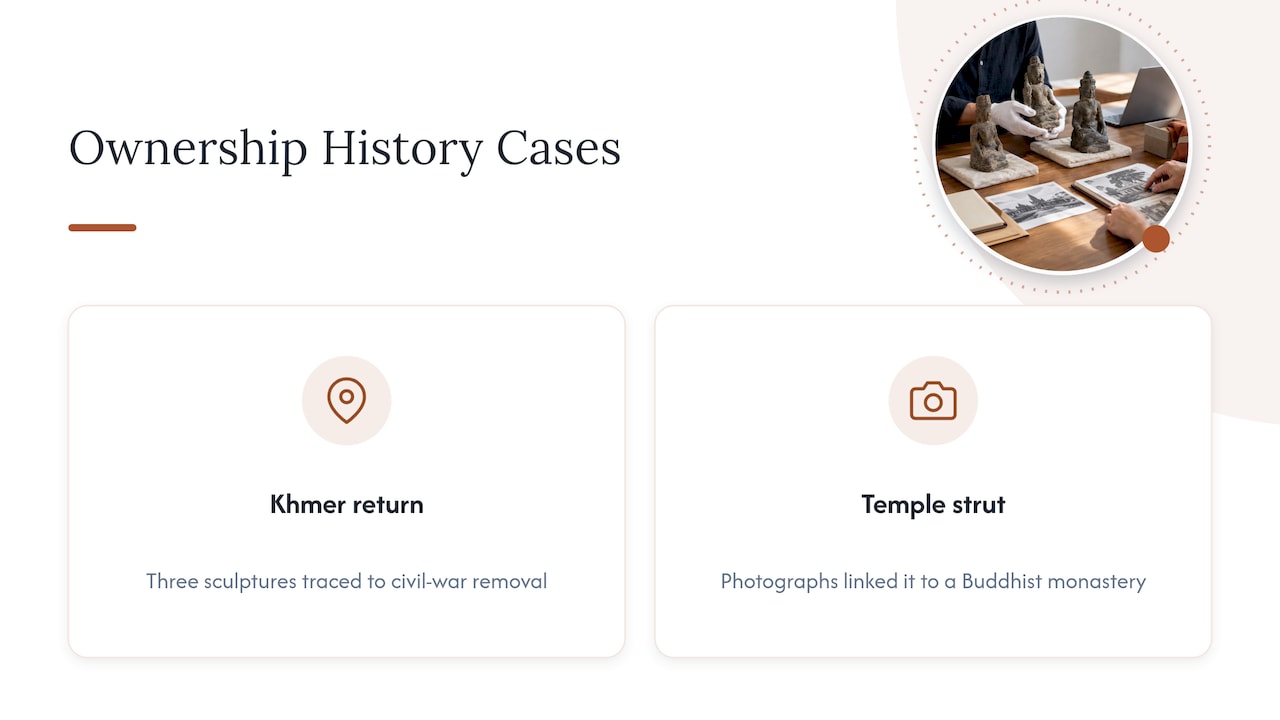
For Southeast Asian sculpture, provenance carries unusual weight, since the legal and ethical status of an object depends on when and how it left its country of origin. A 2025 report on the return of three Khmer sculptures to Cambodia records that a provenance investigation concluded they had been removed during decades of civil war and insecurity (Phnom Penh Post). In another case, The Art Newspaper reported in August 2022 that the Metropolitan Museum returned a Nepalese temple strut after research linked it to a Buddhist monastery through published photographs (The Art Newspaper). Archival images and documented history can test a claimed past, and a buyer who holds that documentation holds the object more securely.
HD Asian Art’s guides on provenance research for Asian art, Buddhist sculpture archive research and why a collection name is not a provenance set out the steps in more detail. A broader walkthrough is available in how to authenticate an Asian antique.
A worked example
Take a Khmer-style bronze Buddha offered at a figure in the thousands of dollars. Two listings could describe it.
Listing A says “Authentic antique Khmer bronze, guaranteed.” It has one photograph and no history.
Listing B gives the region and approximate period, the material, the measurements, the condition including repairs, photographs of the front, back, base and surface detail, and a statement of how the attribution was reached and with what degree of confidence.
The word “guaranteed” appears in the first and not the second, yet Listing B is the stronger offer. It gives a buyer, an insurer, an appraiser or a later heir something to check. A guarantee attached to Listing B’s content, recorded on the invoice, is a promise grounded in a file. Attached to Listing A, it is only a word.
Insurance is a separate question
An authenticity guarantee addresses whether the object is what it was described to be. It does not cover damage in transit, loss or theft. Those risks are handled by shipping and transit insurance. A guide to artwork moving insurance coverage shows how this separate protection is usually framed. HD Asian Art ships worldwide through DHL with full insurance, so the sculpture is protected on its way to the buyer.
Buying for a collection or an interior
The two readers of this subject use the same evidence in different ways.
Collectors and investors need the file to hold up later. Ownership history, an identified provenance, clear photographs and a recorded invoice make resale, loan and insurance valuation easier. Museum-style display requires the same documentation, which is why standards for museum-quality Asian art put provenance at the center.
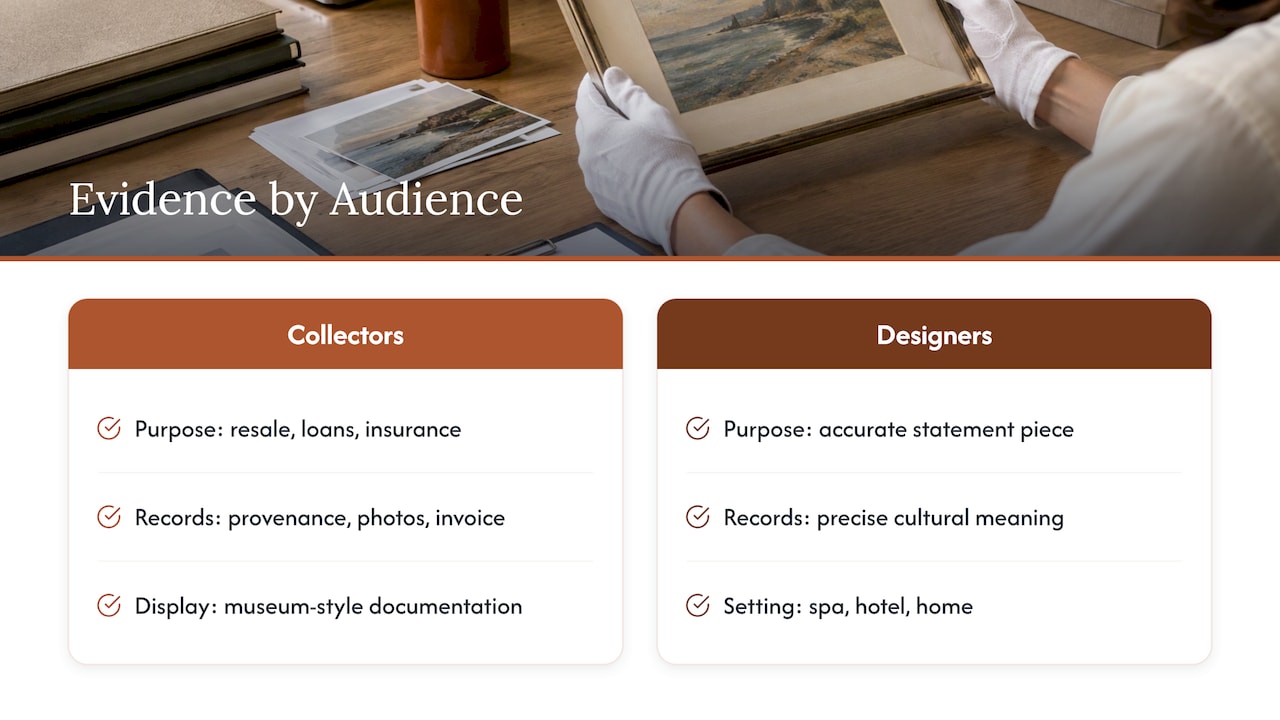
Designers and homeowners need confidence that a statement piece for a spa, yoga studio, hotel or home is what it is described to be, and that the cultural meaning attached to it is accurate. A Buddha’s gesture or a Hindu deity’s attributes carry specific meanings, so a precise description protects the client as much as the object does. The guide to different types of Buddha statues lists common forms and their symbolism.
Our perspective
We treat the guarantee as the last line of a long process, not the first. The process starts with the object: each piece we offer is individually researched, photographed and described by experts before it reaches the gallery.
The description is where authenticity becomes visible. Detailed photography, a plain account of condition and a stated history let a collector form a judgment of their own, and that judgment lasts longer than any slogan.
We also think of the piece as it will be held for decades. Long-term collectability depends on documentation that travels with the sculpture: a clear description, a history that can be followed, and a record that a later owner or museum can read.
Our focus is Buddhist and Hindu statues, sculptures and temple art in bronze, stone and wood from Cambodia, Thailand, Indonesia, Sri Lanka, Vietnam and beyond, and Burmese lacquerware. Narrow focus allows deep research. Worldwide insured DHL shipping completes the work, so the object arrives as described and protected.
James, HDAsianArt.com
Browse the collection
HD Asian Art offers antique and traditional Buddhist and Hindu statues, sculptures and temple art, each with an individual expert description and detailed photography. Collections are organized by subject: Buddha Statues, Hindu Statues, Burmese Lacquerware and Masterpieces. Gift cards redeemable in the gallery are also available.
For a specific deity, the gallery also lists Vishnu statues, Brahma statues and Hanuman statues. A gift card lets a recipient choose the piece.
Frequently Asked Questions
What does an authenticity guarantee mean?
It is a seller’s written promise that an artwork matches its description, such as its age, origin, material or maker. The promise normally comes with a stated remedy if the description proves wrong. Its strength depends on the seller and on the evidence behind the description.
Is a certificate of authenticity the same as a guarantee?
No. A certificate is a document describing the object and is worth the research and the signer behind it. A guarantee is a commitment with consequences for the seller. Placing the guarantee wording on the invoice ties the promise to the sale.
What evidence supports an authenticity claim for an Asian sculpture?
Provenance, examination of the object, comparison with documented works and a clear statement of condition. Professional conservation standards say declarations of age, origin or authenticity should rest only on sound evidence, and good reports state the degree of certainty rather than a bare “authentic”.
Does an authenticity guarantee cover shipping damage?
No. Authenticity concerns what the object is. Damage or loss in transit is covered by shipping insurance, which is a separate arrangement. HD Asian Art ships worldwide with insurance through DHL.
Sources
- A Collector’s Guide to Art Authentication, Observer (2025)
- Code of Ethics and Guidelines for Practice, American Institute for Conservation
- Ongoing Research and Provenance, Rubin Museum of Himalayan Art
- Where Art Meets Science: Ancient Sculpture from the Hindu-Buddhist World, Norton Simon Museum
- Thousand-year-old Khmer sculptures return home, Phnom Penh Post
- The Metropolitan Museum returns two looted artefacts to Nepal, The Art Newspaper (2022)
- Artwork Moving Insurance
