



¿Qué significa Vajra en el arte budista?
¿Qué significa Vajra en el arte budista?
El vajra se define como un cetro ritual en el arte budista que Simboliza tanto el rayo como el diamante., que representa una fuerza irresistible y una indestructibilidad absoluta. Este doble significado forma el núcleo filosófico del budismo Vajrayana, conocido como el “Camino del Diamante”. Comprender qué significa vajra en el arte budista requiere mirar más allá de su forma física.
El vajra codifica capas de la filosofía budista, desde la naturaleza de la iluminación hasta la mecánica del ritual tántrico. Tanto para los coleccionistas como para los estudiosos del arte, reconocer este símbolo transforma la forma de leer una escultura completa o una composición de mandala.
¿Cuáles son los orígenes y la evolución histórica del vajra?
El vajra comenzó como un arma, no como una herramienta espiritual. En la mitología hindú, era el rayo de Indra, rey de los dioses, forjado a partir de los huesos del sabio Dadhichi para destruir al demonio Vritra. Esa historia de origen es importante porque explica por qué el vajra tiene una fuerza tan cruda e imparable como concepto.
El budismo no descartó este poder. En cambio, lo redirigió hacia adentro. Entre los siglos V y VII d.C., el vajra había sido completamente absorbido por la práctica budista tántrica como símbolo de superar el ego y la ignorancia en lugar de destruir enemigos externos. Esta transformación es uno de los cambios conceptuales más significativos en la historia del arte religioso asiático.
Las culturas budistas del Himalaya del Tíbet, Nepal y Bután se convirtieron en los principales centros de la iconografía vajra. El budismo vajrayana, la tradición que toma su nombre directamente del símbolo, desarrolló en torno a él todo un vocabulario ritual y artístico. El Museo de Arte Rubin de Nueva York alberga algunos de los mejores ejemplos de esta tradición en el mundo occidental.
Etapas clave en la evolución artística del vajra:
- Origen hindú: Arma de Indra, lanzada en forma de rayo, utilizada para matar enemigos cósmicos.
- Adopción budista temprana: Reutilizado como símbolo de claridad mental y poder espiritual.
- Integración tántrica (siglos V-VII d.C.): Formalizado como instrumento ritual en las ceremonias Vajrayana.
- Refinamiento del Himalaya: Desarrollado en objetos de bronce muy detallados con características iconográficas estandarizadas.
- Propagación panasiática: Introducido en las tradiciones budistas del sudeste asiático a través de rutas comerciales y de peregrinación.
el Orígenes hindúes del vajra son visibles en la escultura budista temprana, donde el símbolo conserva su asociación con el poder cósmico antes de que la iconografía se espiritualizara por completo.
¿Qué simboliza el vajra en la filosofía budista?
El vajra conlleva dos significados simultáneos y se requieren ambos para comprenderlo plenamente. Como un rayo, representa la fuerza repentina e irresistible de la percepción que atraviesa el engaño. Como diamante, representa la naturaleza indestructible e inmutable de la conciencia iluminada. Ningún significado anula al otro. Trabajan juntos.
En la ontología budista, la esfera central del vajra representa el vacío, conocido en sánscrito como sunyata. Esto no es un vacío sino la naturaleza abierta e incondicionada de la realidad que la práctica budista pretende realizar directamente. Las puntas y los motivos de loto que rodean esa esfera representan las enseñanzas estructuradas y los niveles de sabiduría que llevan al practicante hacia esa realización.
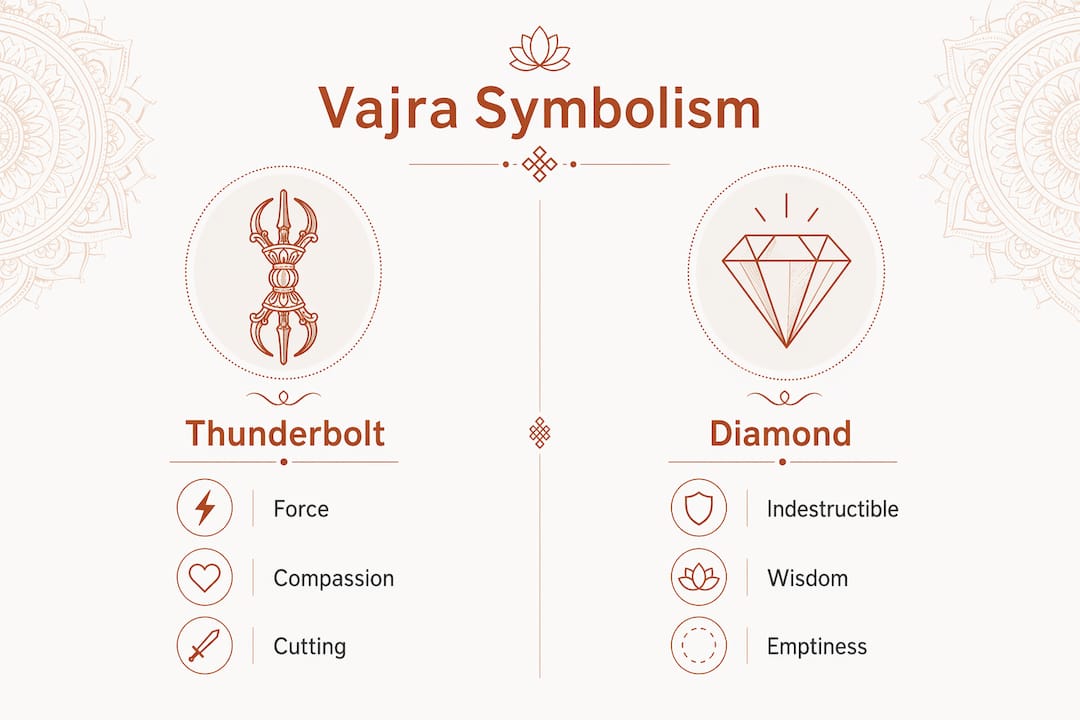
El vajra también significa medios hábiles, o upaya en sánscrito. Esto se refiere a los métodos compasivos que utiliza un maestro para guiar a los estudiantes hacia el despertar. Junto con la campana, llamada ghanta, el vajra forma una declaración filosófica completa. El vajra y la campana juntos Representan la unión del método y la sabiduría, las dos alas del camino hacia la iluminación.
Significados simbólicos centrales codificados en el vajra:
- Calidad del rayo: Visión repentina y penetrante que no se puede bloquear ni desviar.
- Calidad del diamante: Naturaleza búdica inmutable e indestructible presente en todos los seres
- Sunyata: El vacío como fundamento de todos los fenómenos, representado por la esfera central.
- Upaya: Acción compasiva hábil al servicio del despertar de los demás.
- No dualidad: El vajra encarna la conciencia no dual y mantiene unidos a los opuestos.
Consejo profesional: Cuando te encuentres con una deidad sosteniendo un vajra en una escultura budista, mira qué mano lo sostiene. La mano derecha normalmente indica un método compasivo activo, mientras que la mano izquierda indica sabiduría. Esa ubicación por sí sola te dice algo específico sobre el papel de la deidad en el sistema tántrico.
¿Cómo se representa el vajra en el arte budista?
El vajra de cinco puntas es la forma más común en la escultura y los objetos rituales budistas. Cinco puntas simbolizan la transformación de los cinco venenos, que son la ignorancia, la ira, el deseo, los celos y el orgullo, en las cinco sabidurías de la mente iluminada. Esa transformación es el proyecto central de la práctica Vajrayana, por lo que la forma de cinco puntas lleva todo el camino en su geometría.
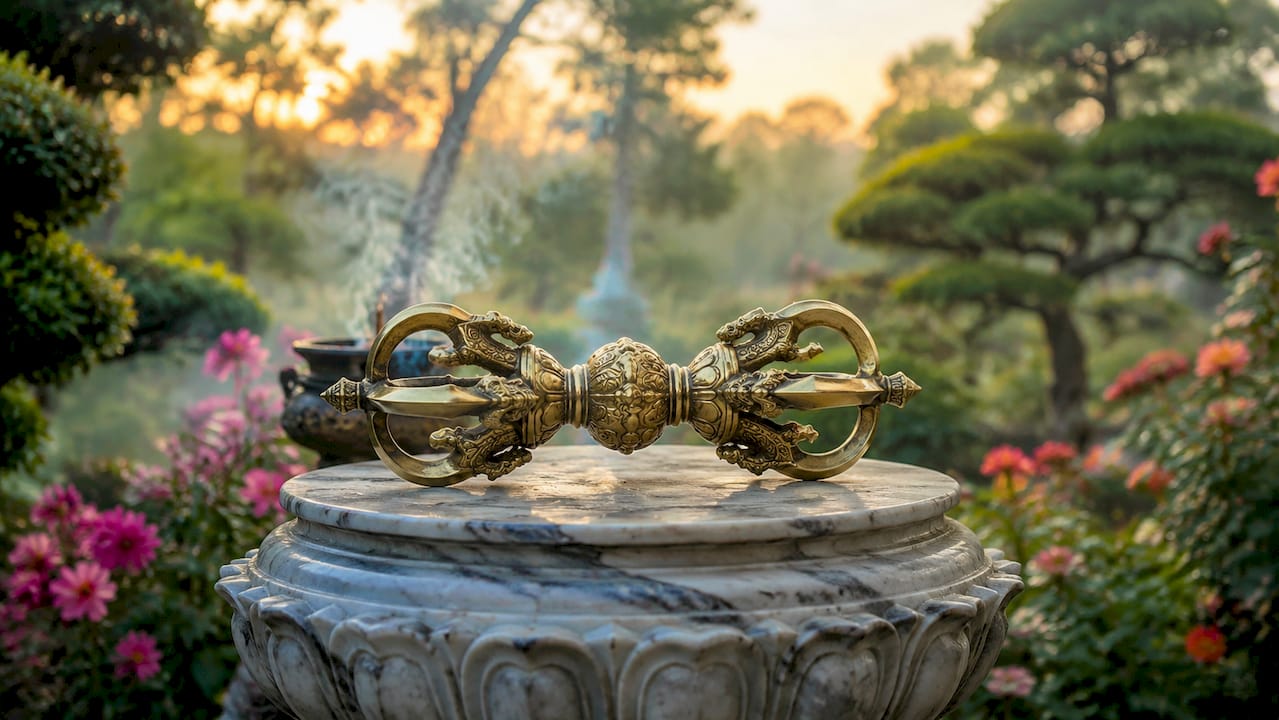
El número de puntas no es arbitrario. Un vajra de un solo frente, llamado vishvavajra cuando está doblado, aparece en contextos rituales y arquitectónicos específicos. En ciertas tradiciones esotéricas tibetanas y japonesas aparecen formas triples. El motivo del loto de 16 pétalos que se encuentra en muchos vajras representa los 16 tipos de vacío reconocidos en la filosofía budista. Cada pétalo es una enseñanza, no una decoración.
| forma vajra | recuento de puntas | Simbolismo primario |
|---|---|---|
| De un solo frente | 1 | Unidad absoluta, realidad indivisa. |
| triple | 3 | Tres joyas: Buda, Dharma, Sangha |
| Cinco puntas | 5 | Cinco sabidurías, transformación de cinco venenos. |
| Nueve puntas | 9 | Nueve vehículos de la enseñanza budista Nyingma |
| Doble vajra (vishvavajra) | 4 direcciones | Estabilidad, fundamento, orden cósmico. |
Las cabezas de makara y los pétalos de loto de los vajras de alta calidad no son adornos decorativos. El makara, una criatura marina mitológica que combina características de cocodrilo, elefante y pez, representa el umbral entre el mundo material y el espiritual. Su presencia en un vajra indica que el objeto es un punto de cruce entre la realidad ordinaria y la despierta.
La coherencia artística del vajra depende de la interacción entre el diseño de las puntas, la posición de la mano de la deidad o mudra y la mirada de la figura que la sostiene. Leer correctamente una estatua budista significa leer los tres elementos juntos. Identificar el vajra en una escultura también ayuda a ubicar a la deidad dentro de una familia de mandalas específica, que es un grupo de deidades relacionadas organizadas alrededor de un Buda central.
Consejo profesional: Al examinar una deidad de bronce que sostiene un vajra, compruebe la expresión facial de la deidad junto al objeto. Un rostro enojado combinado con un vajra indica energía transformadora que corta el ego. Un rostro pacífico combinado con el mismo objeto indica un método compasivo. Mismo símbolo, diferente registro.
¿Cómo funciona el vajra en la práctica ritual budista?
El vajra no es un símbolo pasivo. Los practicantes lo sostienen durante las ceremonias de meditación, recitación y empoderamiento. Su presencia física en la mano tiene como objetivo activar las cualidades que representa, conectando el cuerpo, el habla y la mente del practicante con el estado de iluminación.
El maridaje ritual con la campana es fundamental. En ceremonias tántricas:
- El vajra se sostiene en la mano derecha., que representa el principio masculino de medios hábiles y acción compasiva en el mundo.
- La campana se sostiene en la mano izquierda., que representa el principio femenino de la sabiduría y el reconocimiento directo del vacío.
- Juntos son tocados y golpeados en secuencias coordinadas., marcando transiciones en el ritual e invocando energías de deidades específicas.
- En ceremonias de empoderamiento, el vajra se coloca en la coronilla de la cabeza del estudiante, transmitiendo la energía de una familia de Buda específica directamente a la corriente mental del practicante.
- Durante la meditación, el practicante visualiza sostener el vajra como una forma de identificarse con la deidad y las cualidades que codifica el objeto.
El vajra y la campana son inseparables en el uso tántrico y simbolizan el camino completo hacia la iluminación. Separarlos en un ritual sería como eliminar un lado de una ecuación. el rituales de consagración que activan las esculturas budistas a menudo involucran ambos objetos como instrumentos centrales.
La función espiritual del vajra es cortar. No para herir, sino para cortar el apego del practicante al ego, a la identidad fija y a la ilusión de un yo permanente. Esa acción cortante se entiende como un acto de compasión, no de agresión. La fuerza necesaria para romper con la ilusión profundamente arraigada es exactamente la fuerza que representa el vajra.
Conclusiones clave
El vajra es el símbolo definitorio del budismo Vajrayana y codifica todo el camino desde el engaño hasta la iluminación en un solo objeto ritual.
| punto | Detalles |
|---|---|
| Significado dual en sánscrito | Vajra significa tanto rayo como diamante, y representa fuerza e indestructibilidad simultáneamente. |
| Forma de cinco puntas | El diseño vajra más común simboliza la transformación de cinco venenos en cinco sabidurías. |
| Maridaje ritual | El vajra siempre está emparejado con la campana, representando juntos el método y la sabiduría como el camino completo. |
| esfera central | La esfera en el centro del vajra representa sunyata, o el vacío, la base de la realidad budista. |
| poder compasivo | La fuerza del vajra no es la agresión sino la energía compasiva necesaria para superar la ignorancia y el ego. |
El vajra no es lo que la mayoría de la gente piensa que es.
La mayoría de los visitantes de las colecciones de arte budista asumen que el vajra es un arma. Esa suposición es comprensible. El objeto parece un cetro construido para impactar, y su origen en el rayo de Indra no desalienta esa lectura. Después de años de trabajar con escultura budista en HDAsianArt, encuentro que este es el error más común que encuentro.
El poder del vajra es compasivo, no agresivo. Las iracundas deidades que lo empuñan en el arte tibetano y del Himalaya no están enojadas. Son feroces porque el trabajo de despertar a alguien de un profundo engaño a veces requiere fuerza. Eso es algo muy diferente a la violencia.
Lo que encuentro más notable del vajra como objeto de arte es su densidad filosófica. Un vajra de bronce de cinco puntas del Nepal del siglo XII no es sólo un objeto hermoso. Es un diagrama tridimensional de toda una cosmología. Cada diente, cada pétalo de loto, cada cabeza de makara es una enseñanza específica. Comprender el simbolismo vajra desbloquea la lógica de familias enteras de mandalas y linajes tántricos.
Mi consejo para cualquiera que esté creando una colección de arte budista: aprenda a leer el vajra antes de aprender cualquier otra cosa. Aparece en manos de más deidades que casi cualquier otro atributo. Una vez que puedas identificarlo y entender lo que indica, leerás la escultura budista a un nivel completamente diferente. el Tradición del arte budista mahayana te da el contexto más amplio, pero el vajra es la llave que abre la puerta.
-Jaime, HDAsianArt.com
Explora el auténtico arte budista en HDAsianArt
HDAsianArt se especializa en esculturas budistas antiguas y tradicionales de Camboya, Tailandia, Nepal, Tíbet, Indonesia, Sri Lanka y más allá. Cada pieza de la colección es investigada y descrita individualmente por expertos, con total atención a los detalles simbólicos, incluido el vajra y otros atributos rituales que definen el significado y el linaje de una obra.
Para coleccionistas y eruditos que quieran comprender el arte budista en profundidad, la colección de HDAsiáticoArte Incluye esculturas de deidades de bronce, implementos rituales y objetos del templo donde el vajra aparece como elemento iconográfico central. Cada adquisición viene con envío de DHL asegurado a todo el mundo y documentación que respalda la cobrabilidad a largo plazo y el respeto cultural.
Preguntas frecuentes
¿Qué significa vajra en sánscrito?
Vajra significa rayo y diamante en sánscrito. Estos dos significados juntos definen el núcleo del símbolo: fuerza irresistible combinada con absoluta indestructibilidad.
¿Por qué el budismo Vajrayana lleva el nombre del vajra?
Vajrayana toma su nombre directamente del vajra porque el símbolo representa la naturaleza indestructible de la mente iluminada. La tradición a menudo se llama Camino del Diamante por la misma razón.
¿Cuál es la diferencia entre un vajra de cinco puntas y uno de una sola punta?
Un vajra de cinco puntas simboliza la transformación de los cinco venenos en las cinco sabidurías, lo que lo convierte en la forma filosóficamente más completa. Un vajra de un solo frente representa la realidad absoluta e indivisa.
¿Por qué el vajra siempre se combina con una campana en el ritual budista?
El vajra representa medios hábiles y la campana representa sabiduría. Juntos simbolizan la unión del método y la sabiduría, que es el camino completo hacia la iluminación en la práctica Vajrayana.
¿Es el vajra un arma en el arte budista?
El vajra no es un arma en el arte budista. Su fuerza representa energía compasiva dirigida a atravesar el ego y la ignorancia, sin dañar a los demás.
