



Vishnu Statue Guide: Avatars & Asian Sculpture
Vishnu Statue Guide: Avatars & Asian Sculpture
A collector encountering their first Vishnu statue faces an immediate problem: four arms, multiple attributes, and a sculptural tradition that looks completely different depending on whether the piece comes from South India, Cambodia, or Java. Without a working knowledge of iconographic grammar, you are looking at a beautiful object and nothing more.
With it, you are reading a sophisticated cosmological text rendered in stone, bronze, or gilded wood. This guide gives you the tools to identify Vishnu in his standard form, recognise each of his ten principal avatars by their visual signatures, and understand why the same deity looks so different depending on where and when the sculpture was made.
Table of Contents
- Quick Takeaways
- Vishnu's Core Iconography: The Four Attributes
- The Ten Avatars: Visual Identification Guide
- Regional Styles Across Asia: How Geography Shapes the Sculpture
- Khmer Vishnu: Cambodia's Distinctive Sculptural Language
- Comparing Approaches to Collecting Vishnu Sculpture
- Authentication and Quality: What Museum-Grade Actually Means
- Frequently Asked Questions
- References
Quick Takeaways
|
Key Insight |
Explanation |
|---|---|
|
Four attributes identify standard Vishnu |
The shankha (conch), chakra (discus), gada (mace), and padma (lotus) are present in any iconographically complete Vishnu statue. A missing attribute often signals a specific avatar or regional variant, not an error. |
|
Each Dashavatara avatar has an unmistakable visual signature |
Matsya is a fish or fish-tailed man. Narasimha has a lion's head on a human body. Varaha has a boar's head cradling Bhudevi on his tusk. These forms are consistent across most regional traditions. |
|
Khmer Vishnu has a distinctive frontal posture and simplified crown |
Cambodian Vishnu figures typically stand frontally with a characteristic serene expression and a towering, relatively unornamented crown, quite different from the elaborate South Indian bronze tradition. |
|
Regional divergence is not iconographic error |
A Southeast Asian avatar sculpture that diverges from North or South Indian conventions is following its own equally valid regional tradition, not copying incorrectly. Knowing this distinction protects you from misjudging fine pieces. |
|
The Buddha as ninth avatar requires theological context |
Inclusion of the Buddha in the Dashavatara is a position found in certain Hindu texts, not a statement accepted by Buddhist doctrine. Pieces from syncretic regions like Java or Cambodia may reflect this overlap. |
|
Garuda identifies Vishnu's mount even when Vishnu is absent |
The eagle-man Garuda, depicted kneeling or standing with wings spread, is Vishnu's vahana. His presence in a sculptural program signals a Vaishnava context even if Vishnu himself is not depicted. |
|
Avatar position in relief panels follows a consistent hierarchy |
In Dashavatara relief carvings, cosmic and earliest avatars typically appear highest, animal hybrids at mid-level, and human-form avatars toward the base. This spatial grammar helps date and attribute panels. |
Vishnu's Core Iconography: The Four Attributes
Vishnu is one of the three principal deities of Hinduism, forming part of the Trimurti alongside Brahma and Shiva. His role is preservation: he descends into the world whenever cosmic order, dharma, is threatened, and his sculptural iconography encodes that function precisely. Before you can identify any of his avatars, you need to know what his standard form looks like.
A fully iconographically complete Vishnu statue in his standard form displays four arms holding four specific attributes: the shankha (conch shell), the chakra (spinning discus), the gada (mace), and the padma (lotus). These four objects together are so fundamental that a popular epithet of Vishnu in Sanskrit texts is "Shankha-chakra-gada-pani," meaning "he who holds in his hands the conch, discus, and mace." If a four-armed figure is missing one of these attributes or holds something different, it may represent a specific avatar, a regional variant, or a sectarian form rather than the standard Vaikuntha Vishnu.
Each attribute carries specific theological weight. The shankha, associated with sound and the primordial vibration of creation, is typically held in the upper-left hand. The chakra, the Sudarshana discus, represents cosmic order and the cycle of time. The gada, or mace, symbolises strength and the enforcement of righteous law. The lotus, padma, stands for purity and the unfolding of spiritual possibility. A collector who can read these four objects correctly can identify the deity in seconds, even across wildly different regional styles.
Pro tip: Vishnu is also frequently identified by his vehicle, Garuda, the eagle-man. When a sculpture shows a kneeling or standing winged figure with a human body and bird features, you are looking at Garuda, and you are in a Vaishnava context. This matters when attributing fragmentary pieces or individual figures from a larger sculptural program.
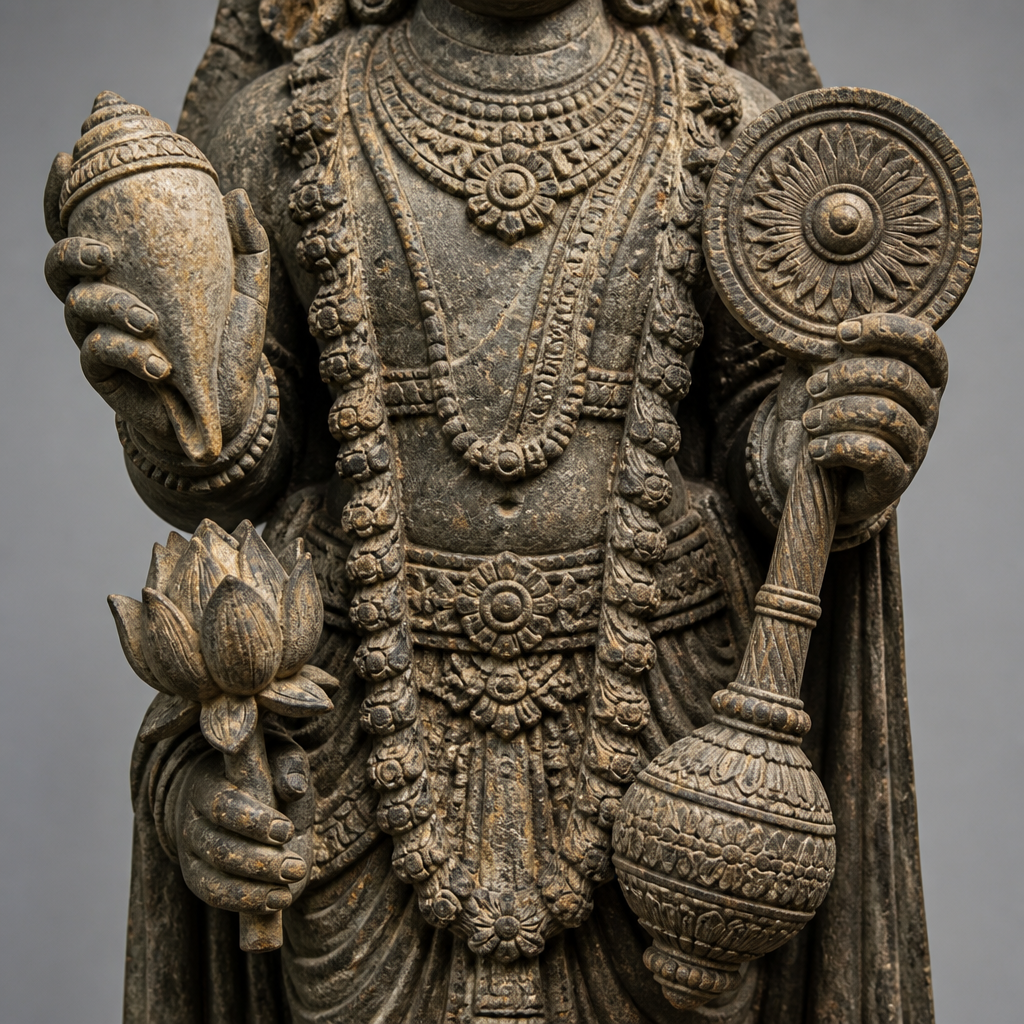
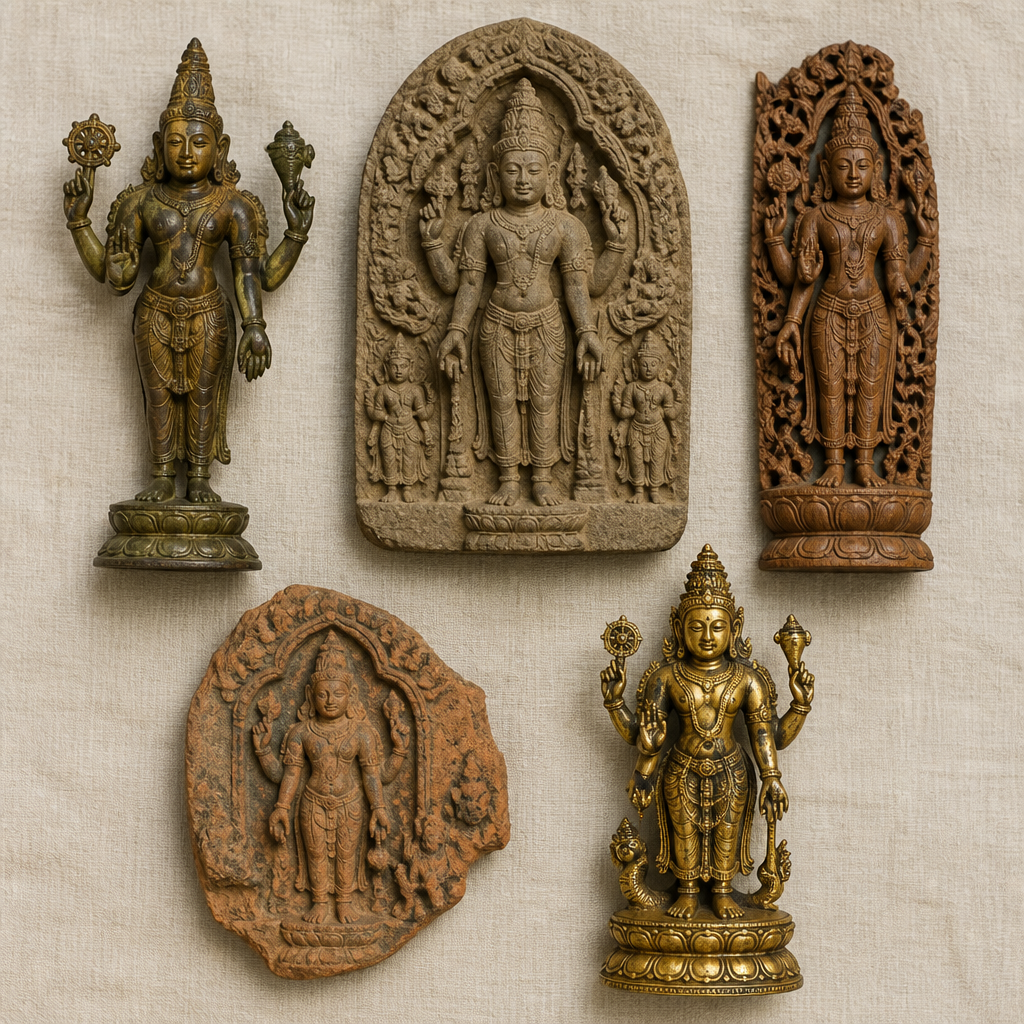
Vishnu's standard posture is also a key identifier. The most common standing form is called samabhanga, a straight, balanced upright stance, or a gentle tribhanga (triple-flexion) in some South Indian bronzes. His face is typically calm and royal, wearing a tall cylindrical crown called a kirita-mukuta. His garment is a dhoti with elaborate belt arrangements, and his chest often bears the Shrivatsa mark, a specific curling tuft, along with the Kaustubha gem at the neck. The combination of crown type, chest marks, and four attributes is your three-point confirmation system.
The Ten Avatars: Visual Identification Guide
The Dashavatara, meaning the ten principal avatars, represents Vishnu's descents into the world to restore dharma at moments of cosmic crisis. The standard list accepted across most Vaishnava traditions includes Matsya, Kurma, Varaha, Narasimha, Vamana, Parashurama, Rama, Krishna, Buddha, and Kalki. Some regional and sectarian traditions substitute Balarama for the Buddha. Each form has sculptural characteristics specific enough to identify immediately once you know them.
The Animal and Hybrid Avatars
Matsya (the fish) appears either as a fish or as a man merging into a fish tail below the waist, sometimes gripping a horn. Matsya rescued the Vedas and the seed of humanity from a cosmic flood, a saviour-of-knowledge role that gives the form its specific iconographic gravity. Kurma (the tortoise) shows Vishnu as a tortoise or a man with a tortoise lower body, often depicted supporting Mount Mandara on his back during the churning of the cosmic ocean. The load-bearing quality of the form is always visually communicated.
Varaha (the boar) is one of the most powerful and widespread avatar depictions. A boar's head sits atop a muscular human body, and the figure is frequently shown cradling the earth goddess Bhudevi on one tusk, lifting her from the cosmic waters. The battle with the demon Hiranyaksha, said in texts to have lasted a thousand years, is sometimes depicted in dynamic relief carvings, particularly in South Indian temple traditions. Narasimha (the man-lion) is equally dramatic: a lion's head on a human torso, usually caught mid-combat, in the act of destroying the demon Hiranyakashipu. The violence of the Narasimha scene is iconographically deliberate and contrasts sharply with Vishnu's usual serene presentation.
The Human Avatars
Vamana (the dwarf) is depicted as a short brahmin figure, usually holding an umbrella and a water pot, about to transform into the cosmic giant Trivikrama who crosses the three worlds in three strides. Sculptures catching the moment of transformation, with one leg raised impossibly high, are among the most dynamic in the Vaishnava tradition. Parashurama is shown as a fierce warrior sage carrying an axe, his defining attribute.
Rama is identifiable by his bow and arrow, frequently accompanied by Sita and Hanuman. Krishna covers an enormous range of sculptural forms, from the infant Krishna stealing butter to the divine cowherd playing his flute, to the cosmic teacher of the Bhagavad Gita. Buddha, when included in the Dashavatara, is depicted in full Buddhist iconographic style, which is why pieces from syncretic regions like Java require careful contextual reading. Kalki, the future avatar who will appear at the end of the current cosmic cycle, is typically shown as a warrior on a white horse, sword raised.
Pro tip: In Dashavatara relief panels, the placement of avatars follows a consistent spatial hierarchy. Cosmic and earliest avatars such as Matsya and Kurma tend to appear at the upper edges or shoulders of the composition. Animal hybrid forms like Varaha and Narasimha sit at mid-level. Human-form and transitional avatars appear near the base. This grammar helps you read and attribute relief panels even when individual figures are damaged.
Understanding avatar iconography is not an academic exercise for collectors. It is the difference between buying a Narasimha you can document and attribute, and buying a "lion-headed figure" you cannot explain to an appraiser.
Regional Styles Across Asia: How Geography Shapes the Sculpture
Vishnu sculpture does not look the same across Asia, and that diversity is precisely what makes building a collection genuinely interesting. The theological content remains consistent across regional traditions, but the artistic vocabulary shifts dramatically depending on whether the piece originates in South India, North India, Cambodia, Java, or elsewhere.
South Indian Bronze: The Chola Standard
The Chola bronze tradition of South India, produced roughly between the 9th and 13th centuries, represents one of the most technically refined approaches to Hindu sculpture ever achieved. Bronze casting used the lost-wax method, known as cire perdue, and South Indian Vishnu bronzes from this period show elaborate crown work, fine surface detail in jewellery and fabric rendering, and a graceful dynamic quality even in standing figures. The tribhanga (triple-flexion) posture, in which the torso, hips, and head each turn slightly off-axis, creates a sense of movement in a static object.
Chola bronzes were designed for liturgical mobility. Unlike stone temple sculpture, they could be carried in procession, dressed, adorned with flowers and silk, and encountered in changing light. This processional function shaped their proportions and their surface quality. A collector evaluating a South Indian Vishnu bronze should look carefully at the crown type, the rendering of the sacred thread, and whether the four attributes are correctly placed.
North Indian Stone: A Different Visual Grammar
North Indian stone sculpture, particularly from the medieval period, presents distinct differences in proportion and facial type from southern work. The Pala period, roughly the 8th to 12th centuries, produced Vishnu sculptures in eastern India characterised by a more disciplined, vertical silhouette. The ornament is present but serves a still centre rather than radiating outward. North Indian stone Vishnu figures tend to draw the eye inward, where Chola bronzes project outward into surrounding space.
The four-headed Chaturanana or Vaikuntha Vishnu, in which the central face of Vishnu is flanked by the faces of Narasimha and Varaha on either side, is a distinct regional form associated particularly with certain North Indian and Kashmiri traditions. It represents a different iconographic programme from standard four-armed Vishnu, and collectors should not confuse it with an incomplete or damaged sculpture.
Javanese Vishnu: Hindu-Buddhist Synthesis
In Java, Indonesia, Hindu kingdoms produced Vishnu sculptures that reflect both Indian aesthetic influence and distinct local artistic conventions. Javanese Vishnu figures tend to be more slender and elongated, with finely carved surface work showing a synthesis of Indian Gupta-period aesthetics and local Javanese formal preferences. The Central Javanese period (8th to 10th centuries) is particularly significant for collectors, as it produced some of the most refined Hindu-Buddhist sculpture outside the Indian subcontinent.
Khmer Vishnu: Cambodia's Distinctive Sculptural Language
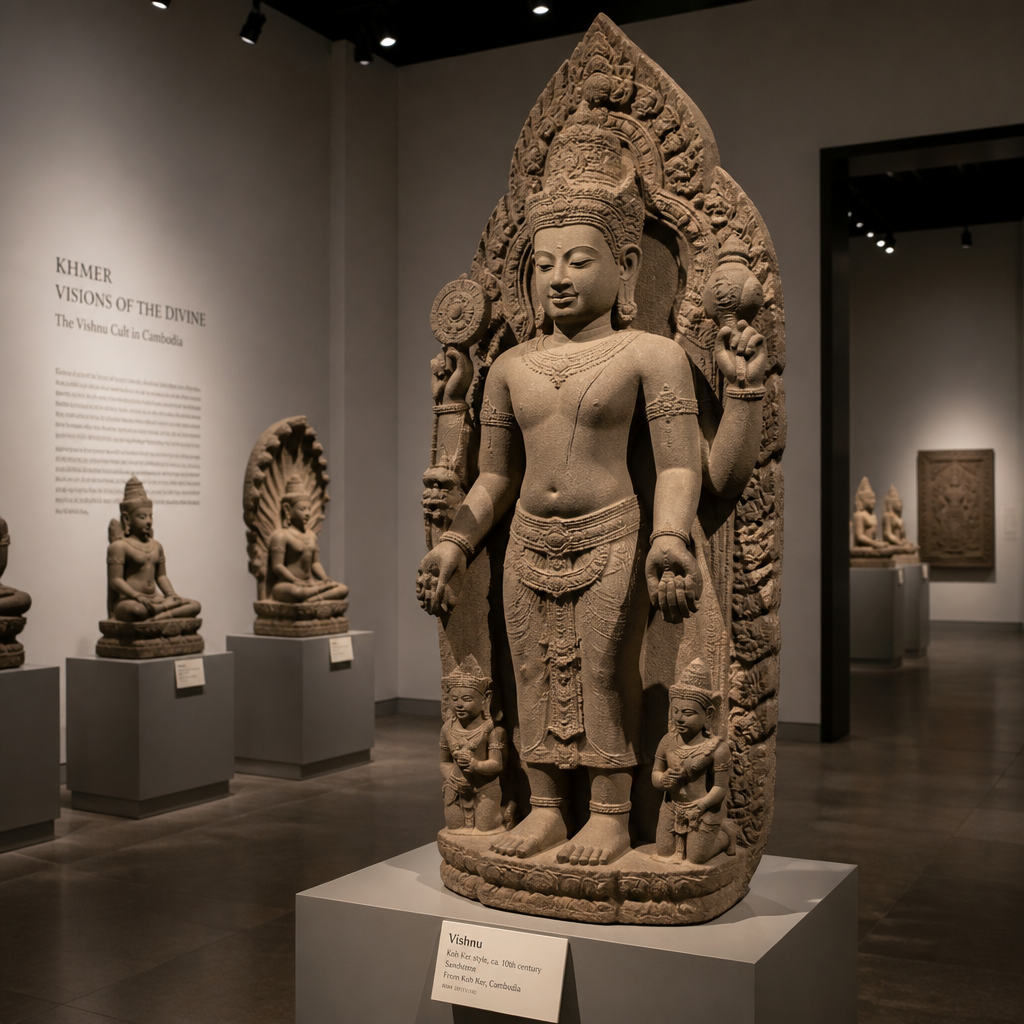
Khmer Vishnu sculpture from Cambodia deserves its own section because it is among the most collected and most misidentified category of Southeast Asian Hindu art. Vishnu and Shiva were the most prominent Hindu subjects in Khmer art, both individually and in composite form as Harihara, a figure combining the iconographic elements of both deities in a single body. The prevalence of Vishnu in Khmer religious sculpture reflects the identification of Angkor-period kings with Vishnu as cosmic preserver.
Khmer Vishnu figures typically stand in a frontal posture, symmetrical and upright, with a characteristic serene facial treatment: broad, smooth faces, gently smiling lips, and almond-shaped eyes that convey composure rather than the more theatrical expressions found in some Indian regional traditions. The crown is towering but relatively simplified compared to South Indian bronze work. A common mistake is reading this simplicity as an absence of craftsmanship. It is, in fact, a deliberate aesthetic choice reflecting Khmer visual priorities.
The iconography of Southeast Asian sculpture strongly reflects Indian influences, which began penetrating the region early in the Common Era. Buddhist and Hindu deities were adopted with their identifying attributes and gestures largely unchanged. However, local sculptural ideals introduced distinct facial types and bodily conventions that make Khmer Vishnu immediately recognisable to a trained eye. The pre-Angkorian period produced particularly important Vishnu examples, and the majority of sculptures from the Funan and Zhenla periods depict Vishnu rather than other deities.
Pro tip: Provenance documentation for Khmer pieces is not optional. The restitution of Khmer works to Cambodia is an active and ongoing issue. Any piece presented as an archaeological find without solid pre-1970 provenance documentation should be treated with extreme caution. A reputable dealer will provide detailed provenance, and a collector who skips this step takes on substantial legal and ethical risk.
Comparing Approaches to Collecting Vishnu Sculpture
There are three broad approaches collectors take to building a Vishnu-focused collection, and each has a different emphasis. Understanding the trade-offs before you start buying saves significant money and regret.
|
Collecting Approach |
Focus and Strengths |
Practical Considerations |
|---|---|---|
|
Single-Form Depth |
Concentrate on one form, such as standing Vishnu, across multiple regions and periods. Builds genuine iconographic expertise quickly. Comparisons across a single shelf become visually instructive. |
Requires patience because specific regional forms of a single iconographic type come to market infrequently. Risk of paying a premium for rarity without deep comparative knowledge. |
|
Dashavatara Programme |
Collect one sculpture for each of the ten avatars. Creates a coherent theological narrative in display. Forces engagement with the full range of Vishnu iconography rather than one favourite form. |
Some avatars are far rarer in sculpture than others. Matsya and Kurma pieces of comparable quality to Narasimha or Rama are harder to source. Completing the set across consistent quality levels takes years. |
|
Regional Focus |
Concentrate on one geographic tradition: Khmer, South Indian bronze, Javanese, or North Indian stone. Develops deep knowledge of one artistic vocabulary. Regional cohesion gives a collection visual coherence. |
Regional focus can narrow the market significantly. Khmer pieces require especially careful provenance research. Quality variation within any regional tradition is wide, and surface-level stylistic similarity masks enormous differences in quality. |
In practice, most serious collections start with one approach and evolve. A collector who begins with South Indian bronzes often finds themselves drawn to comparative Khmer examples once their eye develops. The iconographic grammar is consistent enough across traditions that cross-regional comparison becomes genuinely illuminating rather than confusing.
Authentication and Quality: What Museum-Grade Actually Means
The phrase "museum quality" is used loosely in the art market. For Vishnu sculpture specifically, it should mean that the piece meets the documentation and condition standards that a serious museum would apply to its own accessioned works. That is a high bar, and it eliminates a significant proportion of what circulates in the secondary market.
For a Hindu deity statue to qualify as museum grade, it needs to pass several tests. First, iconographic completeness: the attributes should be present and correctly placed, or the specific iconographic variant should be identified and documented. A seller who cannot explain which avatar a piece represents, or why a four-armed figure is missing its standard attributes, is not a reliable source for serious collectors. Second, condition should be assessed honestly. Natural wear consistent with age is acceptable and expected. Damage that obscures iconographic reading is a more serious problem, particularly for avatars identified primarily by a specific body part or attribute.
Third, and most critically for Khmer and Southeast Asian pieces, provenance documentation must be thorough. The standard for responsible collecting is pre-1970 documentation: export records, auction records, published exhibition appearances, or private collection histories that predate the major waves of archaeological looting that affected Cambodia and other Southeast Asian sites in the late 20th century. Insist on this documentation. A beautiful Khmer Vishnu without provenance is a legal and ethical liability, not an asset.
When assessing a piece's quality independently of provenance, look at the following in sequence: crown shape and detail, hand attribute placement and carving quality, facial type and its fit with the stated regional tradition, body proportion and stance, and finally surface quality. Authentication follows attribute examination, not the reverse. A common mistake is to be drawn in by surface finish or patina before checking whether the iconography is correct. Surface quality is the easiest thing to fake. Correct iconography, well-executed, within a genuine regional stylistic tradition, is much harder to fabricate convincingly.
HD Asian Art's collection of Hindu deity statues is sourced with this standard in mind, with individually researched provenance and expert description of attributes and regional style accompanying each piece. Collectors who want to see how this documentation looks in practice, before committing to a purchase, can review individual listings and contact the gallery directly with questions about attribution or condition.
Frequently Asked Questions
How do I tell a Vishnu statue apart from a Shiva statue when both have four arms?
The four attributes are the primary distinguishing factor. Vishnu holds the shankha (conch), chakra (discus), gada (mace), and padma (lotus). Shiva in multi-armed form typically holds a trident (trishula), a small drum (damaru), or a flame, and his matted hair and third eye are additional distinguishing features. If you see a cylindrical crown (kirita-mukuta) rather than matted hair, and four attributes in the Vishnu set, you are looking at Vishnu or one of his avatars, not Shiva.
What is the difference between a Vishnu avatar sculpture and a standard Vishnu statue?
A standard Vishnu statue shows the deity in his Vaikuntha form: serene, four-armed, holding all four standard attributes, wearing a kirita-mukuta crown. An avatar sculpture shows one of his ten incarnations, which may be fully animal (Matsya, Kurma), hybrid (Varaha, Narasimha), or fully human (Rama, Krishna, Vamana). Avatar sculptures frequently diverge from the four-attribute convention because the form itself encodes the specific intervention rather than Vishnu's universal sovereign identity.
Why does a Khmer Vishnu look so different from a South Indian Vishnu if they represent the same deity?
Regional artistic traditions developed their own visual vocabularies for depicting Vishnu while maintaining the core iconographic attributes. Khmer sculptors prioritised frontal symmetry, smooth surfaces, and a serene facial type tied to local aesthetic ideals. South Indian Chola bronzes prioritised dynamic posture, elaborate surface ornament, and liturgical mobility. Neither tradition is iconographically incorrect. They are reading the same theological text through different artistic languages, and a knowledgeable collector can identify both immediately.
Is it acceptable to display a Vishnu statue as an art object without a devotional context?
Many collectors worldwide display Hindu deity sculptures as art objects and cultural artefacts without regular devotional practice. This is widely accepted. Approaching a piece with respect, understanding its iconographic meaning, and handling it with care are the most important considerations regardless of one's own tradition. A Vishnu statue displayed with genuine knowledge of its iconographic programme honours the craft and tradition behind it far more than uninformed devotional use of a misattributed piece.
How do I identify a Narasimha sculpture if the lion head is damaged or partially eroded?
Look at the posture and the victim figure. Narasimha is almost always depicted mid-action, with a distinctive forward-leaning energy absent from the calm standing Vishnu. The demon Hiranyakashipu, typically shown being disembowelled across Narasimha's lap or knees, is a strong secondary identifier. Even with significant facial damage, the dynamic posture, the presence of the victim figure, and the clawed hands are usually sufficient for attribution by an experienced eye.
What should I look for when evaluating the quality of a Vishnu statue for purchase?
Assess iconographic completeness first, then technical quality of execution, then condition, then provenance. Crown detail, attribute placement, and body proportion tell you more about quality than surface patina alone. For Southeast Asian pieces, particularly Khmer examples, provenance documentation is not secondary to quality assessment. It is part of it. A piece with impeccable carving but no pre-1970 provenance is not a safe acquisition regardless of its aesthetic merit.
If you have handled Vishnu sculpture from a particular regional tradition and want to share what the iconographic details looked like in person, the gallery team at HD Asian Art welcomes that kind of specific conversation in the comments or directly through the contact page.
We would love your feedback and any insights you would share with others. What perspective would you add?
References
-
Museum-grade visual guide to Vishnu avatar iconography and the Dashavatara for collectors
-
Expert guide to Vishnu statue iconography, regional styles, and avatar sculpture
-
Collector's guide to identifying authentic Khmer sculpture, including Vishnu and Harihara
-
Overview of the avatars of Vishnu in art history, with examples from major museum collections
-
Southeast Asian sculpture and the iconography of Hindu deities in Cambodian Khmer art
