



Estatua de Saraswati: Diosa de la sabiduría y guía de las artes
Estatua de Saraswati: Diosa de la sabiduría y guía de las artes
La mayoría de las personas que buscan un estatua de saraswati Ya siento que ella representa algo más profundo que un atractivo decorativo. Lo que los hace tropezar es no saber qué detalles iconográficos realmente importan, cómo las opciones de ubicación se conectan con su papel simbólico o qué distingue una escultura con calidad de museo de una réplica producida en masa.
Saraswati es la diosa hindú de la sabiduría, el conocimiento, el habla, la música y la creatividad disciplinada. Ella no es una deidad de riqueza o poder. Esa distinción cambia todo acerca de cómo se diseña su imagen, a dónde pertenece y qué debe buscar un coleccionista serio o un practicante espiritual al elegir una.
Tabla de contenidos
Conclusiones rápidas
|
Información clave |
Explicación |
|---|---|
|
Cuatro brazos tienen un significado distinto |
Cada brazo se conecta con el reino material o espiritual. Los dos brazos delanteros reflejan la actividad de Saraswati en el mundo; los dos de atrás apuntan a la trascendencia. Juntos también representan los cuatro elementos de la vida interior: mente, intelecto, ego y conciencia. |
|
La veena es su atributo más definitorio. |
El instrumento de cuerda que sostiene no es decorativo. Señala que Saraswati gobierna las artes y que la armonía, tanto musical como personal, es fundamental para su naturaleza. |
|
La ropa blanca indica pureza de intención |
A diferencia de las deidades asociadas con el poder o la riqueza, el sari blanco de Saraswati enfatiza la claridad y la libertad del ego, no la exhibición o el estatus. |
|
El cisne y el pavo real codifican recordatorios morales |
La capacidad mítica del cisne para separar la leche del agua representa el discernimiento. El pavo real recuerda al espectador que debe frenar la vanidad y la indecisión, cualidades que socavan el aprendizaje genuino. |
|
La ubicación debe coincidir con su función. |
Las salas de estudio, las bibliotecas, los estudios de música y los altares domésticos dedicados al aprendizaje son los entornos más coherentes. Colocarla en espacios desordenados o irrespetuosos contradice su naturaleza simbólica. |
|
El material y la escala afectan la idoneidad. |
Un escritorio compacto de bronce se adapta a la mesa de un erudito que trabaja. Una escultura más grande estilo templo de piedra o resina pertenece a un espacio dedicado al altar. Hacer coincidir la escala con el entorno no es opcional para un coleccionista serio. |
|
Los usos devocionales y culturales son válidos |
Una escultura de Saraswati puede funcionar como una murti devocional o como un objeto de arte culturalmente significativo. Decidir qué papel desempeña en su espacio determina cómo la maneja, la mantiene y la muestra. |
Quién es Saraswati y por qué es importante su estatua
Saraswati se encuentra en el centro del panteón hindú como la diosa de vidia (conocimiento) y vak (discurso). Su adoración está históricamente ligada a la alfabetización, la música clásica y el tipo de formación larga y disciplinada que convierte el talento en bruto en habilidades genuinas. Por eso sus estatuas aparecen en escuelas, academias de música, universidades y rincones de estudio en casa, más que en mercados o bancos. Ella no se trata de acumulación. Ella se trata de refinamiento.
Esto es muy importante a la hora de seleccionar una escultura. Una estatua de Saraswati que se siente "tranquila" en comparación con deidades hindúes más marciales es correcta por diseño. Su iconografía se basa en posturas tranquilas, tonos blancos e instrumentos eruditos porque el enfoque es la claridad interior, no la fuerza exterior. Los coleccionistas que se acerquen a su imagen esperando el imponente drama visual de, digamos, una escultura de Durga o Mahakala, encontrarán aquí algo más sutil, y esa sutileza es el punto.
Sus estatuas se encuentran en todo el sur y sudeste de Asia y aparecen en tradiciones hindúes desde India y Bali hasta Nepal y Sri Lanka. El programa iconográfico central sigue siendo reconocible en estas regiones, incluso cuando los estilos locales dan a cada escultura su propio carácter visual. Comprender esa gramática simbólica compartida es lo que separa a un coleccionista informado de alguien que simplemente compra una figura decorativa.
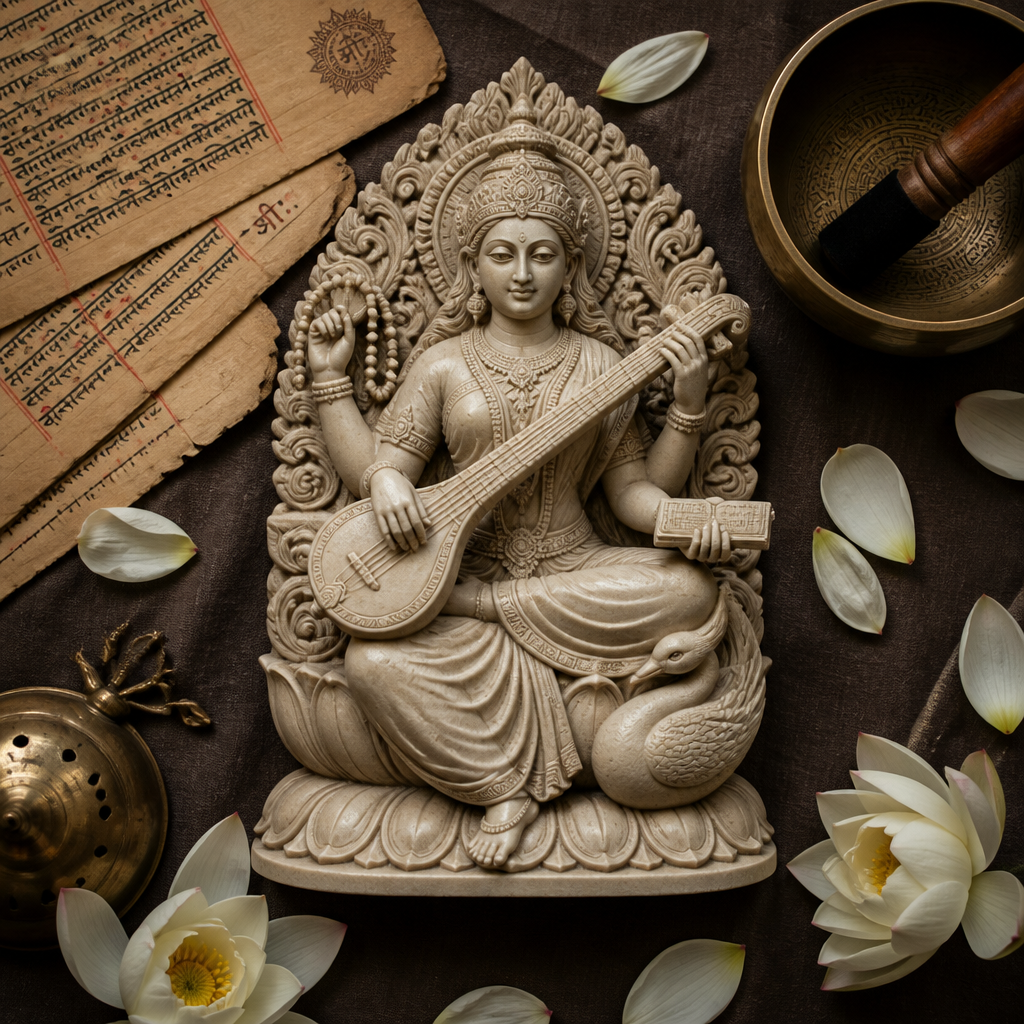
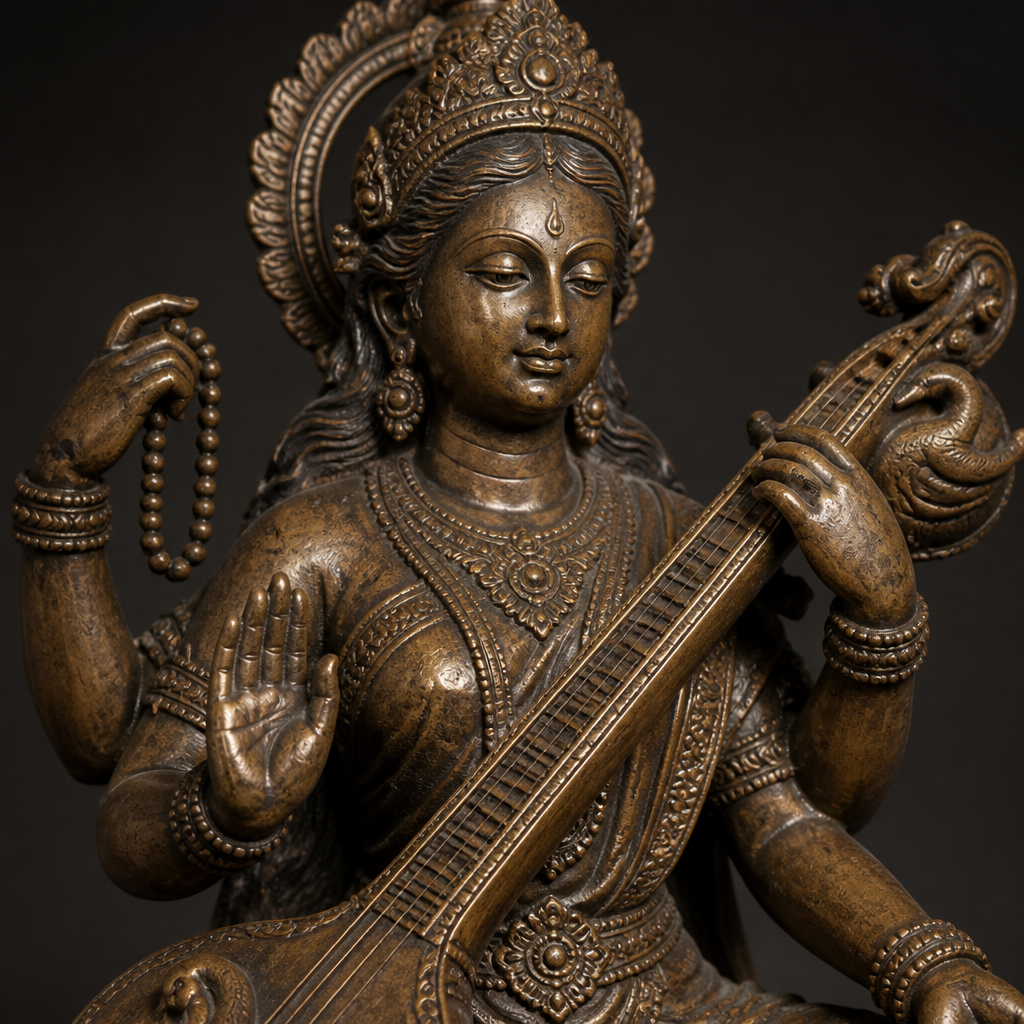
Lectura de los símbolos iconográficos en una escultura de Saraswati
Cada elemento en un bien elaborado escultura saraswati es intencional. Aprender a leer estos símbolos es lo que permite a un coleccionista o practicante evaluar la calidad y autenticidad, y distinguir una estatua que representa fielmente la tradición de otra que la ha simplificado o malinterpretado.
La Veena: arte y armonía
La veena, un instrumento de cuerda clásico indio, es el atributo más distintivo de Saraswati. Su presencia confirma su identidad cuando otras pistas visuales son ambiguas. Más allá de la identificación, lleva un mensaje directo: sintoniza tu corazón y tu mente para vivir en armonía con el mundo que te rodea. Un escultor que representa la veena con cuidado, mostrando sus cuerdas, su cuerpo resonante y la postura de la diosa con los dedos, está demostrando habilidad técnica y conocimientos iconográficos.
El Libro y el Japa Mala
El libro que sostiene son específicamente los Vedas, que representan no sólo el conocimiento en general sino el conocimiento puro y sagrado. el japa mala (cuentas de oración) en otra mano representa disciplina, concentración y meditación. Estos dos atributos juntos constituyen un argumento claro: el conocimiento sin una práctica disciplinada es incompleto. Una estatua que incluye ambos es iconográficamente más completa que una que los omite.
El Loto: Pureza Sin Aislamiento
El loto blanco conlleva uno de los significados más estratificados de la iconografía hindú. Crece en agua turbia pero permanece intacta. Para Saraswati, esto indica la capacidad de buscar conocimiento en un mundo complejo e imperfecto sin verse corrompido por él. En una escultura, el loto suele ser el asiento o el reposapiés, lo que ancla a la diosa literal y simbólicamente en esta idea.
El cisne y el pavo real
Ambos animales aparecen en las imágenes de Saraswati, aunque no siempre juntos. Se dice que el cisne posee la capacidad de separar la leche del agua con su pico, simbolizando el discernimiento entre la verdad y la falsedad. Este es uno de los símbolos filosóficamente más precisos de la iconografía hindú, un argumento visual directo para el pensamiento crítico. El pavo real, asociado con la belleza y la danza, conlleva una nota de advertencia: su presencia es un recordatorio para resistir la vanidad y la indecisión, dos cualidades que obstruyen el aprendizaje genuino.
El loto blanco sobre el que descansa Saraswati simboliza la necesidad de permanecer al margen de las influencias negativas, incluso estando plenamente presente en el mundo donde existen esas influencias.
Ropa blanca y postura tranquila.
El sari blanco de Saraswati es una de las señales más claras de todo el programa iconográfico. El blanco en este contexto simboliza la pureza, específicamente la pureza de intención y motivación. La postura tranquila sentada refuerza esto: no tiene prisa, no compite, no se exhibe. Una escultura que captura bien esta quietud, a través del lenguaje corporal y la moderación proporcional, es más fiel a su naturaleza que una tallada para el drama visual a expensas de una compostura serena.
Consejo profesional: Al evaluar una estatua de Saraswati, cuente los atributos simbólicos presentes. Una representación iconográfica completa debe incluir la veena, el libro, el mala y el loto como mínimo. La falta de dos o más de estos es una señal de que el escultor priorizó la estética sobre la tradición, lo cual importa según su propósito.
Estilos regionales de escultura Saraswati en toda Asia
El culto a Saraswati se extendió por el sur y el sudeste de Asia a través del comercio, las peregrinaciones y la transmisión del conocimiento sánscrito. A medida que la tradición se arraigó en diferentes culturas, las convenciones escultóricas locales moldearon el aspecto de su imagen, incluso cuando el simbolismo subyacente permaneció estable. Para los coleccionistas interesados en estatuas de deidades hindúes con calidad de museo, es esencial comprender estas variaciones regionales.
Tradiciones escultóricas indias
La tradición india produce las esculturas Saraswati más completas iconográficamente, basándose en siglos de pautas de talla de templos. Las esculturas de piedra del sur de la India tienden hacia la elegancia formal y la ubicación precisa de los atributos. Los bronces del norte de la India suelen mostrar una postura más dinámica y joyas elaboradas. Ambos se mantienen fieles al programa de cuatro brazos descrito anteriormente.
Interpretaciones balinesas e indonesias
Bali desarrolló una iconografía distintiva de Saraswati que combina la tradición hindú con la cultura visual local. La balinesa Saraswati a menudo se muestra con una flor de loto que se abre dramáticamente detrás de ella, y los estilos de talla locales aportan una densidad particular de detalles ornamentales a sus joyas y tocados. El festival balinés Saraswati, que se celebra anualmente, mantiene su imagen en el centro de la práctica religiosa viva en la isla, lo que significa que las tradiciones escultóricas balinesas han permanecido estrechamente ligadas al uso devocional en lugar de derivar puramente hacia convenciones decorativas.
Influencia nepalí y tibetana
En la tradición nepalí, Saraswati aparece a veces en formas que reflejan la influencia budista, particularmente como consorte de Manjushri en ciertas tradiciones mixtas. El trabajo en metal repujado dorado característico de la artesanía Newar confiere a estas esculturas una riqueza que difiere notablemente de la talla en piedra india. Para los coleccionistas, esto significa que una estatua nepalí de Saraswati requiere un ojo evaluador diferente al de una estatua india.
Consejo profesional: Si está creando una colección que incluye variaciones regionales de estatuas de diosas hindúes, combine una pieza de Saraswati con esculturas complementarias como Lakshmi o Durga de la misma región. Esto crea agrupaciones de visualización coherentes en lugar de una mezcla visualmente inconsistente de estilos no relacionados.
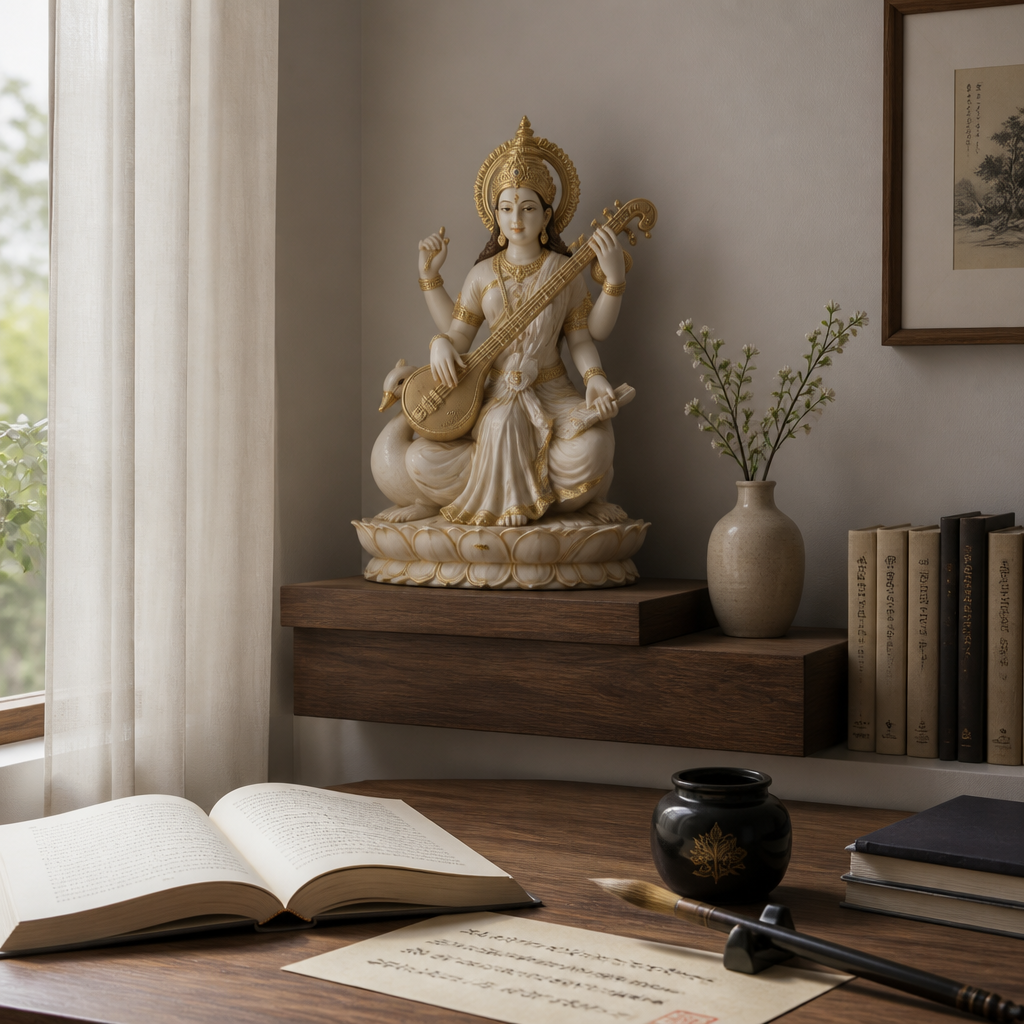
Elegir la estatua de Saraswati adecuada para su espacio
El error más común que cometen los compradores es elegir una estatua de Saraswati basándose únicamente en el tamaño o el precio sin considerar el material, la escala y la integridad iconográfica en relación con el uso previsto. Aquí se explica cómo pensar con claridad la decisión.
Material: Bronce, Piedra y Resina
Las esculturas de bronce envejecen maravillosamente, desarrollan pátina con el tiempo y son apropiadas tanto para exhibición de escritorio como para uso en altar. La piedra, particularmente la arenisca y el granito, es adecuada para piezas más grandes destinadas a espacios dedicados a santuarios o jardines con la protección adecuada. Los materiales de resina o compuestos pueden reproducir detalles superficiales finos a un costo menor, pero no tienen el peso, la longevidad o la calidad táctil del material del metal fundido o la piedra tallada. Para un coleccionista o practicante serio, el bronce o la piedra son el estándar en el que vale la pena invertir.
Escala y configuración
Un pequeño Saraswati de bronce, finamente detallado, en el rango de 15 a 30 cm, se adapta al escritorio de un erudito o a un altar doméstico compacto. Las piezas más grandes, de 60 cm o más, deben colocarse en salas de altar dedicadas, nichos de biblioteca o salas de estar espaciosas donde puedan verse sin aglomeraciones. Reducir el tamaño de una estatua en un espacio grande y desnudo la hace desaparecer. Sobredimensionar una estatua sobre un escritorio pequeño crea una tensión visual que va en contra de la calma que representa la diosa.
Completitud iconográfica versus interpretación artística
Algunos escultores se toman libertades artísticas deliberadas, simplificando atributos o ajustando la postura por razones estéticas. Esto no es intrínsecamente malo para un objeto de arte cultural. Pero si su propósito es devocional o si desea una pieza que represente con precisión la tradición, la integridad iconográfica importa más que la novedad artística. Colección de HD Asian Art de Estatuas de diosas hindúes se basa en tradiciones donde esta fidelidad a la convención iconográfica está integrada en el patrimonio artesanal.
Colocación y cuidado de una estatua de Saraswati
Las decisiones de ubicación de una estatua de Saraswati no requieren un estricto cumplimiento de reglas que quizás no conozcas, pero sí se benefician de la aplicación de la lógica simbólica de la propia diosa. El principio rector es simple: colóquela donde realmente ocurre el aprendizaje, la creatividad o la reflexión, y mantenga ese espacio limpio y ordenado.
Habitaciones que funcionan mejor
Las salas de estudio y las bibliotecas domésticas son los entornos más coherentes. Los estudios de música y las salas de práctica son igualmente apropiados, dado el papel central de la veena en su iconografía. Las oficinas en casa donde se realiza un trabajo intelectual concentrado tienen mucho sentido. Los dormitorios y las cocinas, por el contrario, generalmente se consideran menos adecuados en la práctica devocional tradicional, porque ninguna de las habitaciones está asociada principalmente con el aprendizaje disciplinado que ella gobierna.
Altura y orientación
Colocar una estatua de Saraswati al nivel de los ojos o más arriba comunica respeto. Mantenerla en el suelo o a la altura de los tobillos se considera una falta de respeto en la práctica devocional hindú y también crea una disposición de exhibición visualmente incómoda con fines culturales. El estándar práctico es un estante, una mesa de altar o una estantería dedicada a la altura de los hombros o más arriba.
Limpieza y desorden
El desorden contradice directamente lo que representa Saraswati. Una estatua rodeada de objetos no relacionados, tazas de café vacías o montones de correo sin leer socava la cualidad focal que hace que colocar una estatua tenga significado en primer lugar. Mantenga limpia el área inmediata y, si la estatua es devota, trátela como el objeto más intencional de la habitación.
Para un cuidado continuo, espolvoree las piezas de bronce regularmente con un paño suave. Evite limpiadores químicos fuertes en cualquier superficie de metal patinado. Las piezas de piedra pueden necesitar una limpieza ligera ocasional dependiendo de su porosidad y acabado. Para artículos lacados o superficies doradas, consulte la guía de cuidado específica que viene con la pieza, ya que las diferentes tradiciones de lacado, incluido el lacado birmano, también están disponibles en Arte asiático en alta definición, tienen diferentes sensibilidades a la humedad y la abrasión.
Pieza de colección versus Murti devocional: lo que significa la diferencia en la práctica
Esta distinción es más importante de lo que la mayoría de los compradores creen y vale la pena hacerla explícita antes de la compra. La diferencia no se trata de calidad. Una pieza de colección con calidad de museo puede estar tan bellamente hecha como una murti devocional. La diferencia está en cómo te relacionas con el objeto y qué obligaciones crea esa relación.
La Murti Devocional
Una murti devocional es un objeto consagrado o intencionalmente devocional. Se le saluda, se le ofrecen flores o incienso, se le mantiene escrupulosamente limpio y se le trata como a una presencia viva. Manipularlo de manera casual, colocarlo en el suelo o rodearlo de objetos seculares se considera una falta de respeto. Los compradores que quieran una relación devocional con una estatua de Saraswati deben abordar la compra como un compromiso espiritual a largo plazo, no como una opción decorativa.
La pieza de coleccionista cultural
Una escultura de Saraswati de un coleccionista, expuesta en una biblioteca o galería, sigue siendo un objeto significativo. Lleva el peso de la tradición y la habilidad del artesano. Pero la relación es más curatorial que devocional. Esto no lo hace menor. Lo hace diferente. Los coleccionistas que tienen clara esta distinción tienden a exhibir sus piezas con más atención y a mantenerlas con más cuidado, porque entienden lo que realmente tienen.
La siguiente tabla comparativa ayuda a aclarar las diferencias prácticas entre los tres enfoques principales que adoptan los compradores ante una estatua de Saraswati.
|
Enfoque |
Propósito principal |
Consideraciones prácticas clave |
|---|---|---|
|
Murti devocional |
Práctica y culto religioso activo. |
Requiere atención ritual regular, reglas estrictas de colocación y manejo respetuoso. La integridad iconográfica es esencial. La pieza no debe moverse con frecuencia. |
|
Pieza de exhibición cultural |
Colección de arte, biblioteca en casa o estudio |
La coherencia de la visualización y la calidad estética son lo más importante. Se valora el estilo regional y la autenticidad de los materiales. Menos sujeto a reglas estrictas de ubicación, pero se beneficia de un entorno bien pensado. |
|
Punto Focal Simbólico |
Espacio de trabajo o estudio creativo como presencia inspiradora. |
La escala y la visibilidad son importantes. La estatua debe colocarse donde realmente se vea durante el trabajo. La integridad iconográfica es útil pero no obligatoria para este uso. |
Los compradores que combinan estos enfoques, por ejemplo comprando una murti devocional pero tratándola como un objeto decorativo, tienden a terminar con un arreglo que no satisface ninguno de los dos propósitos. Ser honesto acerca de su relación real con el objeto antes de comprarlo le ahorra dinero y malestar.
Para los coleccionistas que buscan estatuas de deidades hindúes con calidad de museo, explorar la gama completa de HD Asian Art estatuas hindúes junto con específico Estatuas de diosas hindúes Da una idea de cómo los estilos regionales y las elecciones de materiales se manifiestan en una colección curada real, en lugar de hacerlo de forma abstracta.
Preguntas frecuentes
¿Qué representa una estatua de Saraswati en la tradición hindú?
Saraswati representa el conocimiento (vidya), el habla (vak), la música, el aprendizaje y la creatividad disciplinada. Su estatua está asociada con las artes y las actividades académicas más que con la riqueza o el poder. Cada atributo que posee, la veena, los Vedas, el japa mala y el loto, conlleva un significado simbólico específico vinculado al aprendizaje, el discernimiento y la pureza de intención.
¿Qué atributos de las manos son estándar en una auténtica escultura de Saraswati?
Una escultura estándar de Saraswati, iconográficamente completa, muestra cuatro brazos. Dos de las manos sostienen la veena y el libro (Vedas). Los otros dos normalmente sostienen el japa mala y una flor de loto o muestran un gesto específico con la mano (mudra). Los dos brazos delanteros representan su actividad en el mundo material; los dos de atrás representan su dimensión espiritual. La falta de los cuatro brazos o los cuatro atributos es un signo de simplificación iconográfica.
¿Cuál es el mejor material para una estatua de Saraswati destinada a uso doméstico?
El bronce es el material más práctico y duradero para uso doméstico, y se adapta bien tanto a contextos devocionales como de exhibición. Envejece con carácter, se puede limpiar fácilmente y está disponible en varios tamaños. Las piezas de piedra son excelentes para espacios de altar dedicados, pero son más pesadas y menos portátiles. Las piezas de resina o compuestas se adaptan a un presupuesto menor, pero no deben confundirse con la calidad del material del bronce fundido o la piedra tallada.
¿Dónde debería colocar una estatua de Saraswati en mi casa?
Coloque una estatua de Saraswati en una habitación asociada con el aprendizaje, la creatividad o el trabajo concentrado: un estudio, una biblioteca, una sala de música o una oficina en casa. Mantenga el área circundante limpia y despejada. Colóquela a la altura de los hombros o más arriba, no en el suelo. Evite colocarla en habitaciones relacionadas principalmente con dormir o cocinar, ya que se consideran menos apropiadas en la práctica tradicional hindú.
¿Cuál es la diferencia entre una estatua de Saraswati de la India y una de Bali?
Las esculturas indias Saraswati, particularmente del sur de la India, tienden hacia la elegancia formal con una ubicación precisa de los atributos y una ornamentación sobria. Las versiones balinesas suelen presentar detalles decorativos más elaborados, incluido un fondo de loto dramáticamente abanicado, y reflejan la cultura visual local superpuesta al núcleo iconográfico hindú. Ambas son expresiones válidas de la tradición, pero crean efectos visuales muy diferentes en una colección o exhibición.
¿Es apropiada una estatua de Saraswati como regalo para alguien que no es hindú?
Sí, con el contexto apropiado. Una escultura de Saraswati con calidad de museo es un regalo significativo para cualquiera que valore el aprendizaje, las artes o el arte religioso asiático clásico. Proporcionar al destinatario una nota sobre el significado simbólico de la estatua convierte un objeto hermoso en uno informativo y garantiza que se exhiba con respeto en lugar de tratarlo como una decoración genérica.
¿En qué se diferencia una estatua de Saraswati de las estatuas de Lakshmi o Durga?
Lakshmi representa riqueza y prosperidad, por lo que sus imágenes presentan oro, monedas y abundancia. Durga representa el poder protector y su iconografía incluye armas y una montura de león. La iconografía de Saraswati es deliberadamente más tranquila: sin armas, sin oro, sin coronas de dominio. Su ropa blanca y sus instrumentos eruditos marcan su dominio como la vida interior de la mente y las habilidades refinadas que provienen de la práctica disciplinada. Mostrar los tres juntos crea una representación coherente de los tres aspectos principales de lo divino femenino en la tradición hindú.
Si ha colocado una estatua de Saraswati en su hogar, estudio o colección, comparta qué ubicación o elección de material funcionó mejor para su espacio específico. La experiencia práctica de coleccionistas y profesionales es una de las orientaciones más útiles que existen.
Nos encantaría recibir sus comentarios y cualquier idea que pudiera compartir con otros. ¿Qué perspectiva agregarías?
Referencias
