



Proof of Authenticity for Buddhist Statues: A Collector's Guide
Proof of Authenticity for Buddhist Statues: A Collector's Guide
Quick Summary
Proof of authenticity for Buddhist statues is the combined body of physical, documentary, and stylistic evidence supporting a sculpture's claimed age, origin, maker, and material. No single document settles the question, so a convincing case is built from converging evidence rather than one certificate.
- A certificate of authenticity is a seller-issued statement of opinion, not a government record.
- Read provenance records backwards, asking who held the piece, when, and what document proves it.
- Export seals show only that an item passed a customs process, not that it is old.
- Begin visual inspection at the base and interior, where casting seams and tool marks show.
- Scientific testing establishes facts about materials but cannot prove who made an object.
Table of Contents
- What Proof of Authenticity for Buddhist Statues Actually Means
- The Buddhist Statue Certificate of Authenticity and What It Documents
- Buddhist Statue Provenance: Origin, Ownership, and the Paper Trail
- How to Authenticate a Buddhist Statue: A Step-by-Step Visual Inspection
- When to Call a Buddhist Statue Authentication Expert
- Documentation Standards and the Limits of Seller Claims
- Seven Questions to Ask Before You Buy a Buddhist Statue
- Frequently Asked Questions
What Proof of Authenticity for Buddhist Statues Actually Means
Proof of authenticity for Buddhist statues is the combined body of physical, documentary, and stylistic evidence that supports a sculpture's claimed age, origin, maker, and material.
That gap between a paper claim and a real case is where most purchases go wrong. A sculpture may still be beautiful even when the proof behind it is thin.
Below, we break down what each layer of evidence actually shows, where seller documentation stops being useful, and the exact inspection sequence we would run on any piece before money changes hands.
The Buddhist Statue Certificate of Authenticity and What It Documents
A Buddhist statue certificate of authenticity is a seller-issued document describing an object's origin, materials, and date, usually signed by the gallery or dealer.
That is the part most buyers miss. The Smithsonian's documentation of its lacquer Buddha research shows what real verification looks like: researchers used multiple analytical techniques to confirm the age and composition of sculptures over 1,500 years old.
What a Certificate Should List
A useful certificate is specific. If it reads like a form letter, treat it as decoration.
- Object description: material, dimensions, and any visible repairs or later additions
- Attributed date and region: for example, "Khmer, Bayon style, 12th-13th century," not "ancient"
- Ownership history: prior owners, auction records, or collection names with dates
A certificate that lists none of these is a receipt with a seal on it.
Buddhist Statue Provenance: Origin, Ownership, and the Paper Trail
Buddhist statue provenance is the documented chain of ownership from the object's creation to the present day. Provenance is the strongest form of proof available to a collector, because it is built from records created by parties who had no reason to coordinate a story.
A real chain looks unglamorous: an auction catalog from 1978, a customs entry, a museum loan agreement, a family inventory. Gaps are normal. What matters is whether each gap is explained or simply ignored.
Reading a Provenance Record
Read a provenance record backwards, starting with the most recent owner and working toward the object's origin. Ask three questions at each step: who held the piece, when, and what document proves it?
Watch out: export seals are widely misread as proof of age. An export seal may only indicate that an item passed through a specific customs process at a specific time, not that the sculpture is old.
When the paper trail has holes, the work shifts to archives and institutional records. For a deeper walkthrough, see how to verify provenance for Buddhist antiquities. Our guide to Buddhist sculpture provenance archive research walks through where those records live and how to request them.
How to Authenticate a Buddhist Statue: A Step-by-Step Visual Inspection
Authentication starts with a disciplined visual examination, done in good light, in a fixed order. Work through the sculpture methodically rather than letting the face pull your attention first. The base and the back usually tell you more than the front.
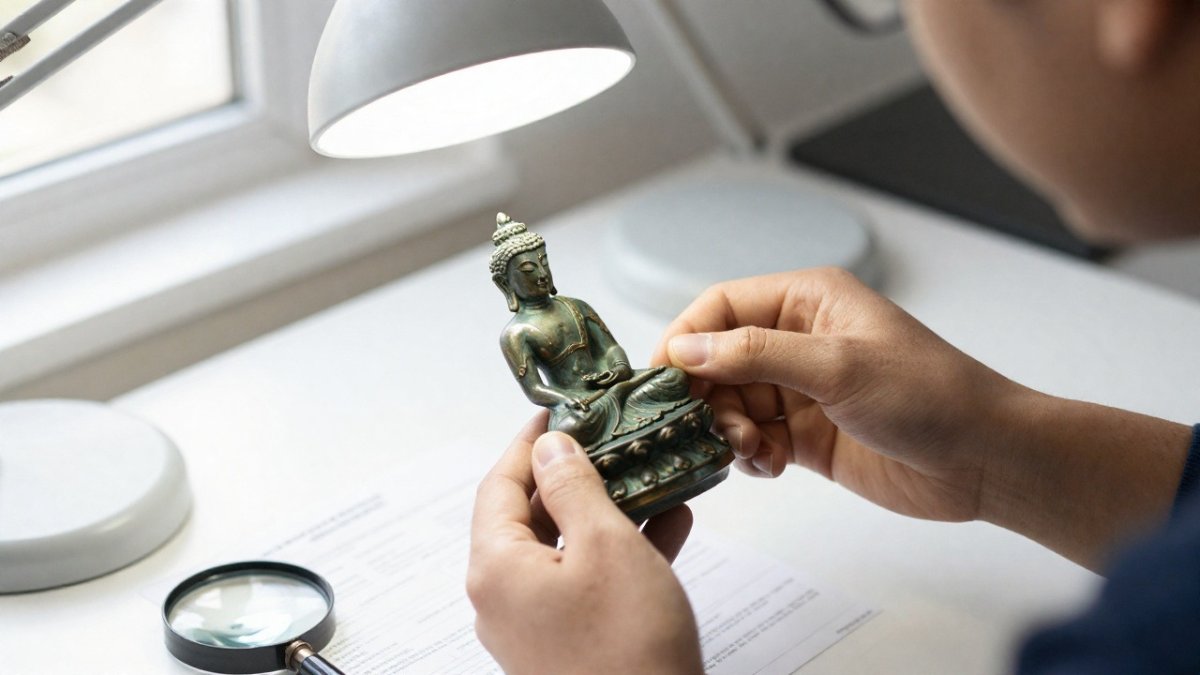
- Examine the base and interior. Look for casting seams, core material, and tool marks. A hollow cast bronze with visible core remnants behaves differently from a solid modern reproduction.
- Check the back and recessed areas. Authentic age shows unevenly. Patina accumulates in crevices and thins on high-touch points. Uniform surface finish across every plane is a warning sign.
- Study the gilding. Original gilding wears at contact points and often survives in protected recesses. Re-gilding covers tool marks and looks flat under raking light.
- Assess the metalwork and casting method. Look for the join lines of a lost-wax casting versus the seam lines of a mold-made copy.
- Compare proportions and iconography. Hand, ear, and drapery proportions follow regional conventions. A Nepali piece and a Chinese piece of the same subject do not share the same silhouette.
- Look for inscriptions. A dated inscription is powerful evidence, but only if the script, grammar, and wear pattern are consistent with the object.
- Document everything. Photograph each finding with a scale reference. Your own record is the beginning of the next owner's provenance.
For bronze-specific detail, our guide to identifying authentic Buddhist bronze statues goes deeper on alloy, casting, and surface behavior.
When to Call a Buddhist Statue Authentication Expert
Bring in an independent expert when the value at stake exceeds the cost of a written opinion, when the seller's documentation is thin, or when the physical and documentary evidence point in different directions. Conflicting evidence is common and is not automatically a red flag.
A qualified appraiser can examine a sculpture in person, compare it against documented examples in the same regional tradition, and issue a written opinion with the reasoning attached. The same habit of asking what was examined and what evidence supports a claim is useful when assessing an online seller, and MobiusLDG can help frame that scrutiny before a purchase.
How to Verify Independence
The value of an expert opinion depends on the expert having no financial interest in the outcome. A dealer who both sells you the statue and certifies it is not independent, no matter how experienced they are. Before you engage anyone, ask:
- Who pays the appraiser? You should, directly, so the opinion serves you rather than the seller.
- Does the appraiser buy or sell comparable objects? If so, ask how they manage that conflict.
- What is the appraiser's stated scope? A conservator, a curatorial specialist, and a generalist appraiser answer different questions.
A common pattern is for buyers to accept a gallery's in-house "authentication" because it is free. Free opinions from interested parties are worth exactly what you pay for them.
What Scientific Testing Can and Cannot Prove
Scientific analysis answers material questions with real precision, and it is most useful when it is targeted rather than broad. Common techniques include:
- X-ray fluorescence (XRF): identifies alloy composition without damaging the surface, which can flag metals or trace elements inconsistent with a claimed period.
- Radiography: reveals internal structure, core material, and hidden joins or repairs that are invisible on the surface.
- Microscopy: shows tool marks, casting seams, and surface layers at magnification.
What testing cannot do is prove a sculpture is "authentic" in the full sense. Testing establishes facts about materials; it does not establish who made an object, when it left its region of origin, or whether its surface is original.
Watch out: avoid any destructive testing, scraping, sampling, or chemical stripping, without written advice from a qualified conservator, because it can permanently reduce both the object's integrity and its value.
Weighing Conflicting Evidence
When the certificate says one thing, the patina says another, and the style points a third way, do not average the clues. Rank them. Documentary records created by disinterested parties usually carry more weight than surface appearance, which is the easiest thing to fake or misread. Style and iconography are strong for placing a piece in a regional tradition but weak for dating a specific object.
Documentation Standards and the Limits of Seller Claims
Seller claims fail in predictable ways. The language gets vague exactly where it should get specific. "Old" replaces a date. "From a private collection" replaces a name. "Museum quality" is a compliment, not evidence.
Compare what a strong document set contains against what a weak one contains:
| Evidence Type | Strong Documentation | Weak Documentation |
|---|---|---|
| Date attribution | Named period and century | "Antique" or "old" |
| Ownership history | Named owners with dates | "Private collection" |
| Material description | Alloy or material identified | "Bronze-colored" |
| Condition | Repairs and losses itemized | "Excellent condition" |
| Issuer | Named specialist, signed, dated | Anonymous gallery stamp |
A Checklist for Checking Any Certificate
Before you treat a certificate as evidence, run it through these questions:
- Who issued it? A named individual or institution with a verifiable reputation, or an anonymous gallery stamp?
- What does it actually claim? Read the wording closely. Does it assert a date and region, or only that the object is "of the period style"?
- What does it explicitly not cover? A good document states its limits, including what the issuer did not examine.
- Is it independently verifiable? Can you contact the issuer, confirm the signature, and find the object in their records?
- Does it match the object? Dimensions, material, and description should line up with what you can see and measure yourself.
- Is it a statement of opinion or a government record? Most certificates are opinions, and they carry only the weight of the issuer's accountability.
Watch out: a certificate of authenticity is not absolute proof. Documentation can be falsified, misread, or simply repeat what the seller was told. If the gallery will not put a name and a date on the paper, the paper is worth less than the frame.
Legal and Ethical Provenance
Documentation is not only about age and maker. For objects that may have left their country of origin, ownership records and export paperwork matter as much as style.
A practical approach is to request the export permit or customs record, check the object against public stolen-art registries, and ask the seller to explain any period when the object's location is unknown.
Weighing a piece against a known reproduction is one of the fastest ways to calibrate your expectations for documentation. Our comparison of antique versus reproduction Buddhist statues sets out what each category should be able to prove.
Seven Questions to Ask Before You Buy a Buddhist Statue
Ask these in order, and do not accept a vague answer to any of them. A seller who cannot answer question three is telling you something useful.
- What exactly is the claimed date, region, and material, stated precisely?
- What documents support that claim, and who issued each one?
- Can you show the full ownership history, including any gaps?
- Has the piece been examined by an independent specialist, and can I see that opinion?
- What repairs, restorations, or later additions are present?
- What are the return terms if an independent appraisal contradicts your description?
- Will you provide high-resolution photographs of the base, back, and any inscriptions?
Question six matters most on expensive pieces. Authentication is not always possible, and a seller who stands behind a description in writing is worth more than one with a prettier certificate.
Once authenticity is established, protection becomes the next concern. Our guidance on how to insure valuable antique Buddha statues covers what to document and when to notify a carrier.
Authenticating a Buddhist sculpture takes patience and a willingness to ask uncomfortable questions, and the reward is a collection you can stand behind.
Frequently Asked Questions
What counts as proof of authenticity for a Buddhist statue?
No single document proves a Buddhist statue is authentic. Strong proof combines a detailed certificate of authenticity, a documented provenance record, and a visual examination of materials, casting method, gilding, patina, and wear. Scientific testing can confirm the age of materials, but it cannot confirm who made a piece or that it was made as a devotional object rather than a later copy. Treat each document as one part of the evidence, not the verdict.
Should a Buddhist statue come with a certificate of authenticity?
A certificate of authenticity is useful, but it is not absolute proof. A certificate documents origin and materials, yet documentation can be falsified or misinterpreted. Ask what the certificate actually states: the maker, the date, the materials, and the method used to reach those conclusions. A certificate that lists specific findings and the examiner's credentials carries more weight than a generic card naming the piece and the seller.
What information should a certificate of authenticity include?
A strong certificate lists the statue's title and subject, dimensions, materials, casting method, gilding and surface finish, region and date range, and any inscription or decorative pattern. It should name the examiner, describe the visual examination performed, and state the evidence behind the dating. Look for a photograph of the piece, a reference number, and a signature. Missing or vague fields are a reason to ask more questions before you buy.
How can you verify the age and origin of a Buddhist statue?
Start with visual examination: check the casting method, tool marks, gilding wear, patina, and the base and back construction. Compare the proportions, mudra, posture, and regional style against documented examples. Then review the provenance record for ownership history and any inscription. Where the stakes are high, a specialist appraisal or conservation-safe scientific testing can confirm material age. Conflicting evidence is common, so weigh the whole set of findings rather than one clue.
Who can authenticate a Buddhist statue?
A Buddhist statue authentication expert is typically a specialist dealer, a museum curator, or an independent appraiser with documented experience in Buddhist sculpture and regional traditions such as Nepali, Chinese, or Southeast Asian metalwork. Ask for credentials, sample reports, and whether the examiner has a conflict of interest, such as selling the piece. Independent appraisal is worth more than a seller-issued opinion because it separates the assessment from the sale.
Are provenance records useful when buying a Buddhist statue?
Provenance records are among the most useful evidence you can review. A documented ownership history, auction records, exhibition history, or family records help confirm origin and legal title. Be aware that export seals do not guarantee age; they may only show the item passed through a customs process. Ask for the full chain of ownership and compare the dates and names against the object's stated age and regional style.
What questions should you ask a seller about a Buddhist statue?
Ask where the piece came from, who owned it before, and what documentation supports the stated age. Request the certificate of authenticity and read what it actually claims. Ask whether an independent expert examined the piece and whether scientific testing was done. Ask about the return policy and how the piece will be packed. A seller who answers clearly and supplies records is a better sign than one who relies on vague claims.

