



How Rarity Shapes the Value of Asian Art Investments
How Rarity Shapes the Value of Asian Art Investments
Rarity raises price, but it doesn’t guarantee return. A unique bronze with documented provenance and museum exhibition history behaves nothing like a limited-edition print with a gap in its ownership record, even when both get labeled “rare” in a listing. The financial effect of rarity depends on three gatekeepers: provenance, condition, and market demand. Get those wrong, and rarity is just a word on an invoice.
The scale of what’s at stake is real. Traditional Asian works saw a 32.4% year-on-year jump in Hong Kong auction sales in 2025, reaching $515 million, and much of that growth traces back to scarce, well-documented pieces rather than broad market lift.
Three things determine whether rarity pays off:
- Type of rarity matters more than the label. Unique one-offs, small-edition works, and period-scarce antiques command different premiums and attract different buyers.
- Verification converts scarcity into value. Provenance records, condition reports, and expert acceptance are what actually move a rare piece from “interesting” to “investable.”
- Rarity trades liquidity for premium. A one-of-a-kind Khmer bronze might sell for a record price and then sit unsellable for years if the buyer pool is thin.
Pro Tip: Before you factor a rarity premium into any purchase decision, ask what percentage of that premium survives a resale ten years out. If nobody can answer, treat the number as speculative.
Key Takeaways
Rarity raises the ceiling on price, but only documented provenance, sound condition, and real market demand determine whether that ceiling holds at resale.
| Point | Details |
|---|---|
| Rarity type matters | Unique one-offs, limited editions, and period-scarce antiques carry different premiums and liquidity profiles. |
| Provenance converts scarcity into value | Documented ownership, exhibition history, and catalog entries turn rarity claims into investable value. |
| Auction premiums can be volatile | Thin comparables widen valuation bands, so rare-lot hammer prices swing further from pre-sale estimates. |
| Liquidity concentrates regionally | Hong Kong, Beijing, and Singapore remain the deepest markets for high-end rare Asian works. |
| Verified sourcing reduces risk | HDAsianArt provides individually researched listings with condition detail and insured shipping for rare Buddhist and Hindu sculpture. |
This article is general information, not a substitute for advice from a qualified financial advisor. Consult a qualified financial professional about your own circumstances before acting on anything here.
Table of Contents
What Counts as Rarity in Asian Art?
Rarity isn’t one thing. It splits into categories that behave differently in the market, and confusing them is the fastest way to overpay.
- Unique one-offs — a single surviving temple guardian statue, a solitary royal commission with no known duplicates.
- Limited editions — contemporary print series or cast-edition bronzes where the edition size (not uniqueness) sets scarcity.
- Period scarcity — categories where survival, not original production volume, creates rarity, such as early Tang-dynasty ceramics that mostly didn’t survive centuries of use and burial.
- Artist-produced rarity — sculptors or painters with genuinely small lifetime output, where every attributed piece matters.
- Culturally restricted objects — ritual and reliquary items tied to temple worship, which carry scarcity from both original limited production and religious sensitivity around trade.
Regional context changes how rarity reads. A Khmer stone piece from Cambodia can be rare because so few pieces left the country intact, while a Japanese woodblock’s rarity often comes down to edition size and print condition. Symbolic and spiritual significance can itself manufacture scarcity value, independent of physical survival numbers.
Pro Tip: A “limited edition of 50” contemporary bronze is not automatically rarer than a common 19th-century antique. Compare surviving population, not just the number printed on the certificate.
How Rarity Drives Auction Prices and Bidding
Rarity moves price through three channels, and understanding each one changes how you read an auction estimate.
The first is a straightforward scarcity premium: fewer available comparables push bidders to compete harder, since walking away might mean waiting years for another chance. The second is a provenance multiplier, where documented ownership history stacks on top of scarcity to justify a much higher hammer price than an unprovenanced twin would fetch. The third, and most overlooked, is comparables breakdown. When a piece has no recent equivalent sale, appraisers and auction houses widen their estimate ranges considerably, because there’s genuinely less data to anchor a number.
This is visible in recent results. Christie’s auction data from 2025 shows rare, museum-quality Asian works consistently outperforming pre-sale estimates, a pattern that shows up across the major houses handling this category, including Sotheby’s and Phillips, and gets amplified at events like Art Basel, where private and institutional buyers scout ahead of major sales.
- Rare pieces with thin comparables often see wider hammer-to-estimate swings than common categories.
- Pre-sale private inquiries frequently signal strength before a lot even goes to the block.
- Insurance and appraisal values for one-of-a-kind pieces carry more uncertainty than for editioned works, simply because there’s less market data to check against.
Auction houses have noticed buyers getting choosier rather than broader. Singapore Business Review reports a pivot toward museum-quality, well-provenanced single-owner collections, with bidders researching artists and categories before committing rather than buying on impulse.
Why Provenance and Condition Decide the Real Premium
Rarity without proof is just a claim. A statue with no ownership trail, no exhibition record, and no independent condition assessment sells at a steep discount to an identical piece with paperwork, regardless of how few examples exist.
A solid provenance file should include:
- Documented chain of ownership, ideally back to the original collection or excavation
- Exhibition history at recognized institutions
- Prior auction records or catalog entries
- Inclusion in a museum collection or loan program
- Reference in a scholarly catalogue raisonné or comparable academic record, the kind maintained by institutions like the New York Public Library’s Wallach Division
Watch for red flags before you commit: gaps in ownership history spanning wartime or colonial-era periods, restoration work that wasn’t disclosed upfront, absence of technical or lab analysis for high-value pieces, and stylistic details that don’t match the claimed period or region.
Condition compounds all of this. A rare bronze with active corrosion or an improperly restored stone sculpture loses real market value even when its rarity is beyond question, because conservation problems threaten both marketability and insurability.
- Commission independent provenance research before negotiating price.
- Request a full condition report, including prior restoration disclosure.
- Where value justifies it, arrange third-party technical testing (thermoluminescence for ceramics, metallurgic analysis for bronzes).
- Cross-check attribution against recognized scholarship or a dynasty identification guide.
Who Buys Rare Asian Art, and How Fast Can You Sell It?
Liquidity for rare Asian works depends entirely on who’s buying, and that buyer pool has shifted meaningfully in the past few years. High-net-worth individuals and family offices still anchor the top end, but younger buyers are now a real force: Christie’s reports that Millennials and Gen Z accounted for A large share of new buyers of Chinese ceramics and works of art in 2025 came from Millennials and Gen Z, who significantly increased their spending since 2021.
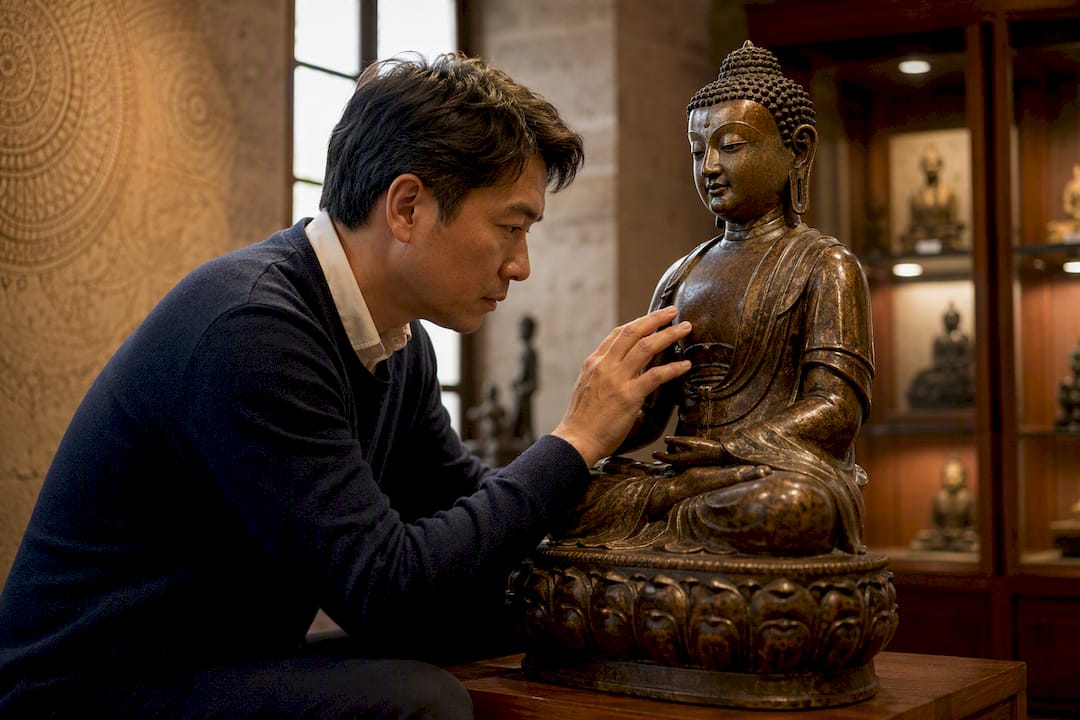
Interestingly, financial return isn’t the dominant motive for many of these buyers. The Art Basel and UBS Survey of Global Collecting found only around 16 to 20% of collectors in key Asian markets cite investment return as their primary reason for buying, which means cultural and spiritual motivations often set the actual price ceiling for rare pieces, sometimes well above what a pure financial model would predict.
| Cost or timeline factor | What to expect |
|---|---|
| Buyer’s premium (auction) | Typically layered on top of hammer price, varies by house and sale |
| Seller’s premium | Commission deducted from proceeds, negotiable at higher price tiers |
| Authentication and testing | Runs from a few hundred to several thousand dollars depending on method |
| Shipping and insurance | Higher for stone and large bronzes; insured transit is standard for rare pieces |
| Typical resale horizon | Often 5 to 15 years for genuinely rare, high-provenance works |
Hong Kong, Beijing, and Singapore remain the deepest liquidity hubs for high-end rare Asian works, which matters if you’re planning a resale timeline. A piece with strong intra-regional appeal, particularly Buddhist or Hindu sculpture with clear ritual significance, often finds buyers faster than a piece that only appeals to Western collectors.
The Real Risks Rarity Introduces, and How to Manage Them
Rarity concentrates risk as much as it concentrates reward. The biggest exposures are authentication risk (a piece turning out to be misattributed or fake), export and legal risk (cultural property restrictions blocking resale or import), illiquidity risk (waiting years for a matching buyer), and valuation volatility (wide appraisal swings due to thin comparables).
Each has a workable mitigation:
- Commission independent authentication before, not after, you negotiate price.
- Use escrow or staged payments for high-value private sales to protect both parties.
- Carry dedicated fine-art insurance rather than relying on general property coverage.
- Consult legal counsel on export and cultural-property compliance before cross-border purchases, since many source countries restrict removal of temple or archaeological material.
- Diversify across artists, periods, and regions rather than concentrating capital in a single rare category.
Export restrictions deserve a direct note: several Southeast Asian and South Asian countries treat certain antiquities as protected cultural property, meaning a legally purchased piece can still face export or resale obstacles depending on its origin and documentation. Provenance research resolves most of this risk before it becomes expensive.
Pro Tip: Never let rarity alone justify skipping a legal compliance check. A stunning, one-of-a-kind piece with murky export history is a liability, not a bargain.
A Practical Checklist Before You Buy a Rare Piece
Before committing capital to a rare piece, work through this sequence rather than jumping straight to price negotiation.
- Initial screening. Confirm the category of rarity (unique, limited, period-scarce) and whether it matches your collecting or investment goal.
- Provenance verification. Request full ownership history, exhibition records, and any catalog references.
- Condition survey. Get an independent condition report, not just the seller’s description.
- Technical testing. For high-value pieces, commission material or age-verification analysis.
- Market comparables check. Research recent sales of genuinely similar works, not just the same broad category.
- Logistics and insurance planning. Confirm insured shipping terms and storage conditions before purchase.
- Resale path analysis. Decide upfront whether auction, private sale, or long-term hold fits your goals.
Ask any seller directly: Can you document ownership back further than the last sale? Has this piece left its country of origin legally? Is there a condition report available? Has it appeared in any exhibition or publication?
Pro Tip: If budget is tight, commission provenance research first and technical testing second. Ownership gaps disqualify a purchase faster and cheaper than a lab test does.
Fitting Rare Asian Art Into a Diversified Portfolio
Rare Asian works function differently from liquid financial assets, and allocation should reflect that. Advisers commonly discuss ranges around 5% to 15% of a portfolio for collectors leaning into alternative assets, though this depends heavily on individual risk tolerance and liquidity needs.
Academic research on the Chinese mainland art market finds that artworks can improve a portfolio’s efficient frontier, particularly for risk-seeking investors, though the benefit varies by category and shrinks once global financial assets dominate the comparison set.
- Expect holding periods of 5 to 20 years for genuinely rare, high-provenance pieces.
- Quick flips are possible but rare, usually limited to hot contemporary segments with active resale demand.
- Family offices and wealth advisers increasingly treat rare art as an intergenerational asset rather than a short-term trade, which shapes how they underwrite rarity premiums.
Legal and Ethical Considerations When Trading Rare Asian Pieces
Rare Asian art sits at the intersection of commerce and cultural heritage law, and that intersection carries real transaction risk. Many source countries, including Cambodia, Thailand, and Indonesia, classify certain categories of temple sculpture and archaeological material as protected cultural property, restricting or banning export regardless of a private sale’s legality within the country itself.
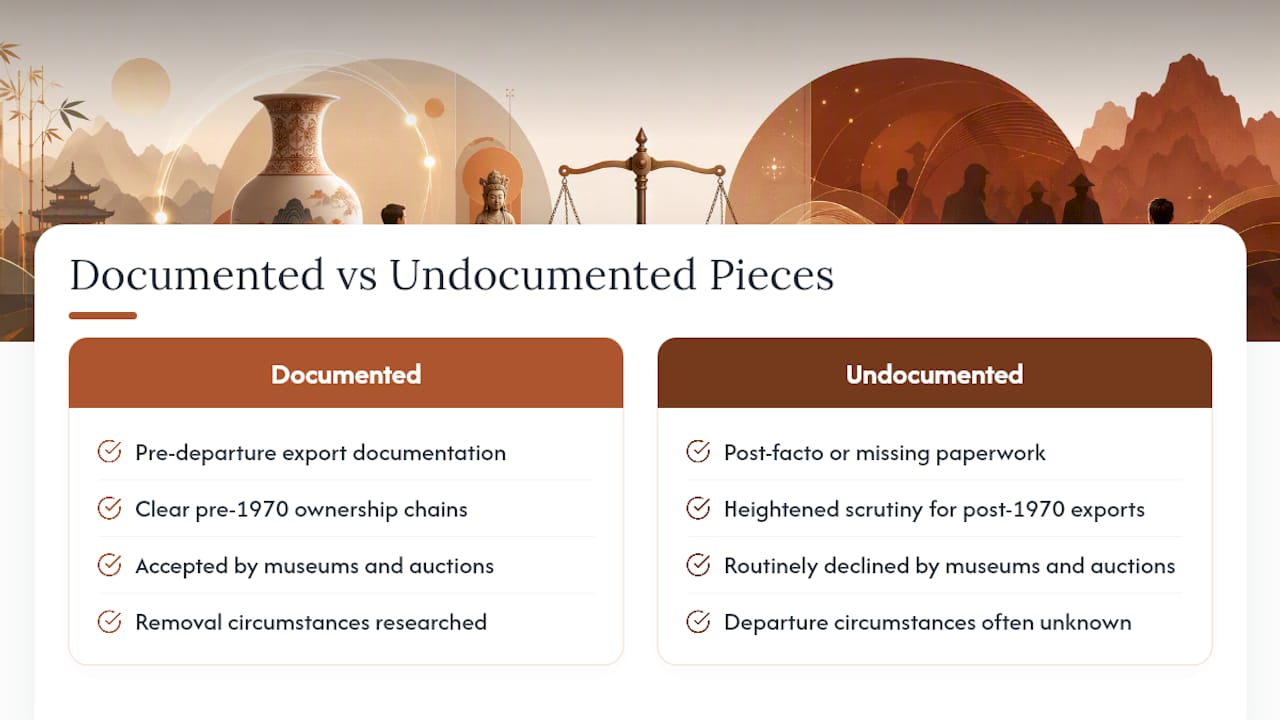
Buyers should verify export documentation predates the piece’s departure from its country of origin, since post-facto paperwork is a common red flag in disputed cases. UNESCO’s 1970 Convention on cultural property, adopted by many source and market countries, generally treats undocumented archaeological exports after that date with heightened scrutiny, which is why serious buyers and auction houses lean so heavily on documented pre-1970 ownership chains.
Ethical sourcing goes beyond legal minimums. Ritual and reliquary objects, in particular, carry ongoing spiritual significance for the communities that produced them. Reputable dealers research not just legal title but the circumstances under which sacred works left temple or monastic custody, since reliquary and ritual pieces often carry cultural weight that pure legal ownership doesn’t fully address.
Museums and major auction houses now routinely decline consignments lacking clear export documentation, a shift that has tightened the market for undocumented material and, in turn, increased the premium commanded by pieces with clean paperwork.
What Actually Separates Good Rarity Bets From Bad Ones
Rarity gets treated as a shortcut to value, and that’s the mistake I see most often. A piece being scarce tells you almost nothing about whether it will hold or grow in value; it just tells you the buyer pool is competing over less supply.
My honest read: pay a rarity premium when provenance is airtight and the piece has independent expert acceptance. Walk away when rarity is the seller’s only argument. And when in doubt, weigh documented condition and ownership history above the rarity claim itself, since those two factors determine whether that premium survives your eventual resale.
How HDAsianArt Helps You Source Verified Rare Pieces
Sourcing rare Asian art without a dedicated research process is how buyers end up with unverifiable claims instead of investable pieces. HDAsianArt individually researches, photographs, and describes every statue and sculpture in its collection, so provenance and condition details arrive with the piece rather than as an afterthought you have to chase down yourself.
Each listing includes detailed background on origin and material, backed by condition assessment and insured worldwide DHL shipping, which removes two of the biggest friction points in cross-border acquisition of antique Buddhist and Hindu sculpture. Browsing a piece like this antique Javanese Avalokiteshvara Bodhisattva statue shows how museum-quality standards and documented sourcing come together in a single listing. If you’re building a collection around genuinely rare, well-provenanced Buddhist and Hindu temple art, start at the HDAsianArt gallery and reach out about a specific piece before it moves.
Sources
- Christie’s: Hong Kong Asian art 2025 second half projected total
- The Art Newspaper: Asian antiquities are gaining a younger following — will it last?
- China mainland art investment: Return and portfolio (ScienceDirect)
