



Buddha Iconography: The 32 Marks Explained
Buddha Iconography: The 32 Marks Explained
Most people who buy a Buddha statue focus on size, material, or country of origin. Far fewer stop to ask what the statue's physical features actually mean, and that gap in knowledge costs collectors dearly. Without understanding Buddha iconography, you cannot distinguish a thoughtfully crafted, iconographically correct sculpture from a decorative piece that borrows Buddhist aesthetics without the substance.
The 32 Marks of a Buddha, known in Sanskrit as the Lakshanas, are the ancient physical attributes that define every authentic representation of the Buddha across all Asian artistic traditions. Once you can read them, every statue tells you its origin, its period, and its meaning.
Table of Contents
- What Are the 32 Marks of a Buddha?
- Origin of the Marks: The Lakkhana Sutta and Pre-Buddhist Tradition
- The Most Important Marks for Collectors and Practitioners
- How the Marks Vary by Regional Artistic Tradition
- Comparison of Iconographic Traditions Across Asia
- Reading a Statue Like an Expert
- Common Mistakes Collectors Make with Buddha Iconography
- Frequently Asked Questions
- References
What Are the 32 Marks of a Buddha?
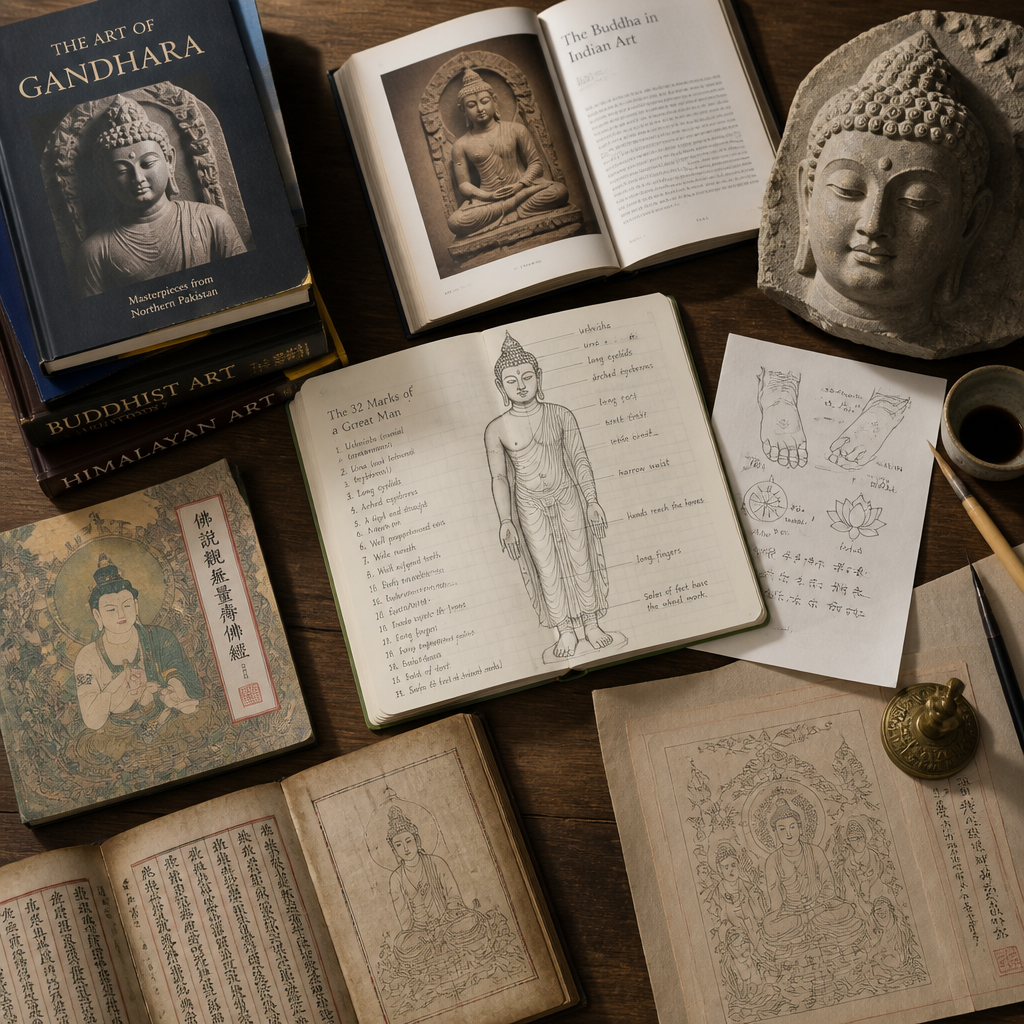
The 32 Marks, or Lakshanas, are a set of physical characteristics considered present on the body of every fully enlightened Buddha. They appear in the Pali Canon's Lakkhana Sutta and describe everything from the way a Buddha places his feet on the ground to the specific texture of his skin, the shape of his jaw, and the protuberance at the crown of his head. These are not decorative flourishes invented by artists. They are a codified visual language rooted in ancient Indian religious thought, adapted and elaborated by Buddhist tradition across centuries and continents.
What makes this system remarkable is its ethical dimension. Each mark, according to the Buddha's own teaching as recorded in the Lakkhana Sutta, is the direct result of ethical action accumulated across many lifetimes. The wheel-mark on the sole of the foot, for instance, arises from having "lived for the happiness of many, a dispeller of fright and terror, provider of lawful protection and shelter, and supplying all necessities." The marks are not arbitrary beauty standards. They are visible proof of moral perfection made physical.
For collectors and altar decorators, this matters enormously. A sculptor working within a living iconographic tradition is encoding that ethical and spiritual meaning into stone, bronze, or lacquered wood. A sculptor working purely for the export market often is not.
Origin of the Marks: The Lakkhana Sutta and Pre-Buddhist Tradition
The 32 Marks did not originate with Buddhism. The concept existed before the Buddha as a list describing a "Superior Being" or "Great Man" in ancient Indian thought. What the historical Buddha did, characteristically, was take a pre-existing cultural framework and reinterpret it. Rather than rejecting the marks or preaching against them, he gave them a new ethical foundation, explaining why each mark exists and what past actions produce it.
This pattern of reinterpretation is important for understanding why the marks appear so consistently across Buddhist art even as stylistic details shift dramatically between Burma, Cambodia, Thailand, Japan, and Sri Lanka. The underlying textual authority is shared across schools. The visual expression of that authority is where regional traditions diverge.
The 32 Marks function as a bridge between ethical teaching and visual art. Every physical feature on a correctly rendered Buddha statue carries doctrinal weight. Reading the marks is reading the dharma made visible.
It is worth noting that some early textual sources, including the Dhamma Wiki tradition drawing on the Tipitaka, raise the question of whether Shakyamuni actually possessed these features in a literal physical sense. The account of King Ajatasattu being unable to distinguish the Buddha from his disciples suggests his appearance was, in practical terms, ordinary. What developed over time was a symbolic and artistic language, not a physiological claim. Knowing this distinction helps collectors understand why the marks matter as iconographic convention rather than historical biography.
Pro tip: When evaluating a Buddha statue from any Asian tradition, start with the three most visually prominent marks: the Ushnisha (crown protuberance), the Urna (forehead mark), and the elongated earlobes. If these three are absent or awkwardly rendered, the piece likely sits outside the serious iconographic tradition regardless of its claimed origin.
The Most Important Marks for Collectors and Practitioners
Of the 32 Marks, a handful appear consistently and prominently across virtually all Buddhist sculptural traditions and are the ones collectors need to recognize immediately.
The Ushnisha: Crown of Wisdom
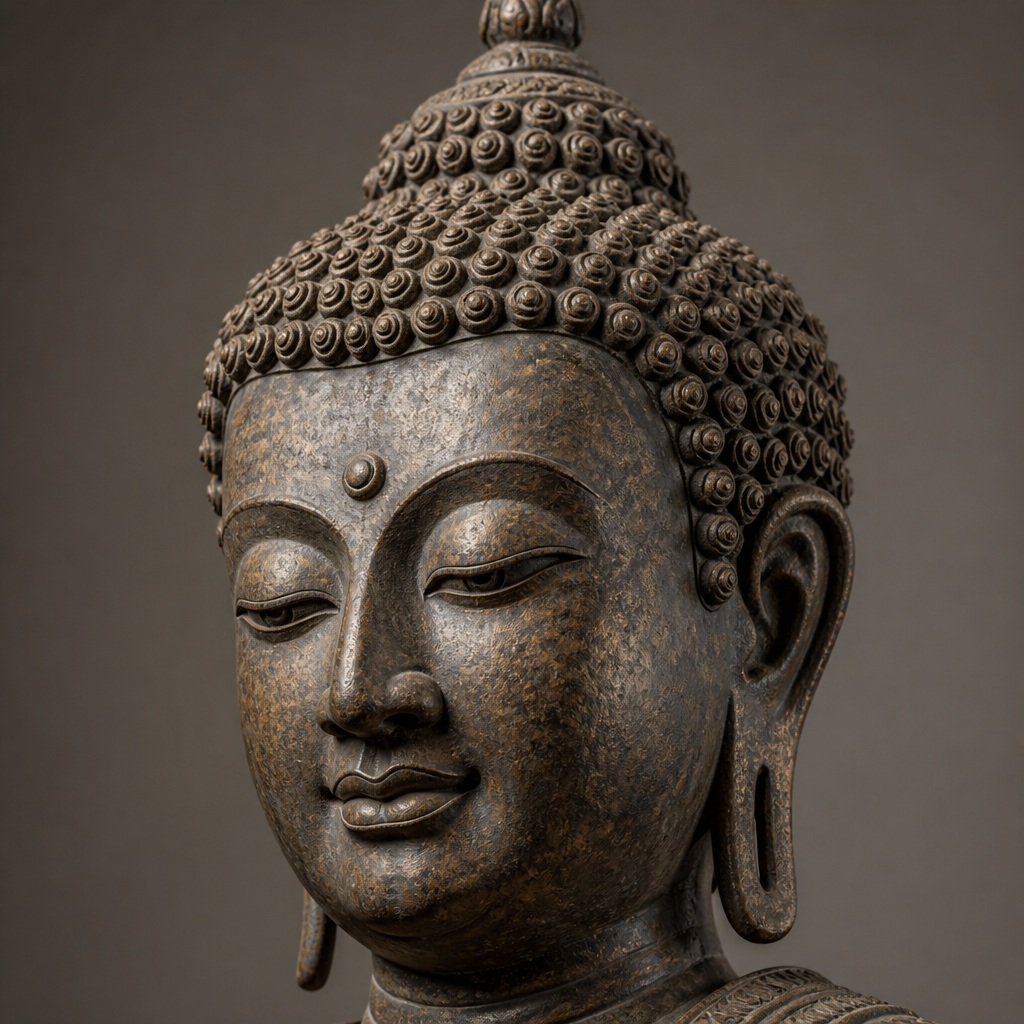
The Ushnisha is the cranial protuberance at the top of the Buddha's head, covered with short curls that turn clockwise. It is universally recognized as a symbol of Supreme Enlightenment and wisdom. In early sculptures, particularly from the 2nd and 3rd centuries, the Ushnisha is relatively modest. In later Southeast Asian traditions, especially Khmer and Thai, it elongates into a dramatic flame-like peak. In Japanese sculpture, it sits as a more contained dome.
Understanding this variation is critical. A dramatically tall Ushnisha is not "more enlightened" than a subtle one. It is simply a different regional convention, and it is one of the most reliable markers of a statue's geographic origin.
The Urna: The Forehead Mark
The Urna is the 31st physical characteristic of the Buddha and appears as a circular dot or whorl of white hair between the eyebrows. It symbolizes and radiates wisdom that illuminates the world. In early sculpture it is often rendered as a simple raised dot. In later traditions it is sometimes represented with a jewel, a crystal, or a precious stone inlay. The Urna appears frequently on 2nd and 3rd century sculptures of both Buddhas and Bodhisattvas.
For altar decorators, the Urna is especially meaningful. In traditional worship practice it is the point from which the Buddha's wisdom light emanates, and its presence on a statue signals that the piece was made within a doctrinally aware tradition.
The Elongated Earlobes
The distended earlobes that appear on virtually every Buddha statue recall the heavy earrings the Buddha wore when he was still a prince, before his renunciation. After becoming an ascetic, he removed the earrings, but the stretched lobes remained. Iconographically they symbolize longevity and the Buddha's royal origins. A statue without elongated earlobes is iconographically incomplete in almost every tradition.
The Wheel Mark on the Soles
The Dharmachakra, or Wheel of the Dharma, imprinted on the soles of the feet is one of the marks most directly connected to ethical action in the Lakkhana Sutta. It appears in reclining Buddha statues and in footprint reliefs, which are objects of veneration in their own right across Sri Lanka, Thailand, and India. When you encounter a reclining statue with clearly articulated sole markings, you are looking at a piece that draws on this specific iconographic tradition.
The Golden Complexion
The mark describing a golden or luminous complexion is one of the three most recognized Lakshanas, alongside the Ushnisha and Urna. In sculpture, this is expressed through gilding in Burmese and Thai traditions, through warm bronze tones in Khmer and Javanese casting, and through specific pigment choices in Chinese lacquerware and painted wood sculpture. When a Burmese craftsman gilds a teak or alabaster Buddha, they are not simply decorating. They are fulfilling an iconographic requirement.
How the Marks Vary by Regional Artistic Tradition
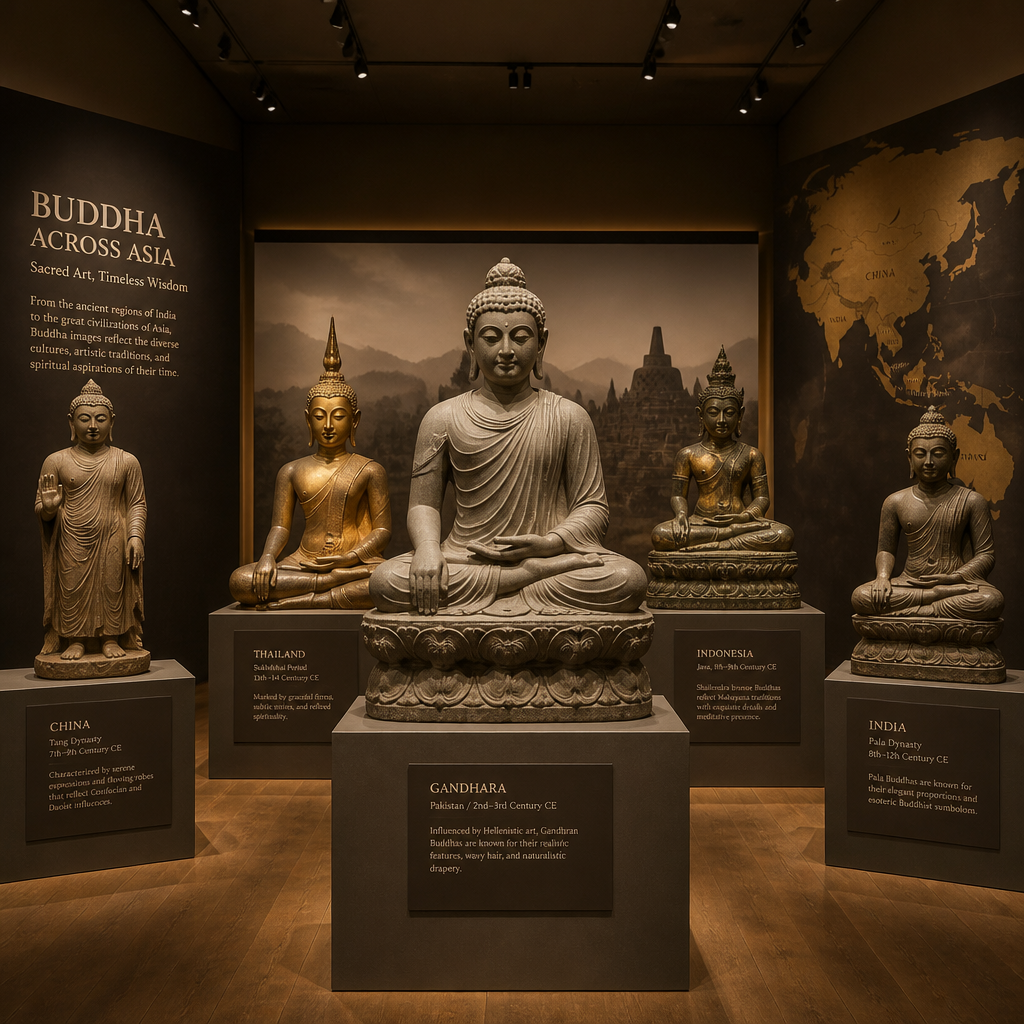
The 32 Marks provide a shared doctrinal foundation, but the artistic expression of those marks differs significantly from one Buddhist culture to another. This is where knowledge of Buddhist sculpture becomes genuinely useful for collectors. A Thai Buddha and a Japanese Buddha are both iconographically correct representations, yet they look strikingly different because each regional tradition developed its own visual vocabulary over centuries.
Burma and Thailand
Burmese and Thai traditions both produce images of exceptional iconographic precision. The flame-like Ushnisha is characteristic of Thai sculpture, particularly in the Sukhothai and Ayutthaya periods. Burmese sculpture tends toward a more rounded, jeweled crown effect in royal images, while monastic images favor a simple, clean Ushnisha covered in stylized curls. Both traditions use heavy gilding to express the golden complexion mark. Burmese lacquerware, a distinct art form, sometimes incorporates Buddha images rendered in the same iconographic vocabulary.
Cambodia and the Khmer Tradition
Khmer sculpture from Cambodia is among the most powerful in the Buddhist world. The Ushnisha in Khmer images is often topped with a finial or lotus bud. The face carries a characteristic slight smile, wide cheekbones, and a serene self-containment that is immediately recognizable. The Urna is typically rendered as a simple raised dot rather than an inlaid jewel. Khmer bronzes often show the naga (serpent) hood over the Buddha's head, combining the iconographic marks with a specific narrative scene.
China and Japan
Chinese and Japanese Buddhist sculpture interpret the marks through the lens of local aesthetic sensibilities. Chinese Buddha images from the Tang dynasty onward tend toward a more rounded, approachable form, with the Ushnisha as a smooth dome or a mass of tight curls. Japanese sculpture, particularly in the Heian and Kamakura periods, achieves extraordinary refinement, with crisp, precise rendering of every iconographic element. The webbed fingers described in the 32 Marks appear in some Japanese gilt bronze images as a subtle membrane between extended fingers.
India, Sri Lanka, and Indonesia
Indian sculpture, particularly from Gandhara and Mathura, represents the earliest artistic attempts to render the 32 Marks in stone. Gandharan work shows Greek artistic influence, with the Ushnisha rendered as wavy hair rather than tight curls. Sri Lankan sculpture follows a more restrained aesthetic, with smooth surfaces and calm proportions. Indonesian sculpture, particularly from Java, draws on the same Mahayana and Tantric traditions that shaped Khmer art, producing images of considerable grandeur with all major Lakshanas clearly present.
Pro tip: When comparing a Thai statue with a Cambodian statue of similar period, look at the Ushnisha first, then the earlobe treatment, then the surface of the lips. These three elements together will tell you more about regional origin than the overall silhouette, which collectors tend to focus on incorrectly.
Comparison of Iconographic Traditions Across Asia
|
Iconographic Feature |
Southeast Asian Tradition (Burma, Thailand, Cambodia) |
East Asian Tradition (China, Japan) |
|---|---|---|
|
Ushnisha Form |
Elongated, flame-like (Thai); jeweled or rounded (Burmese); lotus-bud finial (Khmer) |
Smooth dome or tight curls (Chinese); precise, refined dome (Japanese) |
|
Urna Rendering |
Raised dot, sometimes inlaid gem or crystal |
Raised dot, sometimes painted; occasionally jewel inlay in later periods |
|
Golden Complexion Mark |
Heavy gilding in gold leaf; warm bronze in Khmer casting |
Gilt lacquer, painted gold, or warm bronze patina |
|
Earlobe Treatment |
Strongly elongated, often with ring detail or piercing mark |
Elongated but often more restrained; ring detail less prominent |
|
Body Proportions (Perfectly Proportioned Mark) |
Elongated, elegant, sometimes hyperrefined in Thai work |
Rounded, fuller form, more naturalistic in Chinese tradition |
|
Wheel Mark on Soles |
Prominent in reclining images and stone footprints (especially Sri Lanka, Thailand) |
Present in footprint reliefs; less common in standing or seated images |
Reading a Statue Like an Expert
Knowing the 32 Marks in the abstract is one thing. Applying that knowledge to an actual statue in front of you is a different skill, and it is learnable. A systematic approach prevents the mistake of focusing on surface aesthetics and missing the iconographic content.
Start at the top of the head and work downward. Is the Ushnisha present and clearly articulated? What form does it take, and does that form match the claimed regional origin of the piece? Move to the forehead: is the Urna present as a dot, a whorl, or an inlaid stone? Check the earlobes for elongation. Examine the hands: are the fingers long and tapering? Is there any suggestion of webbing between them? Look at the overall proportions: does the figure's height appear to match the arm span, reflecting the "perfectly proportioned" mark? Finally, examine the base or the soles of the feet if visible: are there wheel marks present?
A statue that satisfies most of these checks is almost certainly the product of a craftsperson working within a living iconographic tradition rather than producing decorative items for export. That distinction has real consequences for both collector value and spiritual significance.
In practice, the most common error is over-weighting the facial expression and under-weighting the structural marks. A serene face is easy to produce. Correct proportional relationships, a properly formed Ushnisha covered with clockwise curls, and a clearly placed Urna require a craftsperson who actually knows the iconographic canon.
Common Mistakes Collectors Make with Buddha Iconography
The most damaging mistake is treating the 32 Marks as a checklist for spotting fakes rather than as a guide to understanding meaning. The marks are a meaning system first. Authentication concerns are secondary, and even authentic pieces from genuine workshops may emphasize different marks depending on local convention.
A second common mistake is assuming that more ornate always means more iconographically correct. Highly decorated, jeweled pieces from certain traditions may represent Bodhisattvas or royal Buddha images rather than the standard Shakyamuni. A Bodhisattva such as Avalokitesvara or Manjushri shares some of the 32 Marks but carries additional iconographic elements including crowns, multiple arms, or specific attribute objects. Confusing a Bodhisattva with a Buddha is a fundamental identification error that changes the piece's meaning entirely.
A third mistake is ignoring the hand gesture (mudra) in favor of focusing only on the physical marks of the body. The mudra and the marks work together as a unified meaning system. A statue in the earth-touching gesture (Bhumisparsha mudra) is specifically representing the moment of Shakyamuni's enlightenment. A statue in the teaching gesture (Dharmachakra mudra) represents the first turning of the wheel of dharma. These gestures belong to the same iconographic language as the 32 Marks and must be read together with them.
Pro tip: If you are building a home altar or a collection focused on a specific tradition, such as Theravada Thai or Mahayana Chinese, learn the regional conventions for the Ushnisha first. That single feature will orient you more reliably than any other physical attribute when you are evaluating a new piece, because it is simultaneously the most doctrinally important and the most visually distinctive element across regional traditions.
Collectors at HD Asian Art who invest time in understanding the 32 Marks consistently report making more confident purchasing decisions, because they are no longer relying on subjective impressions of beauty. They are reading an objective iconographic language that has been stable for more than two thousand years. The collection at HD Asian Art spans Burma, Cambodia, China, India, Indonesia, Japan, Laos, Sri Lanka, and Thailand, which means it offers a genuine comparative view of how these marks translate across the full breadth of Asian Buddhist sculptural tradition.
Frequently Asked Questions
Are the 32 Marks meant to be taken literally as physical features the historical Buddha actually possessed?
This question has been debated within Buddhist scholarship for centuries. Some early textual sources, including accounts in the Tipitaka, suggest that the historical Buddha's appearance was unremarkable to observers, which would be inconsistent with him literally displaying all 32 Marks. The scholarly and practical consensus is that the marks function primarily as a symbolic and iconographic system rather than a biographical description. They encode ethical and spiritual meaning in visual form, and that is the register in which they matter most for understanding Buddhist sculpture.
How do the 32 Marks differ from the secondary marks sometimes mentioned in Buddhist texts?
Beyond the 32 primary Marks (Lakshanas), Buddhist texts also describe 80 secondary marks (Anuvyanjanas) that further refine the physical description of a fully enlightened being. The secondary marks include details such as the color and clarity of the fingernails, the precise shade of the skin, and the quality of the voice. In practice, sculptors have focused on the 32 primary marks, and specifically on the most visually distinctive ones. The 80 secondary marks are rarely rendered in sculpture and function primarily as textual elaboration.
Do the 32 Marks appear in Hindu deity sculpture as well as Buddhist sculpture?
The concept of physical marks denoting a superior being has roots in pre-Buddhist Indian religious thought, which means related ideas circulate in the broader Indian artistic tradition. However, the specific codified list of 32 Marks as described in the Lakkhana Sutta is a Buddhist doctrinal formulation. Hindu iconography operates through a different but equally systematic set of conventions, including specific attributes, gestures, vehicle animals, and iconometric proportions. When viewing a statue from HD Asian Art's Hindu deity collection, the relevant iconographic framework is the Hindu one, not the Buddhist Lakshanas.
How does knowing the 32 Marks affect the value of a Buddha statue for a collector?
Iconographic correctness is one of several factors that experienced collectors weigh. A statue that correctly renders the primary marks, particularly the Ushnisha, Urna, elongated earlobes, and appropriate body proportions, demonstrates that the craftsperson worked within a living iconographic tradition rather than producing decorative approximations. That connection to tradition is a genuine quality indicator. It does not guarantee antiquity or rarity, but it does signal seriousness of craftsmanship, and in the market for museum-quality Asian art, seriousness of craftsmanship is exactly what separates significant pieces from decorative ones.
Which of the 32 Marks is most useful for identifying a statue's regional origin?
The Ushnisha is the single most useful mark for regional identification. Its form varies more dramatically and more consistently across regions than any other mark. A flame-like Ushnisha points strongly to Thai origin. A lotus-bud finial suggests Khmer influence. A smooth, domed Ushnisha with tight curls is characteristic of Chinese Tang and later periods. A restrained, dome-like form with very precise surface detail is often Japanese. After the Ushnisha, examine the earlobe treatment and the facial proportions, particularly the width of the cheekbones and the angle of the jaw, which also carry strong regional signatures.
Can the 32 Marks help identify whether a statue represents Shakyamuni Buddha or a different Buddha?
All fully enlightened Buddhas are said to share the 32 Marks, so the marks alone do not distinguish Shakyamuni from Amitabha, Maitreya, or other Buddhas. Identification of specific Buddhas requires reading the hand gesture (mudra), the color in painted traditions, the throne or seat type, and associated symbols or attendant figures. Amitabha is often identified by the meditation mudra and association with a lotus throne. Maitreya may carry a stupa or water vessel. The 32 Marks confirm that a figure is a Buddha rather than a Bodhisattva or a Hindu deity. They do not, by themselves, tell you which Buddha.
If you have a Buddha statue at home and you have tried reading its marks, share what you found in the comments below, especially if the iconography led you to a surprising discovery about its origin or meaning.
References
