



Estatua del mejor tamaño para el altar del hogar: una guía completa
Estatua del mejor tamaño para el altar del hogar: una guía completa
Elegir la estatua del mejor tamaño para el altar del hogar requiere una cuidadosa consideración de su espacio físico, distancia de visualización y práctica espiritual. En HD Asian Art, entendemos que las dimensiones de una estatua determinan fundamentalmente cómo interactúas con tu espacio devocional.
Esta guía lo guía a través de las medidas exactas, los cálculos espaciales y la lógica de disposición que separan un altar bien proporcionado de uno que parece estrecho o visualmente incómodo.
Tabla de contenidos
Comprensión de las categorías de tamaño de estatuas para altares domésticos
La estatua de mejor tamaño para el altar del hogar se divide en tres categorías distintas, cada una de las cuales satisface diferentes necesidades devocionales y limitaciones espaciales.
Estatuas mini y de bolsillo. Miden de 2 a 6 pulgadas de altura y funcionan bien para altares de viaje, esquinas de escritorio o arreglos en capas. Una estatua de 4 pulgadas vista desde una distancia de 18 pulgadas crea un punto focal íntimo pero exige una mayor proximidad para apreciar los detalles.
Estatuas devocionales de mesa Miden de 8 a 18 pulgadas de alto y representan el punto óptimo para la mayoría de los altares domésticos. Con 12 pulgadas, una estatua se vuelve visible desde el otro lado de un dormitorio típico, manteniendo la escala suficiente para parecer sustancial. Esta categoría equilibra la presencia con la practicidad, ya que el peso sigue siendo manejable y el soporte de los muebles rara vez es un problema.
Piezas a escala de suelo y capilla exceda las 24 pulgadas y cree anclajes visuales imponentes. Una estatua de mármol de 36 pulgadas transforma un rincón entero en un santuario sagrado. Estos exigen un espacio dedicado y habitaciones lo suficientemente grandes como para acomodar su huella visual sin abrumar el entorno.
Medición del espacio de su altar: profundidad útil y espacio libre de altura
antes comprando cualquier estatua, mida tres dimensiones críticas: espacio vertical sobre la superficie, profundidad horizontal utilizable y ancho disponible.
Requisitos de espacio vertical exigen un respiro. Una estatua de 12 pulgadas necesita al menos 2 a 3 pulgadas de espacio libre por encima de su corona. Si su estante se encuentra a 14 pulgadas debajo de un gabinete, una estatua de 10 pulgadas es su máximo práctico. Para estantes montados en la pared, mida desde la superficie del estante hasta la obstrucción más baja encima de él, reste 2 pulgadas para el espacio libre y luego reste otra pulgada para el grosor del estante. Esa altura restante es su verdadero espacio de trabajo.
Evaluación de profundidad horizontal evita que las estatuas parezcan colocadas en una posición precaria. Una estatua de 6 pulgadas de profundidad debe colocarse en un estante de al menos 8 pulgadas de profundidad, dejando 2 pulgadas de espacio detrás para mayor estabilidad visual. Las consideraciones de ancho determinan si puedes agregar piezas complementarias más adelante. Si el estante de su altar tiene 24 pulgadas de ancho y desea una pieza central de 10 pulgadas de ancho, le quedan 14 pulgadas para velas y estatuas secundarias.
Cómo disponer estatuas en un altar: diseño y equilibrio visual
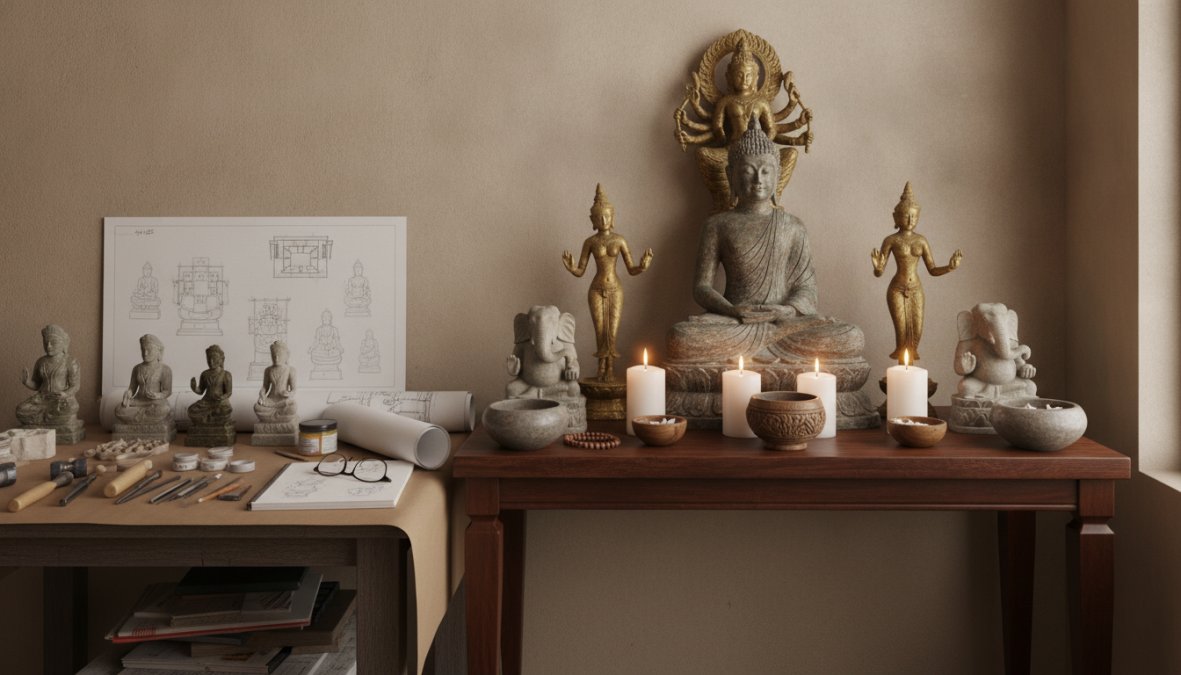
Disposición de varias estatuas Sigue una lógica arraigada en la proporción visual y la jerarquía espiritual. La mayoría de los practicantes organizan las piezas utilizando una composición triangular: una pieza central dominante flanqueada por estatuas de soporte más pequeñas.
Relaciones de escala proporcional determinar si un arreglo se siente armonioso. Si su estatua principal mide 12 pulgadas de alto, las piezas complementarias deben medir entre 6 y 8 pulgadas (de la mitad a dos tercios de la altura). Esta proporción de 1:2 crea coherencia visual. Coloque las estatuas secundarias a profundidades escalonadas en lugar de directamente al lado de la pieza principal. Una estatua central de 12 pulgadas, una pieza de 8 pulgadas colocada 2 pulgadas hacia adelante y 1 pulgada más abajo, y una pieza de 6 pulgadas colocada 3 pulgadas hacia atrás y 2 pulgadas más arriba crean un movimiento visual que parece intencional.
Para arreglos de tres estatuas en un estante de 24 pulgadas, coloque la pieza más alta a 8 pulgadas del borde izquierdo, coloque una pieza mediana a 16 pulgadas de la izquierda y coloque la pieza más pequeña en el extremo izquierdo o derecho. Esta composición triangular asimétrica parece más dinámica que los arreglos centrados.
Reglas para la colocación de estatuas en el altar: creación de armonía estética
Hacer coincidir el tamaño de la estatua con las dimensiones del altar requiere comprender cómo las proporciones varían en los diferentes tamaños de habitaciones. Calcule su proporción dividiendo el ancho del estante por el ancho de la estatua. Un estante de 24 pulgadas de ancho con una estatua de 6 pulgadas de ancho produce una proporción de 4:1. Las estatuas con proporciones de 3:1 a 5:1 se sienten bien proporcionadas.
Consideraciones de distancia y escala de visualización cambiar la forma en que se lee una estatua en el espacio. Utilice esta regla: divida su distancia de visualización típica (en pies) por 2. Ese número se aproxima a la altura ideal de la estatua en pulgadas. ¿Parado a 6 pies de tu altar? Una altura mínima de 3 pulgadas evita que la pieza desaparezca. ¿Parado a 10 pies de distancia? Planifique al menos 10 a 12 pulgadas.
La posición de la luz afecta la lectura del tamaño de la estatua. Una estatua retroiluminada parece más grande debido a la iluminación del borde que define su silueta. Si su altar usa retroiluminación, puede reducir el tamaño de la estatua entre 1 y 2 pulgadas y mantener el mismo impacto visual.
Estatuas de altar pequeñas o grandes: elegir la escala adecuada
La decisión entre estatuas pequeñas y grandes depende del volumen total de su habitación y de su patrón de interacción diaria. Una estatua de 4 pulgadas invita a un compromiso íntimo; una estatua de 16 pulgadas llama la atención desde el otro lado de la habitación.
Capacidad de carga y seguridad de los muebles. Se vuelven fundamentales a la hora de elegir piezas de mayor tamaño, especialmente en mármol o piedra. Una estatua de mármol de 12 pulgadas pesa entre 8 y 15 libras, según la densidad. La mayoría de los estantes de madera soportan esto sin problemas, pero los estantes de vidrio exigen precaución. Calcule la capacidad de peso: si su estante tiene 24 pulgadas entre soportes, generalmente soporta entre 25 y 40 libras distribuidas uniformemente.
Para arreglos montados en estantes, coloque estatuas más pesadas hacia los puntos de soporte (generalmente de 2 a 4 pulgadas de cada extremo) en lugar de en el centro. Las estatuas de resina pesan entre un 40 y un 50 % menos que sus equivalentes de mármol del mismo tamaño, lo que ofrece presencia visual sin penalizaciones de peso. Las estatuas de madera suelen pesar entre 6 y 9 libras por pieza de 12 pulgadas y requieren protección de la humedad y la luz solar directa para evitar deformaciones.
Materiales y durabilidad para la estatua del altar de su hogar
El material que elija afecta la estética, la longevidad y los requisitos de mantenimiento.
estatuas de marmol Ofrecen elegancia atemporal y desarrollan una pátina durante décadas. El mármol es poroso y requiere sellado periódico si se expone a la humedad. Una estatua de mármol en el altar de un dormitorio seco necesita un cuidado mínimo; La misma pieza en un ambiente húmedo eventualmente mostrará manchas de agua. Presupuesto para sellado profesional cada 2-3 años en condiciones de humedad.
Resinas y materiales compuestos. ofrecen ventajas prácticas para la mayoría de los altares domésticos. Las estatuas de resina pintadas a mano capturan la estética del mármol y pesan un 60 % menos. Resisten la humedad, sólo requieren quitar el polvo ocasionalmente y toleran las fluctuaciones de temperatura que el mármol encuentra estresantes.
Estatuas de madera pintadas a mano. Combina artesanía con calidez. La veta natural de la madera añade una complejidad visual que la piedra no puede igualar. Las piezas de madera requieren protección de la luz solar directa y de las fluctuaciones de humedad. Una estatua de madera en una habitación estable y con clima controlado puede durar generaciones.
Las investigaciones indican que la selección adecuada de materiales para su entorno específico extiende la vida útil de la estatua por décadas.
Impacto del tamaño de la habitación: selección de la estatua del mejor tamaño para su espacio
El volumen total de su habitación determina qué tamaño de estatua se considera proporcional. Calcule el peso visual de su habitación multiplicando el largo por el ancho y luego dividiéndolo por 10. Un dormitorio de 12 x 14 pies produce un peso visual de 16,8; su estatua debe medir entre 8 y 12 pulgadas. Una sala de estar de 20x18 pies produce un peso visual de 36; una estatua de 14 a 16 pulgadas parece tener la escala adecuada.
Consideraciones ergonómicas y de accesibilidad Afecta la interacción diaria con la estatua de tu altar. Coloque las estatuas primarias a una distancia de 36 a 48 pulgadas del piso, permitiendo el acceso sentado. ¿Puedes alcanzar cómodamente tu estatua para realizar ofrendas de manos o toques rituales? ¿Se puede desempolvar la pieza sin esforzarse? Estas consideraciones prácticas distinguen los altares que apoyan la práctica diaria de las exhibiciones estáticas.
Para los practicantes con artritis o fuerza limitada en las manos, las alternativas de resina más ligeras permiten el mismo compromiso devocional sin tensión física. La acústica de la habitación y la estabilidad de la temperatura también influyen en la elección de la estatua. El mármol en una habitación con superficies duras puede resultar frío y austero; la resina o la madera se sienten más cálidas.
Ideas de ubicación: estantes, repisas, rincones y escritorios
Las diferentes ubicaciones del altar exigen diferentes tamaños de estatuas y enfoques de disposición.
Colocación de estantes Funciona mejor con estatuas de 8 a 14 pulgadas de alto. Una estatua de 10 pulgadas en un estante de 24 pulgadas de ancho colocada a 7 pulgadas del borde izquierdo se siente equilibrada. La iluminación de los estantes, ya sea tiras de LED incorporadas o una pequeña lámpara enfocada, define la forma de la estatua y crea una atmósfera.
Pantallas de manto acomode piezas más grandes porque las repisas se ubican más arriba (generalmente entre 48 y 54 pulgadas del piso) y los espectadores las ven desde mayores distancias. Una estatua de 14 a 16 pulgadas funciona bien en una repisa estándar. Las repisas también ofrecen más ancho para su disposición.
Colocación de rincones y esquinas Crea espacios íntimos en el altar, perfectos para estatuas de 8 a 12 pulgadas. Las paredes de las esquinas enmarcan naturalmente la estatua, por lo que puede usar piezas un poco más pequeñas que las que elegiría para colocar estantes abiertos.
Altares de escritorio Exija estatuas compactas (de 4 a 8 pulgadas) porque el espacio en el escritorio suele ser limitado y la distancia de visualización es cercana. Los altares de escritorio funcionan mejor con piezas individuales que con arreglos.
| Tipo de ubicación | Altura ideal de la estatua | Distancia de visualización | Mejor material | Enfoque de arreglo |
|---|---|---|---|---|
| Estante (montado en la pared) | 8-14 pulgadas | 3-6 pies | resina, mármol | Pieza única o trío asimétrico |
| manto | 14-18 pulgadas | 6-10 pies | mármol, madera | Pieza central con estatuas flanqueantes. |
| rincón de la esquina | 8-12 pulgadas | 2-4 pies | Resina, pintada a mano. | Disposición triangular de tres estatuas |
| Escritorio | 4-8 pulgadas | 18-24 pulgadas | Resina impresa en 3D | Única pieza íntima |
| Piso (esquina) | 24-36 pulgadas | 8-12 pies | mármol, piedra | Pieza de declaración independiente |
Seleccionar la estatua del mejor tamaño para el altar del hogar significa hacer coincidir tres variables: las dimensiones de su espacio físico, su distancia de visualización y su patrón de interacción diaria, y sus preferencias materiales. El marco anterior elimina las conjeturas del proceso.
En HD Asian Art, nuestra colección cuidadosamente seleccionada de estatuas budistas e hindúes abarca todas las categorías de tamaños, desde piezas íntimas pintadas a mano de 4 pulgadas hasta imponentes esculturas de mármol de 36 pulgadas. Cada estatua es seleccionada cuidadosamente por su artesanía y presencia espiritual. Ya sea que esté creando su primer altar o ampliando un espacio devocional existente, le brindamos la guía y las piezas para transformar su visión en un espacio sagrado.
Preguntas frecuentes
¿Cuál es el tamaño estándar de una estatua de altar doméstico?
No existe un estándar único, depende de las dimensiones del altar y de la distancia de visualización. La mayoría de las estatuas devocionales de mesa miden entre 6 y 18 pulgadas de altura, mientras que las piezas de bolsillo miden menos de 4 pulgadas. Primero mida la profundidad útil y la altura libre de su altar, luego elija una estatua que no ocupe más del 60-70% de su espacio disponible. Esto asegura el equilibrio visual y deja espacio para accesorios del altar como velas u ofrendas.
¿Cómo elijo la estatua del tamaño correcto para mi altar?
Comience midiendo las dimensiones de su altar e identificando su distancia de visión, a qué distancia normalmente se para o se sienta de él. Para un altar con repisa visto desde 3 a 5 pies de distancia, una estatua de 10 a 12 pulgadas funciona bien. Para espacios de oración más cercanos e íntimos, las piezas más pequeñas de 6 a 8 pulgadas son más adecuadas. Considere la escala proporcional del altar: su estatua debe estar visualmente equilibrada con otros elementos. Los materiales más pesados y densos pueden parecer más grandes, así que tenga en cuenta tanto la altura como el peso visual al decidir.
¿Cómo coloco varias estatuas en un altar siguiendo las reglas de colocación?
Utilice la lógica de disposición de varias estatuas variando las alturas y creando un punto focal. Coloque su estatua devocional principal en el centro o ligeramente elevada, con piezas secundarias flanqueándola a diferentes alturas. Mantenga las proporciones visuales; si su estatua principal mide 12 pulgadas, las piezas de soporte deben medir entre 6 y 9 pulgadas para evitar competir por la atención. Deje un espacio adecuado entre las estatuas (mínimo de 2 a 3 pulgadas) para el flujo de aire y la claridad visual. Esta disposición crea armonía estética y respeta las reglas tradicionales de colocación de las estatuas del altar.
¿El tamaño de la habitación afecta el tamaño de la estatua que debo elegir?
Sí, significativamente. En dormitorios pequeños o rincones de oración, las estatuas de gran tamaño abruman el espacio y crean desorden visual. Una estatua de mesa compacta de 6 a 8 pulgadas funciona mejor en espacios reducidos. Las salas más grandes con áreas dedicadas a la meditación pueden acomodar piezas a escala de piso (más de 18 pulgadas) o estatuas del tamaño de una capilla. Considere la altura del techo de la habitación, el color de las paredes y la ubicación de los muebles. Una regla general: su estatua debe ocupar aproximadamente entre el 10 y el 15 % de la huella visual total de su altar, lo que representa la escala general de la sala.
