



Guía de identificación de la dinastía escultórica asiática para coleccionistas
Guía de identificación de la dinastía escultórica asiática para coleccionistas
Asigne una dinastía provisional marcando cinco cosas en orden: iconografía (mudra, brazos múltiples, atributos), tipo de base y pedestal (base de loto, parte inferior sellada), material y método de fundición (bronce a la cera perdida versus costuras modernas), marcas o inscripciones del fabricante y documentos de procedencia. Los recursos especializados de HDAsianArt, las pruebas XRF y los estándares de importación de EE. UU., incluidos CITES y la Convención de la UNESCO de 1970, forman la columna vertebral legal y científica de cualquier autenticación seria.
Lista de verificación rápida de identificación provisional:
- Señal visual: Identificar la deidad principal por pose, gesto con la mano (mudra) y tipo de corona.
- Verificación de materiales: Bronce, piedra o madera: tenga en cuenta el color de la superficie, el peso y las costuras de fundición.
- Marca del fabricante: Busque inscripciones, sellos o firmas de taller en la base o en el reverso.
- Pátina y edad: Pátina uniforme y profundamente incrustada versus coloración aplicada en la superficie o inconsistente
- Pruebas caseras: Utilice una lupa de 10 aumentos o una luz ultravioleta para comprobar las marcas de herramientas, las reparaciones y los tratamientos de superficie.
- Banderas rojas inmediatas: Marcas de herramientas giratorias modernas, costuras pegadas, documentación faltante o un vendedor evasivo
Tabla de contenidos
1. ¿Cómo identificas las esculturas asiáticas por dinastía y región?
Los marcadores estilísticos regionales son el camino más rápido hacia una atribución provisional. La escultura del sudeste asiático estuvo fuertemente moldeada por las tradiciones religiosas indias, lo que significa capas de iconografía compartida sobre distintos estilos locales: primero la región y luego la dinastía.
| Dinastía / Región | Material común | Estilo base/loto | Atributo icónico |
|---|---|---|---|
| Gupta (India, periodo clásico) | Piedra tallada | Base simple o ausente | Rostro idealizado suave, pose frontal. |
| Pala (Bengala, época medieval) | Piedra negra, bronce | Loto escalonado elaborado | Formas alargadas, joyas densas. |
| Chola (sur de la India, época medieval) | Bronce a la cera perdida | Loto ovalado, procesional | Curva en S de Nataraja, pose dinámica |
| Jemer / Angkor (Camboya) | arenisca | Base arquitectónica integrada | Narrativa en bajorrelieve, rostro robusto. |
| Sukhothai (Tailandia, época medieval) | Bronce | Llama ushnisha, postura para caminar | Dedos alargados y elegantes |
| Java/Bali (Indonesia) | Piedra, bronce | Pedestal en relieve narrativo | Escenas intrincadas del templo |
| Nepal / Tíbet | Bronce dorado | Base de loto sellada con inscripciones. | Detalle ritual denso, símbolos dorje. |
Diferenciadores visuales clave por región:
- Gupta: Mathura y Sarnath Los talleres produjeron la forma clásica de piedra del norte de la India: cara suave, finas cortinas que se adhieren al cuerpo, joyería mínima.
- Pala: Los talleres bengalíes preferían la piedra de clorita negra con figuras densamente talladas y coronas elaboradas.
- Chola: Imágenes procesionales en bronce a la cera perdida con una curva en S pronunciada (tribhanga), que a menudo representa a Shiva Nataraja o Parvati
- jemer: Arenisca con un rostro distintivo, tranquilo y ligeramente sonriente; Las figuras a menudo surgen de marcos arquitectónicos.
- Sukhothai: Buda andante con ushnisha de llama, rostro ovalado alargado y mano derecha levantada en abhaya mudra
- Java/Bali: Bajorrelieves de estilo Borobudur y bronces procesionales con intrincados paneles narrativos
- Nepal/Tíbet: Figuras de bronce dorado. con bases de loto selladas que a veces contienen papeles rituales y símbolos vajra
Consejo profesional: Solicite fotografías en primer plano del rostro, ambas manos, la base inferior y cualquier inscripción antes de comprar en línea. Estas cuatro vacunas resuelven la mayoría de las atribuciones regionales sin pruebas de laboratorio.
2. ¿Qué materiales y técnicas revelan la edad y el origen de una escultura?
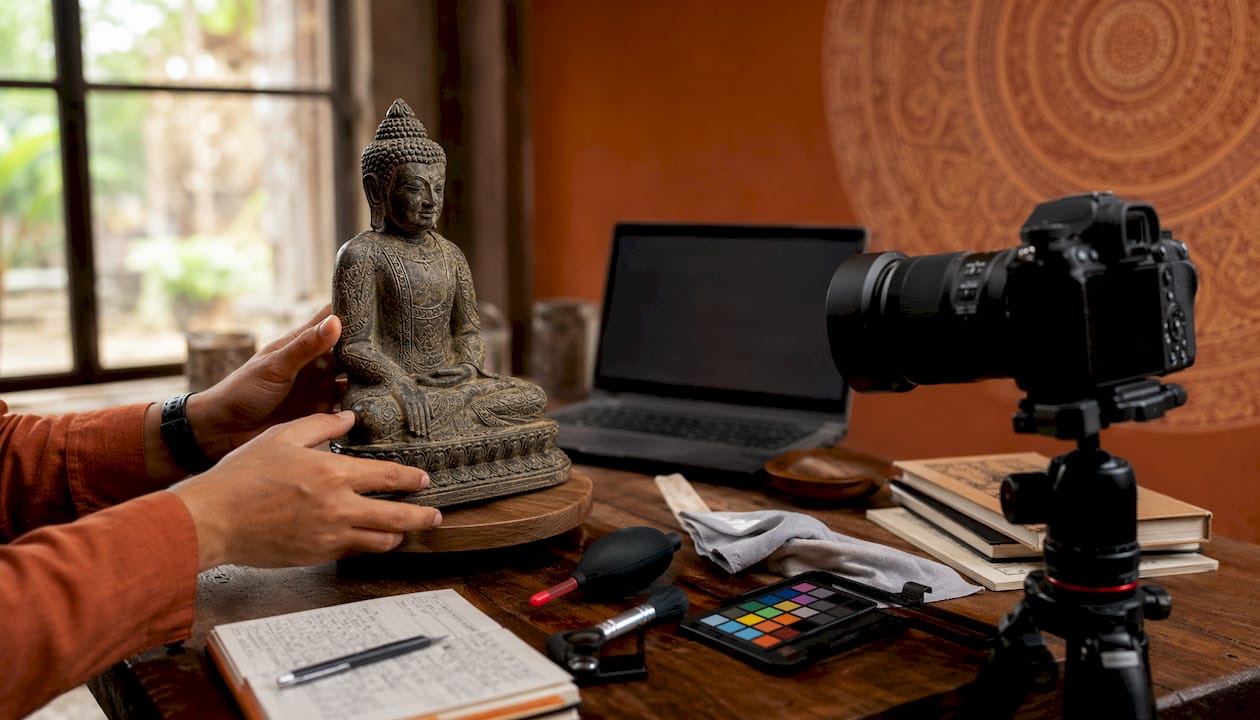
La elección del material no es arbitraria. Los talleres chola utilizaron fundición de bronce a la cera perdida entre aproximadamente 600 y 1200 d.C.; Los escultores jemeres preferían la piedra arenisca local; Los talleres tibetanos refinaron el bronce dorado con elementos de base ritual. Cada elección deja evidencia física.
Rótulos de fundición a la cera perdida (piezas auténticas de época):
- Restos discretos del bebedero por donde el metal fundido entró en el molde
- Interior hueco no uniforme visible a través de la abertura de la base.
- Puntos de microcontracción y ligeras irregularidades superficiales bajo aumento.
- Formas de paredes delgadas con detalles socavados imposibles en fundición en arena
Las modificaciones modernas muestran costuras uniformes, interiores lisos a máquina y líneas de soldadura modernas. Una lupa de 10 aumentos revela la diferencia en menos de cinco minutos. En el caso de la piedra, el cincelado a mano deja trayectorias de herramienta ligeramente irregulares; Las herramientas rotativas modernas producen ranuras perfectamente uniformes sin variación en profundidad.
Controles rápidos en casa:
- Peso: Los bronces de época se sienten densos y equilibrados; las refundiciones modernas huecas son notablemente más ligeras
- Prueba de anillo: Golpee suavemente un bronce: un anillo claro y sostenido sugiere una fundición de época sólida; un ruido sordo puede indicar rellenos compuestos o aleaciones modernas
- Sensación de superficie: La pátina de piedra genuina tiene una calidad incrustada ligeramente cerosa; la pátina aplicada se siente delgada o se desprende en los bordes
HDAsianArt's guía de identificación de piedras cubre las variedades de piedra específicas utilizadas en Camboya, India e Indonesia y cómo la selección de materiales limita tanto la región como la datación.
3. ¿Cómo identifican los mudras y los atributos iconográficos a una deidad?
Los mudras son la principal herramienta de identificación de figuras budistas e hindúes. El gesto de la mano, combinado con el tipo de corona, el número de brazos y cualquier objeto sostenido, vincula una figura a una deidad específica y, a menudo, a una tradición regional.
Mudras comunes y sus significados:
- Abhaya (mano derecha levantada, palma hacia afuera): protección; muy extendido entre las figuras de Buda y bodhisattva
- Dhyana (ambas manos en el regazo, palmas hacia arriba): meditación; estándar para buda sentado
- varada (mano derecha extendida hacia abajo, palma hacia afuera): dar regalos o otorgar bendiciones
- vitarka (tocándose los dedos índice y pulgar, mano levantada): enseñanza o argumentación
- Bhumisparsha (mano derecha tocando el suelo): testigo de la tierra; común en las figuras del Buda Mahayana
Principio de identificación clave: Cuando una figura tiene múltiples brazos, lea primero el par de manos principal para el mudra, luego catalogue cada atributo que tiene (loto, tridente, rosario, caracola) para confirmar la deidad. Es casi seguro que una figura de cuatro brazos que sostiene una flor de loto y un recipiente con agua es Avalokitesvara o Guanyin; una figura con tridente y tercer ojo es Shiva.
Identificadores de deidades primarias:
- Buda: Ushnisha (protuberancia craneal), urna (punto en la frente), lóbulos de las orejas alargados, uno de los cinco mudras anteriores
- Avalokitesvara/Guanyin: Corona con pequeña figura del Buda Amitabha, collares de cuentas y mirada compasiva hacia abajo.
- Tara: Bodhisattva femenina, sentada o de pie, corona, loto en mano, a menudo verde o blanco en la tradición tibetana
- Shivá: Tercer ojo, cabello o corona enmarañados, tridente (trishula), a veces postura de baile de Nataraja con halo de llamas.
- Ganesha: Cabeza de elefante, un solo colmillo, dulce modaka en la mano, barriga
Las diferencias regionales en la representación son importantes. Los budas de Sukhothai interpretan el abhaya mudra con una mano inusualmente alargada, parecida a una llama; Las figuras jemeres lo representan con una palma más ancha y plana. Estas microdiferencias confirman la atribución regional una vez identificada la deidad.
4. ¿Qué pruebas científicas fechan una escultura y cuánto cuestan?
Las pruebas no destructivas son lo primero. Los conservadores de campo recomiendan XRF y microscopy/07%3A_Kingdoms_and_Dynasties_(500_CE__1000_CE)/7.2%3A_Early_Medieval_Empires_of_India_(550_CE__1200_CE)) como el primer paso científico para las esculturas de metal, preservando la pátina de la superficie y al mismo tiempo proporcionando datos de composición de la aleación.
| prueba | Lo que confirma | Lo que no puede confirmar | Costo típico de EE. UU. |
|---|---|---|---|
| XRF (fluorescencia de rayos X) | Composición de aleaciones, elementos superficiales. | Edad, método de fundición. | — |
| Termoluminiscencia (TL) | Última fecha de cocción de cerámica/terracota | Edad del Bronce o de la Piedra | — |
| radiocarbono | Edad de los rellenos orgánicos o núcleos de madera. | Edad del metal o de la piedra | — |
| Microscopía óptica | Tipo de marca de herramienta, tratamiento superficial | Composición de la aleación | $150–$400 por sesión |
Pasos para encargar pruebas de laboratorio:
- Seleccione un laboratorio acreditado en EE. UU. con experiencia documentada en arte asiático
- Fotografiar y documentar la pieza completamente antes del envío (mínimo seis tomas)
- Solicite un formulario de cadena de custodia por escrito al laboratorio.
- Utilice envío asegurado con valor declarado; HDAsianArt coordina la logística asegurada de DHL para las piezas que requieren transporte
La investigación de procedencia a menudo resuelve la atribución más rápido que las pruebas de laboratorio. Los registros de subasta rastreables, los números de acceso a museos o los permisos de exportación pueden cerrar brechas que el análisis de aleaciones no puede. Para piezas valoradas en menos de 4.500 dólares, la tasación experta por sí sola suele ser más rentable que encargar XRF.
Consejo profesional: Pregunte específicamente al laboratorio si su instrumento XRF ha sido calibrado para aleaciones de bronce asiáticas. Las aleaciones de estaño-bronce, bronce al plomo y arsénico-cobre requieren estándares de referencia diferentes.
5. ¿Cómo se detectan las falsificaciones y las falsificaciones modernas?
Las prácticas engañosas comunes siguen patrones predecibles. Reconocerlos no requiere equipo de laboratorio.
La señal de falsificación más fiable es la inconsistencia: pátina que se detiene en una costura, desgaste concentrado solo en los puntos altos o un material base que no coincide con el tipo de piedra de la figura. La edad auténtica distribuye evidencia de uso y exposición por toda la superficie.
Principales señales de alerta:
- Marcas de herramientas giratorias modernas: ranuras perfectamente uniformes sin variación de profundidad
- Desgaste demasiado perfecto: abrasión sólo en puntos altos obvios, en ningún otro lugar
- Pátina inconsistente: diferente color o textura encima y debajo de una línea de unión
- Materiales no coincidentes: una figura de piedra con base de bronce de otra época
- Costuras pegadas o tornillos o sujetadores modernos visibles en la base o en la parte posterior
- Patinado artificial: pátina que se frota con un bastoncillo de algodón humedecido con acetona.
Métodos engañosos comunes:
- Patinado ácido o químico aplicado a piezas fundidas nuevas.
- Conjuntos compuestos: una auténtica cabeza montada sobre un cuerpo moderno
- Refundición utilizando fragmentos de bronces antiguos genuinos para pasar la prueba XRF
- Bases antiguas modernizadas unidas a figuras modernas.
Consejo profesional: Humedezca un hisopo de algodón con agua destilada y presiónelo suavemente contra la pátina. La pátina mineral genuina no se transfiere. La pátina aplicada artificialmente a menudo deja un color tenue en el hisopo.
6. ¿Cómo afecta la restauración a la atribución y el valor?
Se espera y es aceptable una conservación menor. Una reconstrucción importante cambia significativamente la confianza en la atribución y el valor de mercado.
Restauraciones comunes y cómo detectarlas:
- Rellenos: Rellenos de epoxi o yeso en las zonas dañadas; visible bajo luz ultravioleta como fluorescencia blanca o amarilla brillante contra la superficie original más oscura
- Repintar o volver a dorar: Marcas de pincel sobre la superficie original; Los rayos UV revelan capas de fluorescencia desiguales
- Apéndices reemplazados: Brazos o atributos vueltos a unir con líneas de unión visibles, pátina que no coincide o adhesivo moderno en la unión
- Reparaciones estructurales: Armaduras metálicas internas o pasadores modernos visibles a través de la abertura de la base.
Un atributo reemplazado cambia la identificación iconográfica. Una figura de Shiva sin tridente y equipada con una flor de loto moderna se vuelve ambigua. Solicite un informe de estado con credenciales del conservador y fotografías para cualquier pieza que supere los $1000.
Consejo profesional: Pídale a los conservadores que especifiquen los materiales utilizados y si las reparaciones son reversibles. La conservación reversible y documentada utilizando materiales estándar de museo (Paraloid B-72, tejido japonés) es una señal positiva. Los rellenos de epoxi irreversibles son un punto de negociación, no un factor decisivo, pero deben divulgarse.
7. ¿Qué requisitos legales estadounidenses se aplican a las antigüedades asiáticas?
Tres marcos gobiernan las antigüedades asiáticas en los Estados Unidos. Consulte a un asesor legal calificado para adquisiciones de alto valor.
La Convención de la UNESCO de 1970 es la referencia internacional. Los museos y las principales casas de subastas de EE. UU. exigen documentación que demuestre que una pieza estaba fuera de su país de origen antes de 1970 o que tiene una cadena de propiedad documentada desde esa fecha. Las piezas sin procedencia anterior a 1970 enfrentan un escrutinio cada vez mayor en la venta y la importación.
Marcos legales críticos:
- CITES: Se aplica a piezas que contengan marfil, carey, ciertas maderas duras u otros materiales protegidos; El Servicio de Pesca y Vida Silvestre de EE. UU. aplica restricciones de importación y venta
- Convención de la UNESCO de 1970: Establece el estándar para los bienes culturales lícitos; La Aduana de EE.UU. hace cumplir los controles de importación
- Ley de Implementación de Bienes Culturales (CPIA): Los acuerdos bilaterales con países específicos (incluidos Camboya y la India) restringen la importación de ciertas categorías de objetos culturales.
Documentos de procedencia a solicitar:
- Facturas de venta con fechas e identificación del vendedor.
- Permisos de exportación del país de origen.
- Referencias de catálogos de museos o subastas con números de lote
- Correspondencia curatorial o registros de adhesión
- Registros de importación o declaraciones aduaneras
Consejo profesional: Una brecha en la procedencia antes de 1970 no es automáticamente descalificante, pero requiere una debida diligencia adicional. La investigación de la procedencia a través de archivos de subastas y registros de comerciantes a menudo llena los vacíos más rápido que cualquier prueba científica. HDAsianArt's guía de investigación de procedencia Describe el proceso paso a paso para rastrear la propiedad y la documentación de exportación.
8. Lista de verificación de autenticación paso a paso para coleccionistas estadounidenses
Siga esta secuencia desde el primer avistamiento hasta la compra final.
- Evaluación visual inicial: Aplicar la lista de verificación de identificación provisional de la sección inicial; fotografiar las seis vistas
- Solicitar documentación: Registros de procedencia, informe de estado, permisos de exportación y cualquier tasación previa.
- Inspección de la vivienda: Lupa de 10 aumentos para marcas de herramientas y reparaciones; Luz ultravioleta para rellenos y redorado.
- Consulta a un especialista: Comuníquese con HDAsianArt o con un tasador independiente con credenciales documentadas de arte asiático antes de comprometer fondos.
- Encargar ensayos no destructivos: XRF para aleación de bronce; microscopía óptica para marcas de herramientas; costo justificado para piezas superiores a $1,000
- Encargar pruebas destructivas si se justifica: TL para elementos de terracota o cerámica; radiocarbono para rellenos orgánicos; reserva para piezas superiores a $5,000
- Verificar autorización legal: Confirmar el cumplimiento de la CITES, la procedencia de la UNESCO de 1970 y cualquier restricción de la CPIA para el país de origen.
- Organizar envío asegurado: Utilice un transportista con cobertura de valor declarado; HDAsianArt coordina a DHL asegurado en todo el mundo
Lista de verificación de fotografías para tasación (basado en estándares de evaluación profesional):
- Vista frontal completa con referencia de tamaño.
- Vista trasera completa
- Parte inferior de la base (inscripción, cavidad sellada, marcas de fundición)
- Ambas manos (detalle del mudra)
- Cara (ushnisha, urna, corona)
- Cualquier daño, reparación o característica inusual
Consejo profesional: Para piezas de más de $2000, una tasación escrita independiente realizada por un especialista acreditado cuesta entre $150 y $400 y proporciona documentación que respalda tanto el seguro como la reventa. Casi siempre es más barato que las pruebas de laboratorio y más útil para determinar la procedencia.
Conclusiones clave
La iconografía, el tipo de base, el método de fundición y la documentación de procedencia en conjunto proporcionan la identificación de dinastía provisional más confiable para las esculturas asiáticas.
| Punto | Detalles |
|---|---|
| La iconografía primero | Mudra, corona, número de brazos y atributos sostenidos identifican a la deidad antes de cualquier prueba de laboratorio. |
| Base y material | Las bases de loto selladas con inscripciones indican origen tibetano/himalaya; La piedra arenisca apunta a los jemeres. |
| signos de fundición | Los bronces a la cera perdida muestran restos de bebederos e interiores no uniformes; Las modificaciones modernas muestran costuras uniformes. |
| Autorización legal | La documentación de procedencia anterior a 1970 es el estándar estadounidense para bienes culturales lícitos según la Convención de la UNESCO. |
| Recursos HDAsianArt | HDAsianArt proporciona informes de condición, investigación de procedencia, coordinación XRF y envío DHL asegurado para coleccionistas estadounidenses. |
En qué se equivocan a menudo los coleccionistas sobre la atribución de dinastías
La mayoría de los coleccionistas se centran en la edad cuando deberían centrarse en la atribución. Una obra maestra del siglo XX bien documentada realizada por un taller conocido puede superar a una pieza anónima del siglo XIX tanto en interés académico como en valor de mercado. La edad por sí sola no determina la autenticidad o el valor.
El error más común es tratar la iconografía como decoración y no como un sistema de clasificación. Cada atributo de una escultura budista o hindú es un dato. Una figura con cuatro brazos, una flor de loto y una vasija de agua no es genéricamente “asiática”; es casi seguro que es Avalokitesvara, y esa identificación inmediatamente reduce el rango geográfico y dinástico a un conjunto manejable de candidatos. Los coleccionistas que aprenden a leer los atributos resuelven sistemáticamente la mayoría de las atribuciones antes de gastar un dólar en pruebas de laboratorio.
Las lagunas en la procedencia no descalifican automáticamente, pero requieren una evaluación honesta. Una pieza sin historia documentada antes del año 2000 no es necesariamente ilícita, pero conlleva riesgos legales y de reventa que una pieza bien documentada no. La respuesta práctica es investigar la procedencia antes de la compra, no después.
HDAsianArt: soporte especializado para coleccionistas estadounidenses
Los coleccionistas que necesitan soporte de autenticación práctica más allá de una inspección visual tienen un recurso directo en HDAsianArt. El equipo de especialistas de la galería proporciona informes de condición individuales con fotografías detalladas, investigación de procedencia, seguimiento de registros de subastas y documentación de exportación, y coordinación de pruebas XRF independientes para piezas de bronce. Para los coleccionistas estadounidenses que navegan por el cumplimiento de la CITES y los requisitos de documentación de la UNESCO de 1970, el manejo de exportaciones de HDAsianArt y el envío asegurado por DHL cubren la logística desde el país de origen hasta su puerta.
Tres formas prácticas en que HDAsianArt apoya a los coleccionistas estadounidenses: investigación remota con evaluación escrita de expertos a partir de fotografías, referencias a tasadores independientes con credenciales de arte asiático y manejo completo de trámites de exportación para adquisiciones internacionales. Explore la colección autenticada y comuníquese directamente con el equipo de especialistas en hdasianart.com.
Fuentes autorizadas y laboratorios de EE. UU. para consultar
Instituciones y fuentes de referencia:
- PBS Antiques Roadshow - Manual de deidades budistas: introducción accesible a los mudras y la identificación de deidades
- The Metropolitan Museum of Art — Educador de arte del sur y sudeste asiático PDF: Chola, Pallava y marcadores de estilo regionales
- Humanidades LibreTexts — Imperios medievales tempranos de la India: fundición a la cera perdida y tradición del bronce Chola
- InstAppraisal - Guía de identificación de arte asiático: flujo de trabajo de tasación, marcas de autor y estándares fotográficos
- HDAsiáticoArte guía de autenticación de bronce: prácticos indicadores de cera perdida e inspección de pátina
Preguntas que debe hacerle a cualquier laboratorio de EE. UU. antes del envío:
- ¿Está el laboratorio acreditado para el análisis de bienes culturales?
- ¿Se ha calibrado el instrumento XRF para los estándares de referencia de aleaciones de bronce asiáticas?
- ¿El laboratorio proporciona una cadena de custodia por escrito y un envío de devolución asegurado?
- ¿Cuál es el tiempo de respuesta y el tamaño de muestra necesarios para las pruebas de TL o radiocarbono?
Recomendado
- Tipos de piedra utilizados en esculturas asiáticas: una guía para coleccionistas – HD Asian Art
- Investigación de procedencia de esculturas antiguas asiáticas: una guía para académicos - Arte asiático HD
- Cómo autenticar estatuas antiguas de Buda de bronce – Arte asiático HD
- Escultura budista Theravada explicada para estudiosos del arte – HD Asian Art
