



Hindu Home Shrine: Setup, Deities & Daily Rituals
Hindu Home Shrine: Setup, Deities & Daily Rituals
Most people who set up a Hindu home shrine for the first time make the same handful of mistakes: they pick the wrong room, crowd the altar with too many statues, mix ancestor photos with deity images, or skip the placement rules that Vastu Shastra has refined over centuries. The result is a space that feels cluttered rather than sacred, and a practice that never quite settles into a daily rhythm.
This guide cuts through the confusion. Whether you are a practitioner building your first altar or a collector adding consecrated sculpture to an existing devotional space, every decision here, from deity selection to daily puja essentials, is addressed directly and specifically.
Table of Contents
Quick Takeaways
|
Key Insight |
Explanation |
|---|---|
|
East-facing shrines are preferred |
Positioning the shrine so that you face east or northeast during puja aligns with traditional Vastu guidance and captures morning light, which supports a consistent daily practice. |
|
Limit Ganesh murtis to one or two |
Keeping three or more Ganesh statues is considered inauspicious in traditional practice. One well-chosen, high-quality murti is more effective than a crowded grouping. |
|
Never mix ancestor photos with deity statues |
Photographs of deceased relatives belong in the south zone of the home, not on the altar. Mixing the two frequencies is a well-documented Vastu mistake that disturbs the sacred space. |
|
Fierce deities require consistent daily worship |
Statues of Bhairav, Mahakali, or Shanidev carry powerful energy that demands regular, uninterrupted ritual attention. If your schedule is irregular, choose gentler deities first. |
|
Broken or stale rice must be replaced |
Rice is a core offering symbol of purity. Broken or old rice left on the altar invites stagnant energy. Replace offerings regularly as part of your maintenance routine. |
|
Sculpture quality directly affects the practice |
A museum-quality statue with correct iconographic details, correct hand mudras, correct attributes, is not just aesthetically superior. It accurately represents the deity's energy and supports focused meditation. |
|
Guru and saint photos belong off the altar |
Revered teachers are honoured, but their images should be displayed on a wall near the shrine rather than placed on the altar surface alongside deity murtis. |
Choosing the Right Space in Your Home
The first decision, and the one that shapes everything else, is where the shrine lives. A dedicated room is ideal, but it is not required. A quiet corner of a living area works well provided it is free from the television, foot traffic, and general household noise during worship hours. The key is consistency: the space should be somewhere you can return to every morning without rearranging the furniture.
A small shelf or low cabinet mounted against a wall is entirely appropriate for a compact home. What matters more than size is that the surface is stable, level, and reserved exclusively for sacred use. Do not double the altar as a storage shelf for books or mail. That boundary, physical and psychological, is what turns a shelf into a shrine.
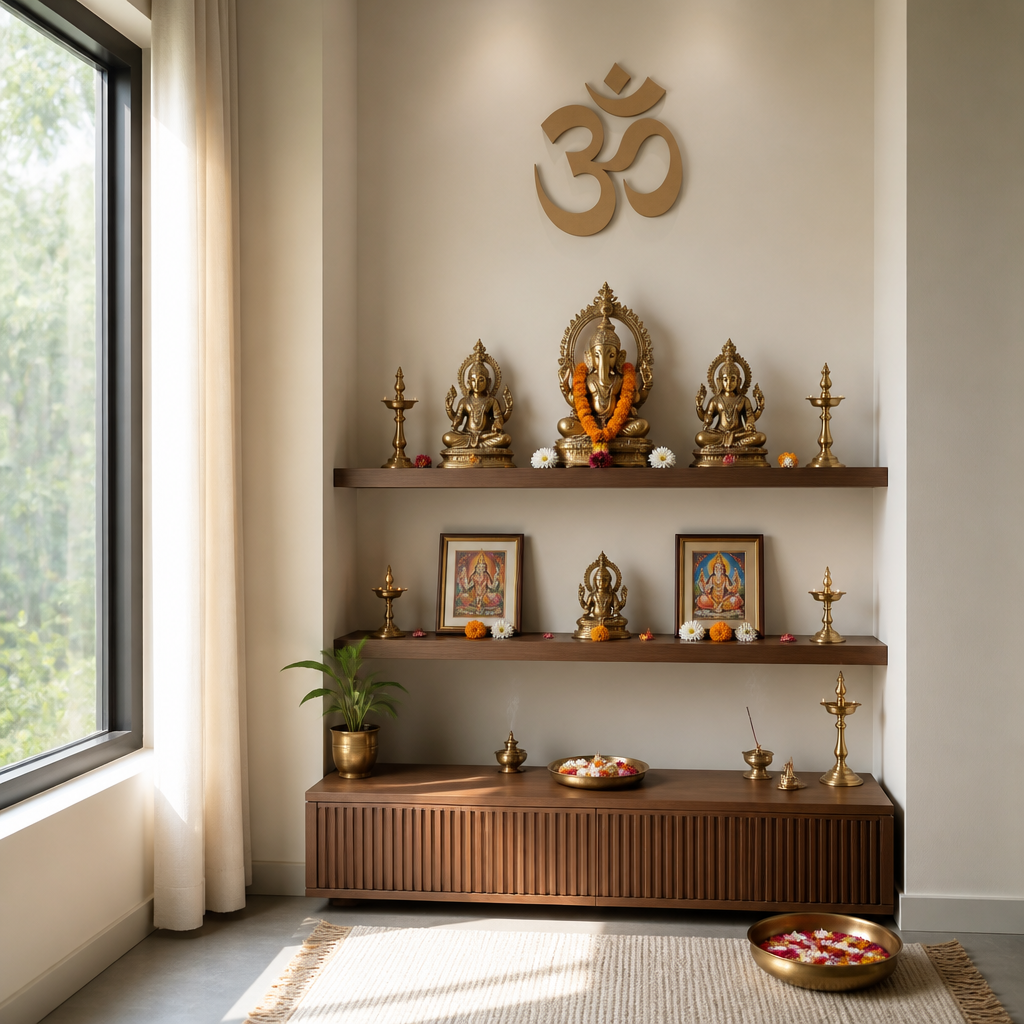
The northeast corner of the home is traditionally considered the most auspicious location for a home temple. It is associated with divine energy flow in Vastu Shastra. The northeast direction is also believed to receive the most beneficial morning light, which reinforces a sunrise puja habit naturally. If the northeast corner is unavailable, east-facing placement is the next best option.
Pro tip: Before placing anything on the altar, spend one week simply sitting in the chosen space in the morning. If the location feels restless, noisy, or difficult to return to, relocate before investing in statues and ritual objects. Commitment to the space comes first.
Deity Selection: Who to Worship and Why It Matters
The most common question new practitioners ask is: which deity do I choose? The honest answer is that personal connection matters more than any prescribed rule. If your family has always worshipped Lakshmi, begin there. If you are drawn to Ganesh as the remover of obstacles, that is a perfectly coherent starting point for a new practice. Deity selection is not arbitrary, but it is deeply personal.
Starting with Ganesh
Ganesh is traditionally invoked before any sacred undertaking, making him the most natural choice for a new shrine. He is the remover of obstacles and the lord of new beginnings. A single Ganesh statue, seated and with his trunk curling to the left, is the standard domestic form. The left-trunk Ganesh is considered accessible and auspicious for home worship. Right-trunk forms are more powerful and are typically found in temples rather than home altars.
Adding Lakshmi, Saraswati, or Vishnu
Once Ganesh is established, most practitioners gradually add a second or third deity. Lakshmi, goddess of prosperity and abundance, is among the most commonly worshipped in domestic settings. Saraswati, goddess of learning and the arts, is particularly relevant for students and creative practitioners. Vishnu, the preserver, and his avatars Ram and Krishna, are central to devotional traditions across India and Southeast Asia.
When selecting a sculpture for any of these deities, iconographic accuracy is not a small matter. Lakshmi should be shown with lotus flowers and gold coins. Saraswati should hold a veena. Vishnu should carry his conch, discus, mace, and lotus. A statue that conflates attributes or omits them is not simply an aesthetic disappointment. It misrepresents the deity's specific energy. This is one reason why sourcing sculptures from a specialist retailer rather than a general home decor store makes a genuine difference to serious practitioners.
Deities That Require Special Consideration
Fierce forms of the divine, including Bhairav, Mahakali, and Shanidev, carry intense transformative energy. Traditional guidance is clear: these deities require daily, uninterrupted worship. If your schedule or life circumstances make daily puja difficult to maintain consistently, these are not the right starting deities. Begin with more accessible forms and add powerful tantric figures only when your practice is well-established and your commitment to daily ritual is solid.
Deity Statue Placement Rules You Cannot Ignore
Placement is where many home shrines go wrong even after the deity selection is thoughtful. The rules are not arbitrary aesthetic preferences. They reflect a coherent system of directional energy management that Vastu Shastra formalised and that generations of practitioners have tested in domestic settings.
The Direction the Deities Face
Deities should ideally face west or north, so that the worshipper faces east or north during puja. Facing east during morning worship aligns the practitioner with the direction of the rising sun, a foundational orientation in Hindu cosmology. Placing the shrine so that the devotee faces south is generally considered inauspicious in traditional Vastu guidance and should be avoided.
Height and Positioning on the Surface
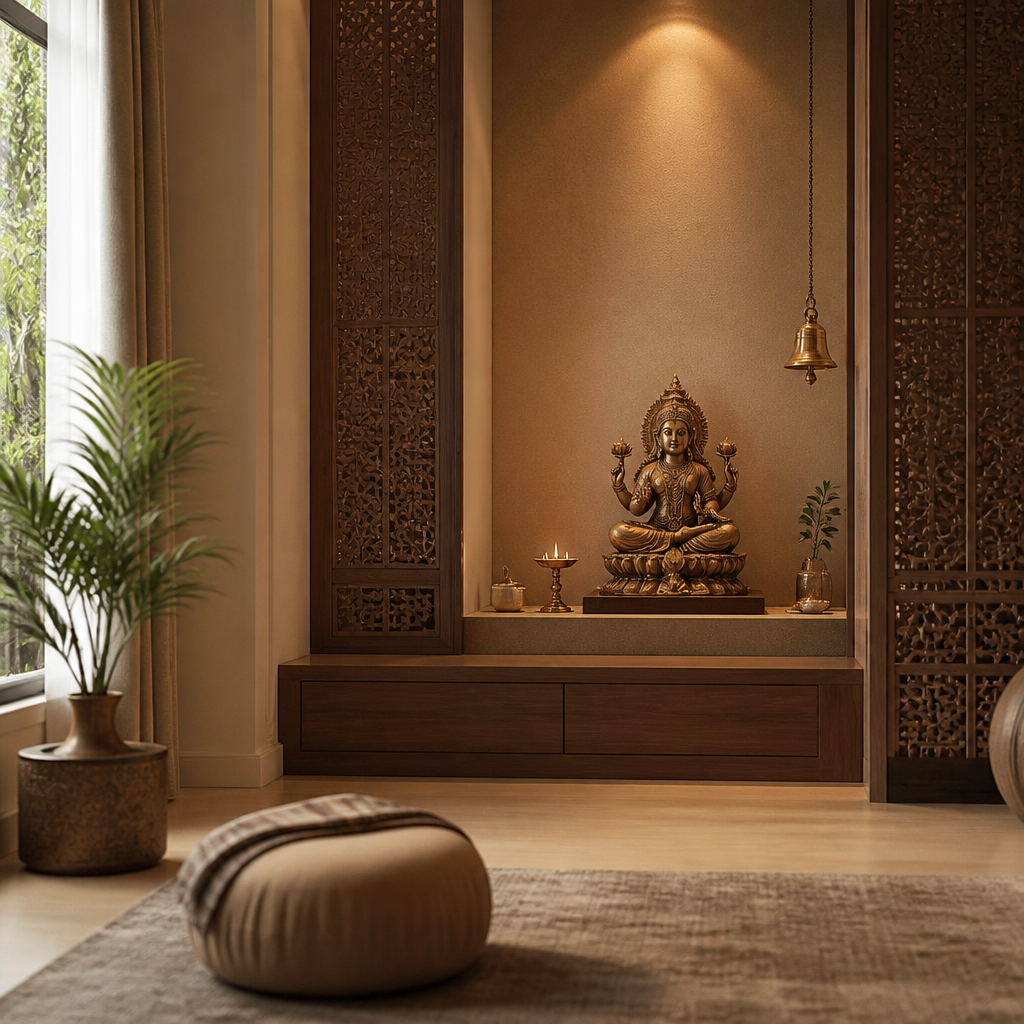
Murtis should be placed at approximately chest height when seated, never on the floor and never so high that you must look sharply upward. The statue surface should be clean stone, wood, or metal. Avoid placing murtis directly on bare concrete or laminate surfaces without a cloth or platform beneath them. A simple silk or cotton cloth in a colour appropriate to the deity, red for Durga, yellow for Ganesh, white for Saraswati, establishes a visual and energetic boundary for the altar.
What Must Not Be Placed on the Altar
This is the area where traditional guidance is most specific. Photographs of deceased ancestors must not share the altar surface with deity murtis. Ancestors and deities operate at different energetic frequencies in Hindu cosmological understanding. The correct place for ancestor photographs is the south zone of the home, not the puja space. Similarly, images or statues of gurus and saints should be displayed on an adjacent wall, not placed on the altar itself. Keeping multiple Ganesh murtis, specifically three or more, is also considered disruptive to the ritual energy of the space.
Pro tip: If you are acquiring a new sculpture for your altar, take a moment to verify its iconographic details before purchasing. A reputable specialist will be able to confirm the hand positions (mudras), the attributes held, and the regional tradition the piece comes from. These are not decorative flourishes. They are the language through which the deity communicates its specific qualities.
Hindu Altar Setup: The Physical Essentials
Once the space is chosen and the deities are selected, the physical setup of the altar follows a clear logic. Each element serves a sensory or symbolic function. Nothing on a well-designed Hindu altar is purely decorative.
The Five Elements on the Altar
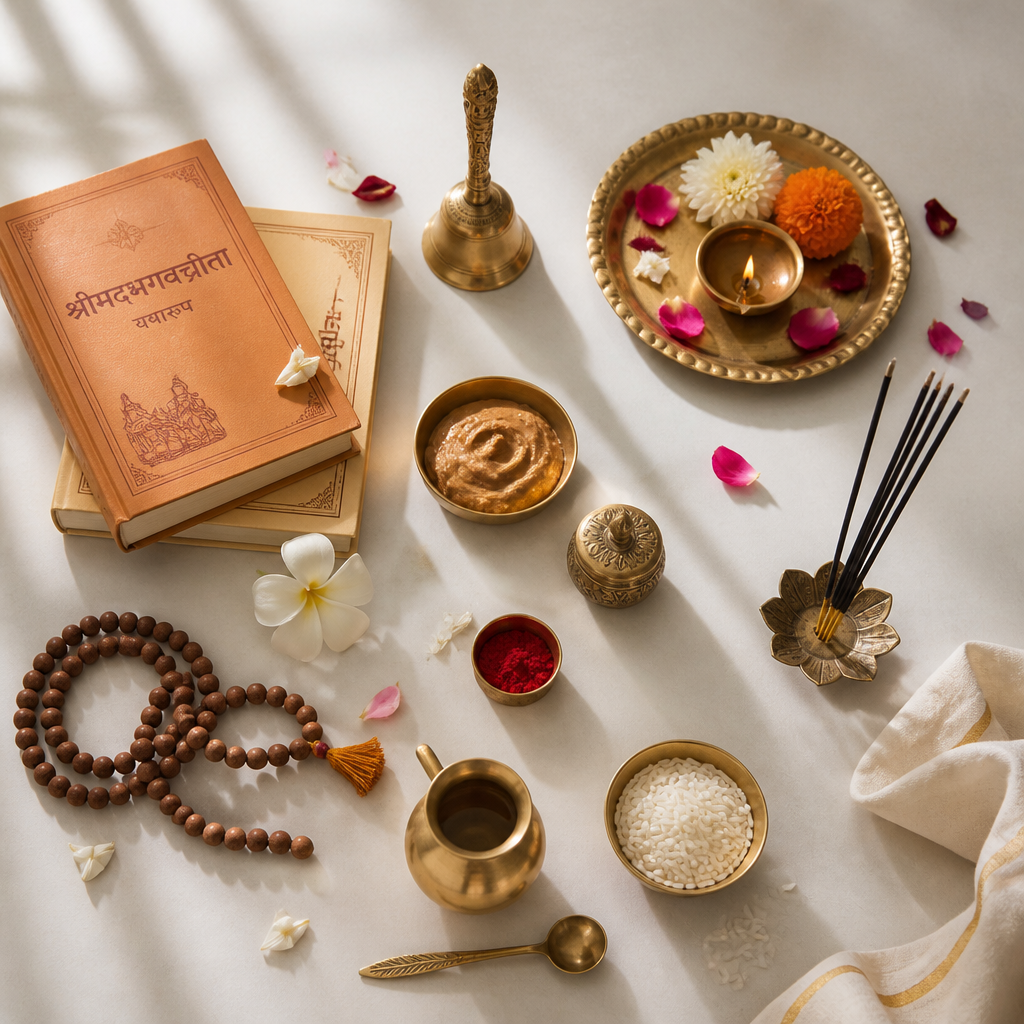
Traditional puja engages all five senses. Earth is represented by the murti itself and by rice or grain offerings. Water is represented by a small vessel or kalaash. Fire is represented by a diya (oil lamp) or candle. Air is represented by incense. Space is represented by the intentional emptiness around the statues, the clearance that allows energy to move. A common mistake is filling every inch of the altar surface with objects, which eliminates the element of space entirely.
Incense and Flowers
Fresh flowers are replaced daily in an active shrine. Wilted flowers should be removed promptly because they carry the energy of decay rather than offering. Incense should be lit at the beginning of puja and allowed to burn fully. The smoke is not symbolic of something else. It is itself an offering, a transformation of matter into fragrance that rises toward the divine.
The Diya
A small clay or brass diya burning clarified butter (ghee) is the traditional flame for home worship. Ghee lamps are preferred over wax candles in most traditional Hindu practice. That said, a clean beeswax candle is a practical alternative in spaces where open flame is a concern. The key is that the flame is intentionally lit at the start of puja and not left burning unattended.
A home temple is not just a wooden cabinet or a shelf with idols. It is the energetic heart of the house, the place where divine frequencies enter, settle, and shape the life of the family. Small mistakes in the temple, invisible to the untrained eye, can silently block the very blessings that daily puja is meant to invite.
Daily Puja Ritual: Structure and Sequence
A daily puja practice does not need to be elaborate to be effective. A focused fifteen minutes performed consistently every morning is worth far more than an hour-long ceremony done sporadically. The sequence is what matters: it creates the internal shift from ordinary consciousness to sacred attention.
The Opening: Cleansing and Invocation
Begin by washing your hands and, ideally, bathing before approaching the altar. Light the diya and incense first. These acts signal the beginning of sacred time. Then offer water to the deity: pour a small amount into a clean vessel placed before the murti. This is the foundational act of hospitality, receiving the deity as an honoured guest in your home.
Offerings and Prayer
Offerings follow water: flowers, rice, fruit, sweets appropriate to the deity. Ganesh traditionally receives modak (sweet dumplings) or coconut. Lakshmi receives lotus flowers and sweets. Offer these with both hands, which signals full giving rather than casual presentation. Recite the appropriate mantra or simply speak your prayer aloud in your own words. Both are valid. The deity does not require Sanskrit fluency. It requires sincerity.
Closing the Puja
The puja closes with arati, the circular waving of a lamp or flame before the deity. This is the moment of direct, concentrated focus on the divine form. After arati, accept prasad (the blessed offering, usually food) and extinguish the diya intentionally. Blowing out the flame with your mouth is traditionally avoided. Use a snuffer or fan the flame with your hand.
Common Mistakes That Undermine Your Practice
The most persistent mistakes in home shrine practice are not dramatic errors. They are small, accumulated habits that gradually degrade the quality of the sacred space. Understanding them specifically is more useful than any general warning about "keeping things clean."
Stale offerings left on the altar are the single most common problem. Rice, flowers, and food that have sat for days are not neutral. They carry the energy of decomposition and signal negligence rather than devotion. A simple rule: if you cannot offer fresh items today, remove yesterday's offerings before leaving the altar. An empty, clean altar is better than one decorated with wilting flowers.
A second persistent mistake is inconsistency in the number and type of statues. Adding a new murti every few months without a coherent understanding of the relationships between deities creates an altar that feels busy and unfocused. In practice, two to four carefully chosen, iconographically accurate murtis produce a more powerful devotional environment than ten statues crowded together without clear intention.
A third issue is sourcing. Generic "Hindu statue" items purchased from mass-market decor retailers frequently contain iconographic errors: wrong number of arms, incorrect attributes, fused elements from different deity traditions. These errors matter to a practitioner. Acquiring sculptures from a specialist in Asian religious art, one who can speak to the regional tradition, the material, and the iconographic provenance of each piece, is not a luxury preference for collectors. It is a practical requirement for anyone building a serious devotional space.
Comparing Three Approaches to Hindu Altar Setup
Practitioners typically fall into one of three approaches when setting up a home shrine. Each has genuine strengths and specific limitations worth understanding before committing to one.
|
Approach |
Characteristics |
Best Suited For |
|---|---|---|
|
Minimalist Single-Deity Altar |
One primary murti, simple cloth, diya, incense, fresh flower. Maximum three ritual objects on the surface. Daily puja takes 10-15 minutes. Easy to maintain consistently. |
New practitioners, those with limited space, practitioners who travel frequently and need a portable or replicable setup. |
|
Traditional Multi-Deity Family Shrine |
Three to five murtis representing a full devotional family (e.g., Ganesh, Lakshmi, Vishnu, Saraswati, Shiva). Dedicated cabinet or alcove. Daily puja of 30-45 minutes. Requires consistent daily attention, especially if fierce deities are included. |
Established practitioners, households with multiple members sharing the practice, those following a specific sampradaya (lineage tradition). |
|
Collector-Devotee Altar |
Museum-quality sculptures selected for both iconographic accuracy and aesthetic quality. May include rare or regionally specific forms (e.g., Cambodian-style Vishnu, South Indian bronze Nataraja). Emphasis on material quality: bronze, stone, or high-fired ceramic. Practice integrates aesthetic contemplation with traditional puja. |
Art collectors with a devotional practice, serious spiritual practitioners who understand iconography, those building a long-term collection of sacred Asian art. |
Frequently Asked Questions
Which deity should a complete beginner choose for their first Hindu home shrine?
Ganesh is the most practical starting point for beginners. He is traditionally invoked before every sacred undertaking, his iconography is distinctive and well-documented, and his energy is considered accessible and protective rather than demanding. A single seated Ganesh murti with a left-curling trunk is the standard domestic form. Once your daily practice with Ganesh is consistent, adding Lakshmi or Saraswati as a second deity is a natural progression.
Can I place my Hindu altar in the bedroom?
Traditional Vastu guidance generally discourages placing the main puja space in the bedroom, primarily because the bedroom is associated with sleep and activities considered incompatible with the ritual purity of a sacred space. If the bedroom is your only option, a small, enclosed cabinet shrine that can be closed during sleep is an acceptable compromise. The altar should ideally face east, even in this arrangement.
How many statues are too many for a home shrine?
There is no single fixed number, but in practice, two to four murtis produce the most focused devotional environment for most practitioners. Crowding the altar with many statues without a coherent understanding of each deity's relationship to the others creates visual and energetic noise. Specific traditional guidance is clear on at least one point: never keep three or more Ganesh murtis on the same altar. One or two forms of Ganesh is the correct limit.
What is the correct material for a Hindu deity statue used in home worship?
Stone and bronze are the most traditional materials for murtis in formal ritual use. Brass is the most common material for domestic shrines across South and Southeast Asia and is entirely appropriate. Wood, particularly carved hardwood from regions with strong Hindu artistic traditions such as India, Bali, or Nepal, is also used widely. What matters most is that the statue is iconographically accurate, structurally sound (no broken limbs or missing attributes), and treated with consistent respect. A museum-quality sculpture in any of these materials will outlast and outlperform a mass-produced resin figure in both aesthetic and ritual terms.
How do I incorporate a Hindu home shrine if I follow a Buddhist practice as well?
Many practitioners in South and Southeast Asia maintain both Buddhist and Hindu devotional objects in the same sacred space, particularly in countries such as Thailand, Cambodia, and Bali where the two traditions have long coexisted. The practical guidance is to give each tradition its own distinct zone or surface rather than mixing statues indiscriminately. A Ganesh figure alongside a seated Buddha is not unusual in homes across the region. What to avoid is placing objects from radically different ritual traditions on the same level without intentional arrangement, which tends to read as decorative rather than devotional.
Do I need to perform rituals of consecration before using a new statue?
In formal temple tradition, a murti undergoes a consecration ceremony called prana pratishtha before it is considered to embody the deity's presence. For home shrines, the practice varies widely by regional tradition and family lineage. Many practitioners perform a simple personal consecration: bathing the new statue, placing it on the altar, lighting incense, offering flowers, and reciting a welcoming prayer or mantra. Others consult a pandit for a more formal ceremony. Neither approach is universally wrong. What is consistent across traditions is that a newly acquired statue should be welcomed intentionally, not simply placed on a shelf and ignored.
If you have set up a Hindu home shrine and have found approaches that work particularly well for your daily practice, sharing your experience in the comments helps other practitioners navigate decisions that no single guide can cover for every circumstance.
References
