



10 gängige Buddha-Handgesten erklärt
10 gängige Buddha-Handgesten erklärt
Inhaltsverzeichnis
-
Die 10 häufigsten Buddha-Handgesten erklärt
- 1. Abhaya Mudra (Schutz und Furchtlosigkeit)
- 2. Dhyana Mudra (Meditation und Kontemplation)
- 3. Bhumisparsha Mudra (Erdberührung)
- 4. Dharmachakra Mudra (Lehre und das Rad des Dharma)
- 5. Varada Mudra (Wohltätigkeit und Wunscherfüllung)
- 6. Karana Mudra (Abwehr des Bösen)
- 7. Vitarka Mudra (Lehre und intellektuelle Debatte)
- 8. Anjali Mudra (Ehrfurcht und Respekt)
- 9. Uttarabodhi Mudra (Erleuchtung und Erwachen)
- 10. Seal Mudra (Erdung und innerer Frieden)
Was sind Buddha-Handgesten? Definition und Etymologie
Mudras sind heilige symbolische Handpositionen, die in allen buddhistischen Traditionen eine tiefe spirituelle Bedeutung haben. Diese Gesten fungieren als visuelle Sprache, um den Geisteszustand, die spirituellen Errungenschaften und die Lehren des Buddha ohne Worte zu kommunizieren. Das Verständnis von Mudras verändert die Art und Weise, wie Sammler und Praktiker mit buddhistischen Statuen umgehen und verwandelt statische Skulpturen in Fenster der buddhistischen Philosophie.
Mudra ist ein Sanskrit-Begriff, der „Siegel“ oder „Geste“ bedeutet und von den Wurzelwörtern abgeleitet ist Schlamm (zur Freude) und ra (geben). Die Praxis hat ihren Ursprung in der Antike Indien und wurde in allen buddhistischen Traditionen kodifiziert, um verschiedene Aspekte der Erleuchtung und spirituellen Praxis darzustellen. Jede Geste trägt eine über Jahrhunderte angesammelte Bedeutung in sich und repräsentiert verschiedene Phasen im Leben Buddhas, verschiedene Aspekte der Erleuchtung und spezifische Lehren.
Mudras in der buddhistischen Ikonographie verstehen
Die buddhistische Ikonographie stützt sich stark auf Mudras komplexe spirituelle Konzepte visuell zu kommunizieren. In der Tempelkunst, Skulptur und Malerei signalisiert die Handhaltung einer Gottheit oder Buddha-Figur unmittelbar deren spirituelle Funktion und Lehren. Verschiedene buddhistische Schulen, tibetische, Zen-, Theravada- und Mahayana-Traditionen, entwickelten ihre eigenen Variationen und behielten dabei die symbolische Kernfunktion des Mudra-Systems bei.
So identifizieren Sie Buddha-Handgesten in Statuen und Kunstwerken
Um Mudras in Statuen zu identifizieren, muss auf bestimmte Handpositionen, Fingerpositionen und die Gesamthaltung der Figur geachtet werden. Der Schlüssel liegt darin, zu beobachten, welche Hand erhoben wird, wie die Finger angeordnet sind und was die Geste über den Zustand oder die Lehre Buddhas aussagt.
Lesen der Handposition und Fingerplatzierung
Jedes Mudra folgt einheitlichen Konventionen hinsichtlich der ausgestreckten, der gefalteten Finger und der Beziehung der Hände zum Körper. Der Daumen spielt oft eine entscheidende Rolle, während Zeige- und Mittelfinger in vielen Mudras eine besondere Bedeutung haben. Die Position der Hand relativ zum Körper ist ebenso wichtig, einige Mudras-Positionen Hände an der Brust auf Höhe, andere auf dem Schoß und einige auf Schulterhöhe oder über dem Kopf.
Wenn Sie eine Buddha-Statue untersuchen, beobachten Sie zunächst die Gesamtposition der Hand, bevor Sie sich auf einzelne Finger konzentrieren.
Symbolik der rechten Hand vs. der linken Hand
In der buddhistischen Ikonographie steht die rechte Hand traditionell für Handeln, Mitgefühl und Hingabe in der Außenwelt, während die linke Hand für Weisheit, Empfänglichkeit und innere spirituelle Arbeit steht. Wenn bei einem Mudra beide Hände beteiligt sind, entsteht durch ihre unterschiedlichen Positionen ein Dialog zwischen aktiven und empfangenden Prinzipien. Diese Rechts-Links-Unterscheidung kommt in allen buddhistischen Traditionen einheitlich vor und macht sie zu einem zuverlässigen Leitfaden für das Lesen von Mudras.
Die 10 häufigsten Buddha-Handgesten erklärt
Die folgenden zehn Mudras repräsentieren die am häufigsten vorkommenden Handgesten in der buddhistischen Kunst, Bildhauerei und Meditationspraxis.
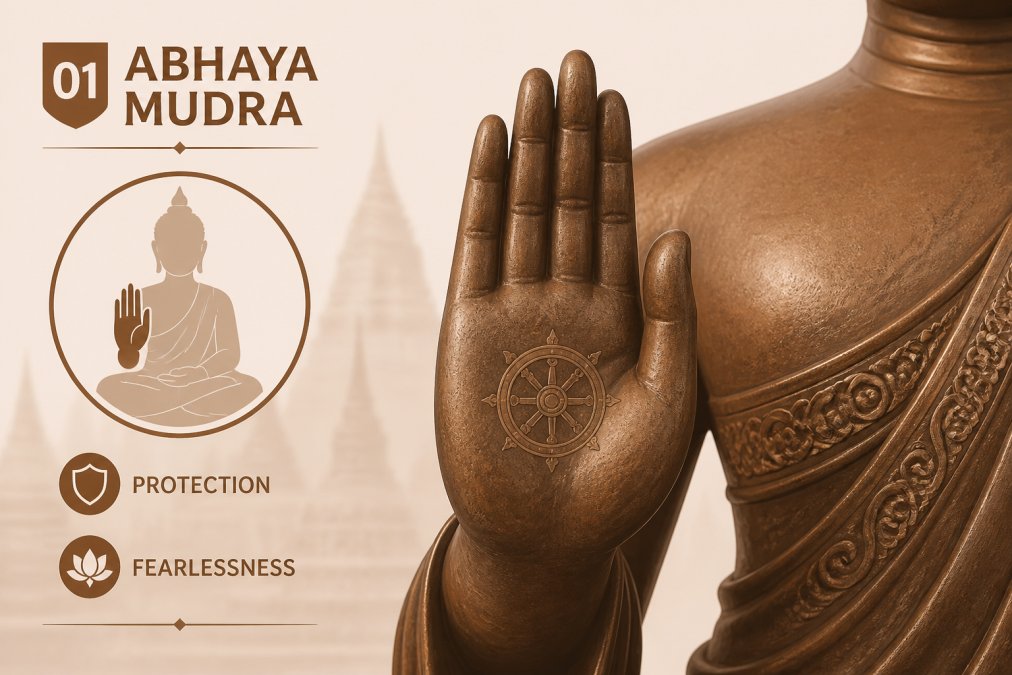
1. Abhaya Mudra (Schutz und Furchtlosigkeit)
Das Abhaya Mudra zeigt die auf Schulterhöhe erhobene rechte Hand mit der Handfläche nach außen und allen fünf Fingern nach oben. Diese Geste bedeutet auf Sanskrit „ohne Angst“ und vermittelt Schutz, Bestätigung und die Beseitigung von Hindernissen. Praktizierende verwenden das Abhaya Mudra in der Meditation Furchtlosigkeit zu kultivieren und die schützende Energie Buddhas anzurufen.
2. Dhyana Mudra (Meditation und Kontemplation)
Beim Dhyana Mudra liegen beide Hände auf dem Schoß, wobei die rechte Hand auf der linken ruht und die Handflächen nach oben zeigen. Diese Geste steht für tiefe Meditation, Kontemplation und die gezielte Konzentration, die für die Erleuchtung erforderlich ist. Dies ist das Mudra, das am meisten mit der Meditation des historischen Buddha unter dem Bodhi-Baum in Verbindung gebracht wird, dem Ereignis, das zu seiner Erleuchtung führte.
3. Bhumisparsha Mudra (Erdberührung)
Das Bhumisparsha Mudra zeigt den sitzenden Buddha mit nach unten ausgestreckter rechter Hand, die Finger zeigen zur Erde, während die linke Hand im Schoß ruht. Der Name bedeutet „die Erde berühren“ und bezieht sich auf den Moment, als Buddha die Erde selbst als Zeugen seiner Erleuchtung berief. Dieses Mudra erscheint häufig in der buddhistischen Kunst Südostasiens und stellt die Verbindung Buddhas zur materiellen Welt dar.
4. Dharmachakra Mudra (Lehre und das Rad des Dharma)
Das Dharmachakra Mudra positioniert beide Hände auf Brusthöhe, wobei die Daumen und Zeigefinger jeder Hand Kreise bilden, während die anderen Finger nach außen ragen. Diese Geste stellt die Drehung des Rades des Dharma und die Übermittlung spirituellen Wissens dar. Die beiden von den Händen gebildeten Kreise stellen das Rad der Lehren dar, während die ausgestreckten Finger die Ausstrahlung der Weisheit Buddhas in alle Richtungen andeuten.
5. Varada Mudra (Wohltätigkeit und Wunscherfüllung)
Das Varada Mudra positioniert die rechte Hand mit der Handfläche nach oben und den Fingern nach unten, als würde sie den darunter liegenden Menschen etwas Kostbares anbieten. Der Name kommt von Varada, was „Wunscherfüllung“ oder „Segen gewähren“ bedeutet, und dieses Mudra repräsentiert das Mitgefühl und die Großzügigkeit Buddhas.
6. Karana Mudra (Abwehr des Bösen)
Das Karana Mudra positioniert die rechte Hand mit nach oben ausgestrecktem Zeige- und Mittelfinger, während Ringfinger und kleiner Finger nach unten gefaltet sind und der Daumen sie an Ort und Stelle hält. Diese besondere Geste stellt die Macht Buddhas dar, Negativität, Böses und spirituelle Hindernisse zu zerstreuen.
7. Vitarka Mudra (Lehre und intellektuelle Debatte)
Bei der Vitarka Mudra werden beide Hände auf Brusthöhe positioniert, wobei Daumen und Zeigefinger Kreise bilden, während die anderen Finger nach oben ragen. Der Name kommt von Vitarka, was „Diskussion“ oder „intellektuelle Analyse“ bedeutet. Dieses Mudra erscheint in Statuen, die den Buddha beim Lehren oder Debattieren zeigen und die intellektuelle Dimension spiritueller Unterweisung betonen.
8. Anjali Mudra (Ehrfurcht und Respekt)
Das Anjali Mudra positioniert beide Hände auf Brusthöhe, die Handflächen sind zusammengepresst und die Finger zeigen nach oben. Dies ist vielleicht die in allen Kulturen allgemein anerkannte Geste, die Respekt, Begrüßung und spirituelle Hingabe symbolisiert. Der Name kommt von anjali, was „Opfergabe“ oder „Anrede“ bedeutet.
9. Uttarabodhi Mudra (Erleuchtung und Erwachen)
Das Uttarabodhi Mudra positioniert beide Hände auf Brusthöhe, wobei die Zeigefinger nach oben ausgestreckt sind und sich berühren, während die anderen Finger ineinander verschränkt sind. Dieses Mudra repräsentiert den höchsten Zustand der Erleuchtung und das vollständige Erwachen der Buddha-Natur. Der Name kommt von uttara (höchste) und Bodhi (Erwachen).
10. Seal Mudra (Erdung und innerer Frieden)
Das Siegel-Mudra, auch Samadhi-Mudra genannt, legt beide Hände in den Schoß, wobei die rechte Hand auf der linken ruht und die Handflächen nach oben zeigen. Diese Geste stellt die Versiegelung der spirituellen Energie im Körper und das Erreichen des inneren Gleichgewichts dar.
| Mudra | Handposition | Bedeutung | Am besten für |
|---|---|---|---|
| Abhaya | Rechte Hand erhoben, Handfläche ausgestreckt | Schutz, Furchtlosigkeit | Mut kultivieren, Sicherheit beschwören |
| Dhyana | Beide Hände im Schoß, rechts auf links | Meditation, Kontemplation | Konzentration vertiefen |
| Bhumisparsha | Rechte Hand nach unten, linke Hand im Schoß | Erdberührend, erdend | Verbindung zur physischen Realität herstellen |
| Dharmachakra | Beide Hände an der Brust, Kreise | Lehre, Rad des Dharma | Studium der buddhistischen Philosophie |
| Varada | Rechte Hand nach unten, Handfläche nach oben | Wohltätigkeit, Wunscherfüllung | Großzügigkeit kultivieren |
| Karana | Rechte Hand mit ausgestreckten Fingern | Das Böse abwehren | Schutz vor Hindernissen |
| Vitarka | Beide Hände an der Brust, nach oben | Lehre, intellektuelle Debatte | Analytische Betrachtung |
| Anjali | Aneinandergepresste Handflächen | Ehrfurcht, Respekt | Ehrung spiritueller Lehrer |
| Uttarabodhi | Beide Hände an der Brust, Zeigefinger berühren sich | Erleuchtung, Erwachen | Fortgeschrittene spirituelle Praxis |
| Siegel | Beide Hände im Schoß | Erdung, innerer Frieden | Gleichgewicht erreichen |
Mudras und ihre Bedeutung: Spirituelle Symbolik
Die tiefere Bedeutung von Mudras geht über die visuelle Identifizierung hinaus. Diese Gesten verschlüsseln komplexe spirituelle Lehren und dienen als Werkzeuge zur Bewusstseinstransformation, indem sie gleichzeitig auf historischer, theologischer, energetischer und praktischer Ebene wirken.
Energiefluss und esoterische Bedeutung
Buddhistische und yogische Traditionen lehren, dass Mudras den Fluss subtiler Energie durch die Energiekanäle des Körpers lenken. Durch die gezielte Positionierung von Fingern und Händen entstehen energetische Kreisläufe, die bestimmte Bewusstseinszustände unterstützen. Der Daumen repräsentiert das individuelle Selbst oder Bewusstsein, während die anderen Finger verschiedenen Elementen und energetischen Qualitäten entsprechen. Praktizierende, die mit Mudras arbeiten, berichten von verbesserter Klarheit, emotionaler Stabilität und spiritueller Einsicht.
Regionale Unterschiede zwischen buddhistischen Traditionen
Das Mudra Das System entwickelte sich in den buddhistischen Traditionen unterschiedlich, als sich die Religion ausbreitete Indien nach Tibet, Ostasien, Südostasien und darüber hinaus. Der tibetische Buddhismus entwickelte ausgefeilte Mudra-Systeme, die ihre Rolle in der rituellen Praxis und im Gottheiten-Yoga betonen. Der Zen-Buddhismus vereinfachte die Mudra-Praxis und konzentrierte sich auf einige wesentliche Gesten, die in der Meditation und im Unterricht verwendet werden. Der südostasiatische Theravada-Buddhismus pflegt enge Verbindungen zu den frühesten Mudra-Traditionen, während der japanische Buddhismus die Mudra-Praxis in die Traditionen des Reinen Landes und der Esoterik einbezog.
Erklärte Handpositionen bei Buddha-Statuen: Praktische Anwendung
Das Verständnis von Mudras verändert die Art und Weise, wie wir mit Buddha-Statuen in Meditationsräumen und Hausaltären umgehen. Anstatt Statuen als rein dekorative Objekte zu betrachten, ermöglicht die Erkennung ihrer Handpositionen den Praktizierenden, Skulpturen auszuwählen, die ihre spezifischen spirituellen Absichten unterstützen.
Verwendung von Mudras in der persönlichen Meditationspraxis
Praktizierende können ihre Meditation vertiefen, indem sie Mudras einbeziehen, die ihrem spirituellen Fokus entsprechen. Viele Praktizierende sind der Meinung, dass die Replikation des Mudra mit ihren eigenen Händen während der Meditation die Entwicklung der damit verbundenen spirituellen Qualität beschleunigt. Wenn Sie mit den Händen im Dhyana Mudra meditieren und sich dabei auf eine Statue in derselben Position konzentrieren, entsteht eine starke Resonanz zwischen Ihrem Körper, der Statue und Ihrer inneren spirituellen Arbeit.
Der Schlüssel zu einer effektiven Mudra-Praxis liegt in der Kombination der körperlichen Geste mit gezielter Absicht und Betrachtung der Bedeutung des Mudras.
Anatomische Ausrichtung für effektives Üben
Die richtige anatomische Ausrichtung stellt sicher, dass die Mudra-Praxis ihre vollen Vorteile entfaltet und körperliche Belastungen verhindert. Die Hände sollten in einer angenehmen Höhe positioniert sein, typischerweise auf Brusthöhe oder im Schoß, wo Sie die Geste ohne Muskelverspannungen beibehalten können. Die Wirbelsäule sollte aufrecht und entspannt bleiben, wobei die Schultern von den Ohren entfernt sein sollten. Eine angenehme, natürliche Atmung ist für eine effektive Praxis unerlässlich.
Verschiedene Buddha-Mudras und ihre Bedeutung in verschiedenen Traditionen
Die bemerkenswerte Konsistenz des Mudra-Systems in allen buddhistischen Traditionen zeigt die Kraft dieser Gesten, spirituelle Wahrheiten zu vermitteln, die kulturelle und sprachliche Grenzen überwinden. Dennoch hat jede Tradition einzigartige Schwerpunkte und Interpretationen entwickelt.
Zen und tibetisch-buddhistische Variationen
Der Zen-Buddhismus legt Wert auf Einfachheit und Direktheit in der Praxis und konzentriert sich auf nur wenige wesentliche Mudras, insbesondere solche, die in der Meditation und im Unterricht verwendet werden. Das Dhyana Mudra hat in der Zen-Praxis eine besondere Bedeutung, da es das Mudra ist, das am unmittelbarsten mit der Erleuchtung Buddhas unter dem Bodhi-Baum verbunden ist.
Der tibetische Buddhismus entwickelte das ausgefeilteste Mudra-System, bei dem Handgesten in komplexe rituelle Praktiken und das Gottheiten-Yoga integriert wurden. In der tibetischen Praxis dienen Mudras als Werkzeuge zur Identifikation mit erleuchteten Qualitäten und zur Transformation des gesamten Wesens des Praktizierenden.
Gottheitsspezifische Mudras im japanischen Buddhismus
Der japanische Buddhismus hat die Mudra-Praxis in seine einzigartigen Formen integriert, insbesondere in esoterischen und Reinland-Traditionen. Verschiedene buddhistische Gottheiten werden mit spezifischen Mudras in Verbindung gebracht, die ihre besondere spirituelle Funktion kommunizieren. Amitabha Buddha wird im Varada Mudra typischerweise mit Händen dargestellt und drückt sein grenzenloses Mitgefühl und seine wunscherfüllende Kraft aus.
Wählen Sie die richtige Buddha-Statue für Ihren Raum
Bei der Auswahl einer Buddha-Statue geht es um mehr als nur ästhetische Vorlieben. Wenn Sie das in der Statue dargestellte Mudra verstehen, können Sie eine Skulptur auswählen, die Ihre spirituelle Praxis und Ihre Meditationsziele aktiv unterstützt.
Passende Mudras zu Ihren Meditationszielen
Wenn sich Ihre Hauptpraxis auf die Entwicklung von Furchtlosigkeit und Selbstvertrauen konzentriert, ist eine Statue, die das Abhaya Mudra darstellt, eine ständige visuelle Erinnerung an diese Qualität. Für Praktizierende, die sich auf die Vertiefung ihrer Meditation und Konzentration konzentrieren, bietet eine Statue im Dhyana Mudra den perfekten Mittelpunkt. Wer Mitgefühl und Großzügigkeit pflegt, profitiert von Statuen, die das Varada Mudra darstellen.
Bei HD Asian Art, Unsere sorgfältig kuratierte Sammlung umfasst authentische buddhistische und hinduistische Skulpturen, die alle wichtigen Mudras darstellenSo finden Sie das perfekte Stück für Ihren Meditationsraum oder Altar.
Um eine Buddha-Statue zu wählen, die zu Ihrem spirituellen Weg passt, müssen Sie das Mudra verstehen, das sie darstellt, und wissen, wie diese Geste Ihre Praxis unterstützt. Wenn Sie eine Statue auswählen, deren Mudra Ihren Absichten entspricht, holen Sie sich einen spirituellen Lehrer nach Hause. Bei HD Asian Art, Unsere Sammlung authentischer buddhistischer und hinduistischer Skulpturen soll Ihre Meditationspraxis bereichern und Ihren Wohnraum in einen Zufluchtsort des Friedens und des spirituellen Wachstums verwandeln. Buddhistische Ikonographie und Mudra-Symbolik in der traditionellen Kunst untersucht diese Themen eingehender, während Forschung zu Meditationspraxis und Handgesteneffekten untersucht die wissenschaftlichen Grundlagen der Mudra-Praxis. Stöbern Sie in unserer sorgfältig zusammengestellten Auswahl und finden Sie die Statue, die Ihre spirituelle Reise vertieft und Ihrem Zuhause dauerhafte Schönheit verleiht.
Häufig gestellte Fragen
Was sind die häufigsten Handgesten Buddhas und was symbolisieren sie?
Zu den 10 häufigsten Buddha-Handgesten (Mudras) gehören Abhaya (Schutz), Dhyana (Meditation), Bhumisparsha (Erdberührung), Dharmachakra (Lehre), Varada (Nächstenliebe), Karana (Abwehr des Bösen), Vitarka (intellektuelle Debatte), Anjali (Ehrfurcht), Uttarabodhi (Erleuchtung) und Siegel (Erdung). Jedes Mudra hat spezifische spirituelle Bedeutungen, die in der buddhistischen Ikonographie verwurzelt sind, und repräsentiert verschiedene Aspekte der Lehren und spirituellen Zustände Buddhas. Diese heiligen Handgesten dienen als visuelle Symbole in Statuen, Kunst und Meditationspraxis.
Wie kann ich verschiedene Buddha-Handgesten in Statuen identifizieren?
Um Buddha-Handgesten zu erkennen, beobachten Sie die spezifische Position der Hände und Finger. Achten Sie darauf, ob die Handflächen nach innen oder außen zeigen, welche Finger ausgestreckt oder gefaltet sind und wie die Hand insgesamt im Verhältnis zum Körper platziert ist. Die rechte Hand steht typischerweise für Handeln und Lehren, während die linke für Weisheit und Mitgefühl steht. Zum Beispiel zeigt das Abhaya Mudra eine nach außen gerichtete erhobene Handfläche, während beim Dhyana Mudra beide Hände im Schoß liegen. Das Erlernen dieser besonderen Positionen hilft Ihnen, die spirituelle Bedeutung des Mudras in jeder Buddha-Statue oder jedem Kunstwerk zu erkennen.
Was ist der Unterschied zwischen Mudras und ihrer Bedeutung in verschiedenen buddhistischen Traditionen?
Verschiedene buddhistische Traditionen, darunter Zen-, tibetischer und japanischer Buddhismus, können Mudras mit regionalen Variationen betonen oder interpretieren. Während grundlegende Mudras wie Abhaya und Dhyana konsistent bleiben, fügen einige Traditionen einzigartige Handgesten hinzu, die für bestimmte Gottheiten oder spirituelle Praktiken spezifisch sind. Der tibetische Buddhismus beinhaltet oft komplexere Mudra-Kombinationen, während Zen-Traditionen sich möglicherweise auf einfachere, meditativere Gesten konzentrieren. Diese Variationen spiegeln den einzigartigen Ansatz jeder Tradition in Bezug auf Erleuchtung und spirituelle Praxis wider, obwohl die grundlegende Symbolik von Schutz, Weisheit, Mitgefühl und Lehren in allen Schulen weiterhin im Mittelpunkt steht.
Kann ich Buddha-Handgesten in meiner eigenen Meditationspraxis verwenden?
Ja, Sie können Mudras in Ihre persönliche Meditationspraxis integrieren. Viele spirituelle Praktizierende nutzen Handgesten, um den Fokus zu verbessern, den Energiefluss zu lenken und die Achtsamkeit zu vertiefen. Beispielsweise fördert das Üben von Dhyana Mudra (Hände im Schoß ruhen) eine ruhige Kontemplation, während Anjali Mudra (aneinandergepresste Handflächen) Ehrfurcht und Zentrierung fördert. Halten Sie während der Meditation zunächst 5–10 Minuten lang ein Mudra und achten Sie dabei auf die richtige anatomische Ausrichtung mit entspannten Schultern und natürlicher Atmung. Die Kombination von Mudras mit Meditation kann Ihre spirituelle Praxis verstärken und eine sinnvolle Verbindung zu buddhistischen Lehren und Symbolik herstellen.
Was macht eine Buddha-Statue authentisch und welchen Einfluss hat das Mudra auf ihren Wert?
Authentische Buddha-Statuen spiegeln echte Handwerkskunst, historische Genauigkeit und korrekte ikonografische Details wider, einschließlich der korrekten Mudra-Darstellung. Die spezifische Handbewegung sollte mit der regionalen Herkunft der Statue und der buddhistischen Tradition übereinstimmen und Kenntnisse über heilige Symbolik demonstrieren. Handgefertigte Stücke aus Südostasien, insbesondere solche mit nachweisbarer Herkunft und traditionellen Materialien, haben einen höheren Wert. Die präzise Ausführung des Mudras, die Positionierung der Finger, die Platzierung der Hände und die allgemeine spirituelle Genauigkeit zeugen vom Fachwissen des Handwerkers und der Authentizität der Statue. Wenn Sie eine Statue für Ihren Meditationsraum oder Ihre Sammlung auswählen, prüfen Sie das Mudra genau, um sicherzustellen, dass es echte buddhistische Tradition und künstlerische Integrität widerspiegelt.
