



Thai Buddha Statues: Periods, Postures & Provenance
Thai Buddha Statues: Periods, Postures & Provenance
Most buyers of a Thai Buddha statue focus almost entirely on aesthetics: does it look good? Is the gold bright? Does the face feel serene? These are reasonable starting points, but they leave serious money and meaning on the table. A collector who cannot distinguish a Sukhothai piece from an Ayutthaya piece, or who cannot read a hand gesture, is shopping blind. Worse, they are vulnerable to misrepresentation.
This guide cuts through the noise and gives you the specific visual, historical, and provenance knowledge you need to buy Thai Buddhist art with real confidence, whether you are building a focused collection or searching for a single meaningful piece for a home altar.
Table of Contents
Quick Takeaways
|
Key Insight |
Explanation |
|---|---|
|
Period style is the first authenticator |
Each Thai period, Sukhothai, Ayutthaya, Rattanakosin, has documented iconometric rules. A statue that mixes features from incompatible periods is either a later reproduction or a fake. |
|
The flame ushnisha is a Sukhothai signature |
The pointed flame rising from the crown of the head is the most reliable single identifier of Sukhothai-style Thai Buddha statues, inherited from Sri Lankan Buddhist art traditions. |
|
The walking Buddha is uniquely Thai |
The walking posture, almost absent in other Buddhist traditions, is a Sukhothai invention. It communicates the Buddha's active compassion rather than static transcendence. |
|
Mudras carry theological weight |
The earth-touching gesture (bhumisparsha mudra) refers to the moment of enlightenment. The raised hand (abhaya mudra) means protection. Reading gestures correctly changes how you read a statue entirely. |
|
Ayutthaya introduced the crowned Buddha |
The ornate, jeweled crown on an Ayutthaya Buddha reflects the merging of royal and divine status in Thai Buddhist culture, a political as much as a spiritual statement. |
|
Provenance documentation is not optional for serious collectors |
Purchase receipts, export licenses, and auction records protect both the buyer's investment and the integrity of cultural heritage. Any reputable dealer provides these without hesitation. |
|
Material analysis distinguishes authentic antiques from reproductions |
Thai bronze pieces often show lead content consistent with period alloy compositions. Patina, casting quality, and gilding wear patterns are all legible signs of age if you know what to look for. |
The Four Major Historical Periods of Thai Buddha Statues
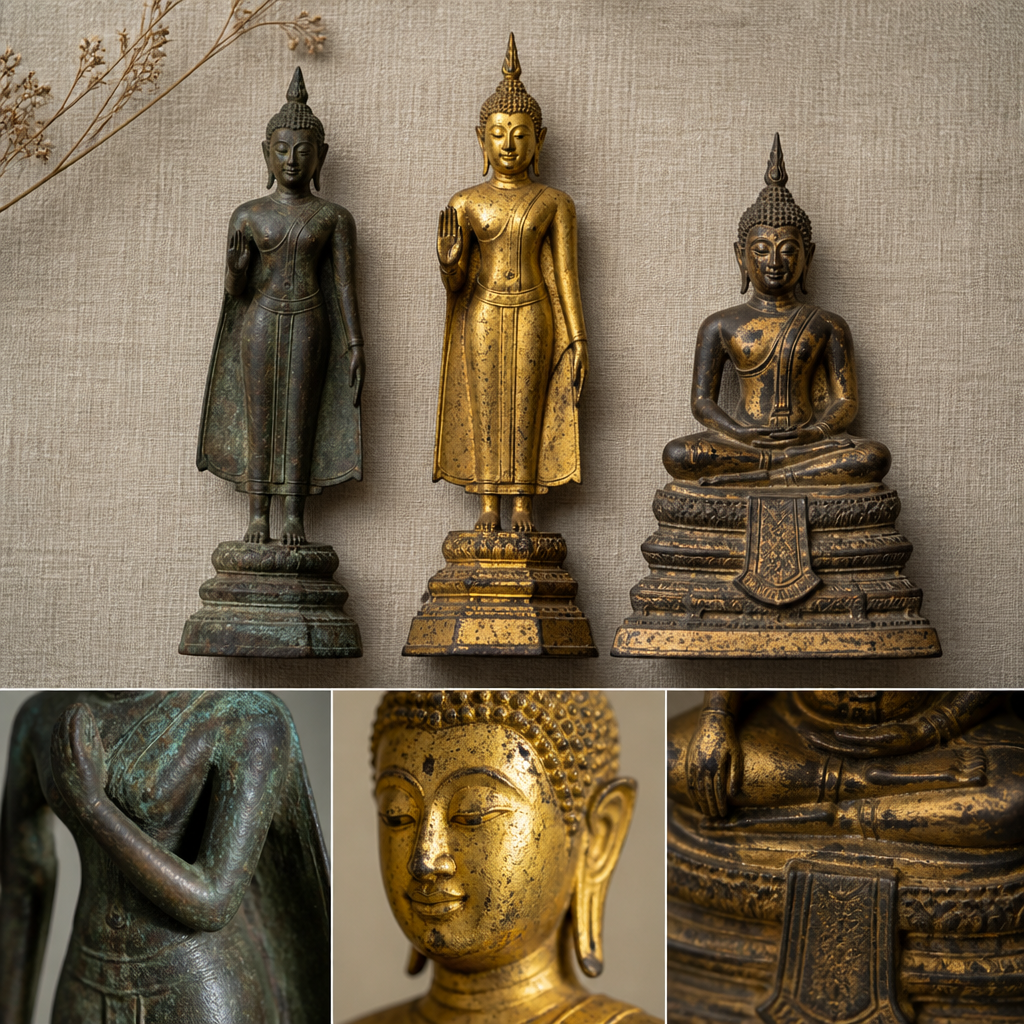
Thai Buddhist sculpture did not emerge from a vacuum. It developed across centuries, shaped by successive kingdoms, shifting trade routes, and the deep influence of Sri Lankan Theravada doctrine. The four primary periods that define Thai Buddhist art are: the early Khmer-influenced phase, Sukhothai, Ayutthaya, and Rattanakosin. Each carries distinct visual signatures in facial form, ornamentation, and posture. Learning to tell them apart is the single most valuable skill a collector can develop.
Dvaravati and Early Khmer Influence (roughly 6th to 13th centuries)
Before Thailand's indigenous styles emerged, the region was shaped by Dvaravati-period Mon culture and Khmer political dominance from Angkor. Dvaravati Buddhas tend to show wide, flat faces, thick lips, and broad shoulders, reflecting early Indian influence filtered through Mon artistic conventions. Khmer-influenced pieces from the Lopburi school display more architectural rigidity: square faces, pronounced brows, and a formality that reflects the hierarchical world of Angkor's court.
These early pieces are rarely available on the open market in authenticated form. For most collectors, they serve as important reference points: understanding what came before Sukhothai makes the Sukhothai revolution in Thai aesthetics far more legible.
Sukhothai Period (roughly 13th to 15th centuries)
The Sukhothai Buddha represents the first genuinely Thai aesthetic vision in Buddhist sculpture. Artists of this period broke decisively from Khmer structural rigidity and produced something lighter, more spiritual, more distinctly local. The signature features are well-documented: an egg-shaped face with a subtle smile, soft flowing body contours with a slight S-curve, thin robes that barely register as garments, and the iconic flame-shaped finial above the ushnisha (the cranial protuberance marking enlightened wisdom). That flame was inherited from Sri Lankan Buddhist art, not Angkor.
The Sukhothai walking Buddha is arguably the period's most significant contribution to world Buddhist art. This posture, depicting the Buddha in mid-stride with weight shifting forward, is almost completely absent from other Buddhist traditions. It was a theological statement: the Buddha is not enthroned above the world, but moving through it, actively sharing compassion.
The Sukhothai school did not simply absorb foreign influences, it reinterpreted them into a visual language that placed spiritual grace above royal power, a distinction that set Thai Buddhist art on its own course entirely.
Ayutthaya Period (roughly 14th to 18th centuries)
Ayutthaya inherited the Sukhothai legacy and expanded it in a more courtly direction. The kingdom was cosmopolitan, wealthy, and deeply invested in the political symbolism of Buddhism. The result was a Buddha image that became more ornate, more regal, and more explicitly tied to royal authority. The most distinctive Ayutthaya development is the crowned Buddha: an image wearing a tiered jeweled crown and elaborate royal regalia, merging the identity of the king and the Buddha in a single form.
Facial features in Ayutthaya work became more refined and angular compared to Sukhothai softness. The ushnisha was often topped with a tiered umbrella form rather than a single flame. Robes received more decorative attention, with carved textile patterns replacing the near-invisible treatment of Sukhothai work. These statues were built to project power as much as serenity.
Rattanakosin Period (18th century to the present)
When the Thai capital moved to Bangkok and the Rattanakosin dynasty was established, Buddhist art entered a period of conscious revival and increasing stylization. Rattanakosin Buddhas often revisit Ayutthaya-period forms but with greater ornamental detail and, in later examples, a move toward more idealized facial features. The period also saw the production of very large cast-bronze Buddhas intended for major temple complexes.
For collectors, Rattanakosin pieces are more accessible and more widely reproduced than Sukhothai or Ayutthaya work. Distinguishing an authentic Rattanakosin piece from a modern reproduction requires attention to casting quality, gilding technique, and the fine details of ornamentation.
Postures and Mudras: What the Hands and Body Actually Mean
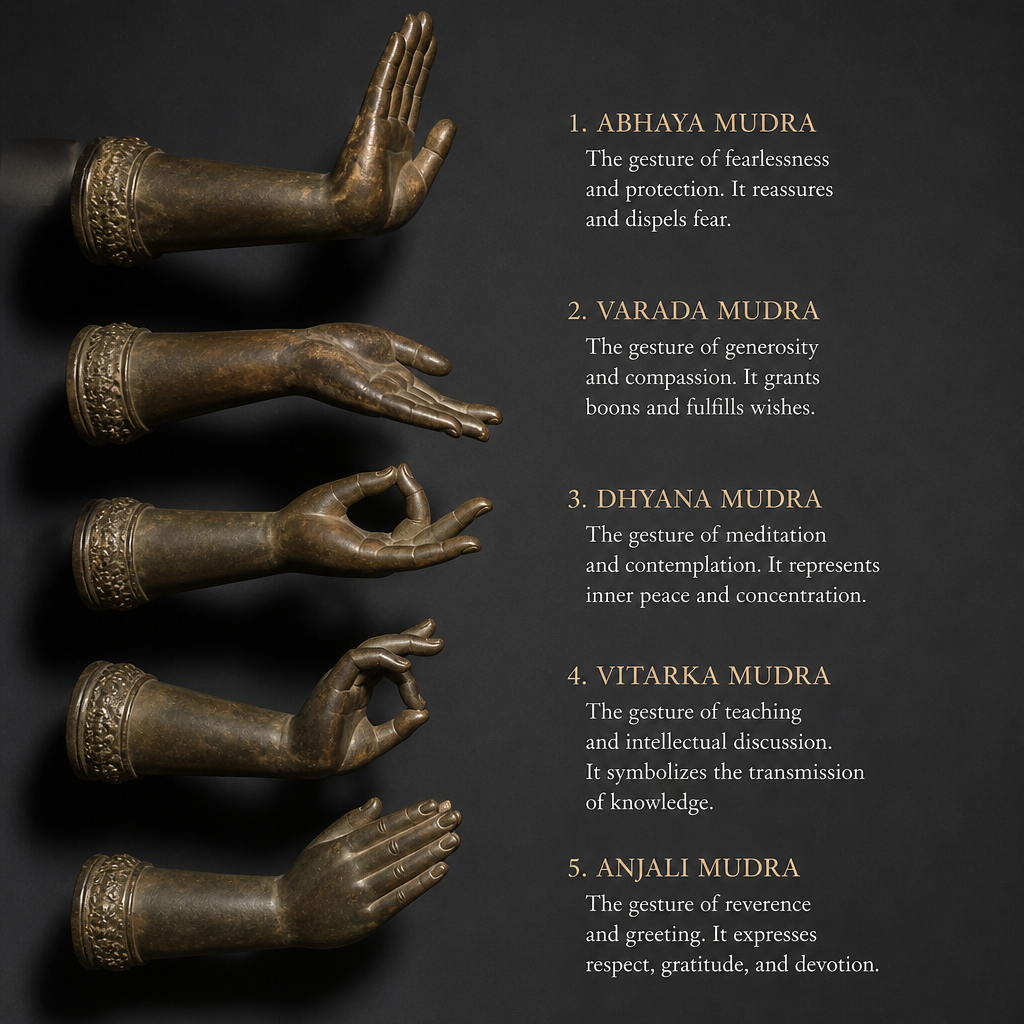
A common mistake among new collectors is treating posture and hand gesture as purely decorative. They are not. Every gesture in Thai Buddhist iconography has a specific theological reference, and reading them correctly changes how you understand and value a piece entirely. There are roughly a dozen recognized mudras in Thai Buddhist art, but five appear with overwhelming frequency.
Bhumisparsha Mudra: Earth-Touching
The earth-touching gesture, the right hand reaching down to touch the ground while the left rests open on the lap, refers directly to the moment of the Buddha's enlightenment. According to tradition, when Mara and his forces attempted to disrupt Shakyamuni's meditation, he touched the earth, calling it as witness to his right to enlightenment. This is the most common seated posture in Thai Buddhist sculpture, particularly in the Theravada traditions of Thailand, Cambodia, and Sri Lanka. A Thai Buddha statue in this posture is not simply a meditating figure; it is specifically a depiction of the enlightenment event.
Abhaya Mudra: Protection
The raised right hand with fingers extended upward is the gesture of fearlessness and protection. In standing Thai Buddhas, this is one of the most frequently encountered postures. The walking Sukhothai Buddha typically pairs it with a forward-curved left arm, creating the sense of the Buddha moving toward the viewer while offering reassurance.
Dhyana Mudra: Meditation
Both hands resting open in the lap, one on top of the other with thumbs touching, signify deep meditation. This posture is common in seated figures and tends to project profound interiority and stillness. It is a good choice for collectors who want a piece oriented toward contemplative practice rather than narrative content.
Varada Mudra: Giving and Compassion
The open hand with palm facing outward and fingers pointing downward represents the giving of blessings and the granting of wishes. It often appears in standing figures and is closely associated with compassion and generosity. In Thai iconography it is sometimes combined with abhaya mudra, the right hand raised and left hand lowered in a posture of simultaneous protection and giving.
Pro tip: When examining a standing Thai Buddha, identify the gesture of each hand separately before reading the figure as a whole. Two different mudras in one figure almost always tell a more specific story than either gesture alone.
The Reclining Position: Parinirvana
The reclining Buddha, lying on the right side with the head supported, depicts the moment of the Buddha's final passing into nirvana (parinirvana). In Thailand this posture appears in temple sculptures of considerable size, though smaller collector-scale versions exist. The serene expression in a well-executed reclining Buddha is one of the most powerful in all of Buddhist art, depicting death not as tragedy but as the ultimate liberation.
Materials and Craft: Bronze, Gilt, Wood, and Stone
The material of a Thai Buddha statue is not incidental to its meaning. Different kingdoms had access to different resources, and different devotional contexts called for different media. Bronze dominates Thai Buddhist sculpture from the Sukhothai period onward, but wood, stone, lacquered papier-mache, and gilt stucco all appear with regional and period specificity.
Cast Bronze
Thai bronzes from the Sukhothai and Ayutthaya periods are generally cast using the lost-wax method, which allows fine surface detail. Authentic antique Thai bronzes often show lead content in their alloy composition, consistent with documented regional practices. Under magnification, genuine period bronzes display crisp casting detail at fingernails, hair texture, and robe edges. The patina of an antique bronze, built up over centuries, is not smooth or uniform: it is layered, varied in color, and shows differential weathering at raised and recessed surfaces.
A common mistake collectors make is accepting a uniform dark patina as proof of age. Artificial patination is straightforward for skilled fakers. The tell is usually the consistency: real aged patina is unpredictable in distribution. Faked patina tends to be too even.
Gilt and Lacquer
Gold leaf gilding is a signature finish on many Thai Buddha statues, particularly from the Ayutthaya and Rattanakosin periods. Authentic gilding applied over a lacquer base will show variation and wear at the high points of the surface. Areas of high contact (the nose, knees, hands) will have worn through to the lacquer or bronze beneath. Painted gold, used on less expensive modern reproductions, tends to look uniformly reflective and flat rather than warm and varied.
Pro tip: Look at the gilding at the points of highest relief first: the nose bridge, the tops of the hands, and the ushnisha. Natural wear in those areas is one of the most reliable indicators of authentic age in gilt Thai bronzes.
Wood and Lacquered Sculpture
Northern Thai traditions, particularly from the Lanna region, produced a significant body of wooden Buddha sculptures. Older wooden pieces show the natural movement of the wood: stable hairline cracking from expansion and contraction over decades. Interior surfaces of hollow wooden figures often retain tool marks from the original carving. Modern reproductions tend to have machine-smooth interiors and artificially applied surface aging.
Period Comparison: Sukhothai vs Ayutthaya vs Rattanakosin
The clearest way to train your eye is to hold the three main periods against each other directly. The table below draws together the key diagnostic features that allow collectors to date and differentiate authentic Thai sculpture by period.
|
Feature |
Sukhothai (13th-15th c.) |
Ayutthaya (14th-18th c.) |
Rattanakosin (18th c.-present) |
|---|---|---|---|
|
Facial form |
Egg-shaped, soft, gentle smile, arched brows |
More angular and refined, stronger jaw definition |
Idealized, symmetrical, increasingly formal |
|
Ushnisha |
Flame-shaped finial (cintamani flame topknot) |
Tiered umbrella crown or ornate diadem |
Tiered crown, often heavily decorated |
|
Robe treatment |
Barely visible, thin flowing lines |
More detailed, decorated textile patterns |
Elaborate robe decoration, high surface detail |
|
Royal regalia |
Absent; the Buddha presented as a monk |
Present; jeweled crown and adornments common |
Present; full royal regalia on crowned examples |
|
Signature posture |
Walking Buddha (pang lila); earth-touching |
Seated earth-touching; standing with crown |
Seated and standing; large-scale temple formats |
|
Primary influence |
Sri Lankan Theravada art |
Sukhothai legacy plus royal court aesthetics |
Revival of Ayutthaya forms with added ornament |
|
Collector availability |
Rarer; high-quality reproductions widely available |
Moderate; genuine period examples well-documented |
More accessible; distinguishing age requires care |
Provenance and Authentication: How to Buy Without Getting Burned
Provenance is the documented history of where a piece has been. It is not the same as authenticity, though the two are related. A statue can be genuine and lack good provenance documentation. A forgery can come with elaborate fabricated paperwork. Understanding both concepts, and how they interact, is essential for any collector spending meaningful sums on Thai Buddhist art.
The Step-by-Step Authentication Process
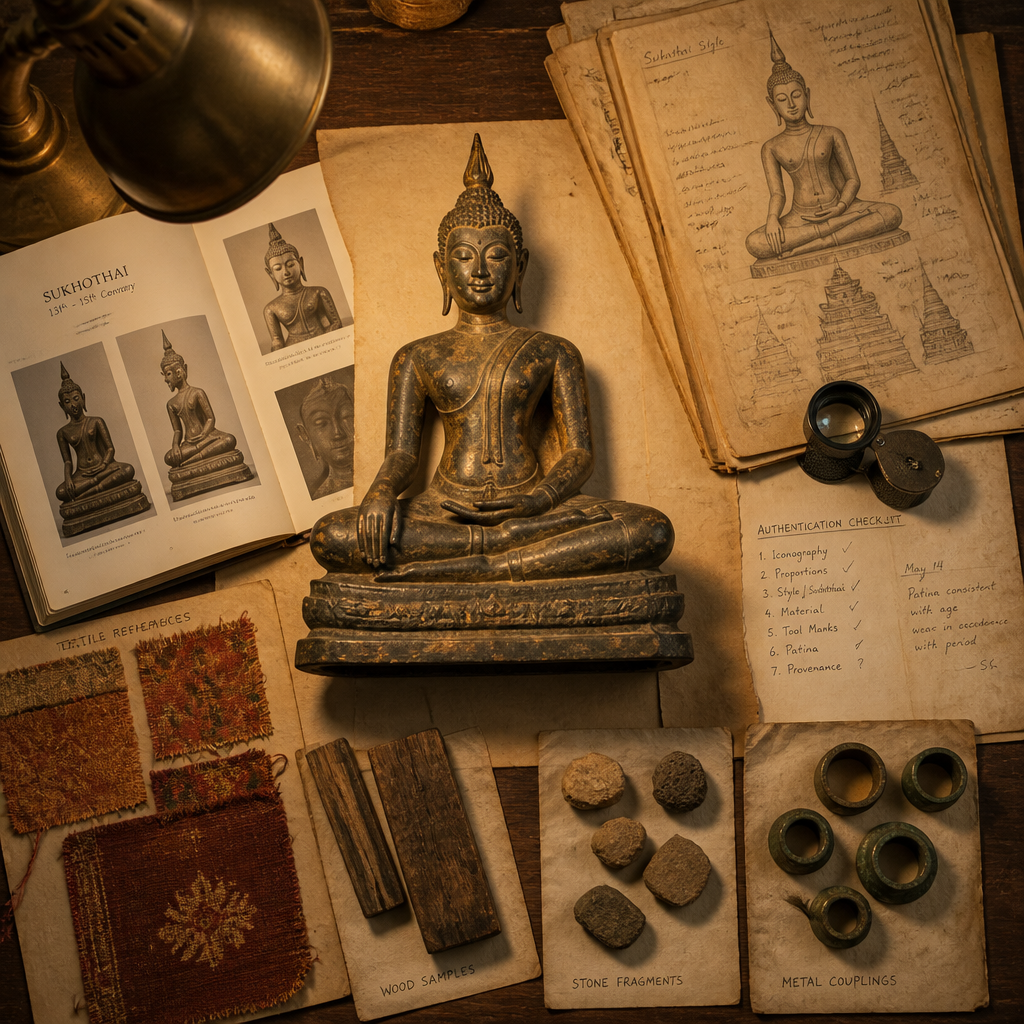
Start with visual assessment. Identify the period style using posture, facial features, robe treatment, and the form of the ushnisha. Note any anomalies: a Sukhothai face on an Ayutthaya-crowned body is a red flag, not an interesting hybrid.
Move to material identification. Determine the medium, examine the surface under good directional light, and look for patina consistency, casting quality, and the behavior of any gilding. Authentic antique bronzes show specific alloy compositions that material analysis can confirm, but your eye is the first filter.
Gather all available documentation. Purchase receipts, export licenses, auction records, and prior ownership history all matter. Any reputable dealer in museum-quality Thai sculpture will provide this without being asked. Hesitation around provenance documentation from a seller is a signal to step back.
Compare against dated reference examples. Major museum collections and published auction archives provide reliable comparative material. A piece that matches documented dated examples in every stylistic detail is far more credible than one that matches nothing closely.
Red Flags Worth Knowing
Artificially uniform patina on bronze is one of the most common signs of cosmetic aging. Random crack patterns that look painted on, or cracks filled with visible modern filler, suggest deliberate distressing. Gilding that is perfectly uniform across all surfaces, with no wear at high points, is a strong indicator of modern application. A piece offered without any provenance history at an implausibly low price for its stated period deserves skepticism, not enthusiasm.
In practice, the safest approach for collectors who are not yet expert in Thai Buddhist sculpture is to buy from dealers who specialize in this material, provide clear provenance documentation, and have a track record with serious collectors. HD Asian Art sources museum-quality pieces with transparent origins across the full range of Thai Buddhist art periods, from Sukhothai-style bronzes to later Rattanakosin crowned figures.
Building a Focused Thai Buddha Collection
A focused collection of Thai Buddha statues tells a coherent story. A scattered accumulation of unrelated pieces from five different traditions simply fills shelf space. The collector who decides to concentrate on Sukhothai-style bronzes, for example, develops genuine expertise in a specific visual language. That expertise makes every subsequent purchase better informed and more defensible.
Deciding on a Collecting Focus
Period focus is the most common organizing principle. A collection that traces the development from Sukhothai through Ayutthaya to Rattanakosin reads as a visual argument about Thai art history. A posture-focused collection, assembling the major mudras across different periods and regional styles, tells a different but equally rich story about Buddhist iconography. A material-focused collection, concentrating specifically on gilt lacquer bronzes or on carved wooden figures, develops connoisseurship in a specific craft tradition.
Do not try to collect everything. The most impressive private collections in any field are those where the collector clearly had a point of view. Buy fewer pieces and know each one deeply rather than accumulating broadly with shallow knowledge of any individual work.
Where Period Meets Posture: The Most Sought-After Combinations
Certain period-posture combinations are more historically significant and more visually powerful than others. The Sukhothai walking Buddha is probably the most distinctive and sought-after combination in Thai Buddhist art: uniquely Thai in form, theologically precise in meaning, and visually unlike anything else in Asian sculpture. A Sukhothai-style earth-touching seated Buddha with a well-preserved flame ushnisha is another combination that consistently draws serious collector attention.
For collectors whose interest is primarily devotional rather than art-historical, the abhaya mudra standing figures in the Ayutthaya style offer a combination of accessible beauty and protective symbolism that works powerfully in a home altar context. HD Asian Art's collection of Thai Buddha statues spans these key period-posture combinations, with detailed descriptions that allow meaningful comparison between styles before purchase.
Pro tip: When assembling pieces across periods, photograph each acquisition against a neutral background and note the specific diagnostic features that place it in its period. Over time this visual archive becomes your own reference library and sharpens your eye faster than reading alone ever will.
Frequently Asked Questions
What is the difference between a Sukhothai and an Ayutthaya Buddha statue?
The Sukhothai Buddha is characterized by a soft egg-shaped face, a flame-shaped finial above the ushnisha, minimal robe decoration, and no royal regalia. The Ayutthaya Buddha tends toward a more angular and refined face, a tiered crown or umbrella ushnisha, more detailed robe treatment, and frequently features jeweled royal regalia. The crowned Buddha, specifically, is an Ayutthaya development rather than a Sukhothai one. Both periods used the earth-touching posture heavily, but the walking Buddha is almost exclusively a Sukhothai innovation.
How can I tell if a Thai Buddha statue is authentic or a reproduction?
Authentic antique Thai bronzes show period-consistent alloy compositions, layered and non-uniform patina, crisp casting detail at fine surfaces like fingernails and hair texture, and natural gilding wear at raised points. Reproductions tend to have uniform patina, smooth interior surfaces, flat and uniformly reflective gilding, and stylistic inconsistencies that mix features from incompatible periods. Provenance documentation including purchase records and export licenses adds further confidence, and expert consultation with a specialist in Southeast Asian sculpture is advisable for high-value acquisitions.
What does the hand gesture on a Thai Buddha statue mean?
Each hand gesture (mudra) has a specific theological meaning. The right hand touching the earth (bhumisparsha mudra) depicts the moment of the Buddha's enlightenment. The raised hand with fingers extended (abhaya mudra) represents protection and fearlessness. Both hands resting in the lap (dhyana mudra) signify meditation. The open hand with palm outward and fingers pointing down (varada mudra) represents generosity and the giving of blessings. Reading the gesture is as important as reading the overall posture when identifying and understanding a Thai Buddha statue.
Is the walking Buddha posture unique to Thailand?
Yes, in practical terms. While walking Buddha figures exist in other Buddhist traditions, the walking posture as a major, fully developed iconographic form is almost exclusively a Thai, specifically Sukhothai, development. It depicts the Buddha in mid-stride with the right foot forward, the right hand in abhaya mudra, and the left arm curving forward. The posture communicates active compassion and the Buddha's movement through the world. It is one of the clearest markers of Sukhothai-style Thai Buddhist art and one of its most significant contributions to Buddhist sculpture globally.
What materials were used to make Thai Buddha statues historically?
Cast bronze using the lost-wax method is the dominant medium from the Sukhothai period onward, often finished with gold leaf over a lacquer base. Stone, particularly sandstone, appears in earlier Dvaravati and Lopburi-period work. Carved wood is significant in northern Thai (Lanna) traditions. Lacquered and gilded papier-mache and stucco appear in certain regional and later-period contexts. The choice of material often reflects the intended setting of the image, its scale, and the resources available to the workshop or patron commissioning it.
What should I look for when buying a Thai Buddha statue as a collector?
Start with period identification: know which historical style you are looking at and verify that the stylistic features are internally consistent for that period. Examine material quality and any surface aging under good light. Request full provenance documentation from the seller. Compare the piece against published museum examples or verified auction records of comparable dated work. Buy from dealers who specialize in Southeast Asian Buddhist art, provide transparent sourcing, and can answer detailed questions about period, material, and provenance without evasion. A piece whose story you can tell completely is worth more, practically and intellectually, than one that raises unresolved questions.
Have you recently added a Thai Buddha statue to your collection, or are you just beginning to explore this field? Share what drew you to it and any questions you encountered along the way in the comments.
References
-
Sukhothai Buddha style: characteristics and visual features explained for collectors
-
How to identify Thai Buddha statue styles across all major historical periods
-
Mudra: understanding the meaning of the Buddha's hand gestures in Buddhist art
-
How to date antique Thai Buddha images: a step-by-step collector's methodology
-
What makes Thai Buddha statues visually and iconographically distinct from other traditions
