



Sammeln südostasiatischer religiöser Skulpturen: Ein Einkaufsführer
Sammeln südostasiatischer religiöser Skulpturen: Ein Einkaufsführer
Südostasiatisch Religiöse Skulpturen repräsentieren jahrtausendealte Andachtspraxis in buddhistischen, hinduistischen und indigenen Glaubenssystemen. Die buddhistische Skulptur entwickelte sich nach der Ankunft der Religion um das 1. Jahrhundert n. Chr. zur vorherrschenden Kunstform, während die hinduistische Ikonographie für den indonesischen und kambodschanischen Ausdruck weiterhin von zentraler Bedeutung war. Dabei handelte es sich nicht nur um Dekorationsgegenstände; Sie dienten als Brennpunkte für Meditation, rituelle Verehrung und spirituelle Transformation in Tempeln und Hausheiligtümern.
Inhaltsverzeichnis
Wenn Sie diesen Kontext verstehen, ändert sich Ihre Herangehensweise an das Sammeln grundlegend. Eine Skulptur ist ein Gefäß spiritueller Absicht, gefertigt von Kunsthandwerkern, die glaubten, dass ihre Arbeit Erleuchtung oder göttlichen Segen ermöglichen würde. Regionale Unterschiede in Stil, Material und Ikonographie erzählen Geschichten von Handelsrouten, kulturellem Austausch und lokaler Innovation.
Buddhistische und hinduistische Ikonographie in Südostasien
Die buddhistische Skulptur konzentriert sich auf Darstellungen des Buddha in verschiedenen Posen: in Meditation sitzend (Dhyana Mudra) für inneren Frieden, segnend stehend (Abhaya Mudra) als Symbol für Schutz und liegend beim Eintritt ins Nirvana. Jede Pose hat eine spezifische spirituelle Bedeutung, die von den Anhängern verstanden wird.
Hinduistische Gottheiten kommen in der kambodschanischen und indonesischen Skulptur vor allem in Shiva und Vishnu vor. Bodhisattvas, erleuchtete Wesen, die ihr eigenes Nirvana hinauszögern, um anderen zu helfen, nehmen einen entscheidenden Platz in der Ikonographie des Mahayana-Buddhismus ein. Avalokiteshvara, der Bodhisattva des Mitgefühls, erscheint häufig mit mehreren Armen, was seine Fähigkeit symbolisiert, unzähligen Wesen gleichzeitig zu helfen.
Mudras (Handgesten) und Asanas (Körperpositionen) kodieren Bedeutungsebenen. Eine erhobene rechte Hand signalisiert Segen und Schutz. An der Brust verbundene Handflächen zeigen Ehrfurcht an. Das Erlernen des Lesens dieser symbolischen Sprachen verändert die Art und Weise, wie Sie Stücke schätzen und authentifizieren.
Regionale Variationen: Khmer-, thailändische, indonesische und vietnamesische Traditionen
Khmer-Skulptur stellt den Höhepunkt der künstlerischen Errungenschaften Südostasiens dar, insbesondere während der Angkor-Zeit (9.-15. Jahrhundert). Khmer-Bildhauer schufen monumentale Tempelreliefs und freistehende Figuren mit bemerkenswerter anatomischer Präzision und spiritueller Intensität. Stein war ihr Hauptmedium, und authentische Patina erzählt Geschichten aus Jahrhunderten in Tempelhöfen und Dschungelruinen.
Thailändische Skulptur hat sich über verschiedene Perioden hinweg entwickelt. Frühe Sukhothai-Buddhas (13.–15. Jahrhundert) zeigen elegante, längliche Eigenschaften mit flammenähnlichen Ushnishas und sanftem Lächeln. Spätere Stücke aus der Ayutthaya-Zeit (15.–18. Jahrhundert) weisen eine aufwändigere Verzierung und einen verstärkten Bronzeguss auf.
Indonesische Skulptur, insbesondere aus Java und Bali, spiegelt eine einzigartige Synthese hinduistisch-buddhistischer Traditionen wider. Javanische Stücke zeichnen sich oft durch aufwendige Verzierungen und dynamische Posen aus. Balinesische Skulpturen integrieren neben buddhistischen und hinduistischen Bildern häufig auch lokale Mythologie und animistische Elemente.
Vietnamesische Skulptur entwickelte sich unter chinesischem Einfluss und behielt gleichzeitig ausgeprägte regionale Merkmale bei. Vietnamesische Buddha-Bilder weisen oft schärfere Gesichtszüge und strengere Ausdrücke auf als thailändische oder kambodschanische Gegenstücke.
| Region | Primäre Periode | Dominantes Material | Besondere Merkmale |
|---|---|---|---|
| Kambodscha (Khmer) | 9.-15. Jahrhundert | Stein, Sandstein | Anatomische Präzision, gelassener Ausdruck |
| Thailand | 13.-18. Jahrhundert | Bronze, Stein | Elegante Proportionen, flammenartige Kronen |
| Indonesien | 8.-15. Jahrhundert | Vulkangestein, Bronze | Aufwändige Ornamentik, synkretistische Bildsprache |
| Vietnam | 10.-19. Jahrhundert | Bronze, Stein | Scharfe Gesichtszüge, strenge Gesichtsausdrücke |
Materialien, Handwerkskunst und Identifizierung authentischer religiöser Skulpturen
Die Materialzusammensetzung von a Südostasiatisch Religiöse Skulpturen verraten sowohl ihr Alter als auch ihre Authentizität. Sammler müssen ein Gespür dafür entwickeln, wie unterschiedliche Materialien altern und welche Altersspuren auf echten Stücken zu sehen sein sollten.
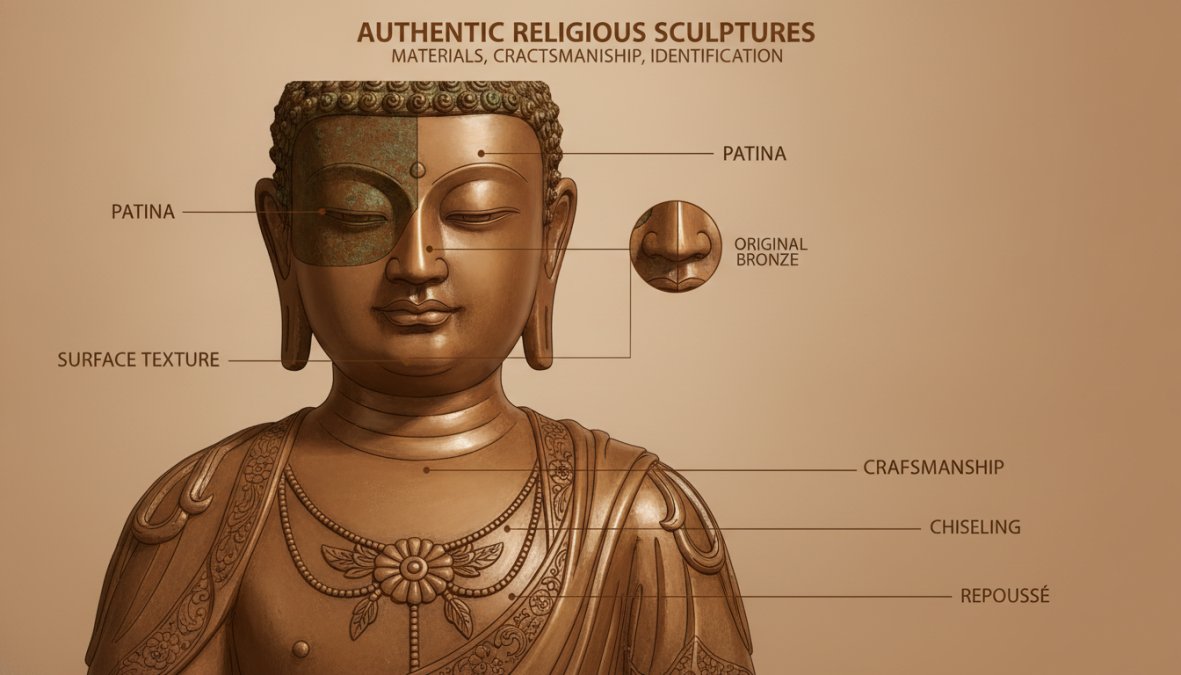
Bronzeguss, Steinschnitzerei und Holztechniken
Bronzeguss verwendeten die Wachsausschmelzmethode, bei der ein Wachsmodell in Ton eingehüllt, erhitzt, um das Wachs zu schmelzen, und mit geschmolzener Bronze gefüllt wurde. Authentische Bronzestücke lassen sich an Nähten erkennen, an denen Gussteile miteinander verbunden sind, an hohlen Innenräumen und am charakteristischen Gewicht von ordnungsgemäß gegossener Bronze.
Steinschnitzerei dominierte Khmer- und indonesische Skulptur. Handwerker bearbeiteten Sandstein, Kalkstein und Vulkangestein mit Handwerkzeugen. Auf authentischen Stücken sichtbare Werkzeugspuren verraten individuelle Schnitztechniken. Echte antike Steinskulpturen weisen eine unterschiedliche Erosion auf, bei der sich weichere Bereiche schneller abnutzen als härtere Bereiche.
Holzskulptur erscheint seltener, stellt aber eine wichtige Tradition in der thailändischen und burmesischen Kunst dar. Echte antike Holzskulpturen weisen Holzwurmschäden, Risse (natürliche Risse, die der Maserung folgen) und eine Verdunkelung durch Alter und Belichtung auf.
Patina- und Altersindikatoren
Patina ist vielleicht der wichtigste Indikator für die Authentizität einer Bronzeskulptur. Durch chemische Reaktionen zwischen Bronze und seiner Umgebung entsteht langsam eine echte Patina.
Grüne Patina deutet auf eine Exposition gegenüber feuchtigkeitsreichen Umgebungen hin, die typisch für Tempelhöfe sind. Diese Patina sollte uneben sein, in geschützten Vertiefungen dicker und auf freiliegenden Flächen dünner. Es sollte fest am Metall haften, nicht abblättern oder sich leicht entfernen lassen.
Braune oder schwarze Patina weist typischerweise auf Stücke hin, die in trockeneren Umgebungen gelagert werden. Diese dunklere Patina sollte natürliche Variationen mit Bereichen aufweisen, in denen das darunter liegende Metall aufgrund von Handhabung und Abnutzung durchscheint.
Tragemuster liefern entscheidende Authentifizierungsnachweise. Echte antike Skulpturen weisen konzentrierte Abnutzungserscheinungen an Bereichen auf, die Gläubige wiederholt berührt haben: an den Füßen, Händen und im Gesicht des Buddha. Dieses Tragen sollte glatt und sanft sein, das Ergebnis jahrhundertelanger ehrfürchtiger Berührung.
Authentifizierung asiatischer Antiquitäten: Provenienz und Überprüfung
Die Provenienz, die dokumentierte Besitzgeschichte eines Kunstwerks, stellt den Goldstandard für die Authentifizierung dar. Eine Skulptur mit klarer Provenienz, die vor 1970 in Sammlungen war und in westlichen Sammlungen verblieben ist, hat deutlich mehr Glaubwürdigkeit als ein Stück mit unbekannter Herkunft.
Provenienzdokumentation und archäologischer Kontext
Dokumentierte Herkunft beginnt damit, zu verstehen, wann und wo ein Stück auf den westlichen Kunstmarkt gelangt ist. Stücke, die vor 1970 in Museumssammlungen, Auktionskatalogen oder veröffentlichten Sammlungen erschienen, haben eine nachgewiesene Provenienz. Eine in einem Museumskatalog der 1950er Jahre dokumentierte Skulptur hat weitaus mehr Gewicht als ein identisch aussehendes Stück mit „unbekannter Herkunft“.
Die Provenienzdokumentation sollte Namen und Daten der Vorbesitzer, Verkaufsunterlagen von Auktionshäusern oder Galerien, Aufzeichnungen über Museumszugänge, veröffentlichte Referenzen und Fotos aus früheren Sammlungen enthalten. Achten Sie bei der Prüfung der Herkunft auf konkrete Details. Vage Behauptungen wie „erworben in“. Thailand„tragen weniger Gewicht als „1968 beim Bangkoker Antiquitätenhändler Somchai gekauft“.
Rote Flaggen und Replikaterkennung
Hochwertige Nachbildungen werden immer anspruchsvoller. Allerdings sollten einige Warnsignale vor dem Kauf eine sorgfältige Prüfung auslösen.
Verdächtig perfekter Zustand stellt eines der stärksten Warnsignale dar. Echte antike Skulpturen weisen Spuren des Alters auf: abgenutzte Oberflächen, angesammelte Patina, kleinere Schäden und Reparaturen. Ein Stück, das frisch geschnitzt aussieht, sollte sofort Anlass zur Sorge geben.
Uneinheitliche Patina weist auf moderne Fertigung hin. Echte Patina entsteht durch gezielte Umwelteinwirkung. Eine Skulptur, die auf allen Oberflächen eine völlig gleichmäßige Patina aufweist, wurde wahrscheinlich künstlich behandelt.
Werkzeugspuren, die zu sauber aussehen schlagen moderne Schnitzerei vor. Alte Handwerker verwendeten Handwerkzeuge und hinterließen unverwechselbare Spuren. Moderne Werkzeuge hinterlassen unterschiedliche Signaturen.
Anatomische Inkonsistenzen Entdecken Sie Nachbildungen von Kunsthandwerkern, die mit authentischer Ikonographie nicht vertraut sind. Ein Buddha mit falscher Mudra-Positionierung oder einer Gottheit, denen wesentliche Eigenschaften fehlen, deutet auf eine moderne Herstellung hin.
Ethisches Kunstsammeln: Rechtliche und kulturelle Verantwortlichkeiten
Das Sammeln südostasiatischer religiöser Skulpturen bringt ethische Verpflichtungen mit sich, die über den persönlichen Genuss hinausgehen. Die Geschichte der Plünderung von Kulturerbe auf dem internationalen Kunstmarkt hat rechtliche Rahmenbedingungen und ethische Standards geschaffen, die verantwortungsbewusste Sammler verstehen müssen.
Rechtliche Herkunftsprüfung und Ausfuhrbestimmungen
Internationales Recht schränkt den Handel mit Kulturgütern ein, die nach bestimmten Terminen aus ihren Herkunftsländern entfernt werden. Das UNESCO-Übereinkommen von 1970 legte den rechtlichen Rahmen fest, dem die meisten Länder folgen. Gemäß dieser Konvention gelten Artefakte, die nach 1970 ohne ordnungsgemäße Exportgenehmigung aus ihrem Herkunftsland entfernt wurden, als gestohlenes Eigentum, unabhängig vom gutgläubigen Kauf.
Dies hat tiefgreifende Auswirkungen für Sammler. Eine schöne Khmer-Skulptur ohne dokumentierte Herkunft vor 1970 kann zwar legal auf dem westlichen Kunstmarkt erworben werden, birgt jedoch erhebliche rechtliche und ethische Risiken.
Exportbestimmungen variieren je nach Land. Thailand, Kambodscha, Vietnam und Indonesien Alle haben Gesetze, die den Export von Kulturgütern einschränken. Wenn Sie ein zum Kauf bestimmtes Stück bewerten, fordern Sie vollständige Unterlagen an: Original-Exportgenehmigungen, Importgenehmigungen, Auktionshaus- oder Galeriedokumentation mit Datum und Standort sowie etwaige wissenschaftliche Analysen oder Gutachten zur Echtheitsprüfung.
Bedenken hinsichtlich des kulturellen Erbes und der Rückführung
Die Repatriierungsbewegung, die kulturelle Artefakte in ihre Herkunftsländer zurückbringt, hat die Landschaft für Sammler grundlegend verändert. Stücke mit klaren Beweisen für Plünderungen, Skulpturen, die während Kriegen aus Tempeln entfernt wurden, oder Stücke, die in der Kolonialzeit ohne Entschädigung erworben wurden, haben moralisches Gewicht.
Stücke aus dem Tempel verdienen besondere Beachtung. Eine Skulptur, die Jahrhunderte lang auf einem Tempelaltar stand, erfüllte innerhalb der Gemeinde eine spirituelle Funktion. Einige Sammler gehen auf dieses ethische Anliegen ein, indem sie Hausheiligtümer schaffen, die den ursprünglichen Andachtszweck der Skulptur würdigen.
Pflege antiker Skulpturen: Konservierung und Zustandsbewertung
Der Besitz einer südostasiatischen religiösen Skulptur trägt die Verantwortung für deren Erhaltung. Ihre Aufgabe als Sammler besteht darin, sicherzustellen, dass diese Objekte noch Jahrhunderte überleben.
Best Practices für die Konservierung religiöser Artefakte
Bronzestücke erfordern Schutz vor Feuchtigkeit und Oxidation. Lagern Sie Bronzeskulpturen in trockenen Umgebungen mit stabiler Luftfeuchtigkeit. Vermeiden Sie es, die Patina direkt zu berühren; Hautöle können lokale Korrosion verursachen. Wenn eine Reinigung erforderlich ist, wenden Sie sich an einen professionellen Restaurator.
Steinskulpturen müssen vor Wasserschäden und Frost-Tau-Zyklen geschützt werden. Sorgen Sie für eine ausreichende Luftzirkulation um die Steinstücke herum. Vermeiden Sie es, Skulpturen dort zu platzieren, wo sich Wasser ansammeln kann oder wo sie starken Temperaturschwankungen ausgesetzt sind.
Holzstücke erfordern eine Klimatisierung. Halten Sie eine konstante Luftfeuchtigkeit zwischen 40 und 55 % ein und vermeiden Sie extreme Temperaturen. Schützen Sie das Holz vor direkter Sonneneinstrahlung, die zum Ausbleichen und zur Verschlechterung der Oberfläche führt.
Alle Materialien sind vor direkter Sonneneinstrahlung geschützt. UV-Strahlung lässt Patinafarben verblassen und schädigt organische Materialien.
Umgebungsbedingungen und Langzeitlagerung
Feuchtigkeitskontrolle ist vielleicht der wichtigste Erhaltungsfaktor. Streben Sie eine stabile Luftfeuchtigkeit zwischen 45 und 55 % an. Verwenden Sie ein Hygrometer, um die Bedingungen zu überwachen.
Temperaturstabilität ist genauso wichtig wie die Luftfeuchtigkeit. Halten Sie nach Möglichkeit Temperaturen zwischen 15 und 21 °C ein.
Lichtmanagement schützt sowohl Material als auch Patina. Stellen Sie die Stücke vor direkter Sonneneinstrahlung geschützt auf. Wenn natürliches Licht unvermeidbar ist, verwenden Sie UV-filternde Fenstervorhänge.
Handhabung und Anzeige bedürfen sorgfältiger Überlegung. Behandeln Sie Skulpturen minimal und nur bei Bedarf. Tragen Sie Baumwollhandschuhe, um zu verhindern, dass Hautöle mit der Oberfläche in Kontakt kommen. Stützen Sie die Teile an der Basis und nicht am Kopf oder an den Armen.
Aufbau Ihrer Sammlung: Kuration und Andachtsnutzung
Das Sammeln südostasiatischer religiöser Skulpturen bietet die Möglichkeit, bedeutungsvolle persönliche Räume zu schaffen, die sowohl ästhetischen als auch spirituellen Dimensionen gerecht werden.
Auswahl von Stücken für Altäre und Meditationsräume
Persönliche Verbindung sollte Ihre Sammelentscheidungen leiten. Eine Skulptur, die Sie spirituell anspricht, die Ihre Aufmerksamkeit erregt, wenn Sie einen Raum betreten, die zur Meditation oder Kontemplation einlädt, gehört in Ihre Sammlung.
Berücksichtigen Sie bei der Auswahl von Stücken für den Altar die spezifische buddhistische oder hinduistische Tradition, zu der Sie sich hingezogen fühlen. Ein Altar des Theravada-Buddhismus könnte einen einfachen, gelassenen Buddha in Meditation darstellen. Ein Mahayana-Altar könnte Bodhisattva-Figuren enthalten, die Mitgefühl und Weisheit darstellen.
Maßstab und Proportionen spielen in Altarräumen eine große Rolle. Eine Skulptur sollte in einem angemessenen Verhältnis zum Raum stehen, den sie einnimmt, und weder den Altar überfordern noch zwischen anderen Objekten untergehen.
Zustand und Authentizität Je nach Verwendungszweck kommt es unterschiedlich darauf an. Eine Skulptur, die für den aktiven Gottesdienst bestimmt ist, kann Alter und Gebrauchsspuren aufweisen, die einen investitionsorientierten Sammler beunruhigen würden.
Tempelheiligtümer und rituelle Funktion im häuslichen Gottesdienst
Schaffung eines Heimtempelschreins erfordert ein Verständnis der rituellen Funktionen, denen diese Skulpturen ursprünglich dienten. In südostasiatischen Tempeln dienen Skulpturen als Mittelpunkt der Meditation, als Empfänger von Opfergaben und als Darstellungen erleuchteter Wesen, die Ehrfurcht verdienen.
Platzierung und Orientierung folgen Sie traditionellen Prinzipien. Eine Buddha-Figur sollte auf Augenhöhe oder leicht darüber positioniert werden, um einen natürlichen Mittelpunkt für die Meditation zu schaffen.
Opfergaben und Ritual Verwandeln Sie eine Skulpturensammlung in eine lebendige Andachtspraxis. Zu den traditionellen Opfergaben können Blumen, Weihrauch, Wasser, Obst oder Licht gehören.
Schaffung eines heiligen Raums beinhaltet mehr als nur das Platzieren einer Skulptur auf einem Regal. Betrachten Sie die gesamte Umgebung. Sanfte Beleuchtung, minimale Unordnung, bequeme Sitzgelegenheiten zum Meditieren und Schutz vor Hausverkehr schaffen eine Atmosphäre, die der spirituellen Praxis förderlich ist.
Markttrends und Bewertung für Sammler
Wenn Sie den Markt für religiöse Skulpturen aus Südostasien kennen, können Sie fundierte Kaufentscheidungen treffen und eine Sammlung aufbauen, die ihren Wert beibehält oder steigert.
Kunstbewertung und Investitionswert verstehen
Bewertungsfaktoren Bestimmen Sie den Marktpreis einer Skulptur. Authentizität steht an erster Stelle; Ein echtes Stück hat einen exponentiell höheren Wert als eine Replik. Die Herkunft ist von entscheidender Bedeutung; Eine dokumentierte Geschichte erhöht den Wert erheblich. Alter, Seltenheit und Zustand beeinflussen die Preisgestaltung; Stücke in ausgezeichnetem Zustand kosten in der Regel mehr als vergleichbare Stücke mit Beschädigungen.
Markttrends zeigen eine steigende Nachfrage nach authentischen südostasiatischen Skulpturen, insbesondere nach Stücken mit eindeutiger Herkunft und dokumentierter Geschichte. Khmer-Skulptur aus der Angkor-Zeit bleibt die gefragteste Kategorie. Stücke aus der thailändischen Sukhothai-Zeit erfreuen sich stetiger Beliebtheit. Indonesische und vietnamesische Stücke bleiben im Vergleich zu ihrer historischen und künstlerischen Bedeutung relativ unterbewertet und bieten möglicherweise Investitionsmöglichkeiten.
Der Markt unterscheidet zwischen Investment-Grade-Stücken und Sammlerstücken. Stücke mit Investment-Grade-Qualität, typischerweise authentifizierte Werke mit ausgezeichneter Provenienz, musealem Zustand und historischer Bedeutung, sprechen seriöse Sammler und Institutionen an. Sammlerstücke, authentische Werke mit geringfügigen Mängeln im Zustand oder einer weniger auffälligen Herkunft, sprechen Liebhaber an und gewinnen in der Regel langsamer an Wert, behalten aber dennoch ihren Wert.
Wo man authentische Stücke kaufen kann
Seriöse Händler bieten die zuverlässigste Quelle für authentifizierte Stücke. Etablierte Galerien, die sich auf südostasiatische Kunst spezialisiert haben, pflegen Beziehungen zu Museen, Auktionshäusern und erfahrenen Echtheitsprüfern. Sie stehen mit Echtheitsgarantien hinter ihren Stücken und liefern in der Regel eine detaillierte Dokumentation. HD Asian Art veranschaulicht diesen Ansatz und bietet sorgfältig kuratierte buddhistische und Hinduistische Statuen neben exquisiten Khmer- und südostasiatischen Skulpturen, die Altäre, Meditationsräume und raffinierte spirituelle Innenräume verschönern sollen.
Auktionshäuser Bieten Sie authentifizierte Stücke mit dokumentierter Herkunft an. Große Auktionshäuser führen umfangreiche Recherchen und Echtheitsprüfungen durch, bevor sie Stücke anbieten.
Museen und institutionelle Deaktivierung bieten gelegentlich authentische Stücke an. Wenn Museumsdeakzessionsarbeiten durchgeführt werden, stellen sie in der Regel eine vollständige Dokumentation und Authentifizierung bereit.
Vermeiden Sie Online-Marktplätze wo die Authentifizierung nicht überprüft werden kann. Arbeiten Sie beim Online-Kauf nur mit Händlern zusammen, die eine detaillierte Dokumentation, Authentifizierungszertifikate anerkannter Experten und klare Rückgaberichtlinien bieten.
Das Sammeln südostasiatischer religiöser Skulpturen verbindet Sie mit Jahrhunderten spiritueller Tradition und künstlerischer Exzellenz. Ganz gleich, ob Sie eine Anlagesammlung aufbauen, einen Meditationsraum schaffen oder sich mit Objekten von tiefer Schönheit umgeben: Die Prinzipien der Authentifizierung, ethischer Verantwortung und sorgfältiger Kuration leiten sinnvolles Sammeln. Durch verantwortungsvolle Sammelpraktiken wird sichergestellt, dass diese heiligen Objekte für künftige Generationen erhalten bleiben und gleichzeitig ihre ursprüngliche kulturelle und spirituelle Bedeutung gewürdigt wird.
HD Asian Art ist auf die Bereitstellung authentifizierter, sorgfältig kuratierter buddhistischer und hinduistischer Statuen sowie exquisiter Khmer- und südostasiatischer Skulpturen spezialisiert. Jedes Stück wird aufgrund seiner Authentizität, ästhetischen Exzellenz und spirituellen Präsenz ausgewählt. Ob Sie auf der Suche nach antiken Schätzen oder zeitgenössischen Stücken sind, die Meditationsräume aufwerten sollen, HD Asian ArtDie raffinierte Kollektion von bringt vom Tempel inspirierte Ruhe und Kunst in Ihr persönliches Refugium.
Häufig gestellte Fragen
Wie kann ich eine südostasiatische religiöse Skulptur vor dem Kauf authentifizieren?
Die Authentifizierung asiatischer Antiquitäten erfordert die Prüfung mehrerer Faktoren: Herkunftsdokumentation, Materialzusammensetzung, handwerkliche Qualität und Patinakonsistenz. Fordern Sie vom Verkäufer eine detaillierte Provenienzgeschichte an, prüfen Sie, ob Werkzeugspuren vorhanden sind, die mit dem Zeitraum übereinstimmen, und überprüfen Sie den archäologischen Kontext, falls verfügbar. Suchen Sie nach Unstimmigkeiten in den Abnutzungsmustern, Gussnähten oder der Oberflächenalterung, die auf moderne Nachbildungen schließen lassen. Ziehen Sie bei bedeutenden Anschaffungen die professionelle Bewertung durch Spezialisten für südostasiatische Kunst in Betracht.
Welche ethischen Überlegungen gibt es beim Sammeln südostasiatischer religiöser Skulpturen?
Ethisches Kunstsammeln erfordert die Überprüfung der legalen Herkunft und die Sicherstellung, dass die Stücke nicht illegal aus ihren Herkunftsländern exportiert wurden. In vielen südostasiatischen Ländern gelten strenge Gesetze zum Schutz des kulturellen Erbes, die religiöse Artefakte schützen. Überprüfen Sie die Exportdokumente und stellen Sie sicher, dass die Skulptur nicht aus Tempeln oder archäologischen Stätten geplündert wurde. Unterstützen Sie seriöse Händler, die transparente Aufzeichnungen führen und bei Bedarf mit Institutionen zusammenarbeiten, die sich für die Rückführung einsetzen. Beachten Sie, dass einige Sammler der Unterstützung lokaler Kunsthandwerker bei der Herstellung zeitgenössischer Stücke Vorrang vor dem Erwerb von Antiquitäten einräumen.
Welche Materialien kommen in südostasiatischen religiösen Skulpturen am häufigsten vor?
Religiöse Skulpturen in Südostasien wurden traditionell aus Bronze, Stein, Holz und Gold gefertigt. Dominierend war der Bronzeguss Thailand und Kambodscha für buddhistische Statuen, während Steinschnitzereien in Khmer-Tempeln eine Blütezeit erlebten. Indonesische Keramik und Holzschnitzereien spiegeln hindu-buddhistische Traditionen wider, während vietnamesische Stücke oft Materialien kombinieren. Jedes Material altert anders, Bronze entwickelt eine charakteristische Patina, Stein weist Verwitterungsmuster auf und Holz erfordert eine sorgfältige Kontrolle der Luftfeuchtigkeit. Das Verständnis der materialspezifischen Alterung hilft dabei, authentische Antiquitäten von modernen Reproduktionen zu unterscheiden.
Wie soll ich antike südostasiatische Skulpturen pflegen und konservieren?
Zur Pflege antiker Skulpturen gehört die Aufrechterhaltung stabiler Umgebungsbedingungen: mäßige Temperatur (18–24 °C), konstante Luftfeuchtigkeit (40–55 %) und Schutz vor direkter Sonneneinstrahlung. Vermeiden Sie eine Reinigung ohne professionelle Anleitung, da aggressive Methoden die ursprüngliche Patina und Oberflächendetails beschädigen. Bewahren Sie Holzteile vor übermäßiger Feuchtigkeit geschützt auf; Bronzeskulpturen profitieren von gelegentlichem sanftem Abstauben. Stellen Sie die Stücke fern von Temperaturschwankungen, Heizungsöffnungen und Wasserquellen auf. Bei bedeutenden Stücken sollten Sie vor Restaurierungsarbeiten konsultierende Spezialisten konsultieren, die Erfahrung mit südostasiatischen Materialien haben.
