



How to Authenticate Asian Religious Sculptures
How to Authenticate Asian Religious Sculptures
Most buyers of Asian religious sculpture get burned the same way: they focus on aesthetics and ignore the physical evidence right in front of them. Reproductions flood the market, and sellers of low-quality castings have grown increasingly sophisticated about mimicking the look of age and craftsmanship.
If you are collecting authentic Asian sculpture, whether a Burmese lacquer Buddha, a bronze Cambodian deity, or a stone Gandharan figure, knowing the difference between a genuine piece and a well-aged fake is not a matter of taste. It is a matter of training your eye, understanding materials, and asking the right questions before you spend a penny.
Table of Contents
Quick Takeaways
|
Key Insight |
Explanation |
|---|---|
|
Material tells you origin |
Specific materials were favoured in specific regions. Schist and stucco signal Gandhara; fine lost-wax bronze with thin walls points to Thailand or Cambodia; thick, heavy castings with uniform patina are often modern reproductions. |
|
Iconography must match the claimed region and period |
Every hand gesture (mudra), crown style, and robe treatment follows strict regional conventions. A "Thai Buddha" with Khmer crown proportions or a "Chinese Ming figure" with wrong facial proportions is inconsistent and warrants deeper scrutiny. |
|
Tool marks and surface texture are diagnostic |
Hand-carved or hand-cast pieces show subtle irregularity under magnification. Machine-made reproductions have perfectly uniform features, identical repetition, and unnaturally smooth recesses. |
|
Artificial patina has tells |
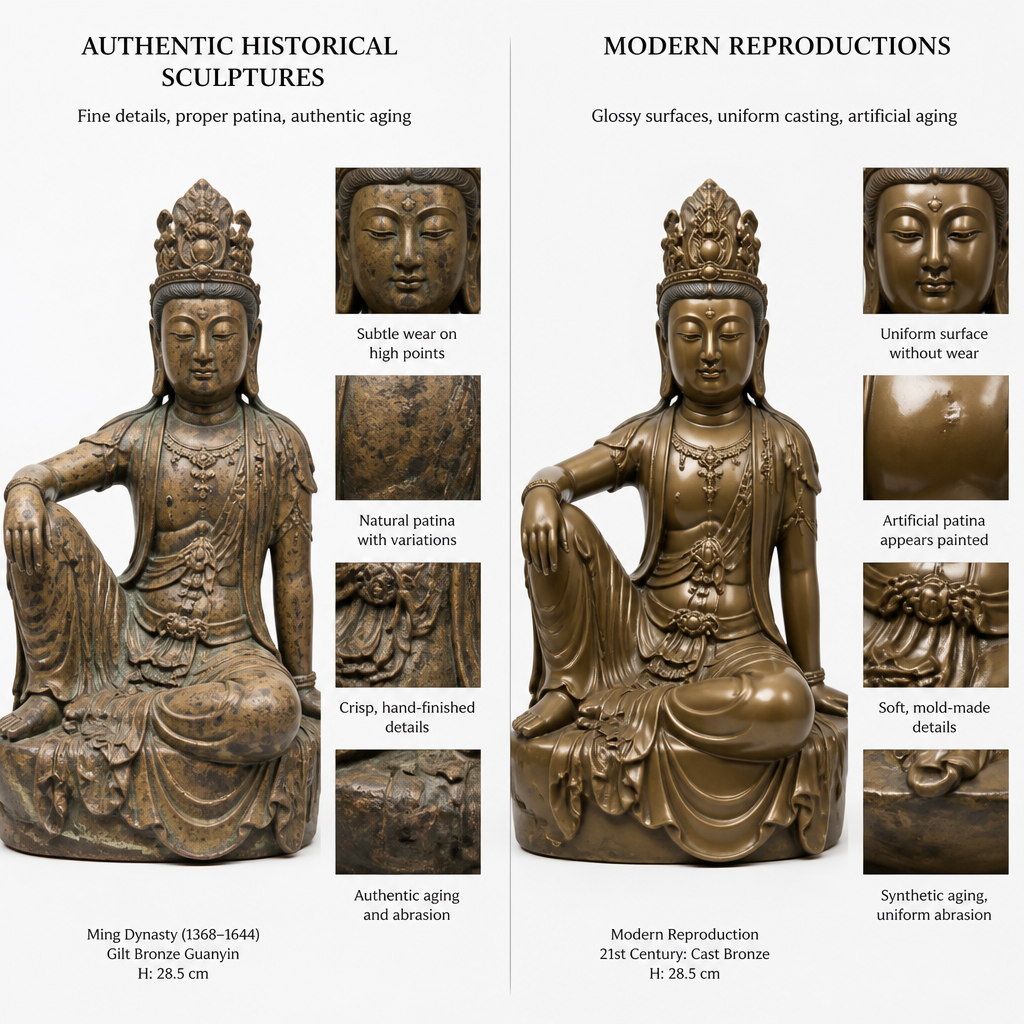
Genuine age patina on bronze is uneven, concentrated in recesses, and cannot be rubbed off cleanly. Applied patina sits on raised surfaces, smells chemical when warmed, and wipes away in streaks. |
|
Provenance documentation matters but is not sufficient alone |
A letter of provenance adds credibility, but paperwork can be fabricated. Physical evidence of age must corroborate any documentation. |
|
Weight and density are underused tests |
Antique bronze statues from Burma, Thailand, and Cambodia are typically heavy relative to their size due to alloy composition. Resin or zinc-alloy reproductions feel noticeably lighter or have a hollow ring when gently tapped. |
|
Seller transparency is itself a quality signal |
A reputable specialist dealer will state the country of origin, approximate period, material, and condition clearly. Vague or evasive descriptions of origin are a consistent red flag. |
Why Material Identification Comes First
Before you assess iconography, before you read the provenance paperwork, identify what the piece is actually made of. Material is the single fastest anchor point for determining where and when a sculpture was likely produced, and it is where fakes most often fail under scrutiny.
For more than two millennia, artisans across Asia used stone, stucco, terracotta, wood, lacquer, and metals including bronze, gold, and silver to create images of Buddhist and Hindu deities. Critically, these materials were not used randomly. Certain materials were strongly favoured in particular countries and periods, which means identifying the medium can immediately help narrow down authenticity claims. Gandharan workshops in present-day Afghanistan and Pakistan are closely associated with schist and grey stucco. Nepalese workshops from the medieval period produced some of the finest lost-wax bronze castings in Asia. Thai and Cambodian traditions produced distinctive bronze alloys with characteristic colour and patina.
When examining a piece, start with weight and density. Lift it if you can. Antique bronze from Southeast Asia has a specific heft that resin composites and zinc alloys simply cannot replicate convincingly. Run your finger into recesses and under the base. Genuine stone carving from India or Sri Lanka has micro-texture variation in hand-finished areas. A reproduction carved by machine or cast in resin feels unnervingly uniform to the touch.
Pro tip: Warm the surface gently with your hand and then smell the area. Resin reproductions often release a faint chemical or plastic odour when warmed. Bronze, stone, and genuine lacquerwork do not.
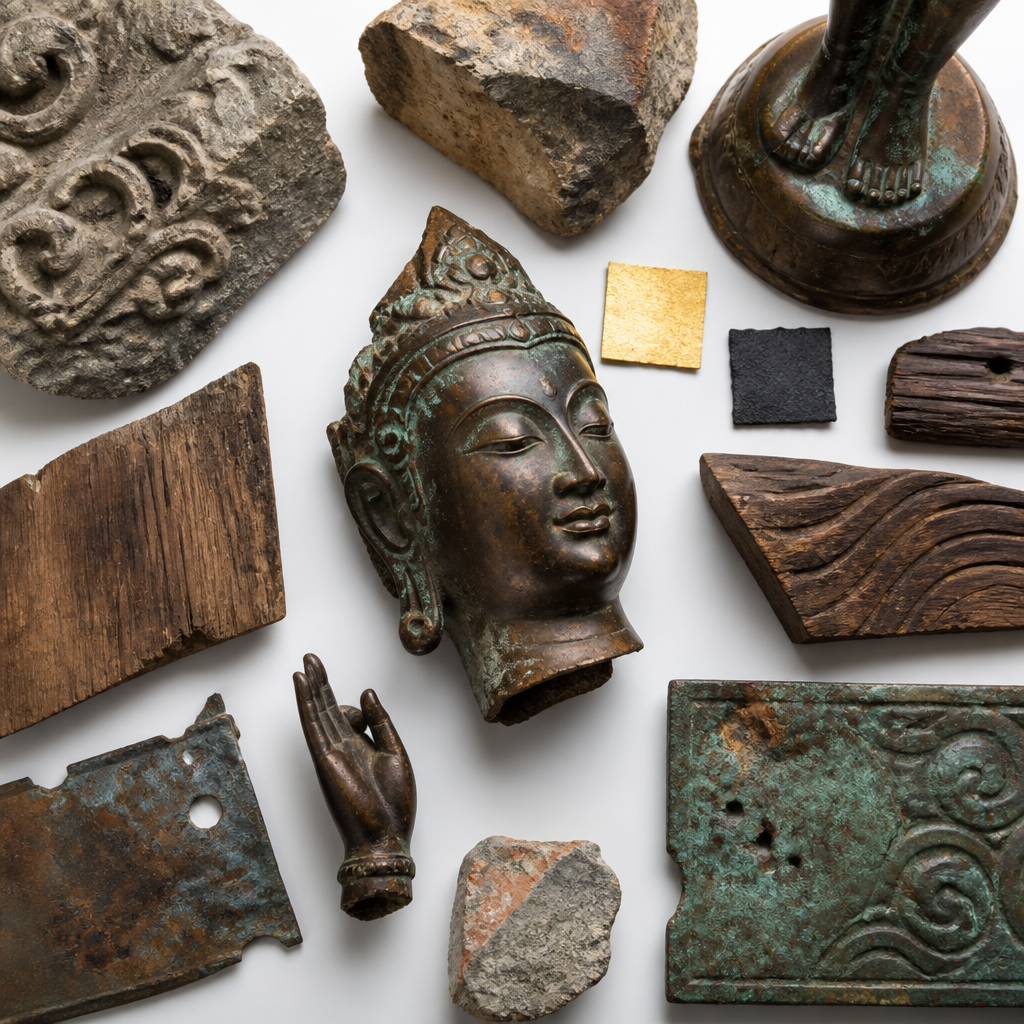
Wood sculptures from Burma, Thailand, and Laos present their own material evidence. Genuine aged teak or other regional hardwoods develop surface checks (small cracks along the grain) that follow the natural wood structure and penetrate slightly below the surface. Fakes often have painted or applied cracking that sits on top of the surface with no depth. On Burmese lacquerware specifically, the lacquer built up through multiple applications over a core gives the finished surface a depth and slight translucency that painted imitations cannot replicate.
How to Authenticate a Buddha Statue by Iconography
Knowing how to authenticate a Buddha statue requires familiarity with the visual conventions, called iconographic programmes, that governed how sculptors in each region represented the Buddha and associated deities. These conventions were not arbitrary. They were codified in religious texts and transmitted through workshop traditions. A departure from these conventions in a supposedly regional or period piece is a significant inconsistency.
Hand Gestures and Their Regional Variations
The mudras (hand gestures) each carry specific meaning, and their precise rendering varies by tradition. The bhumisparsha mudra (earth-touching gesture) associated with the moment of enlightenment appears across Thai, Burmese, Cambodian, and Sri Lankan traditions, but the exact angle of the fingers, the placement of the right hand relative to the knee, and the treatment of the left hand in the lap all differ by region. A Thai-attributed figure with the proportional conventions of a Cambodian piece, or vice versa, demands an explanation. In practice, most sellers of reproductions do not study these details closely enough, and inconsistencies show up clearly once you train your eye.
Facial Proportions and Crown Styles
Thai Sukhothai-style Buddhas have distinctive flame-shaped ushnisha (cranial protuberance) and an oval face with a serene, slightly elongated quality. Cambodian Bayon-style faces are square, with broad flat noses and the enigmatic smile recognisable from Angkor. Burmese Mandalay-period figures carry elaborate gilded crowns when representing crowned Buddhas. Chinese Ming and Qing dynasty gilt-bronze figures have their own facial canon, with fuller faces and specific treatment of the robes. If a piece is attributed to one of these traditions but the facial type belongs to another, you are either looking at a provincial or transitional piece, which is worth investigating further, or a reproduction assembled from visual references rather than workshop knowledge.
Robe Treatment and Base Style
The treatment of monastic robes is another reliable marker. In Gandharan sculpture, robes follow Hellenistic drapery conventions with heavy, naturalistic folds. In Thai and Burmese traditions, robes are rendered more schematically with clean, stylised edges. The lotus bases that support seated figures also have distinct regional and period profiles. Broadly, the more detailed, specific, and internally consistent the iconography across gesture, face, robe, base, and ornament, the stronger the evidence that the piece was made by someone working within a genuine living tradition.
The finest Buddhist sculptures are not just aesthetically resolved, they are iconographically coherent. Every detail was deliberate, and every inconsistency is evidence worth examining.
Construction and Casting Quality Markers
Assessing antique statue quality goes beyond surface appearance. The method of construction leaves physical evidence that is very difficult for reproductions to fake convincingly, even when the visual result is superficially similar.
Lost-Wax Bronze Casting
Genuine historic bronzes from Southeast and South Asia were produced using the lost-wax (cire perdue) process. This process produces thin walls with subtle internal variation, minor surface irregularities, and casting seams that have been worked and finished by hand. When you examine the interior of a hollow bronze figure through the base opening, genuine antique pieces often show rough, unfinished interior walls with organic irregularity. Modern sand-cast or centrifugal-cast reproductions have much more uniform interior surfaces and thicker walls relative to the overall size of the piece.
Surface Finishing and Tool Marks
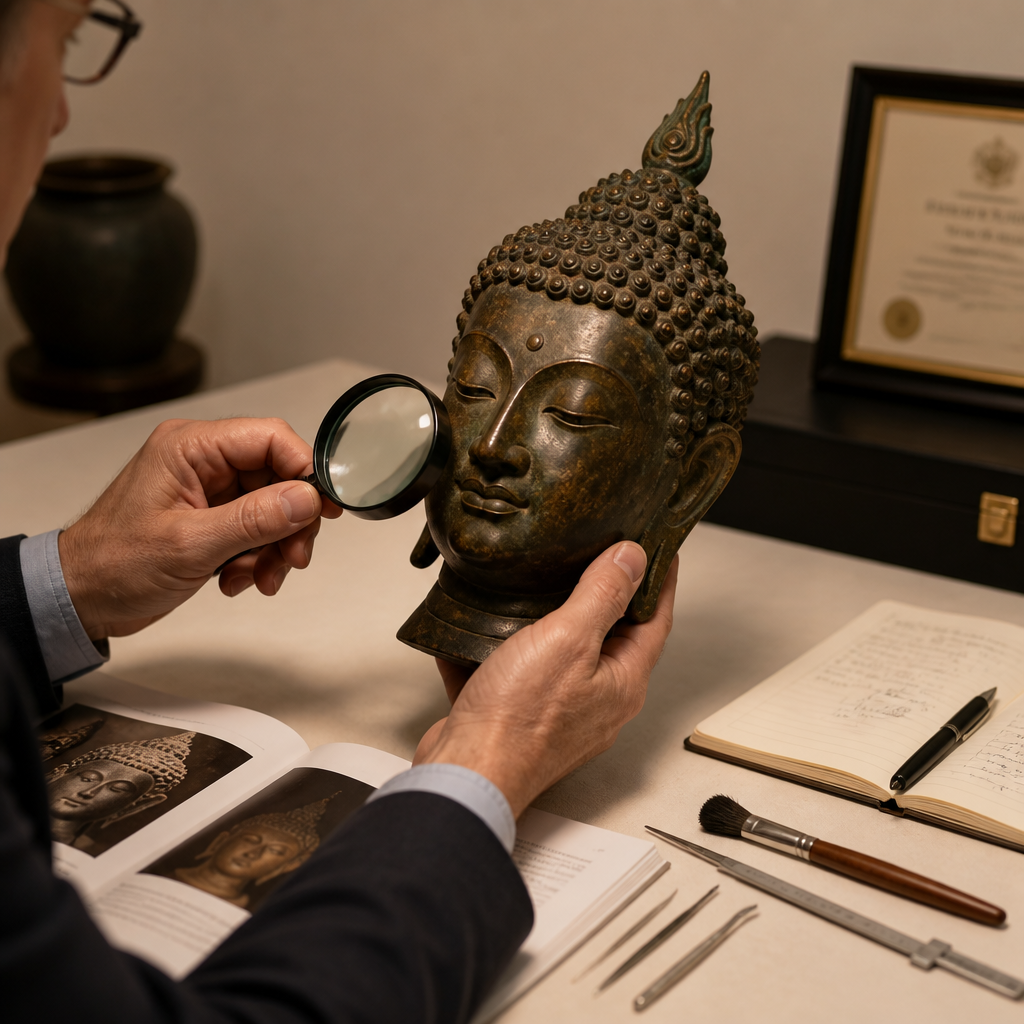
After casting, historic bronzes were cold-worked with chisels and files to refine details. Under magnification, you can see the direction of tool marks, small variations in depth, and areas where the craftsman corrected or adjusted a detail. Machine-finished reproductions show either no tool marks at all or perfectly uniform, repetitive marks. This is particularly visible in the treatment of hair curls on Buddha figures. Genuine historic pieces show slight size variation and irregularity across the curls. Factory-cast reproductions show perfectly identical, evenly spaced curls that look more like moulding than sculpting.
Pro tip: Use a 10x jeweller's loupe to examine the hair curls and robe edges on a bronze Buddha. On a genuine piece, no two curls will be perfectly identical. On a reproduction, they will be essentially clones of one another.
Stone Carving Quality
In stone sculptures from India, Sri Lanka, and Cambodia, quality is visible in the depth and confidence of the carving. Skilled carvers worked fluidly from a clear mental model of the form. Hesitation marks, inconsistent undercutting, and flat, unresolved passages in background areas are signs of either a copy or a low-quality workshop piece. The back of a stone sculpture is also informative. Museum-quality pieces are finished on the reverse, even if more simply. Cheap reproductions are often barely worked on the back, sometimes retaining rough tool marks or cast surface from a mould.
Red Flags That Signal a Reproduction
There is a short list of warning signs that appear consistently across categories of Asian religious sculpture, regardless of whether the piece is a bronze Buddha, a stone Hindu deity, or a lacquered Burmese figure. Learning these by heart will save you from the most common mistakes.
Uniform artificial patina is the most common red flag on bronze. Real patina accumulates in recesses and protected areas first, and its colour varies across the surface. When you see a bronze where the raised areas and the recesses carry exactly the same depth and shade of green or brown, the patina was applied chemically after the fact. Acid-applied and painted patinas also tend to sit on the surface rather than being integrated with the metal, and they can often be disturbed at an edge with a fingernail.
Unrealistic sharpness is a red flag on stone. Genuine antique stone carving shows rounding at edges from handling and time. Factory-produced pieces carved with modern tools often have unnaturally sharp edges that look brand new even when they have been stained or distressed. The distressing is also typically inconsistent, heaviest in the most visible areas and absent in spots a buyer is unlikely to examine closely.
Vague or contradictory origin descriptions from a seller are a consistent red flag regardless of material. A seller who cannot tell you whether a Buddha statue is Thai or Burmese, or who offers only "Southeast Asian, 19th century" without further specificity, either does not know or does not want you to know. Reputable specialists can describe the regional workshop tradition, approximate period, material, and condition with confidence. Where they are uncertain, they say so explicitly and explain why.
Prices that seem too attractive for what is claimed should also raise your attention. A genuine antique bronze from the Ayutthaya period of Thailand, in good condition, is a serious art-market object. A price that places it in the range of contemporary decorative sculpture is either a sign of misattribution or misrepresentation.
Provenance and Documentation
Provenance, the documented history of ownership of a piece, adds credibility and in some cases legal clarity to a purchase. For ancient or antique pieces, provenance documentation showing the piece was in a collection before relevant cultural property export laws came into effect is particularly significant. However, documentation alone is never sufficient for authentication. Physical evidence of age and quality must corroborate whatever the papers say.
A common mistake among buyers new to the field is to treat provenance documentation as a guarantee of authenticity. In practice, paperwork is easier to fabricate than genuine age, and the existence of a letter, invoice, or catalogue entry does not verify that the physical object in front of you is the object described. Always examine the piece independently of the documentation, and treat the documentation as supporting evidence rather than primary proof.
When buying from a specialist dealer, ask directly: can you state the country of origin, the approximate period, the material, and the basis for that attribution? The quality of the answer tells you a great deal about the seller's knowledge and transparency. At HD Asian Art, for example, pieces are sourced directly from across Asia, with descriptions that specify country of origin, material, and regional tradition. That level of specificity is the baseline you should expect from any serious seller of museum-quality Buddhist and Hindu sculpture.
Comparison of Authentication Approaches
There is no single method that authenticates Asian religious sculpture definitively on its own. Serious collectors and appraisers use a combination of approaches, each with different strengths and limitations. The table below compares the three most practical approaches available to non-laboratory buyers.
|
Authentication Approach |
What It Tells You |
Limitations |
|---|---|---|
|
Visual and tactile examination (iconography, material, construction) |
Establishes regional and period consistency; identifies obvious reproductions; assesses casting or carving quality; checks patina authenticity. Accessible to any informed buyer. |
Requires developed expertise. An inexperienced eye will miss subtle inconsistencies. Does not establish absolute date. |
|
Provenance research (ownership history, auction records, publication records) |
Establishes documented history; can confirm pre-export-law ownership; adds credibility and in some cases legal clarity. |
Paperwork can be fabricated. Does not directly authenticate the physical object. Many genuine pieces have no documented provenance. |
|
Scientific testing (thermoluminescence for ceramics/terracotta, XRF for metal alloy analysis) |
Provides objective data on age (TL) or alloy composition (XRF) that is very difficult to falsify. Highest evidentiary value for significant purchases. |
Costly and requires specialist laboratories. XRF testing can only confirm alloy composition is consistent with claimed period, not that the piece is authentic as a whole. Invasive in some cases. |
For pieces in the mid-to-high value range, combining all three approaches is the most reliable method. For lower-value purchases from reputable specialist dealers, thorough visual and tactile examination combined with clear seller attribution is typically sufficient. The key is matching the depth of your due diligence to the value and significance of the acquisition.
Frequently Asked Questions
How can I tell if a Buddha statue is genuinely old rather than artificially aged?
Look at the patina distribution on bronze, or the wear pattern on stone and wood. Genuine age produces wear in the places where handling and environmental exposure actually occur, which are the raised areas, the base, and the contact points. Artificial ageing tends to be applied evenly or concentrated in the most visually obvious recesses. On wood sculptures, genuine ageing produces surface checks that follow the grain and have depth. Applied distressing sits on the surface and does not follow the underlying structure of the material.
Does the country of origin of a Buddha statue affect how I authenticate it?
Yes, significantly. Each major Buddhist and Hindu artistic tradition, Thai, Burmese, Cambodian, Chinese, Indian, Japanese, Sri Lankan, and Javanese, follows distinct iconographic conventions, uses characteristic materials, and employs specific technical approaches. A piece attributed to a specific tradition must be consistent with that tradition across all these dimensions. Mixing iconographic elements from different traditions in a single piece is a common error in reproductions and a reliable red flag.
Is it possible to authenticate a piece without scientific testing?
For many pieces, yes. Thorough visual and tactile examination by an experienced eye, combined with clear and verifiable seller attribution and coherent provenance, is sufficient for a large proportion of purchases. Scientific testing becomes important when the claimed value is high, when there is specific reason to doubt authenticity, or when the piece is being considered for a serious collection. For everyday collecting from established specialist dealers, well-developed visual skills are the primary tool.
What is the most reliable red flag that a Hindu or Buddhist statue is a reproduction?
Perfectly uniform features produced by moulding or machine finishing are the most reliable single indicator. This is most visible in the hair curls of bronze Buddhas and in the decorative border elements of stone deity figures. In genuine workshop-produced pieces, these elements show organic, hand-finished variation. In reproductions, they are mechanically identical. Secondary red flags include artificial patina applied uniformly to all surfaces, unrealistic sharpness at carved edges on pieces claimed to be antique, and vague or contradictory origin descriptions from the seller.
How important is it to buy from a specialist dealer rather than a general antiques market?
It matters considerably. Specialist dealers in Buddhist and Hindu sculpture maintain expertise in regional iconography, materials, and construction methods that general antiques dealers rarely possess. A specialist can attribute a piece confidently to a regional tradition and period, explain the basis for that attribution, and stand behind it. General antiques markets frequently contain pieces that are misattributed, not because of deliberate deception but simply because the seller lacks the background to distinguish a Thai piece from a Burmese one, or a Qing dynasty casting from a 20th-century reproduction. Buying from a specialist whose descriptions are specific and whose sourcing is transparent reduces your risk substantially.
Can high-quality reproductions ever be worth collecting?
Contemporary studio-quality reproductions produced by skilled craftspeople working in living traditional methods can be genuinely beautiful and meaningful objects, particularly for spiritual practice or home altars. The issue arises when they are misrepresented as antique originals and priced accordingly. A quality reproduction sold honestly as such, at a price reflecting what it actually is, is a legitimate purchase. The problem is misrepresentation, not reproduction itself.
Have you encountered a piece that turned out to be something other than what was claimed, or do you have a personal authentication method that has served you well? Share your experience in the comments.
References
