



4 Gallery Vetted Signals Collectors Use to Date a Buddha Statue
4 Gallery Vetted Signals Collectors Use to Date a Buddha Statue
The most reliable verdict comes from stacking four signals: layered, uneven patina; casting or carving marks consistent with hand tools; iconography that matches the claimed region and period; and traceable provenance.
Start by checking material and weight, wear patterns on high points, seams or tool marks, and the base or interior for modern hardware. If those signals conflict, or the piece carries real value, stop guessing and send it to an expert before you buy.
Key Features:
- Provenance documents predating current listings, such as old invoices or auction records, are crucial for establishing authenticity and legal ownership.
- Visual signs like lost-wax casting details, natural patina layering, and traditional joinery strongly indicate genuine age in bronze or wooden statues, respectively.
- Modern repairs, uniform artificial patina, or the presence of contemporary hardware typically reveal reproductions or recent restorations.
- Scientific testing methods such as XRF, UV fluorescence, or radiocarbon dating can verify material composition and age, especially for high-value or suspicious pieces.
- Artisans and appraisers differentiate genuine pieces through attribution to known regional styles and careful surface and interior inspection, not by surface wear alone.
Table of Contents
- How to Tell If a Buddha Statue Is Antique or Vintage or a Modern Reproduction
- Visual Checklist for Signs of a Genuine Buddha Statue
- Technical Testing Options for Buddha Statue Authenticity Checks
- Checking Provenance Before You Buy
- Common Buddha Statue Reproduction Techniques and Red Flags
- When to Get a Professional Buddha Statue Valuation
- What HD Asian Art Looks for When Vetting Incoming Pieces
- A Collector’s Take on Imperfection and Provenance
- Sourcing Authenticated Buddha Statues Through HD Asian Art
- Sources
- FAQ
How to Tell If a Buddha Statue Is Antique or Vintage or a Modern Reproduction
Dealers and appraisers generally use a rough age ladder. An “antique” Buddha statue is usually 100 years old or more. “Vintage” covers decades old but under a century, often mid-20th-century temple or decorative pieces. “Reproduction” means recent manufacture, sometimes made to deliberately mimic an older style. These labels sound tidy until you meet the exceptions that make Buddha statue age determination genuinely hard.
A statue can combine an antique bronze body with a replaced base plate, or an old wood core with a modern repainted face after fire or termite damage. Appraisers call this composite construction, and it matters enormously for value. A fully original 200-year-old Sukhothai-style bronze commands a different price than one with a 1980s repair, even if both look similar in a photo. Honest sellers disclose restoration; evasive ones do not.
Regional style names carry real weight here. Sukhothai, Pala, Ming, Nepalese, and Javanese Buddha statues each follow design conventions tied to specific dynasties, workshops, and centuries. A statue advertised as “14th-century Sukhothai” should show the elongated fingers, flame finial, and serene oval face associated with that period. When the iconography doesn’t match the claimed origin, that mismatch is often the single fastest way to spot fake Buddha statues without touching a lab instrument. Identifying antique Buddha statues starts with knowing what the real thing is supposed to look like, region by region, before you ever inspect surface wear.
This is also where the standard industry term matters more than the shopping phrase. Collectors and appraisers talk about “authentication” and “attribution,” not simply “telling if it’s old.” Attribution means matching a piece to a specific school, period, and likely workshop. Authentication means confirming the physical object is what the attribution claims. You need both, because a statue can be genuinely old and still misattributed, or correctly attributed in style while being a modern copy.
Visual Checklist for Signs of a Genuine Buddha Statue
Material tells its own story before you even reach for a magnifying glass. Genuine age leaves physical evidence that manufacturing shortcuts almost never replicate convincingly.
Bronze statues. Lost-wax casting, the traditional method across Southeast and South Asia, produces small irregularities: slight asymmetry between the statue’s left and right sides, tiny shrinkage pits where metal cooled unevenly, and fine hand-chased details around eyes, drapery folds, and fingers. Case studies on casting technique show that modern sand or shell-mold casting tends to leave a granular surface texture and broad, uniform seams where mold halves met. Patina should build in layers too. Look for a darker, thicker crust in recesses and a lighter, worn sheen on the nose, knees, and hands, exactly where centuries of touching and handling would polish the metal. A single flat greenish or brown coating painted evenly across the whole surface is a red flag, not a feature.
Wood statues. Old wood oxidizes from the outside in, so a fresh break or crack should reveal darker graded coloring toward the surface and paler, newer wood at the very center; recognizing these features as markers of craftsmanship helps verify authenticity as explained in How to Spot Quality Furniture Craftsmanship Markers | Couch & Dumbbells. Genuine insect activity, particularly from wood-boring beetles common in tropical climates, leaves irregular tunnel networks that follow the wood grain unpredictably. Traditional joinery, pegged rather than screwed, is another tell. If you can see fresh pale wood peeking through a “worn” finish, or joinery that relies on visible modern fasteners, treat the age claim with skepticism.
Stone statues. Centuries of handling and weather soften edges and high points while leaving recessed carving crisp. Tool marks matter too. Older stone pieces show hand-chiseled variation, subtle inconsistencies in stroke depth and spacing. Modern reproductions often show repetitive, mechanically even chisel patterns from rotary tools.
Gilding and lacquer. Traditional fire-gilding leaves microscopic pits and thin, uneven gold coverage that thins naturally at edges and high-wear points. Electroplating, by contrast, produces a bright, perfectly even gold layer with no thickness variation, a strong sign of modern re-gilding or an entirely new piece.
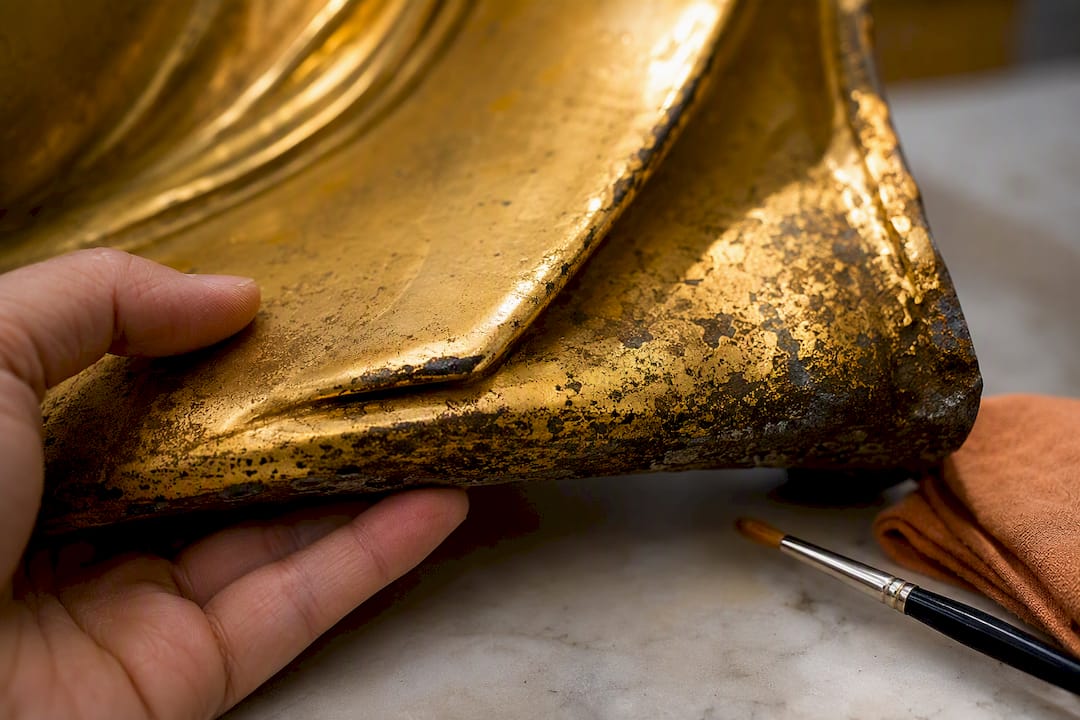
Base and interior. Check for hand-cut base plates, evidence of traditional ritual sealing (sometimes with sacred texts or relics inside), and dirt accumulation that follows logical patterns, thicker in crevices, thinner on protruding surfaces. Modern screws, bright solder, or visible epoxy inside the base almost always indicate a repair or a reproduction.
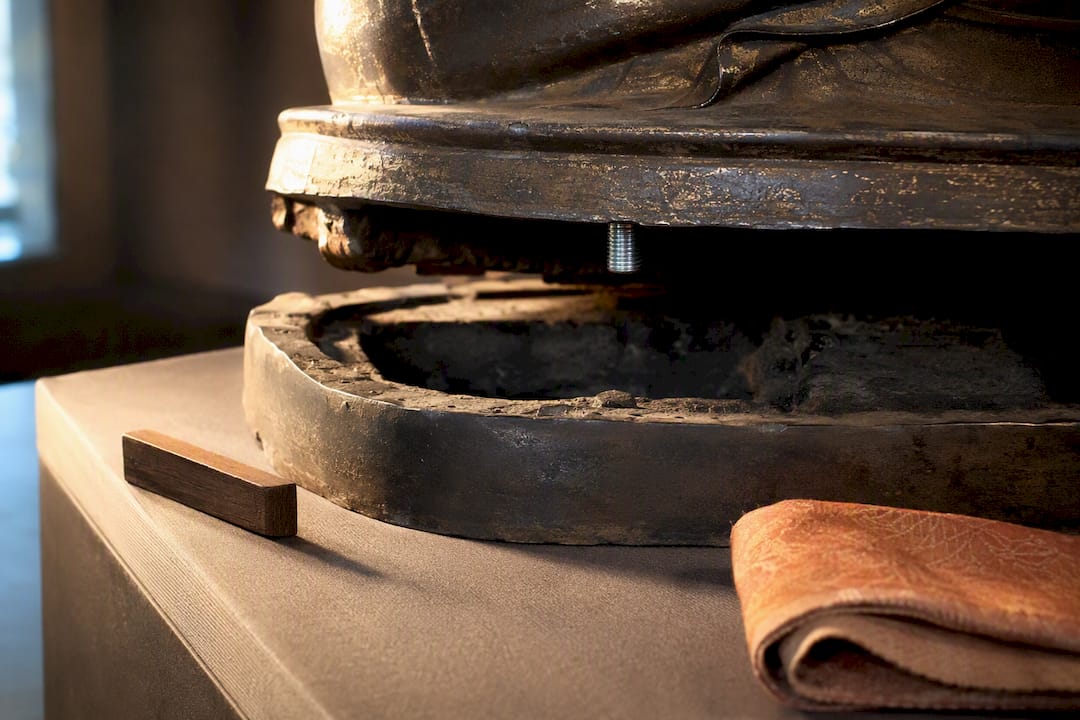
Pro Tip: Photograph the interior of the base and any seams under raking light (a flashlight held at a low angle) before you buy. This single photo often reveals more about authenticity than ten close-ups of the face.
Technical Testing Options for Buddha Statue Authenticity Checks
Visual inspection answers most questions. When it doesn’t, or when the piece is valuable enough to justify the expense, laboratory testing fills the gaps.
- XRF (X-ray fluorescence) analysis is non-destructive and identifies the metal alloy composition in seconds. Unexpected zinc content, for instance, often points to modern brass rather than the copper-tin bronze alloys typical of older Southeast Asian casting, or flags a later repair section grafted onto an older body.
- Microscopy and UV inspection examine surface stratigraphy and gilding under magnification, while UV light exposes modern finishes because artificial lacquers and chemical patinas frequently fluoresce differently than naturally aged surfaces. This is a cheap, fast screening step conservators use before committing to anything more invasive.
- X-radiography looks inside the statue without opening it, revealing modern armatures, hidden repairs, or an internal core inconsistent with the claimed casting method.
- Radiocarbon dating (AMS) and dendrochronology apply to wooden statues and their cores. Wiggle-matching against tree-ring chronologies can narrow radiocarbon uncertainty to roughly 15 to 30 years at a 95% confidence level, and in documented cases has linked a statue’s timber to log-cutting within months of an inscribed dedication date. It requires a small physical sample, so it’s reserved for genuinely uncertain, high-value cases.
Photo-based AI dating tools have entered the market recently, and they’re worth understanding rather than dismissing outright. Research on image-based machine learning models for estimating Buddha statue construction dates shows a mean absolute error of a few decades. That’s a useful secondary data point for research purposes, but it’s nowhere near precise enough to anchor a purchase decision on its own. Treat AI dating the way you’d treat a knowledgeable friend’s guess: informative, not conclusive.
The smartest approach layers these tools by cost. Start with visual inspection, move to UV and microscopy for anything that looks suspicious, then commission XRF or X-ray only when the stakes justify it, and save AMS or dendrochronology for genuinely unresolved, high-value pieces.
Checking Provenance Before You Buy
Good provenance documentation does more to establish authenticity than any single visual clue, and it protects you legally as much as financially.
- Look for paper trails that predate the current listing. Old invoices, exhibition catalog entries, prior auction records, and pre-1970 export documentation all carry weight, and earlier documentation is generally more valuable because it predates the international treaties that now restrict movement of cultural property.
- Ask sellers for specific photos, not just marketing shots. Request close-ups of the base interior, any seals or inscriptions, and the areas showing the most wear. A reproduction red flag many buyers miss: sellers of modern pieces often photograph everything except the base interior, precisely because that’s where modern plates or hardware would be visible.
- Cross-check comparable sales. Auction records and gallery archives for similar statues by style, size, and material help validate whether an asking price is realistic or inflated on the strength of an unsupported “antique” claim.
- Take legal and ethical questions seriously. Statues excavated or exported illegally from source countries in recent decades raise national patrimony concerns that can affect your ability to resell or even legally own the piece. For anything of significant value or uncertain export history, consult a specialist before finalizing a purchase.
Common Buddha Statue Reproduction Techniques and Red Flags
Forgers and unscrupulous restorers rely on a small set of tricks, and each one leaves a detectable trace if you know where to look.
- Artificial patination. Sprayed or chemically induced green and brown finishes sit uniformly across a surface instead of building naturally in recesses. Magnification often shows spray texture or brush strokes; UV light frequently shows a fluorescence inconsistent with age.
- Modern machining and repetitive textures. Belt-sanded seams, rotary-tool striations, and identically repeated decorative patterns all point to power tools rather than hand carving. Genuine hand craftsmanship carries small, human inconsistencies that machines don’t.
- Staged “temple dirt.” Some sellers glue grit or soot into crevices to fake decades of handling. Gently testing adhesion in an inconspicuous spot, real accumulated dirt sits loose and brushes away unevenly, while glued-on grime resists uniformly.
- Modern hardware and fills. Phillips-head screws, bright unoxidized solder, and epoxy fills inside a base or joint are anachronisms. These almost always surface once you actually open or photograph the interior.
Pro Tip: Carry a small UV flashlight (365 nm, widely available for under $20) to any in-person viewing. It’s the fastest field test for artificial patina and modern lacquer, and most sellers won’t object to you using one.
When to Get a Professional Buddha Statue Valuation
Visual inspection is usually enough for casual decorative purchases under a few hundred dollars. The calculation changes once value, rarity, or uncertainty rises.
- Get an appraisal when the asking price exceeds what you’re comfortable losing on a mistake, when the iconography is unusual or hard to place, or when provenance documentation has real gaps.
- Photo appraisals are the cheapest and fastest option, often turned around within days, but they can’t resolve alloy composition or internal construction questions.
- In-person appraisals cost more and take longer to schedule, but let a specialist examine weight, tool marks, and base construction directly.
- Lab testing (XRF, X-ray, AMS) costs the most and can take weeks, so reserve it for pieces where the appraisal itself recommends scientific confirmation.
When you contact an appraiser or lab, provide sharp photos of the base interior, any inscriptions, and close-ups of wear areas, and ask specific questions (“does the alloy match the claimed period and region?”) rather than a vague “is this real?” Accredited conservation labs and members of professional appraisal associations are the right starting point for a qualified referral.
What HD Asian Art Looks for When Vetting Incoming Pieces
Gallery vetting often turns on details a casual buyer would never think to check. A statue’s facial style might read correctly for a claimed 18th-century Burmese origin, but a base plate secured with modern screws instantly reopens the question. Small mismatches like that, iconography right, hardware wrong, are frequently what expose a piece as a later composite rather than an outright fake.
Every incoming piece gets photographed from a consistent set of angles: full front and profile, close-ups of the face and hands, and always the base interior under raking light. That last shot matters more than people expect, since it’s where modern repairs hide. Readers researching a specific piece can dig deeper through guides on authenticating antique bronze Buddha statues or dating Thai Buddha images, or reach out directly for a consultation on a specific statue.
A Collector’s Take on Imperfection and Provenance
Devotional objects deserve respect beyond their resale value, and cultural sensitivity should guide how you buy and display them. A documented crack, an old repair, or worn gilding often adds scholarly and collector interest rather than subtracting from it, since imperfection frequently proves age in ways a flawless surface cannot. Favor sellers who volunteer their documentation instead of withholding it, and keep records of your own purchase and any export history you’re given.
— James, HDAsianArt.com
Sourcing Authenticated Buddha Statues Through HD Asian Art
HD Asian Art exists precisely because most of what this checklist describes takes years to learn and a trained eye to apply consistently. Every piece in the gallery’s collection is individually researched and photographed, with provenance notes, condition details, and specialist descriptions already done for you, so you’re not left guessing at base interiors or patina layers from a single listing photo.
If you’re weighing a specific style, a piece like this antique Indonesian Javanese Avalokiteshvara Bodhisattva statue shows the level of documentation you should expect from any seller claiming authenticity. Requesting condition photos or provenance records from a reputable gallery costs nothing and takes minutes; many galleries offer worldwide insured shipping. Browse the collection, request the base and interior shots on anything that catches your eye, and reach out for a specialist consultation before you commit.
Sources
For deeper research into scientific dating, look into published dendrochronology and AMS wiggle-matching studies for wood, and conservation literature on XRF alloy analysis and UV fluorescence screening. Before hiring any lab, confirm its accreditation and ask specifically about prior experience dating Asian sculpture, not general antiques.
- Built year prediction of Buddha face with heterogeneous label modeled as probabilistic distribution (Osaka University / related proceedings)
- Tree-ring dating and AMS wiggle-matching of wooden statues (published study)
- Mastering antiquity: A comprehensive guide to identifying authentic antique Buddha statues — Appraisily
- UV fluorescence of pigments and coatings — WebExhibits (UV inspection notes)
FAQ
How can you tell the age of a Buddha statue?
Combine visual clues, patina layering, tool marks, and iconographic style, with provenance documentation, and reserve scientific testing like XRF or AMS radiocarbon for pieces where those signals conflict or the value is high.
Where should you not place a Buddha statue?
Traditional practice generally discourages placing a Buddha statue on the floor, in a bathroom, or facing a bedroom directly, since these placements are considered disrespectful to the figure’s devotional significance.
What are the three main types of Buddha statues?
Statues are commonly grouped by posture and gesture: seated (often in meditation), standing (frequently teaching or blessing), and reclining (representing the Buddha’s final passing into nirvana).
How do you identify a Buddha statue’s style or origin?
Match the facial features, posture, hand gestures, and ornamentation against known regional schools such as Sukhothai, Pala, Ming, Nepalese, or Javanese, since each follows distinct conventions tied to a specific period and workshop tradition.
Is a certificate of authenticity necessary when buying an antique Buddha statue?
Documentation strengthens confidence but isn’t the only signal worth trusting. Prioritize sellers who provide detailed provenance, base and interior photos, and clear condition reports alongside any certificate.
