



Apsara Sculpture: Cambodia's Celestial Dancers of Angkor
Apsara Sculpture: Cambodia's Celestial Dancers of Angkor
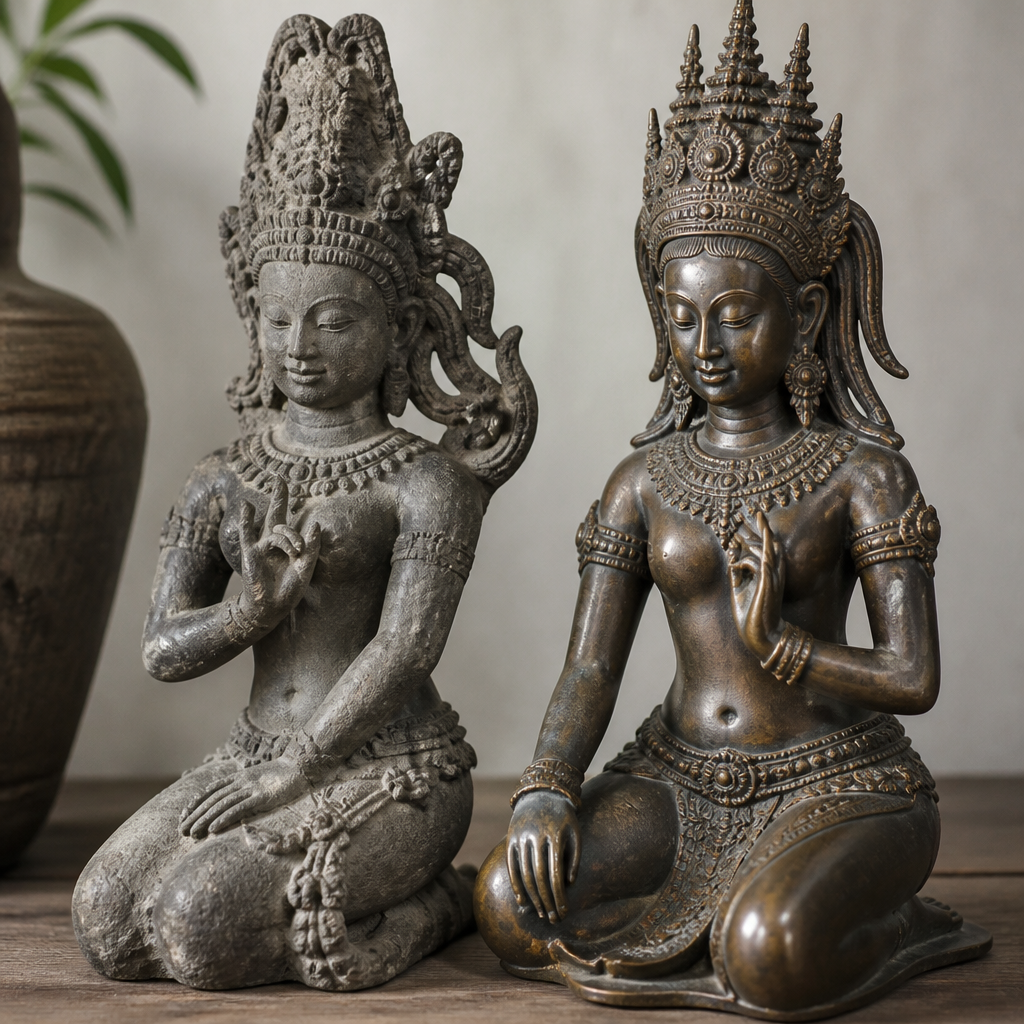
Walk through any major Khmer temple complex and you will see the same figure repeated across walls, pillars, and lintels: a female dancer in a tall headdress, body bent in a graceful line, often holding a flower or a sash. These are Apsaras, the celestial dancers of Cambodian art, and the Apsara sculpture tradition is one of the most recognizable visual languages in Southeast Asia. Many buyers assume every dancer looks alike. They do not, and the differences in material, pose, and origin matter when you are choosing a piece for a collection or a home altar.
Table of Contents
- Quick Takeaways
- Who the Apsara Are in Khmer Belief
- Carving Versus Bronze: Why Most Angkor Apsaras Are Stone
- Reading the Dancers: Pose, Hands, and Costume
- Temple Walls of Angkor and the Carved Tradition
- From Royal Court Stage to Stone
- Comparing Apsara Sculpture Formats
- Choosing an Apsara Statue for Your Home or Collection
- Frequently Asked Questions
- References
Quick Takeaways
|
Key Insight |
Explanation |
|---|---|
|
Apsaras are celestial nymphs, not generic dancers |
Identify the figure by its dancing pose and elaborate headdress. Confirm whether a piece depicts an Apsara or a deity before you pay for it, because the two are often mixed up in listings. |
|
Material tells you the original role |
Stone figures were usually built into temples as permanent architecture. Bronzes were portable, so a bronze Apsara is more likely a standalone devotional or collector object. |
|
Stone weight changes your home setup |
Heavy stone figures need a stable plinth and a floor that can carry the load. Measure your doorways and shelving before ordering. |
|
Hands and posture are the fastest quality check |
Well-made pieces keep the hands, body line, and costume details in balance. Thin, stiff, or awkwardly proportioned hands are a common sign of a weak reproduction. |
|
Temple carvings are the reference point |
The carved dancers on the walls of Angkor Wat are the visual standard most collectors compare against. A seller who cannot explain the reference is guessing. |
|
Vague origin wording is a warning sign |
Look for a named country of origin and a clear description of material and construction. "Asian style" tells you nothing about what you are buying. |
|
Qualifying orders ship free |
HD Asian Art offers free shipping on orders over £35, so you can compare formats and sizes without adding a shipping cost to the decision. |
Who the Apsara Are in Khmer Belief
The Apsara is a celestial nymph, a female spirit of the heavenly realm who appears in Khmer art as a dancer. Heritage Line, which publishes material on the Khmer Apsara dance, describes the figures as celestial nymphs dancing across temple walls, and that image has stayed central to how the form is understood today. When a piece is presented as an Apsara, the subject is not an ordinary court dancer. It is a being of the heavens shown in motion.
In practice, the easiest way to read the subject is to look at what is around the figure. A dancer standing alone with a flower or lotus, shown with calm posture and rich ornament, usually reads as a celestial attendant. A figure placed among other beings or inside a larger architectural frame often belongs to a narrative scene. Collectors who understand this distinction ask better questions about provenance and context.
Cultural meaning also matters for home altars and personal practice. Apsaras stand for beauty, grace, and artistic skill, which is why the figure appears so often in Cambodian visual culture. Some buyers want a piece for its decorative beauty alone, and that is a valid choice. Others want a figure that connects to the traditions the dancer comes from, and they should look for pieces that show real attention to the classical form rather than a loose, generic dancer silhouette.
Carving Versus Bronze: Why Most Angkor Apsaras Are Stone
The material of an Apsara sculpture often tells you more about its purpose than its size or price. The Smithsonian's National Museum of Asian Art explains that heavy stone sculptures were typically architectural elements or figures designed as permanent fixtures, while bronzes were portable objects. That distinction is the single most useful starting point when you evaluate a piece for your own space.
Stone pieces built into architecture
The most famous Apsara imagery in Cambodia is carved in stone and set into temple structures. These carvings were conceived as part of a building, not as objects to be moved. When you see a stone Apsara in a shop, it is usually a freestanding figure or a panel modeled on that architectural tradition. The original context was permanence, and that shapes how a stone piece behaves in a modern home.
A practical point: a stone figure is far heavier than most buyers expect. Set it on a shelf that was never designed for weight, and you create a real risk of damage to both the shelf and the statue. A stable plinth or a floor-level position is the safer choice.
Bronze figures made to move
Bronze Apsaras follow a different logic. Because bronze was used for portable objects, a bronze dancer is easier to place on an altar, a sideboard, or a display plinth. The Metropolitan Museum of Art's educator resource on South and Southeast Asian art covers Buddhist and Hindu sculpture in both stone and bronze, which reflects how the two materials were used across the region.
Judging a bronze means looking at how the metal was worked. Check whether the fine details of the fingers, the sash, and the headdress are crisp and balanced, and whether the surface finish looks deliberate rather than sprayed on. Uneven casting and soft detail are the first signs that a bronze is a rushed copy.
Reading the Dancers: Pose, Hands, and Costume
Once you know the material, the next step is reading the figure itself. The Apsara's body is designed around a bent, poised line rather than a rigid stance. Good sculptors balance the tilt of the torso, the angle of the hips, and the placement of the arms so the figure seems to move while staying still. If a piece looks stiff or static, the proportions are usually off.
Hand gestures and body line
The hands carry much of the meaning in a dancing figure. In a well-made Apsara, the fingers are slender, separated, and held with clear intention. In a weak copy, the hands often look swollen, blunt, or pressed flat against the body. Because hands are hard to carve well, they are one of the fastest ways to judge the skill behind a piece.
Look at the line from the head to the feet as well. A strong figure has a continuous curve, and the weight shifts naturally from one leg to the other. When the line breaks at the waist or the knee, the piece has been assembled from parts that were not designed together.
Headdresses and jewelry
Headdresses and jewelry are where many collectors spend their attention, and for good reason. The crown, earrings, necklaces, and armbands give each figure its identity and its ornamental density. Compare these elements across several pieces, not just one. The best examples show ornament that is intricate but organized, with repeating motifs that feel planned rather than scattered.
Pro tip: Photograph a potential purchase from the side and from above before you buy. The side view reveals the body line, while the top view shows whether the headdress and shoulders are balanced. Ask the seller for both angles if they are not already in the listing.
Temple Walls of Angkor and the Carved Tradition
Angkor is where most people first meet the Apsara, and the carved dancers on its walls remain the reference point for almost every sculpture made since. Heritage Line's article on the Khmer Apsara dance notes that the form is evidenced in carvings on the walls of Angkor Wat. Those carvings are the standard that collectors and makers measure against, even when a piece is made for a modern home.
Why the walls set the standard
Carved relief works differently from a freestanding figure. The dancers are often arranged in rows, interacting with other beings, and framed by architectural borders. Each figure was designed to be seen from a particular distance and angle. When you copy that style for a modern piece, you need to understand the rhythm of the original, not just the outline of a single dancer.
In practice, a good reproduction keeps the sense of rhythm. A dancer who looks correct alone but would clash with a second figure beside her is often a sign that the maker copied from a photograph without understanding the composition.
What copies usually get wrong
Most weak copies share the same failures. The face becomes generic, the headdress becomes flat, and the costume loses its layered drape. The overall body line may still look elegant from a distance, but close inspection shows smoothed-over detail and missing depth. Those details are exactly what a careful buyer should check.
A common mistake is judging by the photograph alone. Images flatten texture, hide the back of the piece, and rarely show the base. Ask for the back and the underside, and check whether the finish on the rear looks as considered as the front.
From Royal Court Stage to Stone
The Apsara was not only a sculptural motif. Heritage Line describes the dance as originally performed in royal courts, serving as both entertainment and a sacred ritual that marked important events. That double purpose explains why the figure carries both artistic refinement and religious weight in the sculptures that survive.
Court dance and ritual
When you see a dancer in stone, you are looking at a frozen moment from a practice that had a clear social role. The poses in sculpture echo the movements of the court dance, which is why the gestures are so precise. A sculptor was not inventing a random pose. The figure reflects a known vocabulary of movement.
For a collector, this history gives a useful lens. A piece that captures a plausible dance gesture usually reads as more authentic than one that simply looks pretty. The question to ask is whether the pose would make sense on a stage or in a ritual setting.
How the tradition changed over time
Heritage Line also describes the dance as one that absorbed influences from other cultures over the centuries. The same is true of the sculpture. Styles shifted, materials changed, and new makers reinterpreted the figure for new audiences. Heritage Line dates the roots of the dance to the 7th century, but dating carved and cast works is a specialist task, so treat any single date you see in a listing with caution.
Recognizing change is useful when you compare pieces. A figure can be a faithful modern interpretation without being an old work, and a seller should be clear about which one you are buying.
Comparing Apsara Sculpture Formats
Most buyers choose between three broad formats. Each one suits a different setting, and each has its own weak points. The table below compares them from the perspective of someone who wants a piece to live in a home, not just in a catalogue.
|
Format |
Typical Setting |
What to Check Before Buying |
|---|---|---|
|
Architectural style stone relief panel |
Wall display, feature panel, or a reference piece in a study |
Mounting method, weight, and whether the panel is designed to hang or stand. Confirm the back is finished if it will be seen from the side. |
|
Freestanding stone figure |
Altar, garden room, or a floor-level corner |
Plinth stability, surface weathering, and the base. A heavy figure on an uneven floor is a safety problem, not just an aesthetic one. |
|
Cast bronze figure |
Home altar, sideboard, or collection shelf |
Casting seams, detail sharpness in the hands and headdress, weight distribution, and whether the patina looks deliberate. |
In practice, the bronze figure is the most forgiving choice for a first purchase, because it is easier to move and reposition. Stone offers more presence and a closer link to the temple tradition, but it asks more of your space. Relief panels suit buyers who want the carved composition without the weight of a full figure.
Choosing an Apsara Statue for Your Home or Collection
The right Apsara depends on where it will live, how you plan to use it, and how much attention you want to give it. A piece placed in a quiet corner for daily viewing has different requirements from one that anchors an altar or a collector's shelf. Start with the space, then choose the material and size.
Size, weight, and placement
Measure the intended spot before you look at listings. Note the height, the depth, and the load your shelf or floor can carry. A figure that is slightly too large often looks crowded, while one that is too small disappears in a room with high ceilings. Stone figures need the most planning because their weight limits where they can safely go.
Think about sightlines too. An Apsara is designed to be viewed from a distance and from the front, so place it where the face and hands can be seen clearly. A figure tucked behind other objects loses the very detail that makes it worth buying.
Reading the seller's description
A trustworthy description names the material, the country of origin, and the construction. It explains whether the piece is an original antiquity, a modern handmade work, or a reproduction. If the wording is vague or avoids the question, treat that as information in itself. Good sellers answer these questions without being asked.
Pro tip: Ask how the piece should be cleaned before it arrives. Stone and bronze respond differently to dust and moisture, and a simple question at the time of purchase prevents damage that is hard to undo later.
A good Apsara rewards close looking. The more you study the hands, the line of the body, and the balance of the ornament, the easier it becomes to tell a carefully made figure from a quick imitation.
Pro tip: If you are buying for an altar, decide on placement before you choose the material. A stone figure that cannot be moved without help is a poor match for a space you plan to rearrange often.
Frequently Asked Questions
What is an Apsara in Cambodian art?
An Apsara is a celestial nymph in Khmer art, shown most often as a dancer. Heritage Line describes these figures as celestial nymphs dancing on temple walls, and they appear across the carvings and sculptures associated with Cambodia's classical tradition.
Are most Angkor Apsaras made of stone?
The carved Apsaras most visitors see at Angkor are stone reliefs, because stone was used for architecture and permanent figures. Bronze was more often used for portable objects, so a bronze Apsara is more likely to be a standalone piece rather than a building element.
How can I tell a well-made Apsara statue from a weak copy?
Start with the hands, the body line, and the headdress. Well-made pieces have slender, clearly defined fingers, a continuous curve through the body, and ornament that is intricate but organized. Soft detail, stiff posture, and flat or blurred ornament usually signal a weaker reproduction.
Does the material affect where I should place a statue?
Yes. Stone figures are heavy and need a stable plinth or a floor-level position that can carry the load. Bronze figures are easier to move and suit altars, sideboards, and display shelves, but they still need a stable base and protection from harsh moisture.
Is an Apsara only a decorative subject?
No. Apsaras are decorative, but they also carry cultural and artistic meaning. The dance they come from was historically performed in royal courts as both entertainment and a sacred ritual, so many buyers choose a piece for its connection to that tradition as well as its visual beauty.
Do you offer free shipping on Apsara statues?
HD Asian Art offers free shipping on orders over £35. You can explore the wider range of Buddhist and Hindu sculptures, including Cambodian and other Southeast Asian pieces, on the HD Asian Art homepage.
Which Apsara detail do you find most difficult to judge when you compare pieces, the hands, the headdress, or the overall body line? Share your experience in the comments, because the buyers who look closely often spot the details that matter most.
References
-
Heritage Line article on the Khmer Apsara dance and its history
-
Metropolitan Museum of Art educator guide to South and Southeast Asian art
-
National Museum of Asian Art notes on Southeast Asian collections
