



Collectors: Insure and Ship an Authenticated Bronze in 1–3 Weeks
Collectors: Insure and Ship an Authenticated Bronze in 1–3 Weeks
Yes, collectors can buy an authenticated antique Asian bronze statue and have it delivered with full provenance and insured courier protection. HDAsianArt researches, photographs, and ships bronzes with worldwide insured DHL service.
The first move before anything ships is simple: request the provenance file and a written condition report, then confirm crating and customs paperwork before you authorize the shipment.
Key Features:
- Provenance should include a documented ownership chain, auction records, export permits, and high-resolution photos of key details before purchase.
- Insure the bronze for its full declared or appraised value during transit, using museum-grade crating and insured courier services like DHL.
- Customs clearance requires an accurate commercial invoice, packing list, provenance documents, and valid export permits, especially for culturally protected artifacts.
- An independent specialized appraiser should verify casting method, alloy composition, and stylistic features specific to the artifact’s region to confirm authenticity.
- The purchase contract must explicitly state shipping, insurance, declared value, and responsibility clauses, including conditions for damage inspection upon arrival.
Table of Contents
- How to Verify Authentication and Provenance Before You Ship a Bronze Statue
- What Insured Shipping and Packaging Look Like for a Museum-Quality Bronze
- What Customs and Import Paperwork Should You Expect?
- Building a Condition Report and Establishing Insured Value
- Your Checklist From Purchase to Delivery
- How to Choose an Appraiser or Authentication Specialist
- Negotiating Shipping and Insurance Terms Into the Purchase Contract
- Managing the Real Risks of Theft and Damage in Transit
- How HDAsianArt Documents and Ships Every Bronze It Sells
- Ready to Add an Authenticated Bronze to Your Collection?
- Sources
How to Verify Authentication and Provenance Before You Ship a Bronze Statue
Provenance is the paper trail that separates a documented 15th-century Tibetan gilt bronze from a well-aged copy. Before you commit to purchase, ask the seller for a written provenance chain, any auction records, prior condition reports, and copies of export or import permits from the piece’s country of origin. Gaps in that chain are not automatically disqualifying, but they should trigger more questions, not fewer.
Physical inspection matters just as much as paperwork. Casting method tells a story: lost-wax bronzes from Cambodia, Thailand, or Sri Lanka show mold-seam patterns and surface texture that mass-produced replicas rarely replicate correctly. Look at the base for consecration deposits or ritual fill, check for old repairs versus recent solder work, and compare stylistic details against known regional and dynastic conventions.
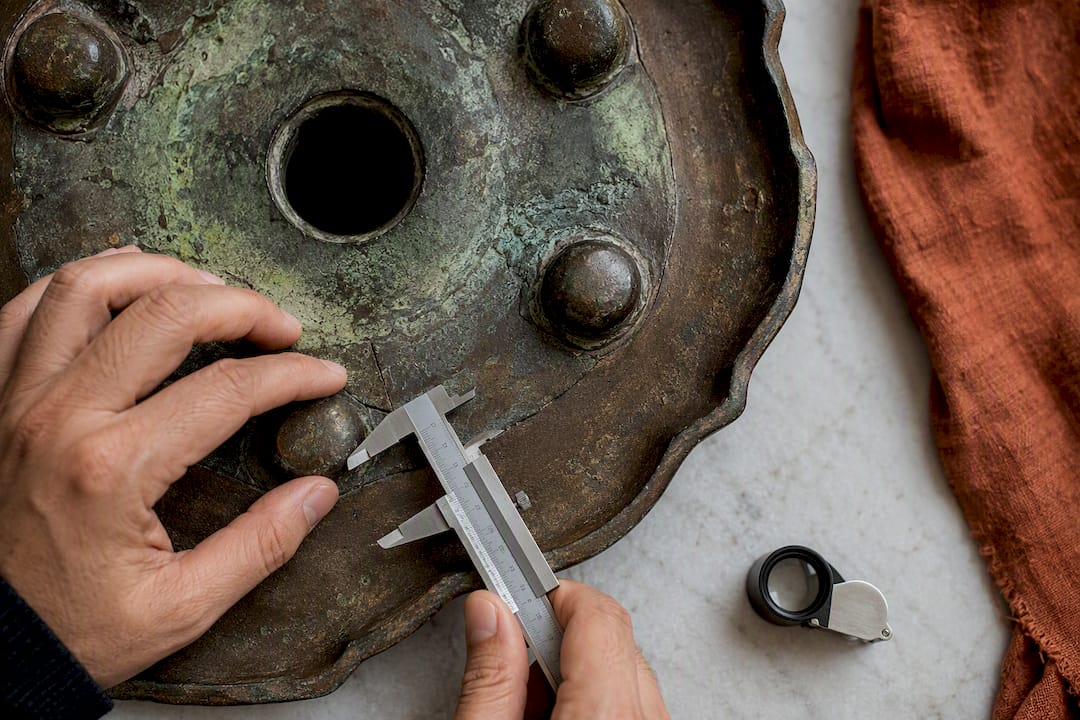
Modern forgeries of ancient bronzes are common enough that simulated patina and aged surfaces fool casual buyers regularly, which is exactly why documentary provenance has to be paired with physical and technical review rather than trusted alone. When a piece carries real market weight, a specialist appraisal or scientific test (thermoluminescence for certain materials, metallurgical analysis for alloy composition) is worth the cost.
Here’s what to request before you wire a deposit:
- A documented provenance chain with dates and prior ownership
- Auction records or gallery sale history, if they exist
- Any existing condition reports from prior owners or appraisers
- Export and import permits already on file for the piece
- High-resolution photography showing base, patina, and repair areas
HDAsianArt’s object research and photography function as a trust signal precisely because they document these details before a buyer ever asks.
Pro Tip: Ask for casting-technique context specific to the region, not generic authentication language. A dealer who can explain how Southeast Asian bronze casting traditions differ from Chinese or Tibetan methods is showing real expertise, not a script.
What Insured Shipping and Packaging Look Like for a Museum-Quality Bronze
Standard carrier liability rarely covers what a documented antique bronze is actually worth. Most freight carriers cap liability at a fraction of declared value, calculated by weight rather than appraised value. Fine-art insurance works differently: it insures the object at its full declared or appraised value, covering transit damage, theft, and total loss from the moment it leaves the seller’s hands until it’s signed for at delivery.
Crating standards for bronze statuary follow a specific logic. A heavy bronze concentrates weight low in the crate, so packing has to prevent internal shifting rather than just cushion the exterior. Museum-grade crating typically involves:
- A custom-built wooden crate sized to the object, not a generic box
- Internal foam or cushioned supports that immobilize the piece against shock and vibration
- Moisture barriers appropriate for ocean or extended air freight
- Clear “this side up” and fragile markings plus weight distribution notes for handlers
Insured international couriers, arranged through the gallery in DHL-style worldwide service, are the standard route for high-value pieces because they combine trackable custody with declared-value insurance rather than blanket carrier terms. When you review a shipping quote, verify the declared value matches the appraised or purchase value, confirm whether insurance is door-to-door or port-to-port, and ask what documentation the insurer requires if a claim arises.
Given that top-tier gilt-bronze pieces have sold for six and seven figures at auction, skipping full-value insurance on a comparable piece to save a few hundred dollars is a poor trade. Transit timelines for insured international bronze shipments typically run one to three weeks depending on customs processing, with staged pickup scheduled once crating is complete and paperwork is confirmed.
What Customs and Import Paperwork Should You Expect?
Clearing U.S. customs with an antique bronze statue requires a specific paper stack, and missing pieces of it cause delays more often than any other single issue. At minimum, expect to need a commercial invoice with accurate declared value, a detailed packing list, provenance documentation, and export licenses from the country of origin where those are legally required.
Cultural property checks add another layer. Some countries restrict export of religious or archaeological artifacts outright, and certain categories can intersect with CITES rules or State Department cultural property agreements, particularly for pieces tied to temple sites or archaeological contexts. A legitimate seller will have already resolved export legality before listing the piece.
Watch for these documentation red flags before you finalize purchase:
- No export permit despite a country of origin that requires one
- Provenance that starts abruptly with no ownership history before a certain date
- Inconsistent descriptions between the invoice, condition report, and provenance file
- A seller unwilling to provide documentation in writing before payment
When any of these appear, pause and consult an attorney familiar with cultural property law or a specialist appraiser before proceeding. The cost of that consultation is trivial next to a seized shipment.
Building a Condition Report and Establishing Insured Value
A proper condition report is the document an insurer, a customs officer, and a future buyer will all eventually reference. It needs to stand on its own without the seller in the room to explain anything.
At minimum, the report should record exact dimensions and weight, material composition, and photographs from every angle including close-ups of the base, any repairs, and areas of wear. Appraisers consistently recommend photographing an object before any cleaning or handling, since restoration attempts before documentation can destroy evidence of age and prior condition.
Your photography checklist should include:
- Full front, back, and side views with a ruler or scale reference in frame
- Close-ups of the base, any inscriptions, and casting seams
- Detail shots of repairs, cracks, or restoration work
- Overall shot showing the piece next to a known measurement standard
Insured value gets established by combining the purchase price, any independent appraisal, and comparable auction results for similar pieces. That documented value becomes the number the insurer uses for coverage and the number customs references for declared value. If a claim ever gets filed, the insurer will ask for exactly this file.
Pro Tip: Keep the condition report and photography set as a standalone folder, separate from the sales invoice. If you ever resell the piece, that documentation becomes part of its provenance and adds real value at the next sale.
Your Checklist From Purchase to Delivery
Moving a bronze statue from purchase decision to your door safely follows a predictable sequence. Skipping steps is where things go wrong.
- Confirm provenance and request the formal condition report with high-resolution photography
- Agree on insured shipping terms in writing, including declared value and crating standards
- Collect and verify export and import paperwork, including any required permits
- Confirm the shipping quote covers door-to-door insurance, not just carrier liability
- Supervise or confirm the insured pickup and track the shipment through customs
- Inspect the piece against the condition report immediately on arrival, before signing off
| Stage | What to confirm | Who handles it |
|---|---|---|
| Pre purchase | Provenance chain, condition report | Buyer and seller |
| Pre shipment | Insured value, crating standard | Gallery or shipper |
| Customs | Invoice, permits, packing list | Shipper and broker |
| Arrival | Physical inspection vs report | Buyer |
Each stage produces a document you’ll want if a dispute or insurance claim ever arises. Keep them together, not scattered across email threads.
How to Choose an Appraiser or Authentication Specialist
Not every appraiser has real depth in Southeast Asian or South Asian bronze traditions, and that distinction matters more than general antiques credentials. Look for someone with a documented specialization in the specific region and period your piece comes from, not a generalist Asian art appraiser working from broad training.
Ask for their professional affiliations, such as membership in a recognized appraisal association, and request examples of past work involving comparable bronzes. A specialist should be comfortable discussing casting technique, alloy composition, and regional stylistic markers without falling back on vague language like “it looks old” or “the patina seems right.”
Appraisal practice recommends systematic documentation over impressionistic judgment, including detailed photography, measurements, and condition histories, plus attention to common red flags like repetitive mold seams, replaced bases, and inconsistent provenance. A qualified appraiser follows that same discipline rather than offering a quick verbal opinion.
Be cautious of anyone who wants to handle, clean, or “restore” a piece before completing the appraisal. That sequence destroys evidence an insurer or future buyer would want intact. A good specialist documents first and touches the object as little as possible until the paperwork is done. If a seller resists independent appraisal entirely, treat that resistance itself as information worth weighing carefully.
Negotiating Shipping and Insurance Terms Into the Purchase Contract
The purchase contract for a high-value bronze should specify shipping and insurance terms explicitly, not leave them as a verbal understanding to sort out after payment clears. Vague contracts are where disputes start.
Spell out who arranges the crating and insured courier, what declared value the insurance will use, and who bears responsibility if the piece is damaged before it reaches the carrier versus after. Specify a delivery timeline with a reasonable window, since customs delays are common and an unrealistic deadline creates friction that helps nobody.
Include a condition-verification clause: the buyer inspects the piece against the pre-shipment condition report within a defined window after arrival, with a clear process if damage is found. Without that clause, a damaged arrival becomes a he-said-she-said dispute instead of a straightforward insurance claim.
Payment terms matter too. A deposit tied to authentication and a final payment tied to shipment confirmation protects both sides better than full payment upfront with shipping details settled later. If the seller resists putting shipping and insurance terms in writing, that reluctance is worth noting before you finalize anything.
Managing the Real Risks of Theft and Damage in Transit
High-value bronzes face two distinct risks in transit: physical damage from mishandling and theft or loss during custody transfers. Managing each requires different tactics.
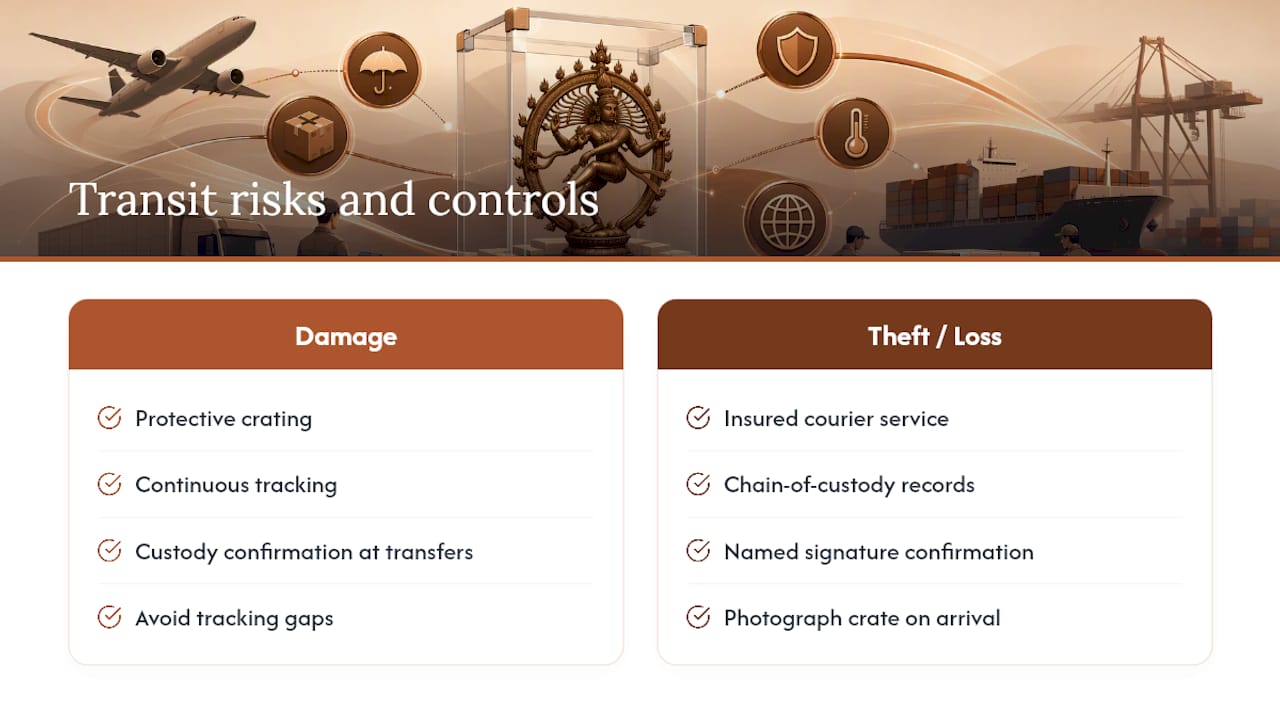
For damage, the crating standards already covered do most of the work, but tracking matters too. Insist on a shipment that provides continuous tracking with custody confirmation at each transfer point, not just an origin and destination scan. Gaps in tracking data are exactly where claims get complicated later.
For theft, insured couriers with chain-of-custody documentation reduce exposure significantly compared to freight forwarders who consolidate shipments with less individual accountability. A piece moving alone in a tracked, insured crate is a harder target than one sitting in a mixed consolidated shipment waiting for space.
Consider requiring signature confirmation from a specific named recipient rather than a general delivery signature, particularly for pieces valued well into six figures. Photograph the crate immediately upon arrival, before opening it, to document its condition at handoff. If damage appears after opening, that photo becomes part of the claim file. None of this eliminates risk entirely, but it closes the gaps where claims typically fall apart from lack of documentation rather than lack of coverage.
How HDAsianArt Documents and Ships Every Bronze It Sells
Every bronze that HDAsianArt lists goes through object research before it’s photographed, not after. That sequence matters: documenting casting details, base condition, and stylistic markers first means the photography and description that follow are accurate rather than promotional guesswork.
Condition reporting and museum-grade crating happen together, since the report defines what the crate needs to protect. Worldwide insured DHL shipping then carries the piece from gallery custody to the buyer’s door with tracked, insured transit at every stage. Clients get provenance documentation, condition photography, and shipping confirmation as a package, not scattered across separate requests.
— James, HDAsianArt.com
Ready to Add an Authenticated Bronze to Your Collection?
HDAsianArt is the direct path to a bronze statue you can trust, backed by research you can verify rather than a listing you have to take on faith. Every piece in the gallery’s collection carries expert object research, detailed photography, documented provenance, and worldwide insured DHL shipping arranged from the gallery’s end, so you’re not left coordinating crating and customs paperwork on your own.

Before you commit to a piece, ask for the condition report, the provenance file, and a shipping quote that specifies declared value and insurance terms in writing. If a bronze catches your eye, visit the HDAsianArt gallery to review current inventory and start that conversation directly with the team that researched the piece.
Sources
- Collecting guide: Buddhist sculpture | Christie’s
- The Collector’s Eye: Identifying Modern Forgeries in Ancient Bronze Markets - Ancient Bronzes
- How to identify Asian antiques: Marks, Materials and Provenance | Appraisily
