



Hindu Goddess Durga: Myth, Forms and Home Care
Hindu Goddess Durga: Myth, Forms and Home Care
Does every image of the Hindu goddess Durga need the same number of arms, weapons and ritual setting to be recognised as Durga? In Britain, museum collections and community festivals show a more varied picture: regional traditions and household customs shape how she appears and how people relate to her.
Table of Contents
- Who the Hindu Goddess Durga Is
- How to Identify a Durga Image
- The Battle That Restored Cosmic Order
- Museum Sculptures and What Changed
- Durga Worship across British Hindu Homes
- How to Place and Care for a Home Image
- Choose the Durga Form for Your Space
Who the Hindu Goddess Durga Is
Durga is a principal form of the Goddess and the shakti, or active female energy, associated with Shiva. She is best known for defeating the buffalo demon Mahisha, an act that restores cosmic order.
On an autumn visit to a British home or community hall, you might see a crowned goddess standing on a lion, weapons fanned around her and a buffalo demon beneath her. This is a familiar scene, but it isn't a template every Hindu household follows. Durga can appear as a warrior, a standing goddess or a gentler figure, and one image doesn't cancel the others.
A protector and a cosmic force
For devotees, Durga is a protector called upon during Navratri and at other times of need. At a cosmic scale, she carries the strength that the gods lend her to overcome a force they cannot defeat alone. A simple analogy is a set of keys: the gods hold many keys, but only the combined key turns the lock.
Her name is commonly explained as “the unassailable one”, the power that difficulty cannot shift. In the Mahishasuramardini story, the goddess's victory isn't violence for its own sake. It marks the return of order after danger threatens to overwhelm it.
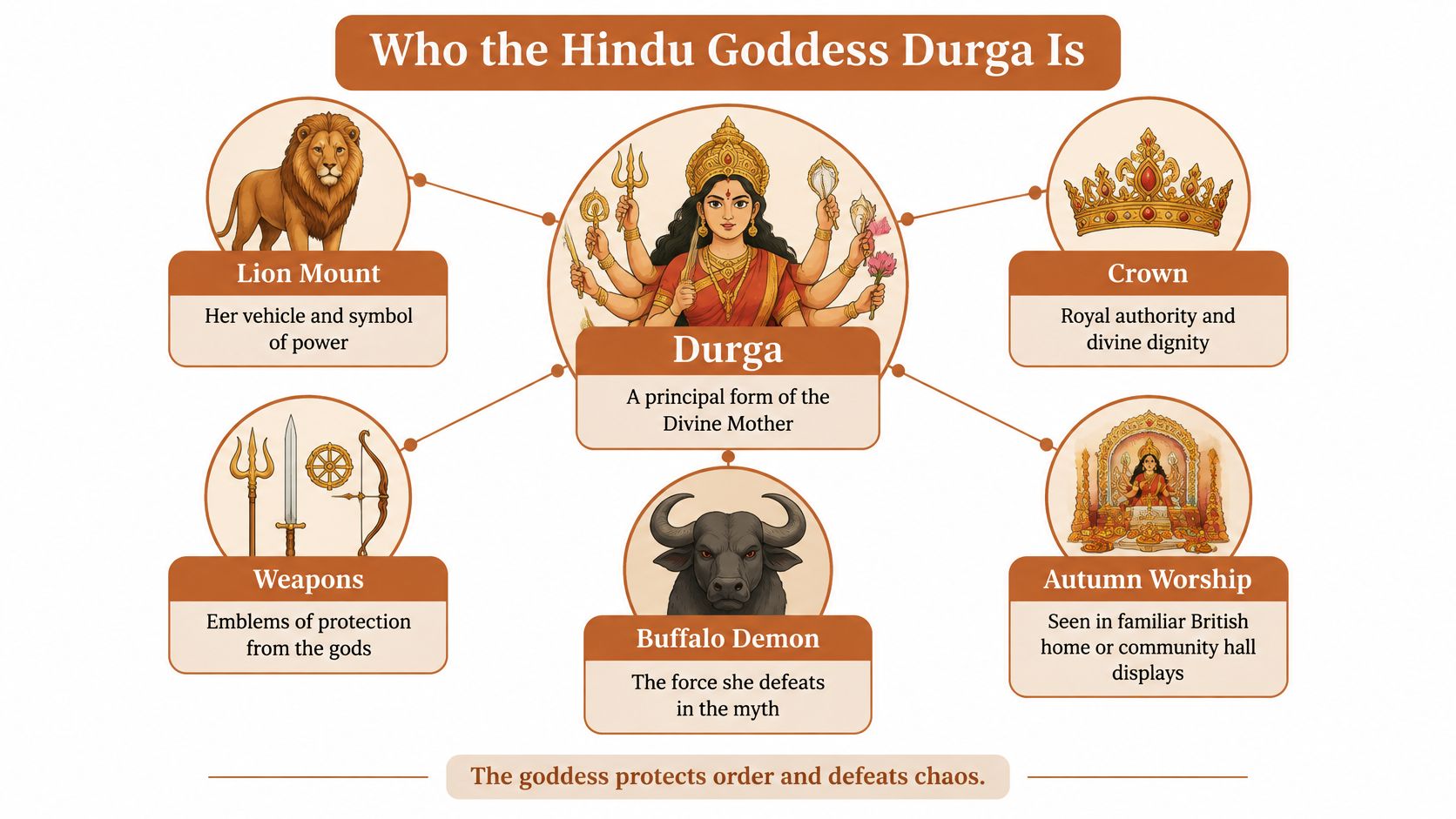
When you meet a Durga image, start with three field marks: arm count, weapons, and the lion or buffalo. They can help you read the image before you know its regional style or devotional setting. The aim isn't to assign one meaning to every feature, but to notice how they work together.
With those basics, you'll be better placed to name a form, distinguish worship from decoration and choose a respectful place for an image at home.
How to Identify a Durga Image
Arms, weapons, vehicle and the defeated buffalo identify her faster than a caption.
Treat identification as a set of checks, not a guess based on a label. A caption can be incomplete, and a multi-armed goddess isn't automatically Durga. Look at the whole composition: the figure's pose, what she holds, the animal beside her and any foe beneath her.
The range is broad. Early Mahishasuramardini images include four-armed terracotta figures, while later sculptures can make the goddess's multiple weapons part of a more elaborate scene. Festival images often show her upright on a lion, prepared to strike Mahishasura with a long spear.
A practical field card
The Victoria and Albert Museum's Nepalese soapstone sculpture, accession 325(IS), is a useful example of why materials and sculptural details matter alongside the deity's name. Its crowned, four-armed Durga stands in a militant pose on a lotus, with a lion and an upraised sword; the pointed back-slab and rope-like carved edge add further identifying details. The V&A collection record for the Nepalese Durga also shows how a museum catalogue can record region, stone type, arm count, vehicle, weapon, base and back-slab.
| Form | Arms | Vehicle and foe | Distinguishing marks |
|---|---|---|---|
| Early Mahishasuramardini | Four | Buffalo restrained | Shiva's trident; terracotta type known from about the 1st century AD to 320 AD |
| Developed warrior Durga | Eight | Buffalo demon | Trident, discus, sword, bow, bell and shield |
| Bengal shrine image | Ten | Lion, with other deities around her | Standing on a lion; West Bengal shrine type dated 1825 to 1850 |
| Nepalese militant Durga | Four | Lion on a lotus base | Crowned; upraised sword; pointed back-slab with rope-like edging |
| Karnataka slaying scene | Eight | Demon emerging from the buffalo | Trident pierces the emerging demon; mid-13th-century limestone type |
| Festival Durga | Variable, often many-armed | Lion, with Mahishasura below | Upright stance and a long spear or trident ready to strike |
Use the fields in the table as a record, not as a rigid checklist where every feature must appear. A damaged sculpture may be missing a weapon, for example, and a painting may show the story differently from a carved figure. For another collector-focused explanation of how to record visual features, see this guide to identifying Hindu goddess statues.
Don't name every Devi image Durga
Kali, Parvati and Lakshmi are also forms of Devi, but they aren't interchangeable with Durga. Compare the arms, weapons, vehicle and base together, then consider the image's posture and whether the buffalo-slaying story is present. If the main identifying marks are missing or unclear, record what you can see and avoid a confident attribution until you have more context.
The field card helps you describe what's in front of you; the story behind the weapons helps explain why the scene takes this form.
The Battle That Restored Cosmic Order
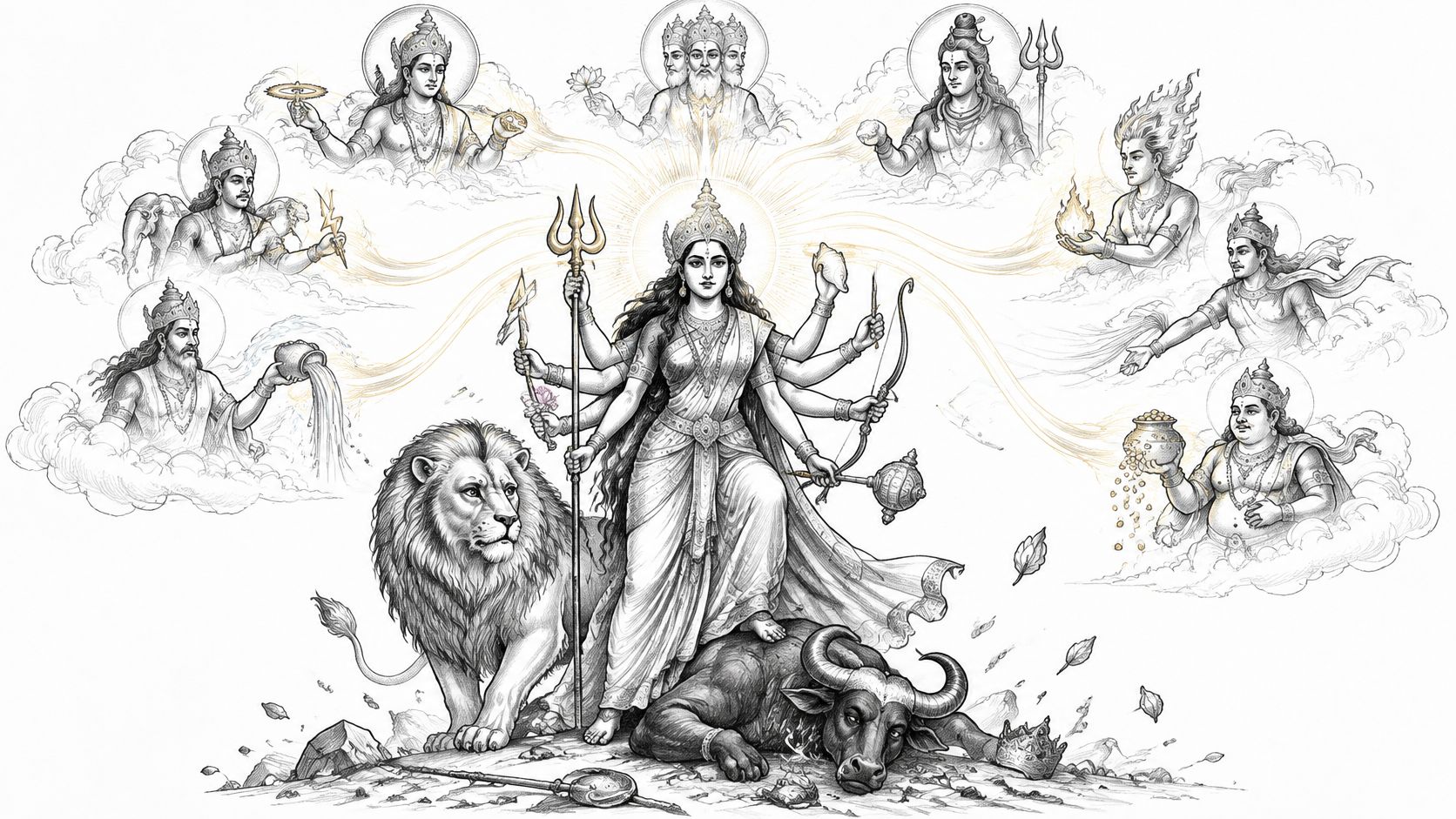
In many tellings, Mahisha has received a boon that prevents a man from killing him. The gods cannot defeat him by acting alone, so they release their energies as the Goddess and lend her their weapons. The story presents her victory as a shared divine response, with Durga as the power capable of bringing those gifts together.
Each weapon can suggest a different kind of strength. Shiva's trident points to piercing insight; Vishnu's discus evokes order; and a spear or sword makes the decisive cut. These meanings help explain the visual language of the story, but the objects aren't a household instruction to imitate the battle.
The turning point comes as Mahisha shifts between buffalo and an emerging human form. Durga pins the changing shape and strikes, preventing chaos from hiding behind another appearance.
Destruction in this story restores order. The goddess's ferocity is the cost of protection, not a mood to imitate at home.
The festival rhythm
Navratri runs for nine nights, and Dusshera falls at its end in September or October in the Gregorian calendar. National Museums Scotland's account of Durga describes the making of large, carved and painted festival idols: Durga stands on a lion with a long spear ready to strike Mahishasura. The nine aspects known as Navadurga can provide a way to pace the nights, without implying that every image or household follows one visual pattern.
A household might keep a quiet standing image throughout the year and bring out a more elaborate slaying scene for the festival. That choice can reflect available space, family custom and the kind of observance the household practises. A dramatic festival image and a simpler year-round figure can both belong to a devotional life.
Museum Sculptures and What Changed
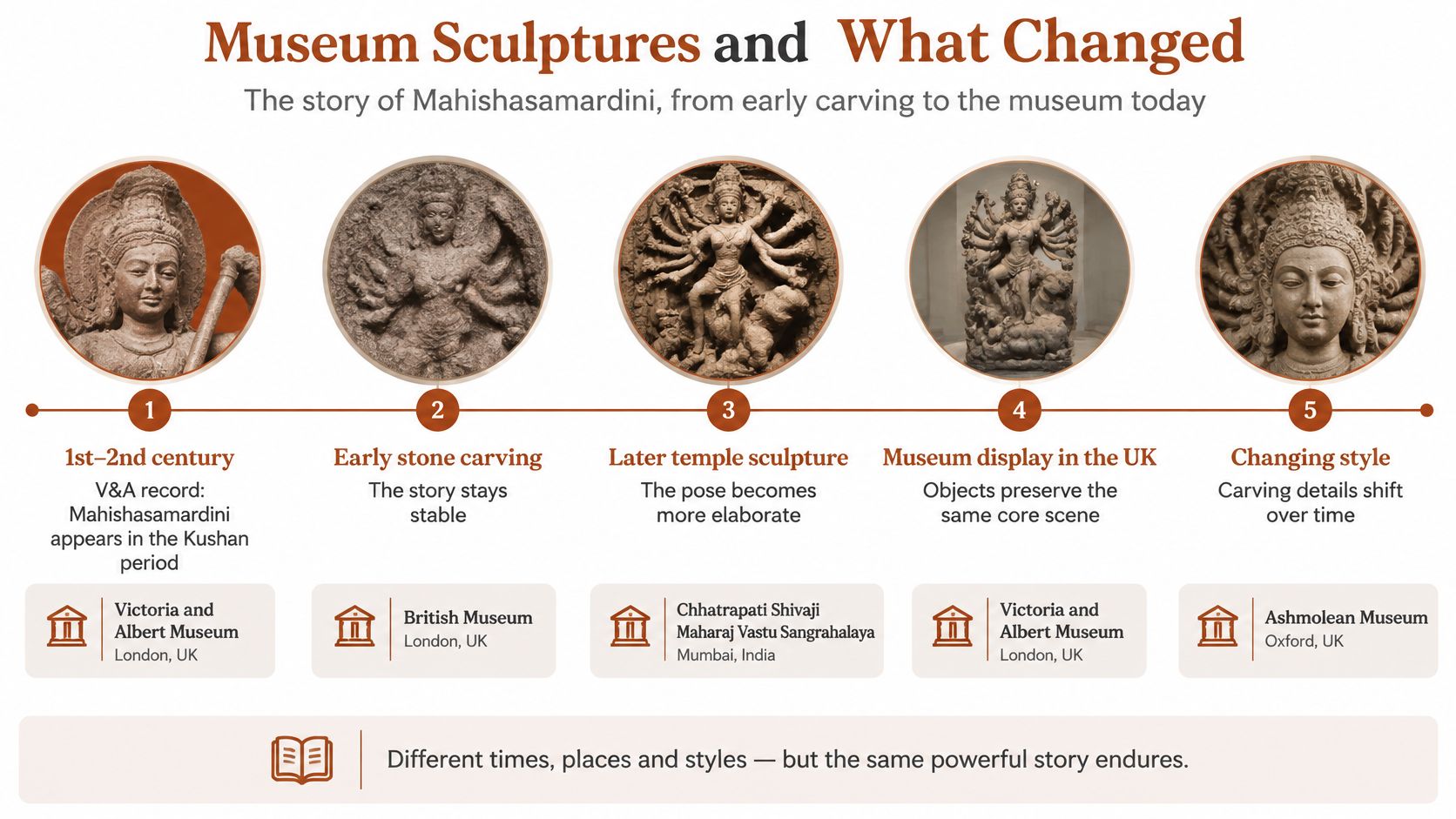
The Mahishasuramardini story has a stable core, but artists have changed its sculptural details across time and place. The Victoria and Albert Museum records the subject in the Kushan period, from about the 1st century AD to 320 AD, giving the scene roughly 1,800 years of sculptural history. Its early terracotta type restrains the buffalo while Durga uses Shiva's trident; a later eight-armed form adds a wider array of weapons. The V&A's Durga sculpture record documents both the development of the iconography and a West Bengal shrine image.
| Object | Collection | Date | Material and size | What it shows |
|---|---|---|---|---|
| Early Mahishasuramardini | V&A | About 1st century AD to 320 AD | Terracotta; size not stated | Four arms; buffalo restrained; Shiva's trident |
| Eight-armed Durga | V&A | Later development of the theme | Not stated in the public note | Trident, discus, sword, bow, bell and shield |
| Orissa buffalo-slaying panel | British Museum, acquired 1872 | Eighth century | Sandstone; 44.5 × 33.5 × 11.8 cm | Trident driven into Mahisha's exposed throat |
| Southern Karnataka figure | V&A | Mid-13th century | Limestone; 147 × 82 × 37 cm; 450 kg | Eight arms; demon emerges from the buffalo |
| West Bengal shrine | V&A | 1825 to 1850 | Shrine image; size not stated | Ten arms; stands on a lion among other deities |
| Nepalese soapstone Durga | V&A, accession 325(IS) | Not stated | Soapstone | Four arms, lion, lotus, sword and pointed back-slab |
A more explicit encounter
The British Museum's Orissa panel record describes a forceful moment: Mahisha's neck is pushed back to expose his throat as Durga drives in her trident. The eighth-century sandstone carving is associated with the popularity of goddess worship, including tantric traditions, in medieval Orissa. The panel entered the museum in 1872 after John Bridge acquired it and his family later donated it.
A different scene appears in the V&A's southern Karnataka limestone figure. Durga has eight arms, and the demon emerges from the buffalo as her trident pierces him. The V&A record for the Karnataka sculpture gives the figure's dimensions and recorded exhibition weight as 450 kg, details that affect how a museum can move and display it.
The handling lesson
A heavy limestone sculpture needs a checked floor load, secure lifting gear and a plinth designed to support concentrated weight. Its projecting trident and multiple arms also create points that can chip during transport, so handlers need to protect those features rather than gripping them.
By contrast, the West Bengal shrine image places a ten-armed Durga on a lion among other deities. It expands the scene beyond the encounter with Mahisha, showing how a familiar story can sit within a larger devotional setting.
Durga Worship across British Hindu Homes
A Navratri poster can be familiar without being the right model for every British Hindu home. Customs differ among Shaivite, Vaishnavite and Shakta families, and among Bengali, Gujarati, Punjabi, Tamil and Nepalese communities. A Bengali Durga Puja image, for example, isn't a universal template for every family altar.
Census figures record religious affiliation, not whether someone worships Durga, follows a particular sect or actively practises. In England and Wales, 1,020,533 people identified as Hindu in the 2021 Census, or 1.7% of the population, according to the Religion Media Centre's factsheet on Hinduism in the UK. Those figures provide demographic context, not a count of Durga devotees. For a household, family tradition is a better guide to which image and ritual feel appropriate.
Public festivals and private practice
A 2022 Brunel University study of Durga Puja in Britain, citing the Indian Bengalis in UK website, documents approximately 70 Durga Puja festivals. It describes them as important focal points in the religious lives of Hindu Bengalis. During autumn 2020, public-health restrictions made indoor, in-person celebrations impossible, so organisers held smaller private rituals and livestreamed them through social media. Worship adapted its format rather than stopping.
In a diaspora setting, UK Durga Puja can combine temple worship with public gatherings, food, performances and online audiences. London Sharad Utsav 2025 was reported as attracting more than 15,000 visitors, serving free food to over 7,000 devotees daily, reaching more than three million online viewers and generating over £100,000 for small businesses. These are organiser-reported figures described in coverage of London Sharad Utsav 2025, not national estimates.
Visiting with respect
Non-Hindus can attend public events respectfully. Follow the hosts' guidance about shoes, photography and offerings, and join public parts of a gathering unless you're invited into a private ritual. If you're unsure, ask an organiser before taking photographs or approaching an altar.
At home, start with one question: does the image match your family's regional tradition, and is it intended for puja or for display? A helpful overview of the festival's devotional themes is this guide to Navaratri and goddess energy.
How to Place and Care for a Home Image
A home image needs a setting that suits its purpose and protects its physical features. Decide whether you're buying for worship or display before choosing the object or its place. A puja image calls for a cleaner, calmer spot than a hallway ornament.

- Decide worship or display before buying. A puja image benefits from a dedicated, orderly spot; a decorative object may suit a shelf elsewhere. For a rented home, these wall art tips for rented homes can help you plan a considered display without treating the room as a permanent installation.
- Choose a suitable place. Use a pooja room, meditation corner or dedicated shelf, ideally at or above seated eye level. Don't place the image in a bathroom, beside a bin or directly on the floor.
- Face her into the room. Leave space for a lamp, flowers or a quiet moment, and avoid burying the image among unrelated objects. Clear surroundings make the image easier to approach with attention.
- Keep shared shrine images upright and clear. If other deities share the space, arrange them so Durga remains unobstructed and her weapons aren't pressed against a wall.
- Clean gently. Dust with a soft, dry cloth. Don't soak stone, scour bronze or leave painted surfaces in direct sunlight; harsh cleaning and prolonged sun can damage finishes.
- Check support before unpacking. For a heavy stone image, confirm that the shelf or plinth can bear its weight first. When storing it, pad projecting arms and the trident so they don't take the force of a knock. This guide to caring for a bronze sculpture offers further material-specific care advice.
- Plan for seasonal images. A temporary larger image or print can join a smaller year-round statue at Navratri. Retire it in the way your household treats festival images, without assuming that every family performs immersion.
The final test is practical: the spot stays clean, the image isn't used as a prop, and people moving through the room won't knock its arms.
Choose the Durga Form for Your Space
Choose an image that fits both the household's tradition and the room, rather than trying to collect every form. If your aim is a calmer daily presence, a smaller standing or four-armed Durga with her lion can make the figure easy to read without a crowded slaying scene.
For festival devotion or a Bengali household custom, a many-armed Mahishasuramardini may be the familiar choice. Before bringing one home, check that the plinth and room can accommodate its weight and projecting weapons. Collectors can use the same museum-minded checks: record the region, material, arm count and base, and be wary of a description that calls the object only a generic goddess.
Make a shortlist based on the family's tradition and the shelf's limits, then confirm the material and scale before choosing a carving. HD Asian Art sells Hindu statues of Brahma, Devi, Durga, Ganesha, Hanuman, Krishna, Lakshmi, Murugan, Parvati, Shiva, Vishnu and Erawan. Its sculptures are suitable for home shrines, meditation rooms and puja spaces, as well as for home décor and collections.
HD Asian Art offers a curated collection of museum quality, design led Asian sculpture, including Hindu deity statues such as Durga. Explore HD Asian Art to compare forms and materials, then choose an image that fits your tradition and the space you have prepared.
