



6 Proofs Collectors Need When Buying an Antique Asian Sculpture Online
6 Proofs Collectors Need When Buying an Antique Asian Sculpture Online
Verify the material and casting or carving technique, demand paper provenance, review a condition report against high-resolution photos, and buy only from a seller with clear return and insurance terms.
Skip any of those four, on a marketplace listing, an auction lot, or a gallery page like HD Asian Art, and you’re guessing rather than collecting.
Key Features:
- Verify that the material, weight, and surface details match the claimed type, as suspiciously light or warm surfaces can indicate fakes.
- Demand provenance evidence like original invoices, dealer labels, or auction references rather than relying on verbal histories.
- Review high-resolution photos of the base, interior, and surface with raking light to spot repairs, tool marks, or restoration details before paying.
- Confirm the seller’s return policy, shipping insurance, and reputation, and compare total costs including fees and import duties to the asking price.
- Be cautious of inconsistent style or material claims that do not align with regional or period-specific characteristics.
Table of Contents
- The Real Checklist for What to Look for When Buying an Antique Asian Sculpture Online
- Material-By-Material Red Flags and Authenticity Cues
- How Do You Verify a Seller’s Provenance Claims?
- What Photos Should You Request Before Buying?
- Condition, Restoration, and the Red Flags That Kill Value
- How Do You Know If the Price Is Fair?
- Where Can You Buy Safely, and How Do You Vet a Seller?
- How HD Asian Art Authenticates and Documents Every Piece
- Understanding Common Styles and Periods in Asian Sculpture
- What Are the Risks of Buying Antiques Online, and How Do You Reduce Them?
- A Collector’s Note on Patience
- Ready to Start Collecting With Confidence?
- Sources
- FAQ
The Real Checklist for What to Look for When Buying an Antique Asian Sculpture Online
Buying sight unseen means the photo and the paperwork carry the entire weight of the decision. Work through these in order, and don’t send payment until each one checks out.
- Verify material and technique. Does the surface, weight, and casting or carving evidence match the claimed material? A “bronze” that feels suspiciously light or a “jade” that warms instantly in your hand is telling you something.
- Demand provenance evidence. Ask for the original invoice, an old dealer label, or an auction lot number, not just a story about a grandfather’s collection.
- Inspect condition and restoration. Filled chips and reglued joints happen to genuinely old pieces; ask what was repaired and how it’s disclosed.
- Request the standard photo set and a written condition report before any money changes hands.
- Confirm the seller’s return policy, shipping insurance, and reputation. A seller who hesitates here is a seller to walk away from.
- Run the pricing sanity check. Add the buyer’s premium, shipping, and insurance to the hammer or asking price before comparing it to anything.
Material-By-Material Red Flags and Authenticity Cues
Material tells its own story, and each one lies in a different way.
- Bronze: Genuine patina settles into recesses and casting seams unevenly, while chemically induced patina often looks uniform and can scratch off with a fingernail. Check the hollow interior for casting seams and file marks.
- Porcelain: Study the foot rim first. Kiln grit, glaze pullback, and smooth handling wear at the edge are strong dating clues, and cobalt blue depth and variation matter more than the painted scene itself.
- Wood and lacquer: Old lacquer builds up in visible strata, and shrinkage over centuries often leaves slight cracking or color pooled in crevices that newer pieces don’t show.
- Jade and hard stone: Real jade feels cold and dense; serpentine, soapstone, and dyed quartz are common lookalikes that warm quickly and feel noticeably lighter.
Reign marks, seals, and signatures are claims the seller is making, not proof. Authenticating a piece requires checking material quality, construction technique, and period-appropriate wear rather than trusting the mark alone. One more thing worth flagging early: ivory and some tortoiseshell pieces carry real legal restrictions on sale and export in many jurisdictions, so confirm legal compliance before you buy, no matter how old the piece appears.
How Do You Verify a Seller’s Provenance Claims?
Provenance is the paper trail that backs up an age or origin claim, and some documents carry far more weight than others.
- Original invoices from a known dealer or gallery
- Old exhibition or dealer labels still attached to the base
- Auction lot numbers and catalog references you can look up independently
- Published references in exhibition catalogs or academic surveys
An estate story is nice context, but it isn’t documentary proof. Paper provenance helps build confidence, but it needs corroboration rather than standing alone. If a seller can’t produce anything beyond a verbal history, that’s not automatically disqualifying, but it should push you toward more object-based verification, not less.
Pro Tip: Search the auction house archives (many publish free lot histories) for the same seal, style, or dealer name before you buy. Corroborating even one detail independently is worth more than any amount of seller reassurance.
When provenance is thin, ask the seller directly for more documentation or a specialist opinion before you commit. HD Asian Art’s own provenance research guide walks through exactly which documents matter and how to weigh them.
What Photos Should You Request Before Buying?
Photographs are the only physical inspection you get in an online purchase, so the shot list matters as much as the price.
- Full front and full reverse, straight on, no flash.
- Base or footrim, which reveals more diagnostic information than almost any other angle.
- Interior/hollow view for bronzes, showing casting seams and tool marks.
- Close-up of any marks or seals, since these need context, not just visibility.
- A raking-light shot across the surface to reveal old repairs or tool marks invisible in flat lighting.
- Close-up of any damage or restoration, with a coin or ruler for scale.
Trade practice photographs the base first, then works outward, because kiln grit, tool marks, and casting discrepancies show up there before anywhere else. Natural window light beats flash every time; flash flattens the texture that tells you whether wear is genuine or manufactured. If a seller balks at supplying any one of these shots, that’s your answer.
Condition, Restoration, and the Red Flags That Kill Value
Restoration isn’t automatically a dealbreaker. Filled chips, reglued breaks, and replaced fingers or attributes are common on centuries-old pieces and can be entirely acceptable, provided they’re disclosed and reflected in the price.
- Old, disclosed repairs that match the surrounding patina and material
- Undisclosed fills or replacements only visible under raking light or close inspection
- Uniform, artificial aging applied all over rather than settling naturally into recesses
- Mismatched materials in a “repair” that don’t match the original composition
- A foot rim or base that’s suspiciously clean on an otherwise heavily worn piece
Condition often determines whether a piece is a good buy far more than age alone does. A written condition report paired with as much direct viewing as possible remains the strongest risk mitigator available to an online buyer. Ask for that report before you pay, not after.
How Do You Know If the Price Is Fair?
Start by pulling comparable results from public auction archives, then adjust for condition, provenance strength, and size. A piece with full documentation and undamaged surfaces earns a premium over an otherwise identical, undocumented example.
- Search auction archives for the same period, region, and material, not just the same subject.
- Add the buyer’s premium, platform fees, shipping, insurance, and any applicable import duties to the hammer price before comparing.
- Walk away, or bring in a specialist, when the asking price assumes a rarity or age the evidence doesn’t support.
A quick example: a listed price of $3,200 plus a 20% buyer’s premium, $150 shipping, and insurance can land closer to $4,000 landed. Provenance and condition evidence should track with the price being asked; when the paperwork is thin but the price behaves like a documented museum piece, treat that gap as your biggest warning sign.
Where Can You Buy Safely, and How Do You Vet a Seller?
Collectors generally buy through specialist galleries, dealer-run online shops, auction houses, or vetted marketplaces, and each provides a different mix of documentation. Specialist galleries typically research and photograph each piece individually. Auction houses supply lot histories and condition reports on request. Marketplaces vary enormously in vetting, so the burden shifts to you.
Run this script with any seller before paying:
- Ask for full provenance documentation, not a summary.
- Request a written condition report, separate from the sales description.
- Ask for the complete photo set outlined above, including base and raking-light shots.
- Confirm shipping method, insurance coverage, and who bears risk in transit.
- Confirm the return window and what triggers a valid return.
- Ask for references or past sale examples if the seller is new to you.
Reputable dealers and galleries typically supply condition reports, provenance notes, and insured shipping as standard practice, so hesitation on any of these points is itself useful information.
How HD Asian Art Authenticates and Documents Every Piece
HD Asian Art researches, photographs, and describes each sculpture individually before it’s listed, rather than relying on a generic catalog description. That process leans on the same fundamentals covered above.
- Detailed, multi-angle photography including base, interior, and close-up marks
- Material and technique review specific to the claimed region and period
- Provenance research, cross-checked against known dealer, auction, and catalog records
- Specialist consultation when a piece’s style, casting method, or condition needs a second opinion
Readers building their own evaluation skills can work through HD Asian Art’s internal guides on bronze casting techniques, dynasty and period identification, and authenticating bronze Buddha statues specifically. Specialist documentation like this doesn’t eliminate risk entirely, but it shifts a meaningful share of the verification burden off the buyer’s shoulders.
Understanding Common Styles and Periods in Asian Sculpture
Style and period claims mean little without regional and technical context, and the range across Asia is wide enough that no single “old” look applies everywhere. Khmer sculpture from Cambodia’s Angkorian era favors sandstone and bronze figures with distinctive serene expressions and stylized ornamentation tied to specific temple complexes. Thai Buddhist bronzes shift noticeably across the Sukhothai, Ayutthaya, and Rattanakosin periods, with silhouette, drapery style, and facial proportion all changing in ways specialists use to date a piece within decades, not centuries.
Javanese sculpture from Indonesia’s classical period tends toward volcanic stone and bronze, often showing Hindu-Buddhist syncretism in a single figure. Burmese lacquerware and gilded wood carving follow their own layered-construction traditions distinct from mainland Southeast Asian stone work. Sri Lankan and Vietnamese traditions each carry further regional variation in proportion, material choice, and iconographic detail.
The practical takeaway: a seller’s period claim should match the material, technique, and stylistic details actually visible in the photos, not just a plausible-sounding date range. A “17th century” attribution on a piece with tool marks and surface characteristics typical of the 19th century, or a “Khmer” attribution on a piece with clearly Javanese iconography, is a mismatch worth investigating before you buy. HD Asian Art’s dynasty identification guide breaks down these regional and period markers in more depth.
What Are the Risks of Buying Antiques Online, and How Do You Reduce Them?
The single biggest risk in online antique buying is that you’re relying entirely on someone else’s photography and description to make a judgment you’d normally make with your hands. That concentrates risk into two places: the photo set and the paperwork. The weaker either one is, the higher your exposure.
Misattribution is the most common risk, a piece described as older, rarer, or more significant than the evidence supports. Condition risk runs close behind: damage or restoration hidden in a poorly lit photo or cropped out entirely. Shipping risk matters more for sculpture than most collectibles, since stone, ceramic, and lacquer pieces are genuinely fragile in transit despite looking sturdy. Payment and return risk round out the list. A buyer with no recourse if the piece doesn’t match its description is exposed regardless of how good the piece itself turns out to be.
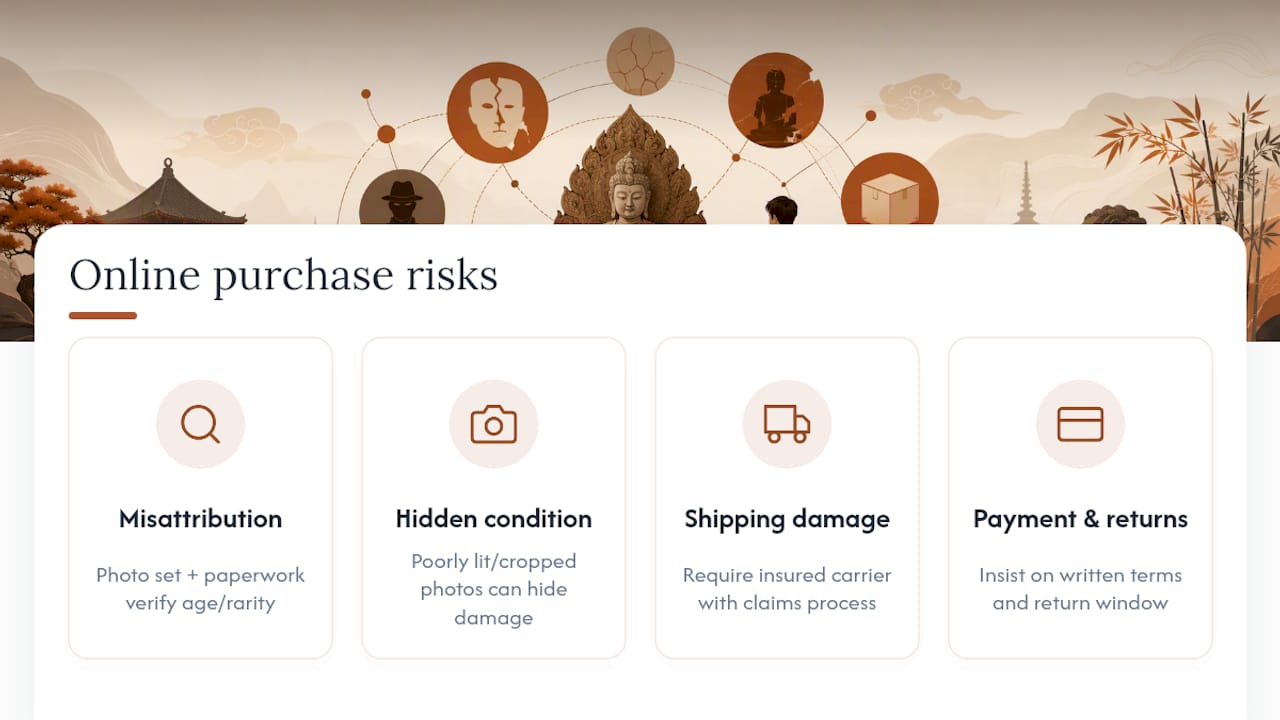
The mitigation strategy mirrors the checklist already covered: insist on the full photo set before paying, get provenance and condition claims in writing, confirm insured shipping with a carrier that has a real damage-claims process, and never buy from a seller unwilling to offer a reasonable return window. Concentrating risk this way means the quality of the photo set and the clarity of the provenance directly determine how safe a purchase actually is. A seller who welcomes every one of these requests is signaling confidence in the piece. One who pushes back is signaling something else entirely.
A Collector’s Note on Patience
Buy what genuinely moves you, but verify everything before you commit funds to it. The pieces worth owning for decades are the ones where the paperwork and the object tell the same story, and that story rarely reveals itself on the first photo.
— James, HDAsianArt.com
Ready to Start Collecting With Confidence?
Every check covered in this guide, material verification, provenance documentation, condition reporting, and a full photo set, is standard practice at specialist galleries rather than an extra step you have to request. Each piece available is individually researched, photographed from the angles that actually matter, and described with the material and period detail a serious collector needs to make a real decision.
You can see this approach in action on a listing like the Indonesian-style Javanese Bodhisattva statue, where provenance notes and condition detail sit alongside the full photo set rather than a single hero shot. If you’re comparing casting technique against a reproduction for context, a piece like this handmade Persian sword replica shows how modern construction and surface finish differ from genuine period work. When you’re ready to start, browse the current collection at HD Asian Art or reach out directly with provenance or condition questions before you buy.
Sources
- How to Identify Asian Art: Reign Marks, Materials & Real Values — InstAppraisal
- LAPADA guide to buying sculptures — LAPADA
- Your Guide to Buying Asian Art at Auction — John Nicholsons
FAQ
What Makes Asian Art Valuable?
Value comes from a combination of material quality, technical craftsmanship, condition, documented provenance, and rarity within a specific period or region, not age alone. A well-documented, undamaged piece from a recognized period commands a premium over an identical but undocumented example.
How Can You Tell If Chinese Porcelain Is Valuable?
Check the foot rim for kiln grit and handling wear, examine the cobalt blue’s depth and variation, and weigh the piece in your hand. Genuine age tends to show in the base and glaze pullback more reliably than in the painted decoration.
How Do You Tell If a Sculpture Is Chinese or Japanese?
Regional style, material choice, and technical construction differ significantly between Chinese and Japanese traditions, and HD Asian Art’s own dynasty identification guide breaks down the stylistic markers collectors use to tell them apart, alongside the Southeast Asian traditions the gallery specializes in.
What Are Five Signs of a Valuable Antique?
Strong material and technique evidence, documented provenance, an honest condition report, natural uneven wear patterns, and a price that tracks with verified comparables are the five signals worth checking together, since no single one proves value on its own.
Is It Safe to Buy Antique Asian Sculpture Online?
Buying online is reasonably safe when the seller provides a full photo set, written condition report, provenance documentation, and insured shipping with a fair return policy. Galleries like HD Asian Art build these steps into every listing specifically to reduce that risk for the buyer.
