



Japanese Buddha Statues: Five Centuries of Artistic Evolution
Japanese Buddha Statues: Five Centuries of Artistic Evolution
Most people who encounter a Japanese Buddha statue for the first time see only serenity. What they are actually looking at is a layered record of theological arguments, political upheavals, technical experiments, and changing ideas about what the sacred should look like.
From the imperial workshops of eighth-century Nara to the populist devotional culture of the Edo period, Japanese Buddhist sculpture passed through transformations so decisive that a Nara-period bronze and an Edo-period wooden figure can seem to belong to entirely different traditions, even though a continuous line of craft and doctrine connects them.
Table of Contents
- Quick Takeaways
- Nara Period: The First Flowering of Japanese Buddhist Sculpture
- Heian Period: Elegance and the Amida Ideal
- Kamakura Period: Realism and the Kei School
- Muromachi and Momoyama: Zen Influence and Stylistic Refinement
- Edo Period: Devotion at Scale
- Period Comparison: Three Defining Styles
- What Period Tells You About Quality and Authenticity
- Frequently Asked Questions
- References
Quick Takeaways
|
Key Insight |
Explanation |
|---|---|
|
Nara period sculpture follows Tang Chinese models closely |
Bronze and dry-lacquer figures from this era display confident, full-bodied proportions and stylized drapery rooted in Tang dynasty aesthetics brought to Japan by monk-scholars. |
|
Heian sculpture introduced the yosegi-zukuri joined-wood technique |
Master sculptor Jocho perfected the method of assembling a figure from multiple interlocking wood shells, making large statues lighter, faster to produce, and less prone to cracking. |
|
The Kei school redefined Japanese Buddhist sculpture in the Kamakura period |
Sculptors such as Unkei and Kaikei moved away from Heian idealization toward powerful physical realism, producing figures with muscular bodies, vivid expressions, and inlaid crystal eyes. |
|
Amida Buddha became the dominant subject in late Heian and Kamakura devotional art |
Pure Land Buddhism's promise of rebirth in the Western Paradise made Amida the most requested commission for both temple patrons and private households. |
|
Muromachi period sculpture declined in innovation but Zen portraiture rose |
Large-scale Buddhist icon production slowed, but Zen Buddhism drove a new interest in realistic portraiture of abbots and patriarchs, shifting sculptural energy toward the human face. |
|
Edo period production was broad and populist, not just elite |
Urbanization and growing merchant wealth meant Buddhist statues moved out of imperial temples and into household altars, creating demand for smaller, accessible wooden figures. |
|
Material choice signals period and intent |
Bronze signals early imperial ambition; single-block ichiboku wood signals early Heian esoteric severity; joined wood signals late Heian elegance; crystal-inlaid eyes signal Kamakura realism. |
Nara Period: The First Flowering of Japanese Buddhist Sculpture
Buddhism reached Japan officially in the sixth century CE, transmitted through the Korean kingdom of Baekje. It took roughly another century before Japanese sculptors stopped copying imported prototypes and started producing original work on Japanese terms. The Nara period (710 to 794 CE) represents the first great flowering of that indigenous tradition, and every subsequent period of Japanese Buddhist art is, in some sense, a response to what Nara established.
Two technical methods dominated Nara period production. The first was dry lacquer construction, known in Japanese as kanshitsu. Craftsmen built up layers of lacquer-soaked hemp cloth over a clay or wooden armature, then removed the inner core to leave a hollow, lightweight shell. The technique allowed extraordinary surface detail and was used for major temple icons, including the celebrated Ashura figure at Kofukuji temple in Nara. The second method was large-scale bronze casting, which required enormous furnaces and highly organized imperial workshops. The colossal bronze Vairocana Buddha at Todaiji, completed in 752 CE, is the direct product of that ambition.
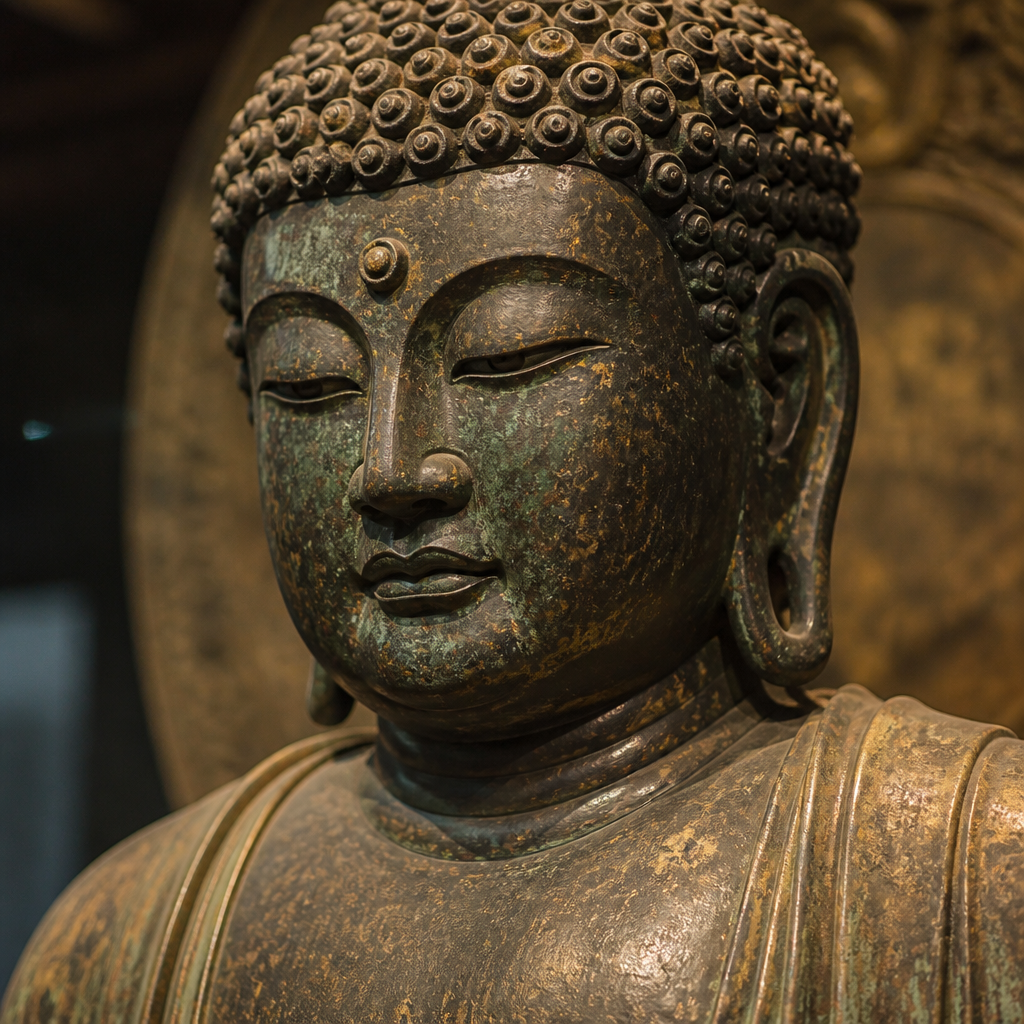
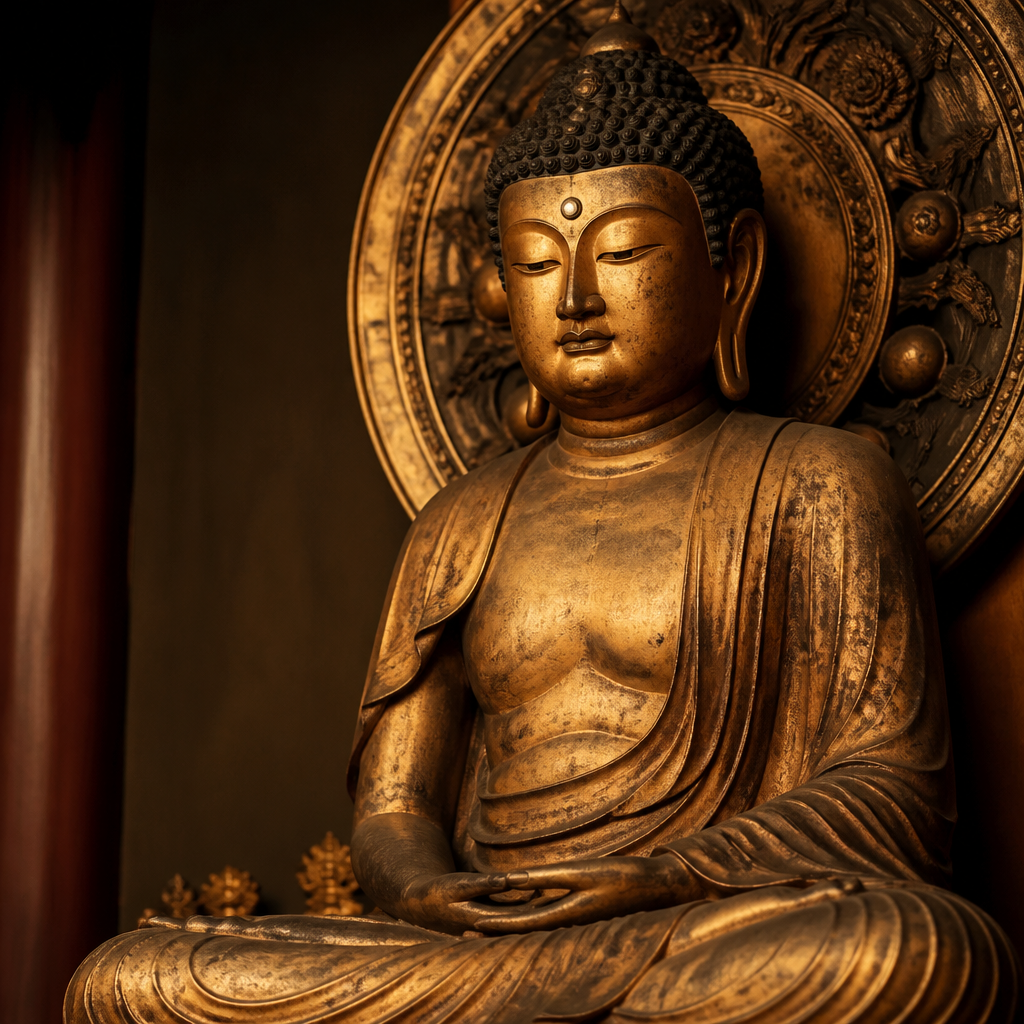
Nara period figures share a clear visual language: confident, full-bodied proportions, smooth surfaces, stylized drapery rendered with almost mathematical regularity, and a quality of cosmic authority rather than personal warmth. These sculptures follow Tang dynasty Chinese aesthetic models closely, because the theoretical and technical knowledge that shaped them came from the continent. Monk-scholars who had studied in China brought back both doctrine and artistic conventions, and Nara sculptors applied them faithfully. The result is a style that reads as formal, grandly idealized, and deliberately remote, which was entirely intentional. These were imperial cult objects as much as religious ones.
The Role of the Tenpyo Culture
The cultural moment that produced the best Nara sculpture is sometimes called the Tenpyo period, named for an imperial era within the Nara years. Imperial patronage funded workshops at a scale Japan had never seen before. Temples such as Todaiji and Kofukuji became production centers staffed by professional sculptors operating under state supervision. The records of Kofukuji temple indicate that an assembly of 27 sculptures was completed and installed in 734 CE, demonstrating the organizational capacity behind this output.
In practice, original Nara period sculptures almost never appear on the collector market. They are national treasures held in temple collections and Japanese national museums. What collectors encounter as "Nara style" are typically later period workshop replicas made in deliberate homage to that original grandeur. Knowing this prevents a costly misreading of what you are actually buying.
The Nara template established the terms that every later Japanese sculptor either refined or deliberately rejected. To understand any period of Japanese Buddhist art, you must first understand what Nara decided the Buddha should look like.
Heian Period: Elegance and the Amida Ideal
The transfer of the imperial capital from Nara to Kyoto in 794 CE was not just administrative. It signaled a profound theological reorientation. Two new Buddhist sects, Tendai and Shingon, introduced esoteric doctrines from Tang China that demanded a different kind of sacred image: one that was powerful, sometimes deliberately austere, and often kept hidden from ordinary view. Early Heian sculpture, sometimes called the Jogan style, responded with ichiboku zukuri, single-block wood carving. These figures were hewn from a single large timber, their surfaces given a deliberately rough, weighty quality that expressed the mystery of esoteric theology rather than the formal grandeur of Nara bronze.
The late Heian period shifted direction again, dramatically. Pure Land Buddhism and its promise of rebirth in the Western Paradise of Amida Buddha spread widely through the aristocracy of Kyoto. The Fujiwara clan, the dominant political force of the era, channeled enormous resources into building Amida halls and commissioning Amida Buddha sculptures to fill them. The aesthetic changed accordingly: where early Heian figures were weighty and severe, late Heian Amida figures became graceful, luminous, and almost weightlessly serene.
Jocho and the Joined-Wood Revolution
The technical and aesthetic breakthrough of the late Heian period came from a sculptor named Jocho. His Amida Buddha, completed in 1053 CE for the Phoenix Hall of Byodoin temple at Uji, to the southeast of Kyoto, defined the sculptural ideal of the entire era. Jocho used a new technique called yosegi-zukuri, assembling the figure from multiple pieces of wood carved out like interlocking shells and joined from the inside. The method produced figures that were lighter than solid-wood sculpture, less prone to the cracking caused by drying timber, and faster to produce in a workshop setting where multiple craftsmen could work on different sections simultaneously.
The Byodoin Amida also introduced a new canon of proportions. The figure is broader and lower-slung than Tang Chinese models, with a face that projects calm rather than distance, half-closed eyes and a measured gesture that makes transcendence feel intimate rather than remote. This was a deliberate recalibration, a move away from Chinese prototypes toward something that felt distinctly Japanese, a quality later critics would associate with the aesthetic concept of miyabi, courtly elegance.
Pro tip: When evaluating a Japanese Amida figure, look at the proportional relationship between the head and the body. Late Heian figures in the Jocho tradition tend toward a broader, more compressed silhouette than either Nara or Kamakura figures. A very slender, upright Amida is more likely to be a Kamakura or later workshop piece, not a Heian-style commission.
Kamakura Period: Realism and the Kei School
The Kamakura period (1185 to 1333) brought a military government to eastern Japan and the decline of Kyoto aristocratic power. It also produced what many scholars consider the peak of Japanese Buddhist sculpture, a flowering of realism and psychological intensity that has no real equivalent elsewhere in Asian religious art of the period.
During the Genpei War (1180 to 1185), fighting destroyed many of the great temples in Nara, including Todaiji and Kofukuji. The reconstruction effort was enormous, and a Nara-based workshop tradition known as the Kei school received the major commissions. Their response to those commissions changed Japanese sculpture permanently. Where Heian sculptors had refined elegance and idealization to near-abstraction, the Kei school moved toward powerful physical realism: muscular bodies, faces with vivid individual expressions, and eyes inlaid with crystal to catch the light in a way that seems almost alive.
Unkei and Kaikei: Two Masters, Two Registers
The two most significant sculptors of the Kamakura period, and arguably of the entire Japanese tradition, are Unkei and Kaikei. Unkei, considered the greatest master of the Kei school and the son of its founder Kokei, developed a style that suited the tastes of the emerging warrior class. His figures project raw physical authority. Guardian deities and Buddhist kings under his hand look genuinely threatening, their energy barely contained by the formal requirements of religious iconography. Kaikei worked in a different register, producing figures that balanced Kamakura vigor with a refined finish that retained something of Heian grace. Both operated within the same workshop tradition, taking signatures on their works, a practice that increased significantly during this period.
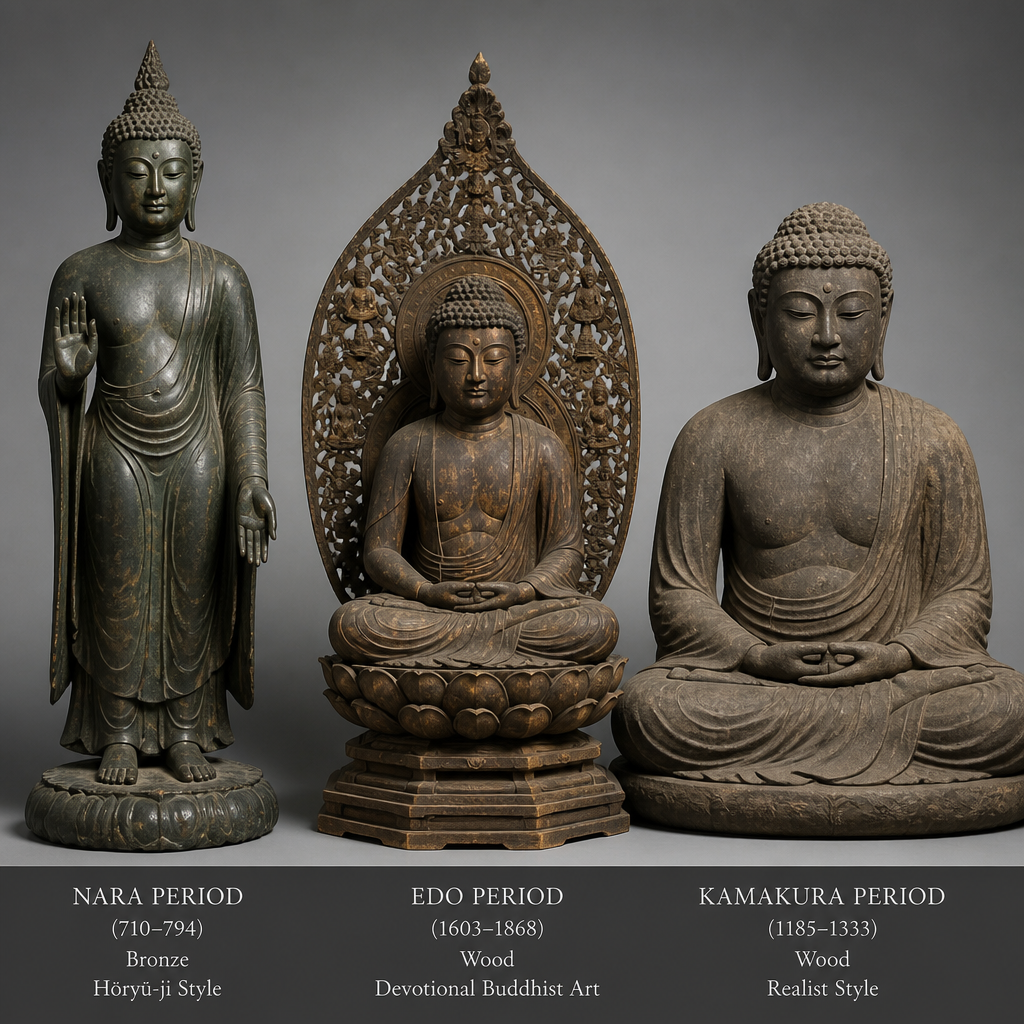
Beyond guardian deities, Kamakura period Buddha figures themselves changed character. Seated Amida sculptures became more robustly modeled, their bodies suggesting genuine physical presence rather than the ethereal weightlessness of Heian idealization. New devotional movements focused on individual deities spread the demand for Buddhist images much wider than the aristocratic court, and Zen Buddhism, arriving from China and gaining patronage among elite warriors, introduced yet another aesthetic current: disciplined simplicity rather than elaborate ornament.
Pro tip: Crystal-inlaid eyes, called gyokugan, are one of the clearest period markers in Japanese Buddhist sculpture. The technique became standard in Kamakura period Kei school works and remained common through later centuries. If a figure claimed to be pre-Kamakura has inlaid crystal eyes, that claim deserves skeptical scrutiny.
Muromachi and Momoyama: Zen Influence and Stylistic Refinement
The Muromachi period (approximately 1336 to 1573) saw a general decline in the large-scale Buddhist icon production that had defined the Kamakura years. The political instability of the Ashikaga shogunate, combined with the fact that the great reconstruction commissions had already been completed, reduced the volume of major temple sculpture. What replaced it, in terms of artistic energy, was Zen-influenced portraiture and a new interest in objects associated with tea culture and refined domestic life.
Zen Buddhism, by the Muromachi period well established in Japan with strong patronage from the warrior aristocracy, brought a different relationship to the image. Where Pure Land Buddhism made the Buddha statue central to salvation practice, Zen was philosophically skeptical of image worship, preferring direct experience through meditation. Yet this skepticism did not eliminate Buddhist sculpture. Instead it redirected it toward portraiture of abbots and patriarchs, highly realistic representations of individual human faces that sit in a fascinating tension with the tradition of transcendent iconic Buddhas that came before them.
The Momoyama Interlude
The Momoyama period (approximately 1573 to 1600) was brief but influential in Japanese cultural history, associated with the flamboyant aesthetic of warlords such as Oda Nobunaga and Toyotomi Hideyoshi. Buddhist sculpture did not experience a dramatic stylistic revolution in these years, but the period reinforced tendencies toward bold forms, rich surface treatment, and a willingness to combine materials and decorative techniques. Lacquerware, including the production of Buddhist ritual objects, developed significantly during this era, an important context for understanding the decorated Buddhist objects, including lacquered altar items, that collectors encounter from this period.
Edo Period: Devotion at Scale
The Edo period (1603 to 1868) transformed the social context of Japanese Buddhist art more completely than any previous era had. Political stability under the Tokugawa shogunate, combined with urbanization and the growth of a prosperous merchant class, meant that Buddhist devotional culture moved out of imperial temples and into the everyday life of ordinary households. The butsudan, the domestic altar, became a fixture of Japanese homes, and demand for Buddhist statuary expanded accordingly, reaching a population that no previous period had served at scale.
The dominant material was wood, and production ranged from workshop figures of genuine quality to highly standardized temple-supply items. This breadth means that "Edo period Japanese Buddhist sculpture" describes an extremely wide range of objects. At the high end, skilled craftsmen working in the traditions inherited from Kamakura and Muromachi produced figures of real distinction. At the other end, repetitive workshop production created the affordable household icons that populated altars across Japan.
What Collectors Should Know About Edo Production
For collectors and serious buyers of Asian religious art, the Edo period presents both opportunity and risk. The opportunity is that genuinely skilled Edo period wooden Buddha figures appear on the market more readily than Heian or Kamakura pieces, and at more accessible prices. The risk is that the wide quality range within Edo production makes evaluation difficult without a trained eye.
Key markers of quality in Edo Buddhist figures include precision in the carving of hands and facial features, refinement of surface lacquer or gilding that shows age-appropriate wear rather than uniform artificial distress, and anatomical coherence in the body proportions. A common mistake among newer collectors is to equate age with quality: a mediocre Edo figure is still a mediocre figure, while a skilled one from the same period can be an object of real beauty and cultural significance.
Period Comparison: Three Defining Styles
|
Feature |
Heian (Late, Fujiwara) |
Kamakura (Kei School) |
Edo (Quality Workshop) |
|---|---|---|---|
|
Primary material |
Joined wood (yosegi-zukuri), gold leaf |
Joined wood, lacquer, crystal inlay |
Wood, lacquer, pigment, occasional gilding |
|
Dominant subject |
Amida Buddha, Bodhisattvas |
Amida, guardian deities, Shakyamuni |
Amida, Shakyamuni, Jizo, Kannon |
|
Aesthetic register |
Serene, graceful, aristocratically elegant |
Powerfully realistic, physically intense |
Ranges from refined to standardized |
|
Eye treatment |
Painted eyes, downcast gaze |
Crystal inlay (gyokugan) standard |
Painted eyes most common, some crystal |
|
Patron base |
Fujiwara aristocracy, imperial court |
Warrior class, reconstructed temples |
Merchant households, urban population |
|
Scale tendency |
Large temple icons, some intimate hall figures |
Large institutional commissions, some portable |
Smaller household altar scale predominates |
What Period Tells You About Quality and Authenticity
Understanding the periodization of Japanese Buddhist sculpture is not an academic exercise. For anyone building a collection or selecting a piece for a home altar, it directly shapes how you evaluate what you are looking at and what questions to ask before buying.
The most important principle is that stylistic period is not the same as chronological date. Japanese craftsmen consistently revived earlier styles. Heian-style Amida figures were produced in the Edo period. Kamakura-inflected realism appeared in Muromachi workshop output. What you are reading when you look at a figure is primarily a set of aesthetic choices, and those choices have meaning, but they do not always tell you when the object was made. Distinguishing a genuine Kamakura piece from a later Kamakura-revival piece requires attention to wood aging, tool marks, lacquer chemistry, and hardware. It is not something you determine from a photograph alone.
Reading Iconography as Period Evidence
Beyond material and technique, the choice of subject itself carries period information. Amida Buddha dominated devotional production from the late Heian through the early Edo period, reflecting the long dominance of Pure Land doctrine. Jizo, the protector of children and travelers, became increasingly popular as a household icon through the later Edo period. Kannon in multiple forms, from the graceful single-figure Heian-style compositions to the fierce eleven-headed versions associated with esoteric Shingon practice, appears across every period but in different visual registers.
For collectors of museum-quality Japanese Buddhist sculpture, the interplay of iconography, style, material, and technique is precisely what makes these objects intellectually compelling as well as visually beautiful. A piece that shows fluency in a particular period's visual language, whether a late Heian Amida with the right proportional canon or a Kamakura guardian with convincing gyokugan inlay, rewards sustained looking in a way that purely decorative objects rarely do. Exploring the range of Japanese Buddha statues available at HD Asian Art's Japanese collection gives you a direct visual education in how these period distinctions play out in actual objects.
Pro tip: When a seller describes a Japanese Buddhist figure as "Kamakura period" based primarily on the presence of crystal eyes, be cautious. Crystal eye inlay (gyokugan) was used from the Kamakura period onward through the Edo period. It is a necessary but not sufficient marker of Kamakura dating. Look also at the proportions, the carving style of the drapery, and the construction method of the wooden joins.
Frequently Asked Questions
What makes a Japanese Buddha statue different from Chinese or Thai Buddhist sculptures?
Japanese Buddha statues developed a distinctive visual vocabulary over more than a millennium, starting from Chinese and Korean prototypes but gradually diverging in proportional canon, material preference, and aesthetic register. Key differences include the Japanese preference for wood as the dominant sculptural medium from the Heian period onward, the specific proportional ideals codified by sculptors like Jocho, the crystal-inlaid eye technique (gyokugan) that became standard in Kamakura period work, and the aesthetic of quiet restraint that runs through even the most powerfully realistic Japanese figures. Chinese Buddhist sculpture tends toward different proportional ideals and broader stylistic variation across regions. Thai Buddhist sculpture has its own iconographic conventions, particularly around the flame ushnisha and elongated fingers, that mark it as distinct at a glance.
What is an Amida Buddha statue and why is it so common in Japanese collections?
Amida, also rendered as Amitabha in Sanskrit, is the Buddha of Infinite Light who presides over the Western Pure Land, a paradise of rebirth available to any being who calls on Amida's name with sincere intention. Pure Land Buddhism spread widely through Japan from the late Heian period onward, and the Amida figure became the most commissioned Buddhist image in Japanese history. For collectors, Amida statues in the Japanese tradition are particularly refined because they were typically made for the most wealthy and aesthetically demanding patrons, resulting in a concentration of sculptural quality that other subjects do not always match.
Can a collector realistically acquire an authentic Kamakura period Japanese Buddhist statue?
Genuine Kamakura period (1185 to 1333) pieces of significant scale and quality are extraordinarily rare outside Japanese institutional collections and are classified as important cultural properties or national treasures. What appears on the collector market described as "Kamakura period" is often either a Muromachi or Edo period figure made in the Kamakura style, or occasionally a genuine Kamakura piece of smaller scale or simpler quality. This is not necessarily a problem: a skilled Edo period figure in the Kamakura tradition can be a beautiful and historically significant object in its own right. The issue is accuracy of attribution, which requires expert authentication rather than stylistic impression alone.
What does the mudra, or hand gesture, of a Japanese Buddha statue tell you?
The mudra is one of the most reliable iconographic clues to a figure's identity and doctrinal function. The dhyana mudra, both hands resting in the lap, identifies a meditating figure and is standard for Amida in the Heian and later traditions. The bhumisparsha mudra, one hand touching the earth, identifies Shakyamuni at the moment of enlightenment, a form very common in Southeast Asian but also present in Japanese sculpture. The abhaya mudra, one hand raised palm outward, signals protection and is associated with several deities. The specific gesture of the hands matters: a single difference in finger position can indicate an entirely different theological identity, so close attention to mudra is essential for accurate iconographic reading.
How does the Nara period Great Buddha at Todaiji relate to later Japanese Buddha statues?
The Vairocana Buddha at Todaiji, completed in 752 CE and still one of the largest bronze Buddha statues in the world, represents the apex of imperial-scale Buddhist patronage in Japan. It is a Vairocana figure, the cosmic or universal Buddha who appears in esoteric Buddhist cosmology as the embodiment of ultimate reality, and its iconography is quite different from the Amida figures that would dominate later production. Its significance for the broader tradition is more historical than stylistic: it established the seriousness of Japanese imperial commitment to Buddhism, created the technical infrastructure for large-scale bronze and lacquer production, and set a standard of grandeur that later periods responded to in different ways, some by refining it, others by deliberately moving away from monumental scale toward intimate devotional objects.
What should I look for when buying a Japanese Buddha statue for a home altar?
For a home altar context, the most important considerations are iconographic accuracy, material integrity, and the quality of the carving or casting in the facial features and hands. Iconographic accuracy matters because different Buddhist deities carry different meanings and are associated with different practices. A Jizo figure, for example, has specific ritual associations that differ from an Amida or a Shakyamuni. Material integrity means looking for stable, well-aged wood or metal without structural cracks, unstable flaking lacquer, or obvious modern repairs that compromise the figure's visual coherence. The face and hands are where the sculptor's skill shows most clearly and where you can most easily distinguish a figure with genuine expressive quality from a standardized production piece.
If you have handled or collected Japanese Buddhist sculpture and have questions about period identification or iconographic reading, share your experience in the comments below.
References
-
Overview of Japanese Buddhist sculpture techniques and periods, Encyclopaedia Britannica
-
Kamakura period sculpture and the Kei school, Asia Society New York
-
Biography and legacy of sculptor Jocho, Encyclopaedia Britannica
-
Unkei and the Kei school sculptural tradition, EBSCO Research Starters
