



Japanese Buddha Statue: A Collector's Introduction
Japanese Buddha Statue: A Collector's Introduction
Most collectors who ask about buying a Japanese Buddha statue arrive with one question: which one? What they actually need to ask is: which tradition, which period, which deity, and which material?
Japanese Buddhist sculpture is one of the most technically refined art traditions in Asia, spanning more than fourteen centuries, multiple Buddhist schools, and a range of iconographic figures that are frequently confused even by experienced buyers. This guide cuts through that confusion and gives you a working framework for understanding, choosing, and living with Japanese Buddhist art.
Table of Contents
- Why Japanese Buddhist Sculpture Stands Apart
- Quick Takeaways
- The Four Major Historical Periods Every Collector Should Know
- The Principal Figures in Japanese Buddhist Art
- Materials and What They Tell You
- Comparing Collecting Approaches
- What to Look for When Buying a Japanese Buddhist Sculpture
- Frequently Asked Questions
- References
Why Japanese Buddhist Sculpture Stands Apart
Japanese Buddhist sculpture arrived from Korea and China around the sixth century, but Japan did not simply copy what it received. Each successive historical period transformed imported iconography into something distinctly Japanese, developing new materials, new techniques, and new spiritual emphases. The result is a tradition that rewards study: every stylistic detail on a well-made figure communicates something about the period, the workshop, and the devotional intent behind it.
For collectors sourcing from specialists like HD Asian Art's Japanese sculpture collection, understanding these layers is what separates a meaningful acquisition from a decorative purchase.
Quick Takeaways
|
Key Insight |
Explanation |
|---|---|
|
Period shapes style, not just age |
Asuka, Nara, Heian, and Kamakura works each have distinct aesthetic signatures. Identifying the period tells you more than any provenance label. |
|
Not all figures are "the Buddha" |
Japanese Buddhist art includes Nyorai (Buddhas), Bosatsu (Bodhisattvas), Myo-o (Wisdom Kings), and Tenbu (guardian deities). Each category has separate iconography. |
|
Material signals intended use |
Wood dominated Japanese sculpture, particularly hinoki cypress and zelkova. Bronze was reserved for major temple commissions. Material choice is a provenance clue. |
|
The mudra (hand gesture) identifies the figure |
Amida Nyorai and Shaka Nyorai are frequently confused. The hand gesture and associated Buddhist school clarify identity far more reliably than appearance alone. |
|
Kamakura-period realism was a deliberate innovation |
Joined-woodblock construction and inset crystal eyes were technical breakthroughs that enabled naturalistic figures previously impossible from a single trunk. |
|
Fierce figures are not separate deities |
Myo-o figures such as Fudo Myo-o are manifestations of compassion in wrathful form, central to Shingon esoteric Buddhism, not fearsome gods unrelated to the Buddhist tradition. |
|
School affiliation determines altar logic |
Pure Land traditions center Amida; Zen settings feature Shaka; Shingon and Tendai include Myo-o and mandala lineages. Knowing this helps you place a figure correctly. |
The Four Major Historical Periods Every Collector Should Know
Japanese Buddhist sculpture changed substantially across four periods between the mid-sixth century and 1333. Understanding these periods is the single most efficient way to develop your eye as a collector.
Asuka Period (538-710)
The earliest Japanese Buddhist sculptures show strong continental influence. The characteristic "Tori style," associated with the sculptor Kuratsukuri Tori, features symmetrically folded clothing, almond-shaped eyes, a raised right hand, and what scholars call the "archaic smile." Figures tend to be frontal and symmetrical, with flatter backs, designed to be viewed from a fixed position in a temple setting.
The Shaka image of Asukadera Temple is considered Japan's oldest documented Buddha figure and a clear example of this early Asuka style. For collectors, Asuka-period works are rare and primarily held in museum and temple collections. What you will more commonly encounter are later works made in conscious reference to this foundational style.
Nara Period (710-794)
The Nara period was short, but artistically concentrated. The capital at Nara became Japan's first true center of Buddhist image-making, producing works that remain among the finest surviving sculptures in Asia. Nara Prefecture today holds the largest collection of these early treasures. Works from this period often display aristocratic elegance and a more volumetric treatment of the figure than in the Asuka period.
Pro tip: When examining a figure described as "Nara style," look for the characteristic fullness of the face, the rounded treatment of drapery folds, and the sense that the sculptor was working toward three-dimensionality rather than a purely frontal presentation.
Heian Period (794-1185)
The Heian period produced two distinct phases of sculpture. Early Heian works, carved from single large pieces of wood using the ichiboku-zukuri technique, are often described as powerful and even austere, deliberately contrasting with the elegance of Nara-period works. Later Heian works moved toward a softer aesthetic, reflecting the aristocratic culture of the Kyoto court.
This period also saw the introduction of Shingon esoteric Buddhism, which brought entirely new iconographic requirements: fierce Myo-o Wisdom Kings, elaborate mandalas, and multi-armed figures that had not appeared in earlier Japanese Buddhist art. Heian-period Amida Nyorai figures, particularly those associated with the Pure Land school, set the visual template for welcoming, compassionate Buddha figures that persists in Japanese devotional art to this day.
Kamakura Period (1185-1333)
For many collectors, Kamakura-period sculpture represents the apex of Japanese Buddhist image-making. The shift from aristocratic to warrior-class patronage brought a new emphasis on realism and psychological presence. Two technical innovations made this possible: joined-woodblock construction (using multiple hollow blocks of wood rather than a single trunk) allowed for more dynamic postures and expressive gestures; inset crystal eyes created a vivid sense of life and immediacy that earlier techniques could not achieve.
The Asia Society's scholarship on this period notes that figures from this era rendered folds of drapery and facial features with "convincing naturalism," and that fierce guardian deities possessed "a great sense of movement and dramatic facial expressions." Contact with Chinese sculptural traditions during this period also intensified, bringing additional technical refinements.
The Principal Figures in Japanese Buddhist Art
Japanese Buddhist iconography organizes figures into a clear hierarchy. Knowing this hierarchy prevents the most common collector error: misidentifying what you are actually looking at.
Nyorai: The Buddhas
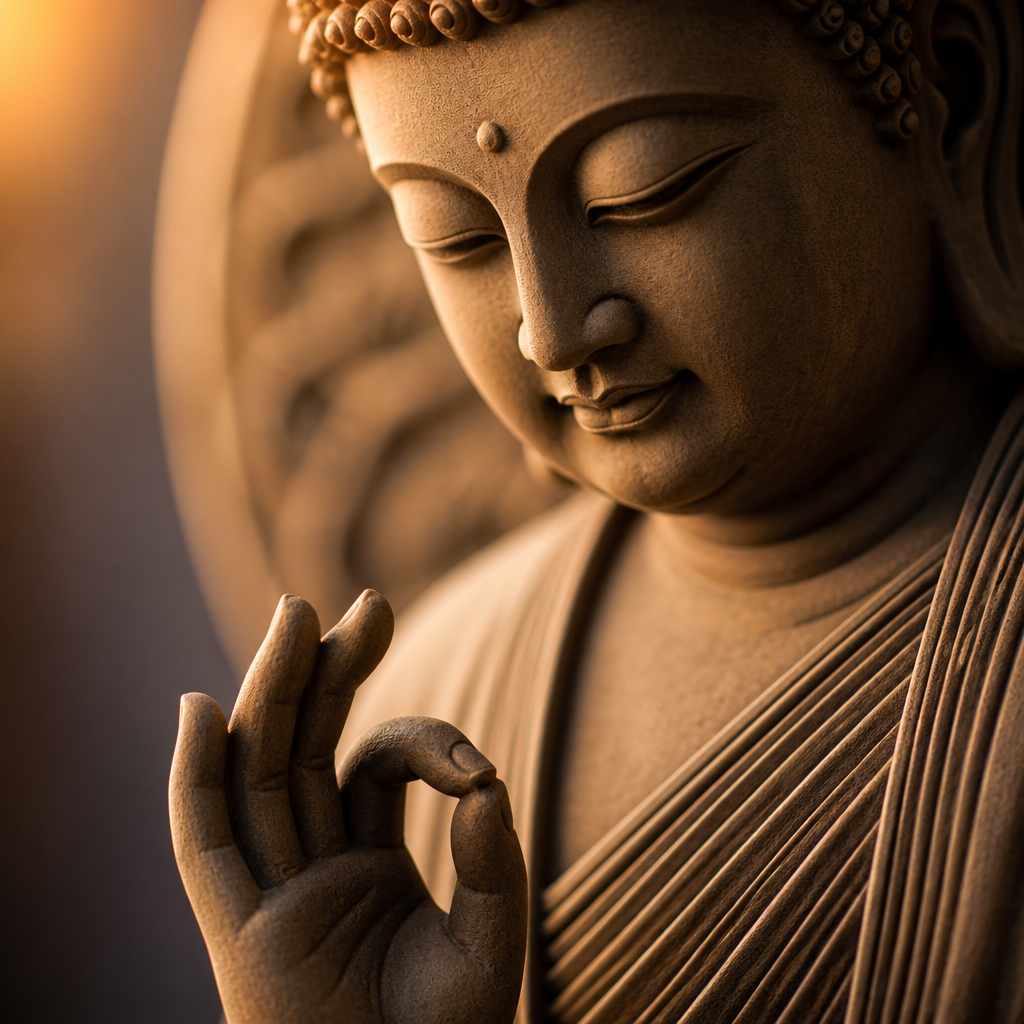
Nyorai are fully enlightened Buddhas. The most important for collectors are Shaka Nyorai (the historical Buddha Shakyamuni), Amida Nyorai (Amitabha, the Buddha of Infinite Light central to Pure Land Buddhism), and Yakushi Nyorai (the Medicine Buddha). Shaka Nyorai is the appropriate choice for Zen-inflected settings and meditation spaces. Amida Nyorai, identifiable by the raigo-in mudra (welcoming hand gesture), is the dominant figure in Pure Land devotional practice.
A frequent point of confusion is between Amida and Shaka when both are depicted seated in meditation (dhyana mudra). Historical records, the sectarian affiliation of the originating temple, and the proportions of the figure are the reliable distinguishing factors, not appearance alone.
Bosatsu: The Bodhisattvas
Bosatsu are beings who have attained enlightenment but remain to assist others. The most significant for collectors is Kannon (Avalokiteshvara), the Bodhisattva of compassion, who appears in dozens of forms including the Eleven-Faced Kannon (Juichimen Kannon) and the Thousand-Armed Kannon. Jizo Bosatsu, a gentle protective figure associated with children and travelers, is another commonly collected form. Bosatsu figures are often identified by their elaborate crowns, jewelry, and flowing garments, in contrast to the plain robes of Nyorai.
Myo-o: The Wisdom Kings
Myo-o are guardian figures introduced to Japan through Shingon esoteric Buddhism during the Heian period. The most significant is Fudo Myo-o (Acala in Sanskrit), depicted with a fierce expression, flames, a rope, and a sword. These are not separate deities but fierce manifestations of compassion, intended to shock practitioners out of delusion and into awakened action. For collectors drawn to esoteric Buddhist iconography or who want a strong protective presence in a dedicated practice space, Fudo Myo-o is a clear and powerful choice.
Tenbu: The Guardian Deities
Tenbu are heavenly guardians, many of them adapted from Hindu deities. The four Shitenno (Heavenly Kings), who guard the four cardinal directions, are among the most recognized. These figures frequently appear in temple guardian sets and are far less common as individual collector pieces than Nyorai or Bosatsu.
Materials and What They Tell You
In Japanese Buddhist sculpture, material choice was functional and meaningful, not purely aesthetic. Understanding what each material communicates helps you evaluate a piece accurately.
Wood
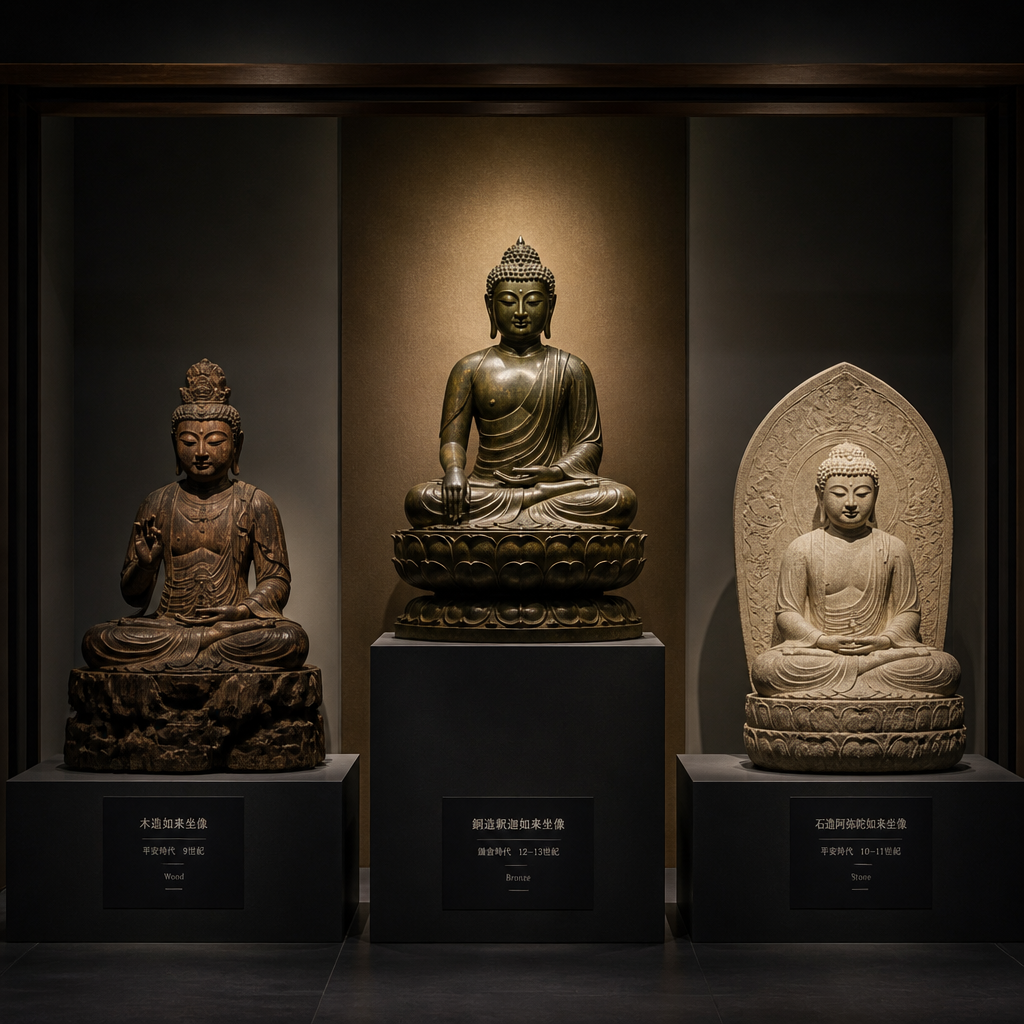
Wood is the defining material of Japanese Buddhist sculpture. Hinoki cypress and zelkova were the most common choices for significant works. Early Heian pieces were typically carved from a single large trunk (ichiboku-zukuri), which limited scale and posture. The Kamakura period's shift to joined-woodblock construction (yosegi-zukuri) removed these constraints, enabling the dynamic, life-sized figures that define the period's best work. When examining a wooden piece, look at the joins: well-executed yosegi construction leaves subtle but legible seams that confirm the technique and approximate the period.
Bronze and Gilt Bronze
Bronze casting was used for major temple commissions from the Asuka period onward. The Great Buddha at Nara (Todai-ji) is the supreme example, but bronze was also used for smaller devotional figures. Gilt bronze figures often retained their gold surface partially, and the character of remaining gilding, whether mercury gilding or gold leaf, is one of the details an experienced eye checks immediately. Bronze figures are heavier, more durable, and generally associated with more formal or institutional contexts than wooden domestic sculptures.
Lacquer
Dry lacquer (kanshitsu) was used for some Nara-period figures, built up over a hemp-cloth core. These are now primarily held in museum collections. For contemporary collectors, lacquer appears more often as a surface treatment on wooden figures than as a primary structural material. Lacquered surfaces on Japanese Buddhist sculpture can be red, black, or polychrome, and their condition is a significant factor in valuation.
The material a Japanese Buddhist sculptor chose was not a budget decision. Wood, bronze, and lacquer each carried distinct ritual associations and practical requirements that shaped the devotional life of the figure before it ever reached a collector's hands.
Comparing Collecting Approaches
Collectors of Japanese Buddhist sculpture generally orient themselves around one of three approaches. Each has genuine advantages and requires different knowledge.
|
Approach |
Best For |
Key Considerations |
|---|---|---|
|
Period-focused collecting (e.g., Kamakura-style works) |
Art historians, serious collectors building a thematic collection |
Requires strong iconographic literacy; provenance research is essential; period attributions on non-museum pieces should always be assessed cautiously |
|
Deity-focused collecting (e.g., all Kannon or all Fudo Myo-o) |
Spiritual practitioners and devotional collectors who want thematic coherence |
Allows for meaningful comparison of the same figure across different periods and materials; easier to develop deep iconographic knowledge in one area |
|
Aesthetic and home altar collecting (selecting by presence and setting) |
Home decorators and practitioners who want a spiritually resonant living space |
Prioritize scale, material finish, and the specific mood of the piece; a well-chosen figure for a dedicated home altar matters more than period attribution |
In practice, most collectors start with aesthetic collecting and migrate toward either period-focused or deity-focused approaches once they develop stronger iconographic foundations. Neither path is wrong, but being explicit about which approach you are following saves money and prevents regret.
Pro tip: Before buying any Japanese Buddhist sculpture for a home altar or practice space, identify which Buddhist school the figure belongs to and whether that aligns with your practice. Placing a Shingon esoteric figure like Fudo Myo-o in a Zen meditation space is not incorrect, but it creates a visual and devotional mismatch that experienced practitioners will notice.
What to Look for When Buying a Japanese Buddhist Sculpture
Buying Japanese Buddhist art as a collector is genuinely different from buying decorative Asian antiques. Here is what to assess before committing to a piece.
Iconographic Accuracy
A well-made figure will be internally consistent: the mudra, the attributes (sword, lotus, rope, wheel), the crown or lack of crown, and the facial expression should all align with the identified deity. A common mistake is accepting a dealer's identification of a figure without cross-checking the iconography. An Amida in the dhyana mudra with no welcoming gesture is almost certainly misidentified. Look at the hands first.
Condition and Surface Integrity
For wooden figures, look at the lacquer or painted surface. Stable, original surface treatments, even aged or partially worn ones, are preferable to heavily restored or repainted pieces. For bronze, assess whether patination is consistent or whether it shows signs of artificial aging. Cracks in wooden figures are expected with age and humidity changes; structurally significant splits that compromise the form are a different matter.
Scale Relative to Setting
Japanese sculptures were designed for specific settings: temple niches, household altars (butsudan), or tokonoma alcoves. A figure that overwhelms a domestic setting loses its contemplative function. In a modern home outside Japan, a clean shelf at chest-to-eye level with adequate depth for the base is a reliable default placement. Scale the figure to the space, not to ambition.
Source Reliability
Sourcing Japanese Buddhist art from a specialist retailer with documented provenance and curatorial expertise matters more here than in almost any other collecting area. HD Asian Art's focus on museum-quality works sourced directly across Asia provides a meaningful level of assurance compared to general antiques markets where iconographic misattribution is common. When in doubt, ask direct questions: Where was this acquired? What period attribution is being made, and on what basis?
Pro tip: The most undervalued question to ask any dealer is: "What would change your identification of this piece?" A dealer who cannot answer that question is not applying genuine iconographic analysis. A specialist who can point to the specific features that would indicate a different deity or period is one worth working with.
Frequently Asked Questions
What is the difference between a Nyorai and a Bosatsu in Japanese Buddhist sculpture?
Nyorai are fully enlightened Buddhas who have completed the path and often appear in simple robes with no jewelry or crown. Bosatsu are Bodhisattvas who have attained enlightenment but remain to help others, and they typically appear with elaborate crowns, jewelry, and richly decorated garments. This visual distinction is the fastest way to sort figures by category when you are learning.
Is it appropriate to collect Japanese Buddhist statues for non-religious or decorative purposes?
This is a genuine question and worth answering honestly. Many Japanese Buddhist figures were made for temple and household devotional use, and treating them with basic respect (not placing them on the floor, for instance, or in bathrooms) is the minimum standard most practitioners and dealers expect. Collecting for aesthetic appreciation while maintaining appropriate placement is entirely normal and practiced by collectors worldwide. The figures themselves carry considerable cultural and artistic significance regardless of the buyer's personal beliefs.
What materials are most common in Japanese Buddhist sculpture available to collectors today?
Wood is by far the most commonly encountered material, ranging from small lacquered domestic pieces to substantial carved figures. Bronze pieces appear regularly but tend to be priced higher. Stone and dry lacquer (kanshitsu) figures from early periods are predominantly held in museum and temple collections and rarely available to private collectors. Well-made contemporary wooden figures produced by Japanese craftspeople using traditional techniques represent excellent value for collectors who prioritize quality over age.
How do I identify a Fudo Myo-o versus other fierce figures in Japanese Buddhist art?
Fudo Myo-o is specifically identified by a combination of attributes: a sword (representing the cutting of delusion), a rope (for binding evil), flames behind the figure (representing purifying fire), a fierce or wrathful facial expression, and typically a dark-colored body. He is almost always depicted seated or standing against a flame mandorla. If a fierce figure lacks these specific attributes in combination, it may be one of the other Myo-o or a guardian Tenbu figure, and the full set of attributes should be checked against established iconographic references.
What is the best starting point for a new collector of Japanese Buddhist art?
Start with a single deity category and learn its iconography thoroughly before expanding. Kannon Bosatsu is a good entry point: the figure appears in many forms across all periods, the iconography is well documented in English-language sources, and the range of available pieces suits most budgets. Once you can identify Kannon reliably across different periods and materials, the broader iconographic system becomes much easier to navigate. Buying from a specialist retailer with curatorial expertise, such as HD Asian Art's dedicated Japanese sculpture collection, gives you reliable iconographic labeling as a foundation while you develop your own eye.
How does Japanese Buddhist sculpture differ from Thai or Burmese Buddha statues?
Thai and Burmese Buddha statues are rooted primarily in Theravada Buddhist traditions, which focus on Shakyamuni (the historical Buddha) and feature a relatively limited range of figure types compared to Japanese Mahayana and Vajrayana traditions. Japanese sculpture encompasses a far wider cast of figures, including Bodhisattvas, Wisdom Kings, and heavenly guardians drawn from both Mahayana and Shingon esoteric lineages. Stylistically, Japanese sculpture developed its own national aesthetic quite early, producing figures that are immediately distinguishable from Southeast Asian works in their surface treatment, facial type, and compositional approach.
If you collect Buddhist or Hindu sculpture from across Asia and have a particular view on how Japanese works compare with pieces from Burma, Cambodia, or India, we would be glad to hear what draws you to one tradition over another.
References
-
Introduction to Buddhist statues in Nara Prefecture, Japan's oldest sculptural center
-
Asia Society exhibition guide to Kamakura-period realism in Japanese sculpture
-
Illustrated introduction to Japanese Buddhist statue categories and iconography
-
HD Asian Art guide to Japanese Buddha statue styles from Nara to Kamakura
