



How to Arrange Buddha Statues for Good Energy
How to Arrange Buddha Statues for Good Energy
Table of Contents
- Buddha Statue Placement Rules: The Do's and Don'ts
- Feng Shui Buddha Placement for Harmony and Energy Flow
- Creating a Home Meditation Sanctuary with Buddha Statues
- Choosing the Right Buddha Mudra and Form for Your Space
- Vastu Shastra Guidelines for Buddha Statue Arrangement
- How to Maintain Your Buddha Statue and Sacred Space
- Conclusion: Arranging Your Buddha Statue with Intention
- Frequently Asked Questions
Buddha Statue Placement Rules: The Do's and Don'ts
Learning how to arrange Buddha statues for good energy starts with one principle: treat the figure as a guest of honor, not a knickknack. Placement carries meaning. A statue set beside a bathroom door or used as a paperweight sends a different message than one given a clean shelf, a low table, or a quiet corner of its own. HD Asian Art offers a carefully curated collection of Buddhist and Hindu statues, alongside exquisite Khmer and Southeast Asian sculptures, designed to enhance altars, meditation spaces, and refined spiritual home interiors.
The rules below are simple, but they matter more than most decor guides admit. They also rest on a distinction worth naming up front: for many practitioners, a Buddha figure is an object of veneration, not a decorative accent. Arranging it well is a form of respect, and the guidelines that follow come from that understanding rather than from a style trend.
- The Met's Heilbrunn Timeline essay on Buddhist art and its ritual contexts
The Essential Do's for Respectful Placement
Do place your statue at or slightly above eye level when seated, roughly 36 to 48 inches from the floor for most adults in a chair, or about 24 to 30 inches if you sit on a cushion. This range lets the figure read as a focal point rather than an object beneath you.
Do keep the surrounding surface clean and uncluttered. Do face the figure toward the room's main seating area, so anyone entering the space meets its gaze. Do offer the statue a small dedicated zone, even a single shelf, so it has room to breathe.
A common mistake is buying an oversized piece for a narrow console and crowding it with candles, books, and plants. In practice, one well-lit statue on a bare surface carries more presence than five objects competing for attention. As a rule of thumb, leave at least the statue's own width of empty surface on either side.
The Critical Don'ts: Areas to Avoid
Never place a Buddha statue on the floor of a hallway where feet pass directly in front of it. Skip bathrooms, laundry rooms, and kitchen counters where grease and steam accumulate. Avoid shoe racks, garage shelves, and any spot below a staircase. These spaces carry heavy foot traffic, waste, and noise, and a sacred figure set among them reads as careless.
The reasoning is consistent across traditions: a statue belongs above the level of daily foot traffic and away from spaces associated with waste or clutter. In a bedroom, position the figure so it does not face the bed directly, a corner shelf angled toward the room works better than a nightstand.
The one exception is a large garden statue, which can sit at ground level outdoors, provided it faces a walkway or planting bed rather than being used as a step or doorstop.
A Quick Room-by-Room Reference
| Room | Good Spot | Avoid |
|---|---|---|
| Living room | Console or shelf facing seating, at seated eye level | Under a TV, beside speakers |
| Entryway | Facing the door as a guardian, on a raised surface | Floor level where shoes land |
| Study or office | Desk-adjacent shelf, facing your chair | Behind you, facing a wall |
| Bedroom | Corner shelf angled toward the room | Facing the bed, on a nightstand |
| Bathroom, kitchen, laundry | , | Any placement |
Feng Shui Buddha Placement for Harmony and Energy Flow
Feng Shui Buddha placement treats the statue as a stabilizer rather than a generator. The goal is calm, grounded energy, not a burst of activity. Practitioners generally position the figure in the calmest sector of a room, away from sharp corners, mirrors that double its reflection, and electronics that hum.
It helps to be clear about what Feng Shui is and is not doing here. Feng Shui is a traditional Chinese system for arranging space; Buddhism is a separate tradition with its own conventions for honoring a figure. Many households blend the two, and that is fine, but the blending is a modern habit rather than a rule from either tradition.
Direction, Orientation, and the Main Entrance
Facing the main entrance is the most debated point in Buddha statue placement rules. A statue facing the door is often described as a guardian, welcoming guests and screening out negative influences before they travel deeper into the home. Facing the room instead is the better choice when the statue serves as a meditation focal point, because you want to meet its gaze while seated, not turn your back to the door.
Reading the Bagua for Statue Placement
Feng Shui practitioners map a space using the bagua, a grid of nine life areas. Two zones come up most often for a Buddha statue:
- The knowledge and self-cultivation area (traditionally the near-left corner from the main entry) suits a meditative figure and supports study or practice.
- The center of the home, sometimes called the health or tai chi position, suits a stabilizing figure that anchors the whole space.
Directional Preferences and What They Mean
| Placement Goal | Orientation | Best Room |
|---|---|---|
| Guardian at the threshold | Facing the main entrance | Entryway, foyer |
| Meditation focal point | Facing the seating area | Living room, study |
| Quiet reflection | Facing a window, back to a solid wall | Bedroom corner, office |
| Grounding the home | Center of the space, facing outward | Living room, hallway |
A solid wall behind the statue is the one near-universal preference across both Feng Shui and Buddhist convention. It gives the figure support and keeps it from feeling exposed. A statue floating in the middle of a room, or backed by a mirror, is the arrangement most practitioners advise against.
Creating a Home Meditation Sanctuary with Buddha Statues
A home meditation sanctuary is a defined area, even a small one, where a Buddha statue anchors your practice and the surrounding objects support stillness. The statue does the visual work; everything else stays quiet.
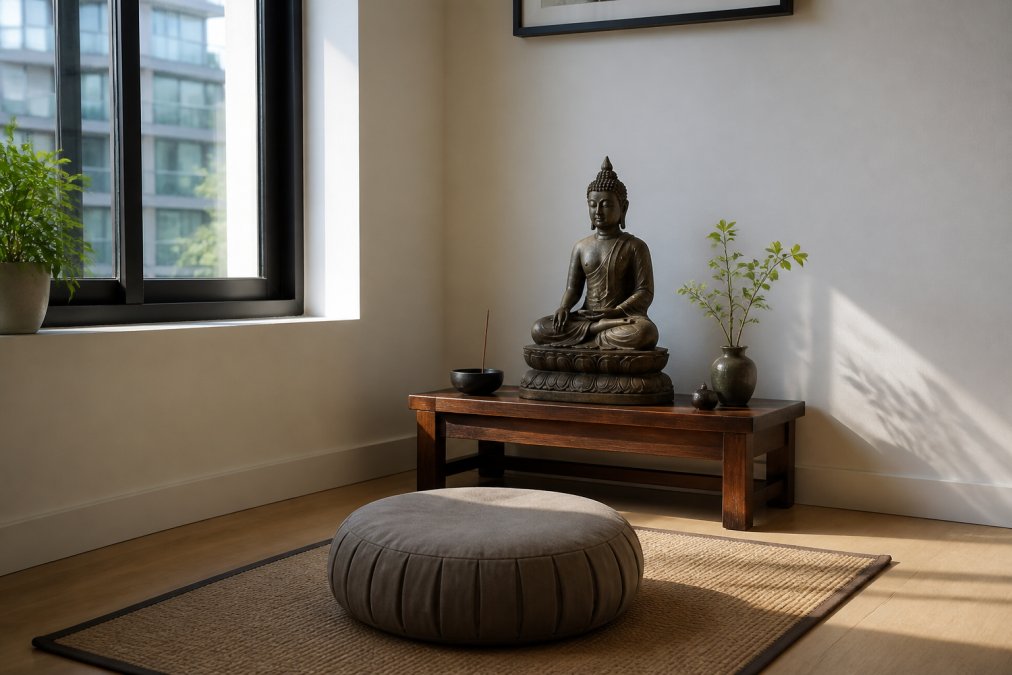
Placement for Small Spaces and Apartments
Small apartments don't require small statues, but they do require honest measurements. A meditation corner needs roughly a square meter of floor, or a single wall shelf at seated eye level if floor space is tighter. Measure the shelf depth before choosing a piece, since bases vary widely and a statue that overhangs the edge never looks settled.
For apartments, a wall-mounted shelf at seated eye level solves the space problem without shrinking the statue's presence.
Choosing the Right Buddha Mudra and Form for Your Space
The mudra is the hand gesture a Buddha figure holds, and it carries specific meaning. The Dhyana mudra, hands resting in the lap, signals meditation and suits a practice corner. The Abhaya mudra, one hand raised with palm outward, signals protection and reassurance, making it a natural fit for an entryway. The Bhumisparsha mudra, one hand touching the earth, represents steadfastness and works well in a study or workspace.
Vastu Shastra Guidelines for Buddha Statue Arrangement
Vastu Shastra guidelines for Buddha statue arrangement emphasize direction, elevation, and cleanliness. The northeast corner of a home is traditionally considered the most auspicious zone for a spiritual object, and many practitioners place a statue there facing east or north. Elevation matters too: a statue set on a pedestal or shelf, never directly on the ground indoors, keeps it above the level of daily foot traffic.
How to Maintain Your Buddha Statue and Sacred Space
Care is part of arrangement.
Refresh the space seasonally. Remove anything that has quietly accumulated around the base, reposition the statue if a sightline has changed, and wipe the surface beneath it. A clean, intentional space is the point of the whole exercise.
Conclusion: Arranging Your Buddha Statue with Intention
The challenge with any arrangement is that it's easy to place a statue and hard to place it well. Position, orientation, mudra, and upkeep all feed into whether a piece feels like a sacred focal point or just another object on a shelf. HD Asian Art offers a carefully curated collection of Buddhist and Hindu statues, alongside exquisite Khmer and Southeast Asian sculptures.
Frequently Asked Questions
Where should a Buddha statue be placed in a home for good energy?
The best placement for good energy is a clean, elevated, and peaceful spot where the statue can be seen and respected. A living room, dedicated meditation area, or home office are excellent choices. The statue should ideally face the main entrance to welcome positive energy, but avoid placing it directly on the floor or in a hallway. This creates a focal point for mindfulness and tranquility.
What are the common mistakes to avoid when placing a Buddha statue?
Common mistakes include placing a Buddha statue in a bathroom, kitchen, or on the floor, as these locations are considered disrespectful and can disrupt energy flow. Avoid putting it under a staircase, in a cluttered area, or facing a wall. Also, do not place it in a spot where it is used as a generic home decor item, like a shoe rack or a bookshelf, as this diminishes its spiritual significance.
Does the direction a Buddha statue faces matter for energy flow?
Yes, direction can influence energy flow. In feng shui, placing a Buddha statue facing the main entrance is believed to invite positive energy and act as a guardian for the home. For meditation, facing the statue towards the east, the direction of the rising sun, is common. The most important factor is that the placement feels respectful and intentional, supporting your spiritual practice.
How can I create a dedicated meditation space using Buddha statues?
Start by choosing a quiet, clutter-free corner of a room. Place your Buddha statue on an elevated surface like a small table or shelf, ensuring it faces the room or the entrance. Add elements like a cushion, a small plant, or a candle to define the space. The goal is to create a consistent, tranquil area that signals to your mind it is time for mindfulness and inner peace.
