



Buddhist Art Investment: Value, Risks and Due Diligence
Buddhist Art Investment: Value, Risks and Due Diligence
Buddhist art can be a long-term holding, but it behaves differently from stocks or bonds. Value rests on authenticity, documented ownership history, condition and rarity. Resale is slow and costly. US import law adds a layer of due diligence that affects both price and saleability. This guide covers what drives value, what the market data shows, which legal rules apply in the United States, and how to match a work to a collecting goal.
Key Features
- Provenance, certification and exhibition history measurably raise prices in peer-reviewed auction research.
- Art is illiquid. Auction fees, holding costs and slow resale mean a multi-year horizon is the realistic frame.
- US import rules, including the 2003 US-Cambodia agreement, make export and ownership documents central to Southeast Asian sculpture.
- Authenticity, material, condition, date and subject are the main checks before any purchase.
- Buy for the object first. Treat appreciation as a possible outcome, not a promise.
Table of Contents
- What the market data shows
- What drives the value of Buddhist sculpture
- Which kinds of Buddhist art attract collectors
- How to check authenticity, age and condition
- US law and ethics for buyers
- Costs, liquidity and resale
- Perspective
- Browse authenticated pieces
- Principles for buying well
- FAQ
- Sources
What the market data shows
The art market moves in cycles. The Art Basel and UBS Global Art Market Report 2025 estimated global sales at $57.5 billion in 2024, a 12% decline year on year. Public auction sales fell 25% to $19.0 billion, while private sales by auction houses rose 14% to $4.4 billion. The pattern points to buyers moving toward private, negotiated transactions in a softer period.
The United States remains the largest single market. One summary of the 2024–2025 report puts US sales at roughly $27.2 billion, about 43% of the global total by value.
For Buddhist and wider Asian religious art, these figures give context but no forecast. Broad market totals are dominated by contemporary and modern Western works. Religious sculpture trades in a narrower field, with fewer buyers and fewer comparable sales.
Academic work on art as a financial asset describes the tension. A 2025 thesis from SIA notes that low-liquidity assets should compensate investors with higher expected returns or lower entry prices. It also observes that the art market often defies this expectation, with midmarket prices between $50,000 and $1 million among the highest in all asset classes.
The practical reading: collectors who buy well-documented, high-quality works and hold them for years are better positioned than anyone buying for a quick turn.

What drives the value of Buddhist sculpture
Provenance and documentation
Provenance is the documented history of an object’s ownership. In a large study of auction records, Li, Ma and Renneboog (2022) found that provenance information in catalogs raised the probability of sale by up to 4% and produced hammer price premiums of up to 54%. The same study found that pedigree, exhibition history, literature references and certification lifted prices by 21%, 42%, 54% and 14% respectively. These figures come from auction data across all art categories, not Buddhist art alone, but the mechanism applies directly: buyers pay more when an object’s history can be verified.
A dissertation analyzing 86 auctions of Chinese antiquities between 2000 and 2016 reached a similar conclusion: verifiable provenance increases the value of an object, and stakeholders are increasingly concerned with it.
The Indian, Himalayan and Southeast Asian field has moved the same way. At a 2025 session of the Center for Art Law, speaker Sandhya Jain-Patel described a shift to a documentation-driven market. She also called it a healthy market with mostly good-faith participants, where knowing the regulatory timeline is essential for accurate valuation.
Types of documents that carry weight include old invoices, dated photographs, collection inventories, exhibition records and export paperwork. The gallery’s guides on provenance documents and provenance research for antique sculpture go through them in detail.

The factors appraisers weigh
The International Society of Appraisers lists the points a collector should assess in a Buddha figure in its Looking at Buddha article:
- Authenticity. Reproductions are common and may carry added signatures, temple seals or reign names.
- Rarity and materials. Bronze, stone, wood and lacquer each age and trade differently.
- Dimensions and condition. Loss of wood or metal, corrosion, fading, water, fire or insect damage, and loss of an original base or mounting all count.
- Date and country of origin. Origin matters in part because some countries are covered by agreements that can involve repatriation.
- Subject and association. Desirable subjects, or links to a revered figure or temple, add interest.
- Overall quality. Modeling, proportion and surface carry the final judgment.
The same article notes that it helps to know when an object entered the United States or Canada.
Rarity
Supply of genuine antique religious sculpture is finite. No new Angkor-period or Dvaravati-period pieces are being made, and each work that enters a museum leaves the private market for good. The gallery’s article on how rarity shapes Asian art value expands on this.
Which kinds of Buddhist art attract collectors
Demand concentrates in a few recognizable areas. Each suits a different goal.
| Category | Typical materials | What collectors look for | Suits |
|---|---|---|---|
| Khmer and Angkor-style sculpture | Stone, bronze | Stylistic period, modeling, surface patina, documented export | Serious, research-minded collections |
| Dvaravati and early Thai Buddhas | Stone, bronze | Early style, rarity, dating evidence | Specialist collections |
| Burmese lacquerware | Lacquer over wood or bamboo | Age, intact gilding, form, ritual function | Entry-level and decorative collecting |
| Hindu deities in Southeast Asian styles | Stone, bronze, wood | Iconography, completeness, scale | Display and thematic collections |
| Large masterpiece-grade works | Stone, bronze | Museum-level quality, scale, documented history | Long-term holdings |
The gallery’s Buddha statues, Hindu statues and Burmese lacquerware collections cover these areas.
Matching a work to a goal
Three questions sort most decisions:
- Is the aim to hold, to display or both? Works acquired for display in a home, studio or hotel should also meet the documentation standard that makes them saleable later.
- What is the time horizon? Five years or more is the sensible minimum for any art holding.
- What is the budget ceiling per object? A smaller number of better pieces usually outperforms many modest ones, because quality and rarity drive the premium.
How to check authenticity, age and condition
The checks below follow practice at museums and appraisers.
- Request the attribution in writing. The Journal of Antiques advises asking the seller to state attribution, estimated date, material and known condition issues. A certificate records the seller’s opinion, and the quality of the explanation and supporting evidence is what counts.
- Study the photographs. Detailed images of the base, the back, casting seams, wear patterns and surface deposits tell more than a front view. See the guide to five photos collectors use to verify an antique Buddha.
- Ask for the ownership history. The Rubin Museum of Himalayan Art states that before acquiring a work it seeks written documentation of ownership history, including past locations, exhibition and publication history, clear title and whether the work appears in databases of stolen objects. Private buyers can ask the same questions.
- Consider an independent specialist for a significant purchase. The same Journal of Antiques piece says a specialist can help assess uncertainties.
- Record condition at purchase. Photograph the piece on arrival and keep the dealer’s description with the invoice.
A broader walkthrough is in the gallery’s Buddhist art collection guide.
US law and ethics for buyers
Legal compliance directly affects value. A piece that cannot be documented as legally imported is hard to resell, lend or donate.
- The CPIA. The Convention on Cultural Property Implementation Act, signed in January 1983, implements the 1970 UNESCO Convention. Under Section 307, restricted material may not be imported without an export permit or documentation showing it left the country of origin before restrictions took effect.
- Cambodia. The US-Cambodia Memorandum of Understanding, signed in 2003 and amended and extended in 2008, restricts import of certain Khmer archaeological material from roughly the 6th to the 16th century, including stone, metal and ceramic objects, unless Cambodia documents that export did not violate its laws.
- Buyer responsibility. The State Department’s 7 FAM 680 guidance says US citizens bear ultimate responsibility for the legality of their purchases and should exercise due diligence that an object is not stolen or looted. It lists possible penalties under several federal statutes.
- Museum standards. The AAMD guidelines say member museums normally should not acquire a work unless research shows it was outside its country of modern discovery before 1970 or legally exported after 1970. The American Alliance of Museums similarly expects museums to obtain written documentation, including export and import papers.
Before buying a Khmer, Himalayan or other regulated-origin piece, ask the seller for documents showing date and route of export and US entry. For high-value objects, an attorney who works in cultural property law can review the file. Museum standards also show where private collectors are headed: documentation is what makes an object eventually acceptable to institutions.
Costs, liquidity and resale
Buying is the easy half. The SIA thesis cited above reports that buyer’s premiums at auction run around 15% to 27%, seller’s commissions about 10% of the sale price, and annual maintenance costs 1% to 5% of value. Bought-in rates, meaning lots that fail to sell, average 17.9% over ten years.
One analysis of 5,651 linked resales by Artscapy found that among quick resales within three years, only 40.5% recovered the original purchase price, and the median resale came in 17.2% below it. These are general art-market figures, not specific to Buddhist art, and they argue for patience.
The Management Science study also notes that illiquidity raises the risk of a work going unsold because buyers are few, and that trust, proxied by provenance, matters most in opaque markets. Complete documentation is therefore the best protection at resale.
Budget for these items:
- Insured shipping and transit coverage
- Climate-appropriate display and handling
- Insurance on the collection at replacement value
- Periodic appraisal for insurance purposes
- Seller’s commission or dealer margin at exit
Collections also need a succession plan. Collectors with Singapore ties can read about estate planning for art collections, which covers how wills and trusts keep a collection intact. US collectors should consult a local estate attorney on equivalent steps.
Perspective
We approach Buddhist art as objects first and assets second. Every work in the gallery is individually researched, photographed and described by experts, because a collector can only judge what is shown clearly.
Our view is that documentation and quality are the two variables a buyer can control. Provenance, condition and a clear description do not guarantee appreciation, but the research on auction prices points the same way: verifiable history is rewarded.
That is why curation comes before inventory. Pieces are selected for craftsmanship, spiritual symbolism and long-term collectability, across bronze, stone, wood and lacquer from Cambodia, Thailand, Indonesia, Sri Lanka, Vietnam and Burma. Worldwide DHL shipping is fully insured, so the object arrives as it was photographed.
For a first purchase, we suggest a single well-documented piece in a category the buyer wants to live with. Knowledge builds from there.
James, HDAsianArt.com
Browse authenticated pieces
HD Asian Art offers antique and traditional Buddhist and Hindu statues, sculptures and temple art in bronze, stone and wood, plus Burmese lacquerware. Each listing carries a researched description and detailed photography. Insured DHL shipping is available worldwide.
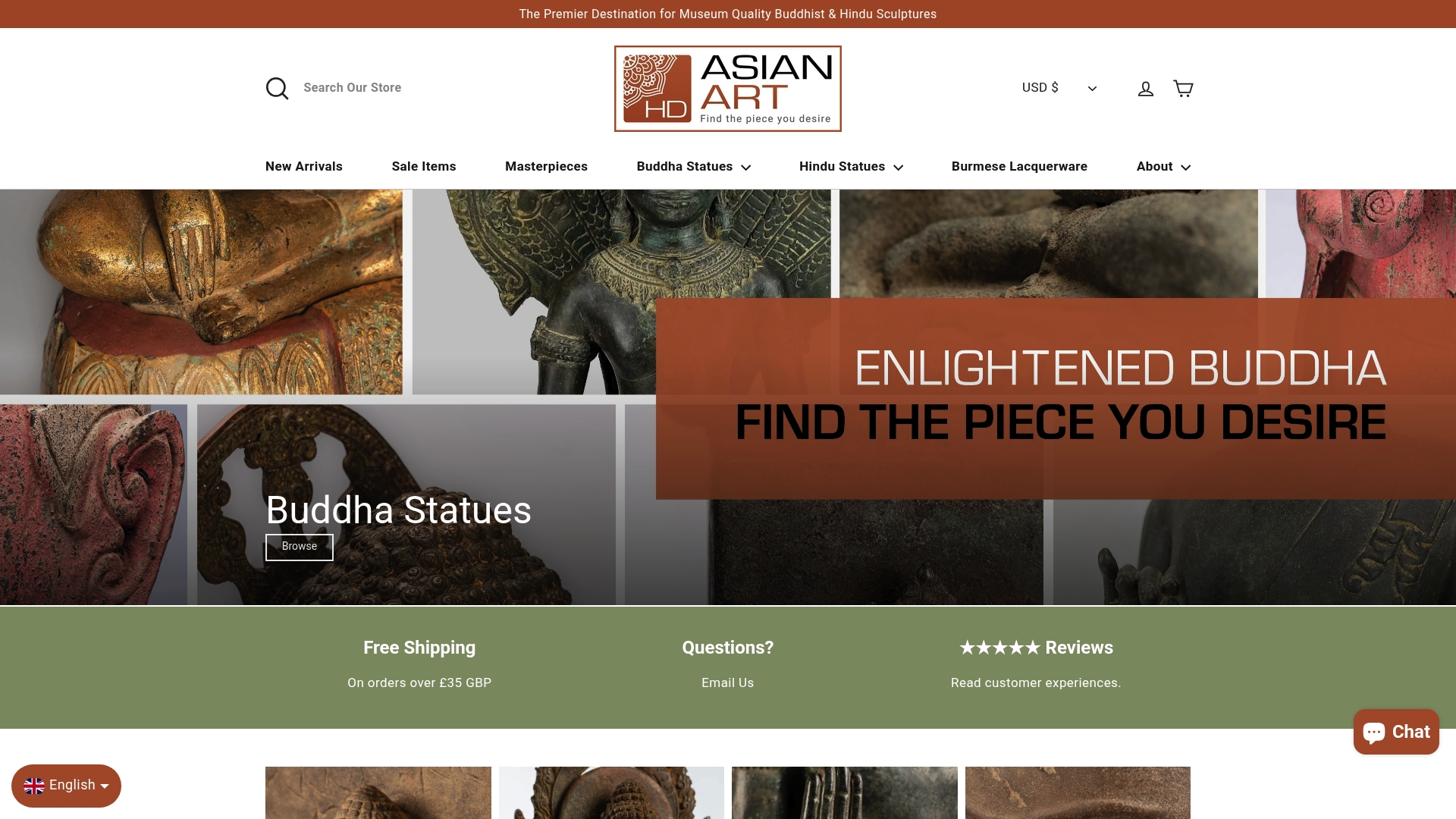
Start with the Masterpieces collection for museum-quality works, or the Buddha statues collection for a broader selection. Gift cards are available from the gallery home page.
Principles for buying well
- Buy documented pieces. Papers are part of the object.
- Prefer fewer, better works over many modest ones.
- Keep every invoice, photograph and written description in one file.
- Confirm the legal status of export and import for the country of origin.
- Plan to hold for years, and count exit costs in advance.
- Display respectfully. The gallery’s note on displaying religious Buddhist art explains placement customs.
Frequently Asked Questions
Is Buddhist art a good investment?
It can be a sound long-term holding when the piece is authentic, well documented and in good condition. Returns are not guaranteed, and resale is slow and carries fees. Collectors usually do best when they buy for lasting interest and treat appreciation as a secondary benefit.
What increases the value of a Buddhist sculpture?
Provenance, exhibition and publication history, certification, rarity, material, condition and quality of workmanship all contribute. Auction research links verifiable provenance to price premiums of up to 54%. Subject and association with a revered temple or figure can add further interest.
Which Asian art investments do collectors favor?
Collector demand is steady for Khmer sculpture, early Thai Buddhas, Himalayan works and Burmese lacquerware. The best choice depends on budget, goal and available documentation. A single strong piece in one category usually serves better than scattered purchases.
Are there legal restrictions on importing Buddhist art into the US?
Yes. The CPIA restricts import of designated archaeological and ethnological material without export permits or proof of earlier export. The US-Cambodia agreement covers certain Khmer objects. Ask the seller for export and import documentation and consult a cultural property attorney for high-value pieces.
How long does it take to sell a Buddhist sculpture?
Timelines vary widely by piece and channel. Well-documented works sell more readily, while auction lots can go unsold, with bought-in rates averaging 17.9% over a ten-year period in one study. Plan for a multi-year horizon.
Sources
- Art Basel and UBS Global Art Market Report 2025
- Global Art Market Report 2024–2025 summary
- Can art function as a financial asset class? (SIA thesis, 2025)
- In Art We Trust, Management Science
- Chinese antiquities auction dissertation, eScholarship
- Provenance Matters, Center for Art Law
- Looking at Buddha, ISA Appraisers
- Ongoing Research and Provenance, Rubin Museum
- Choosing your first antique Buddha, Journal of Antiques
- US Implementation of the 1970 UNESCO Convention
- US-Cambodia Memorandum of Understanding
- 7 FAM 680 Cultural Objects
- AAMD Guidelines on the Acquisition of Archaeological Material and Ancient Art
- American Alliance of Museums, Archaeological Material and Ancient Art
- Art Flipping: What Quick Resales Cost, Artscapy
- Estate planning for art collections
